IZhO 2016, Теория — Задача 1. Problem 1
XII International Zhautykov Olympiad/Theoretical Competition · 10 т.
THEORETICAL COMPETITION. January 15, 2016. Please read this first:
The time available for the theoretical competition is 4 hours. There are three questions.
Use only the pen provided.
You can use your own calculator for numerical calculations. If you don’t have one, please ask for it from Olympiad organizers.
You are provided with Writing sheet and additional paper. You can use the additional paper for drafts of your solutions but these papers will not be checked. Your final solutions which will be evaluated should be on the Writing sheets. Please use as little text as possible. You should mostly use equations, numbers, figures and plots.
Use only the front side of Writing sheets. Write only inside the boxed area.
Begin each question on a separate sheet of paper.
Fill the boxes at the top of each sheet of paper with your country (Country), your student code (Student Code), the question number (Question Number), the progressive number of each sheet (Page Number), and the total number of Writing sheets used (Total Number of Pages). If you use some blank Writing sheets for notes that you do not wish to be evaluated, put a large X across the entire sheet and do not include it in your numbering.
At the end of the exam, arrange all sheets for each problem in the following order:
- Used Writing sheets in order;
- The sheets you do not wish to be evaluated
- Unused sheets and the printed question.
Place the papers inside the envelope and leave everything on your desk. You are not allowed to take any paper out of the room.
Условие
This problem consists of three independent parts.
1A A homogeneous planet of radius has no atmosphere and does not rotate. A stone is thrown from the surface of the planet at an angle to the horizontal with the speed , which is equal to the orbital velocity for the surface of the planet. Find the maximum height of ascent of the stone above the surface of the planet. At what range from its initial point, measured along the surface of the planet, the stone will hit the surface? [4 т.]
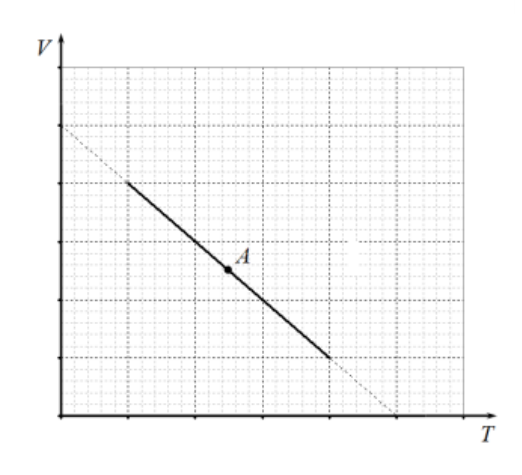
1B One mole of an ideal monatomic gas performs a process whose chart in VT coordinates completely lies on a straight line. Find the heat capacity of the gas at the point A, equidistant from the points of intersection of the process line with the coordinate axes. [3 т.]
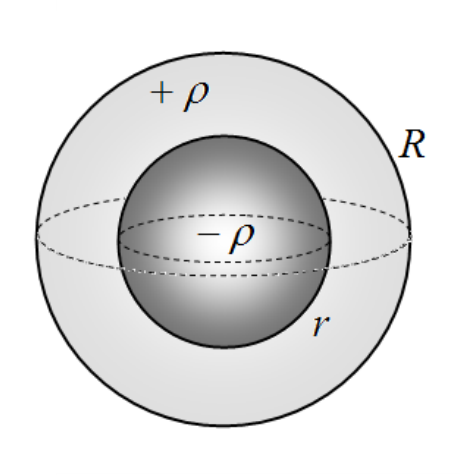
1C Two spheres with the radii and () with the common center divide the space into three domains. The interior of the small sphere is uniformly charged with the volume charge density , the domain in between the spheres is uniformly charged with the volume charge density , and there is no charge outside the larger sphere. Find the ratio of the radii , at which the potential in the center of the symmetry of the system is equal to the potential at infinity. [3 т.]
Отговори
- 1A
- 1B
- 1C
Решение
Problem 1A (4.0 points)
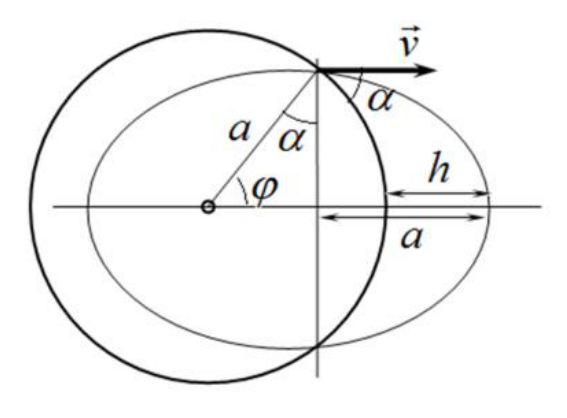
For Keplerian motion the total energy, as well as the period of rotation, depends only on the semi-major axis, which for stone’s orbit coincides with the planet radius (), and the starting point lies on the semi-minor axis because its distance to the focus (the center of the planet) is equal to (see fig.). From the figure one gets
This result can also be obtained by solving a set of equations which is written from the conservation of energy and angular momentum.
The flight range of the stone is found as .
Grading scheme
| № | Content | points |
|---|---|---|
| 1. | The maximum height is found | 2 |
| Conservation of energy | 0,5 | |
| Conservation of angular momentum | 0,5 | |
| The set of equation is correctly solved | 1 | |
| or | ||
| Semi-major axis is found | 0,5 | |
| Justification for semi-major axis | 0,5 | |
| The correct sketch is drawn | 0,5 | |
| Answer | 0,5 | |
| 2. | The angle is obtained () | 1 |
| Correct answer to the question | 1 | |
| Total | 4.0 |
Problem 1B (3.0 points)
According to the definition the heat capacity is written as
Let the gas parameters at the point A be equal (,,). Then, the equation of the process takes the following form
For small deviations one derives
With the aid of the equation of state , one finally gets
Grading scheme
| № | Content | points |
|---|---|---|
| 1. | Expression for C that contains the derivative | 1.0 |
| 2. | The derivative is found for the point A | 1.0 |
| 3. | Correct answer ( or ) | 1.0 |
| Total | 3.0 |
Problem 1C (3.0 points)
It follows from the symmetry that the potential at the center of a uniformly charged volume of spherical shape with respect to the point at infinity is equal to
where denotes a coefficient of proportionality which is the same for a sphere of any size.
Our system of charges can be represented as a superposition of a sphere of radius with the volume charge density , and a sphere of radius charged with the volume density . Then, the potential at the center is found as
where
Grading scheme
| № | Content | points |
|---|---|---|
| 1. | The formula for the potential at the center | 1.0 |
| Derivation of the potential at the center | 1.0 | |
| Wrong coefficient for the potential at the center | - 0.5 | |
| Wrong derivation of the potential | 0 | |
| 2. | Superposition principle is used | 1.0 |
| 3. | Correct answer | 1.0 |
| Total | 3.0 |
Оригинал в Архива: IZhO-2016-Theory_eng.pdf · официални решения: IZhO-2016-Theory_eng_sol.pdf