IZhO 2016, Теория — Задача 2. Problem 2. Equilibrium in terms of potential energy
XII International Zhautykov Olympiad/Theoretical Competition · 10 т.
THEORETICAL COMPETITION. January 15, 2016. Please read this first:
The time available for the theoretical competition is 4 hours. There are three questions.
Use only the pen provided.
You can use your own calculator for numerical calculations. If you don’t have one, please ask for it from Olympiad organizers.
You are provided with Writing sheet and additional paper. You can use the additional paper for drafts of your solutions but these papers will not be checked. Your final solutions which will be evaluated should be on the Writing sheets. Please use as little text as possible. You should mostly use equations, numbers, figures and plots.
Use only the front side of Writing sheets. Write only inside the boxed area.
Begin each question on a separate sheet of paper.
Fill the boxes at the top of each sheet of paper with your country (Country), your student code (Student Code), the question number (Question Number), the progressive number of each sheet (Page Number), and the total number of Writing sheets used (Total Number of Pages). If you use some blank Writing sheets for notes that you do not wish to be evaluated, put a large X across the entire sheet and do not include it in your numbering.
At the end of the exam, arrange all sheets for each problem in the following order:
- Used Writing sheets in order;
- The sheets you do not wish to be evaluated
- Unused sheets and the printed question.
Place the papers inside the envelope and leave everything on your desk. You are not allowed to take any paper out of the room.
Условие
One of the widely known principles of the general physics is that every system tends to decrease its potential energy, and the stable equilibrium position corresponds to the state with the minimum of its value.
In this problem the interaction of the liquid with the solid surface is studied. To describe this interaction the following parameters are introduced:
is the surface tension at the interface between the liquid and the air;
is the surface tension at the interface between the liquid and solid;
is the surface tension at the interface between the solid and the air;
is the contact angle (wetting angle).
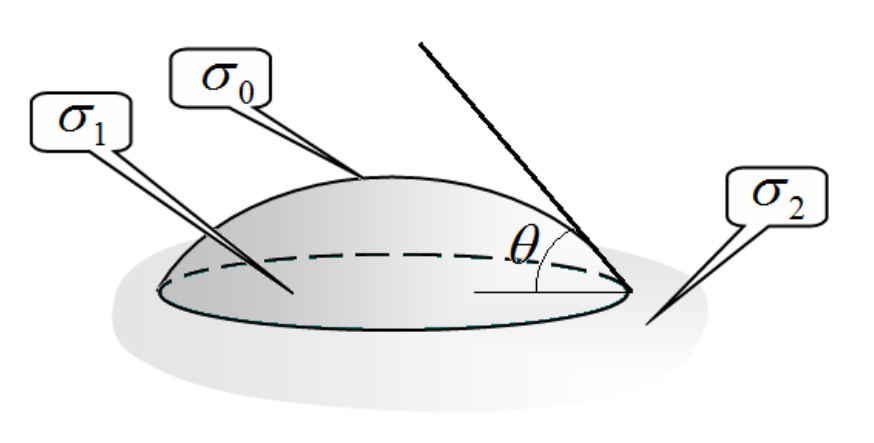
The values , , designate the surface energy per unit area of contact between media.
In all parts of the problem, use the following numerical values for water:
the surface tension ;
the contact angle ;
the mass density ;
the acceleration of gravity .
1. Introduction (1.0 points)
1 Prove that the change in the surface energy at the liquid-solid interface is found as
where stands for the change in the area of the contact between the liquid and solid. [1 т.]
2. Water in a vertical cylindrical tube (2.0 points)
The open tube with the inner radius is lowered vertically so that its lower end touches the surface of the water.
Let a water level in the tube be at a certain height , which does not necessarily correspond to its equilibrium value.
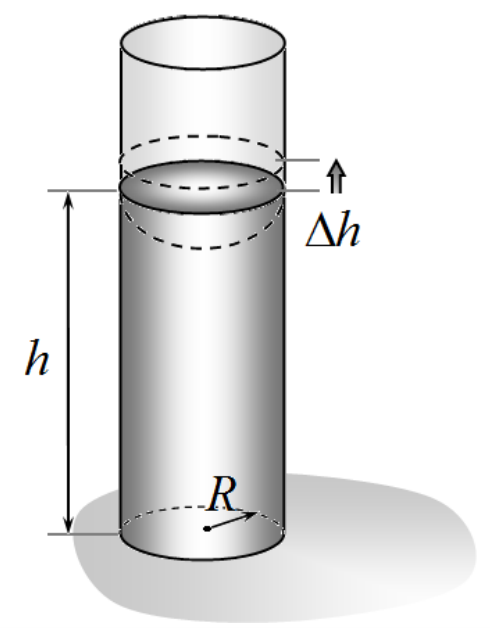
2.1 Find the formula for the change in the surface energy of the system that corresponds to an additional small rise of water level in the tube. [0,5 т.]
2.2 Find the formula for the change in the potential energy of the liquid in the gravitational field that corresponds to an additional small rise of water level in the tube. [0,5 т.]
2.3 Using the principle of the minimum potential energy, find the formula for the height of the water in the tube in equilibrium position. Calculate its numerical value from the quantities provided above. [1 т.]
3. Water in a vertical conical tube (4.0 points)
A long conical tube is vertically lowered into the water so that its lower end touches the surface of the water. The inner radius of the tube at its lower base is equal to , and its inner radius at the upper base is close to zero. The tube walls make an angle with the vertical.
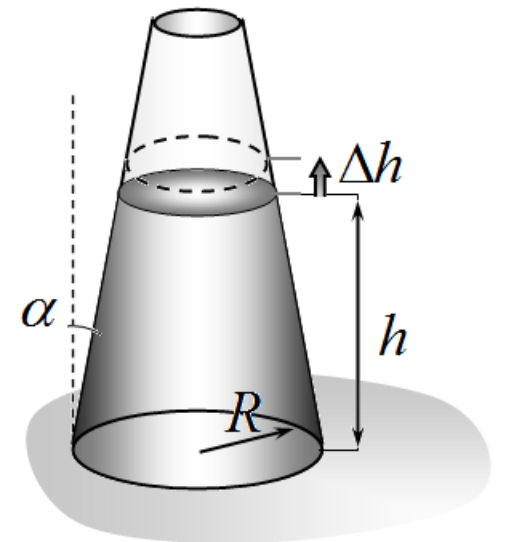
Note: in the following neglect any change in the surface energy at the interface between the liquid and the air.
Let a water level in the tube be at a certain height , which does not necessarily correspond to its equilibrium value.
3.1 Find the formula for the change in the surface energy of the system that corresponds to an additional small rise of water level in the tube. [0,5 т.]
3.2 Find the formula for the change in the potential energy of the liquid in the gravitational field that corresponds to an additional small rise of water level in the tube. [0,5 т.]
3.3 Find the equation that determines the height of water in the tube in equilibrium position and rewrite it in terms of and the value of found in 2.3. [1 т.]
3.4 Let an angle be . The tube is partially filled with water up to a certain level . Find the dependence of the ultimate height of the water level in the tube as a function of . [1 т.]
3.5 Specify the range of angles (providing its numerical values) at which the water completely fills the tube. [1 т.]
4. Outflow of water (3.0 points)
A bottle is completely filled with water, sealed tightly with the cork and turned upside down. Two identical round holes of radii are drilled in the cork.
4.1 At what minimum value of the hole radius the water will pour out of the bottle? [3 т.]
Mathematical tips
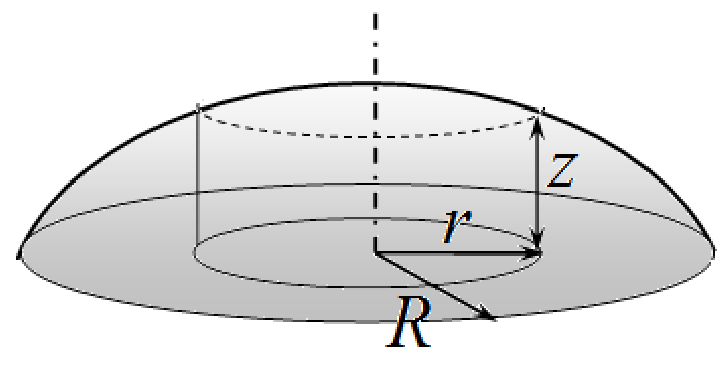
Rather small convex spherically shaped surface can be approximately described by a function
where denotes the radius of the bulge with being its height such that .
Then, up to higher orders the area of the spherical part of the bulge is found as
and its potential energy in the gravitational field is derived as
Отговори
1 Proof from the balance condition .
2.1
2.2
2.3 14 mm
3.1
3.2
3.3
3.4 When H < h2 = 83,5 mm the water level stops at h1 = 16,5 mm (stable equilibrium); if the initial level exceeds h2 the water fills up the tube completely.
3.5
4.1 6.6 mm
Решение
1. Introduction (1.0 points)
1.1 [1.0 points] The change in the surface energy at the liquid-solid interface is found as
Considering the small segment of the boundary of the drop one can write the condition of its balance
It follows from equations (1) and (2) that
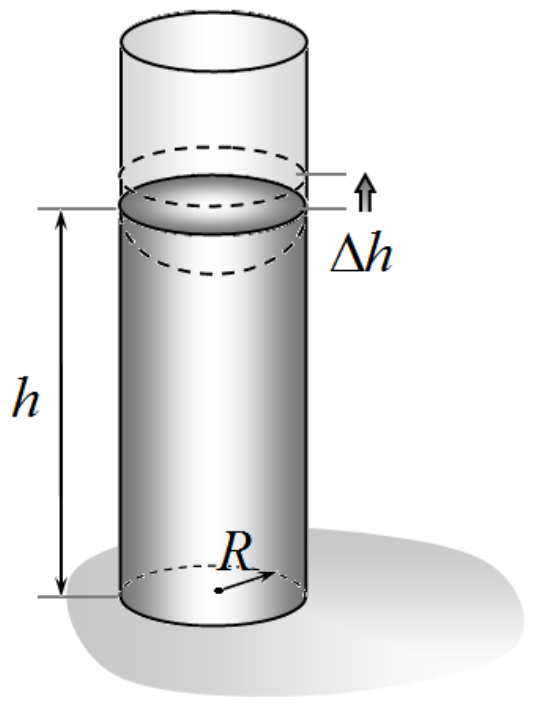
2. Water in a vertical cylindrical tube (2.0 points)
2.1 [0.5 points] The formula for the change in the surface energy of the system that corresponds to an additional small rise of water level in the tube takes the form
where is the change of the contact area between the liquid and the inner surface of the tube.
2.2 [0.5 points] The formula for the change in the potential energy of the liquid in the gravitational field that corresponds to an additional small rise of water level in the tube takes the form
It is taken into account that the liquid of the mass has risen to the height .
2.3 [1.0 points] If exceeds , the energy of the system decreases when the liquid has risen, and hence the liquid will continue to rise, otherwise liquid level will go down. At the position of equilibrium, the total change in energy should be equal to zero, and, thus,
Substitution of the numerical values leads to the following result
3. Water in a vertical conical tube (4.0 points)
3.1 [0.5 points] The formula for the change in the surface energy of the system that corresponds to an additional small rise of water level in the tube takes the form
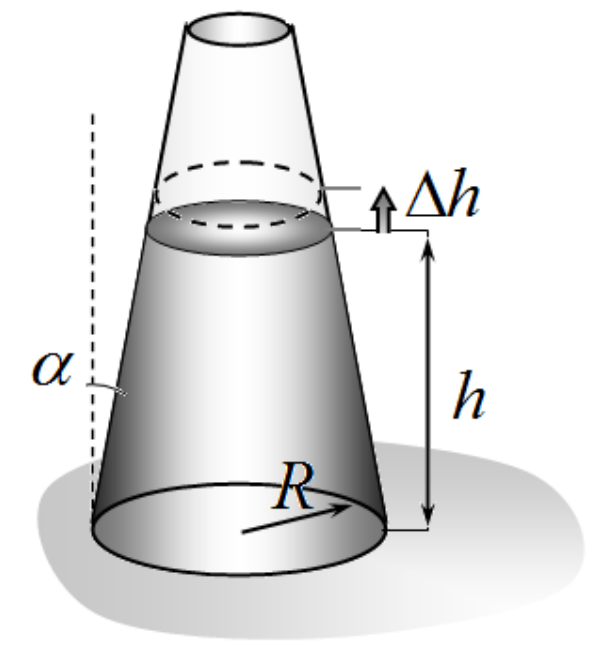
Here is the tube radius at the height .
3.2 [0.5 points] The formula for the change in the potential energy of the liquid in the gravitational field that corresponds to an additional small rise of water level in the tube takes the form
3.3 [1.0 points] As above, the equilibrium position corresponds to the equality of the modules for the energy changes written here as
Substituting the expression for the radius of the tube at the height , one gets the equation
in which the parameter is easily introduced as
3.4 [1.0 points] The resulting equation is square with respect to . Therefore it is necessary to analyze its roots, or condition of their absence. Let us rewrite equation (12) in the form
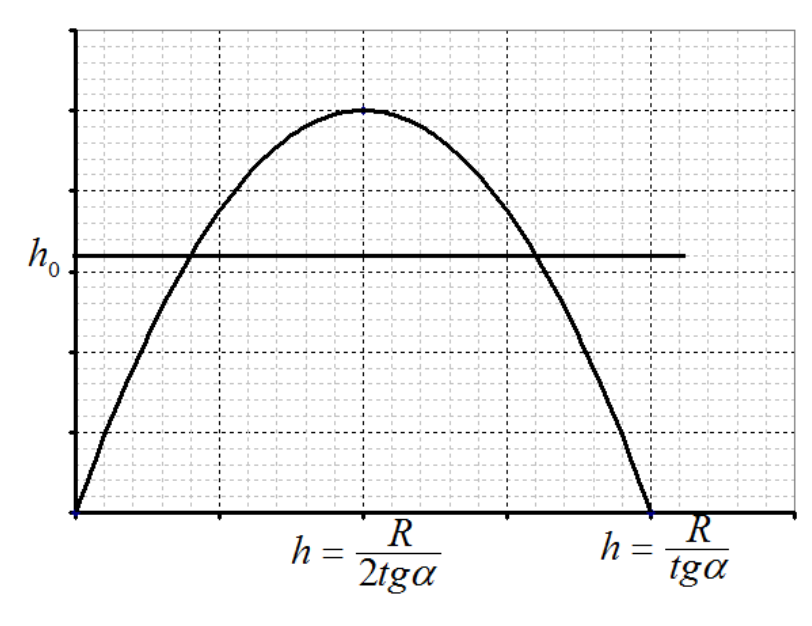
The quadratic function on the right side of this equation has zeros at and ,, and therefore, it reaches its maximum value of at . Consequently, equation (12) has no real roots at . Otherwise, there are two roots. At the given parameters of the tube , so there are two root corresponding to the two equilibrium positions. It is easy to show that the smaller root gives a stable equilibrium position, and the larger one is unstable and their numerical values are evaluated as
Thus, when the water level in the tube stops at the height and if the initial water level exceeds the water fills up the tube completely.
3.5 [1.0 points] The water fills up the tube at any initial value of , if equation (12) has no roots at all. This condition is fulfilled when
or
4. Outflow of water (3.0 points)
4.1 [3.0 points] The water will start to pour out through the hole only if the water surface in the openings lose stability. This happens if the decrease of the potential energy in the gravitational field exceeds the increase in the absolute value of the surface energy. This condition is expressed by the inequality
from which it follows that
Grading scheme
| № | Content | points | |
|---|---|---|---|
| 1 | The segment of the boundary is chosen | 0,5 | 1,0 |
| Balance condition for the segment (2) | 0,5 | ||
| 2.1 | Formula (4) | 0.5 | 0.5 |
| 2.2 | Formula (5) | 0,5 | 0,5 |
| 2.3 | The equality for the change of energies (6) | 0,5 | 1,0 |
| Formula (7) | 0,2 | ||
| Correct numerical value (with significant digits of accuracy) | 0.3 | ||
| 3.1 | Formula (8) | 0,5 | 0,5 |
| 3.2 | Formula (9) | 0,5 | 0,5 |
| 3.3 | Equation (10) | 0,5 | 1.0 |
| Equation (12) | 0,5 | ||
| 3.4 | Solution of equation (12) | 0,3 | 1,0 |
| Analysis of the stability of the roots | 0.5 | ||
| Correct result | 0,2 | ||
| 3.5 | Condition for root absence | 0,6 | 1,0 |
| Numerical value of the angle | 0,4 | ||
| 4.1 | Basic idea: change in the potential energy must be greater than the change in the surface energy | 1,5 | 3,0 |
| Inequality (15) | 1,0 | ||
| Numerical value for the radius (with significant digits of accuracy) | 0,5 | ||
| Total | 10,0 |
Оригинал в Архива: IZhO-2016-Theory_eng.pdf · официални решения: IZhO-2016-Theory_eng_sol.pdf