IZhO 2016, Теория — Задача 3. Problem 3. Nonlinear capacitor
XII International Zhautykov Olympiad/Theoretical Competition · 10 т.
THEORETICAL COMPETITION. January 15, 2016. Please read this first:
The time available for the theoretical competition is 4 hours. There are three questions.
Use only the pen provided.
You can use your own calculator for numerical calculations. If you don’t have one, please ask for it from Olympiad organizers.
You are provided with Writing sheet and additional paper. You can use the additional paper for drafts of your solutions but these papers will not be checked. Your final solutions which will be evaluated should be on the Writing sheets. Please use as little text as possible. You should mostly use equations, numbers, figures and plots.
Use only the front side of Writing sheets. Write only inside the boxed area.
Begin each question on a separate sheet of paper.
Fill the boxes at the top of each sheet of paper with your country (Country), your student code (Student Code), the question number (Question Number), the progressive number of each sheet (Page Number), and the total number of Writing sheets used (Total Number of Pages). If you use some blank Writing sheets for notes that you do not wish to be evaluated, put a large X across the entire sheet and do not include it in your numbering.
At the end of the exam, arrange all sheets for each problem in the following order:
- Used Writing sheets in order;
- The sheets you do not wish to be evaluated
- Unused sheets and the printed question.
Place the papers inside the envelope and leave everything on your desk. You are not allowed to take any paper out of the room.
Условие
The electrical circuit contains the voltage source connected in series with the resistor and the nonlinear capacitor, whose capacitance depends on the voltage across it and is graphically shown in the figure below.
Note: to solve this problem you may need to use some piece of squared paper provided under the graph,
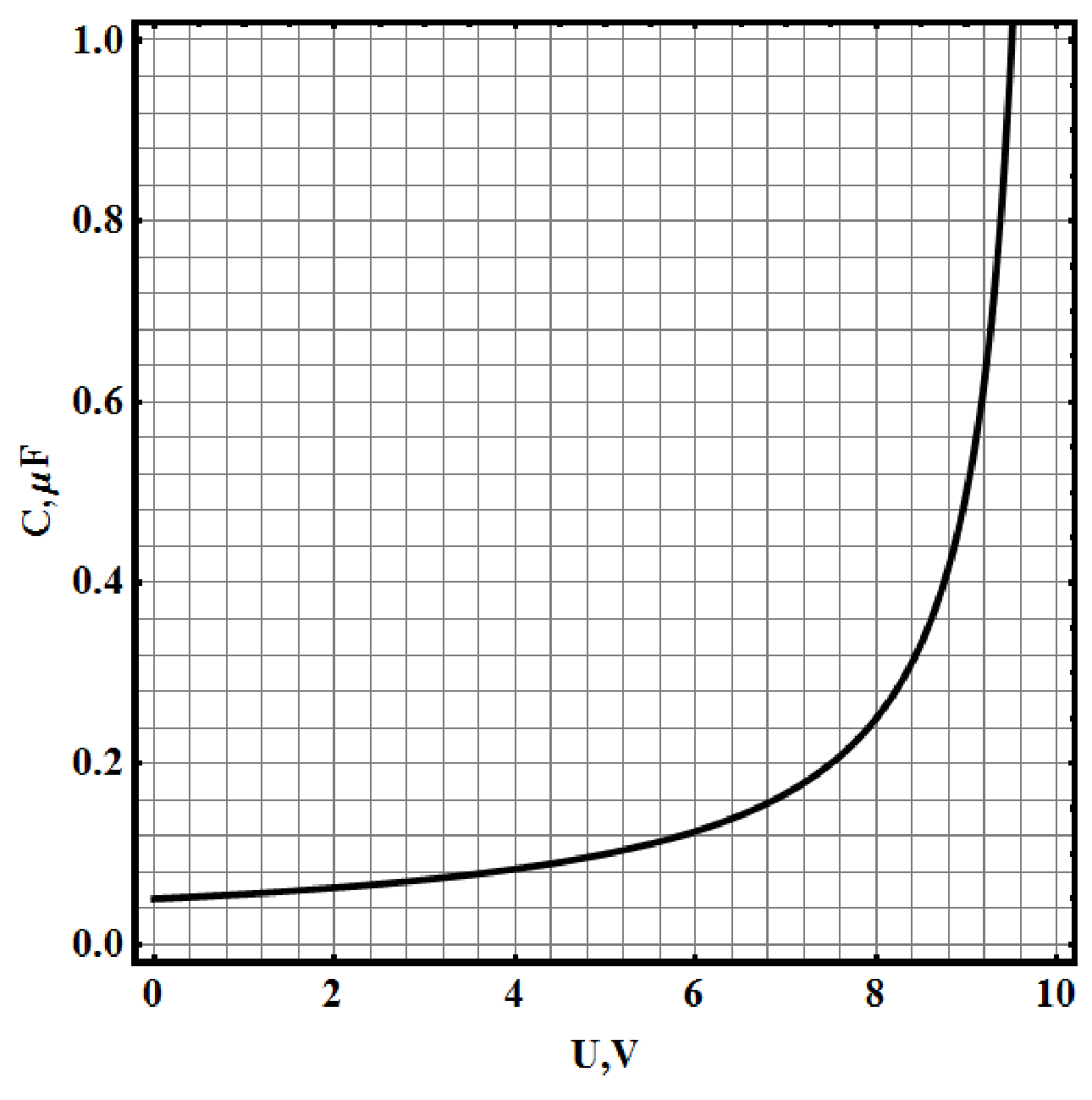

1. Assume that . Find the charge of the capacitor, which appears on its plates after a sufficiently long period of time. [0,75 т.]
Suppose that at the initial time moment the charge of the capacitor is zero, and the voltage source provides V. It is seen from the graph that the capacitance of the capacitor at this voltage goes to infinity, i.e. .
2. How long does it take for a capacitor to be charged to the voltage V? [0,25 т.]
3. Find the time moment , when the charge of the capacitor is equal to . [3 т.]
4. Find the time interval at which the charge of the capacitor grows from to . [0,5 т.]
5. Find the charge of the capacitor at the time moment . [0,5 т.]
Let a source provide a constant voltage with a small portion of alternating voltage such that V, where . After a sufficiently long period of time electrical oscillations of voltage and current are set up in the circuit.
6. What is the phase difference between the voltage oscillations across the capacitor and the resistor? [0,5 т.]
7. Find the dependence of the electric current in the circuit as a function of time. [4 т.]
8. Find the voltage across the capacitor as a function of time. [0,5 т.]
Отговори
1. 0.5 μC
Printed as with ; the source writes the microcoulomb as μCl.
2.
3. 2 ms
4. 5.2 ms
5. 5 μC
Printed as μCl.
6.
7.
8.
Решение
- [0.75 points] After a long period of time the electric current in the circuit turns zero and the capacitor will be fully charged, i.e.
The voltage provided by the source is thus drop on the capacitor whose capacitance at V is obtained from the graph
The charge of the capacitor is therefore found as
- [0.25 points] Since the electric current in the circuit is finite and charging the capacitor to the voltage drop of V requires an infinite charge, the corresponding time is obtained as.
- [3.0 points] Let the capacitor be charged with the charge and its capacitance is equal to , then, since all elements are connected in series, one gets
where the electric current is obtained as
Substituting (6) into (5) yields
where is a function of the charge of the capacitor.
The function is easily retrieved from the provided graph of and turns out linear as shown in the figure below.
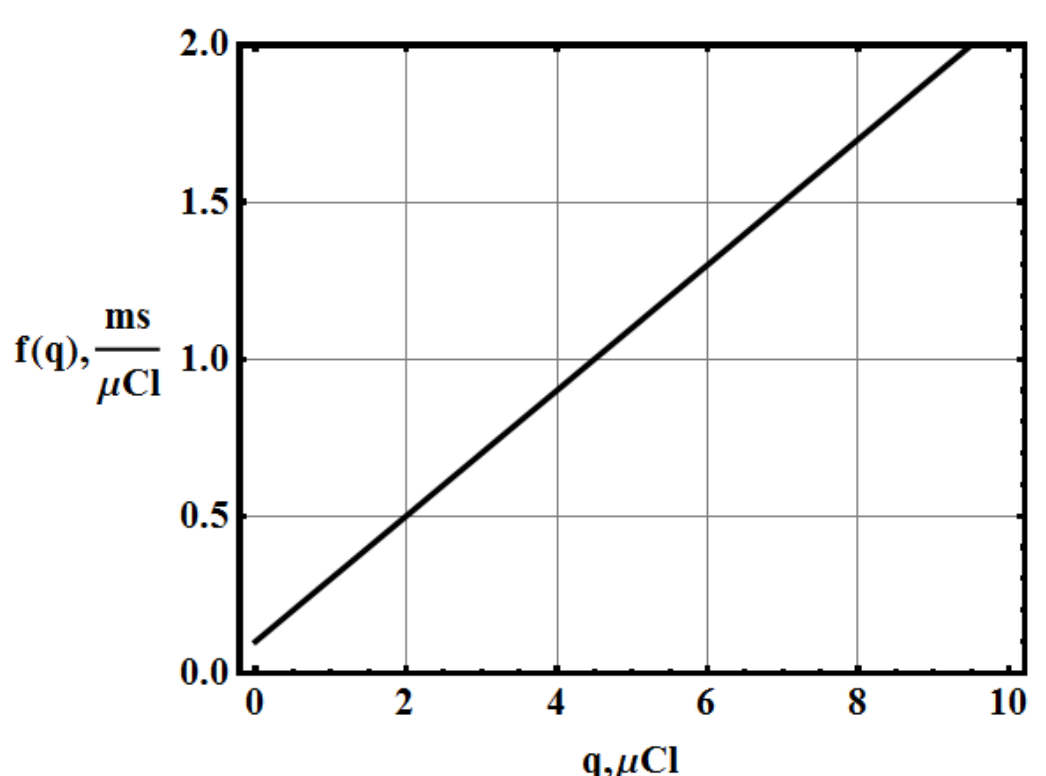
The linear equation has the form
The time needed for a capacitor to be charge to мкКл, is derived from equations (7) and (8) as
- [0.5 points] The time interval , needed for the capacitor to increase its charge from μCl till μCl is found as
- [0.5 points] Solving equation (11) one obtains that
It is obvious that at the initial time moment , that is why the plus sign must be taken in formula (13) and one finally gets that
- [0.5 points] For an ordinary capacitor its charge is proportional to the voltage drop across it, i.e.
and the electric current in the circuit is derived as
Since the capacitor and the resistor are connected in a series, then the electric current passing through them is the same, and, thus, the oscillation of voltage on the resistor is in phase with the oscillation of the current. Substituting gives rise to , i.e. the phase difference between the oscillations of the voltage across the capacitor and the resistor is .
The circuit contains the nonlinear capacitor but the proportionality in equation (16) stays the same, since the oscillation of the voltage is small compared with the constant voltage provided by the source, i.e.
- [4.0 points] The voltage drop has constant and alternating components. After a long period of time the constant component of the voltage will be dropped across the capacitor only, i.e.
and the constant component of the voltage drop across the resistor will be equal to zero, i.e.
In our case the capacitance is voltage dependent, that is why equation (16) is rewritten in the form
where the effective capacitance is found as
It is well known that the reactive resistance of the capacitor is equal to
To calculate the electric current for the resistor and the capacitor connected in a series let us use the vector diagram shown in the figure below.
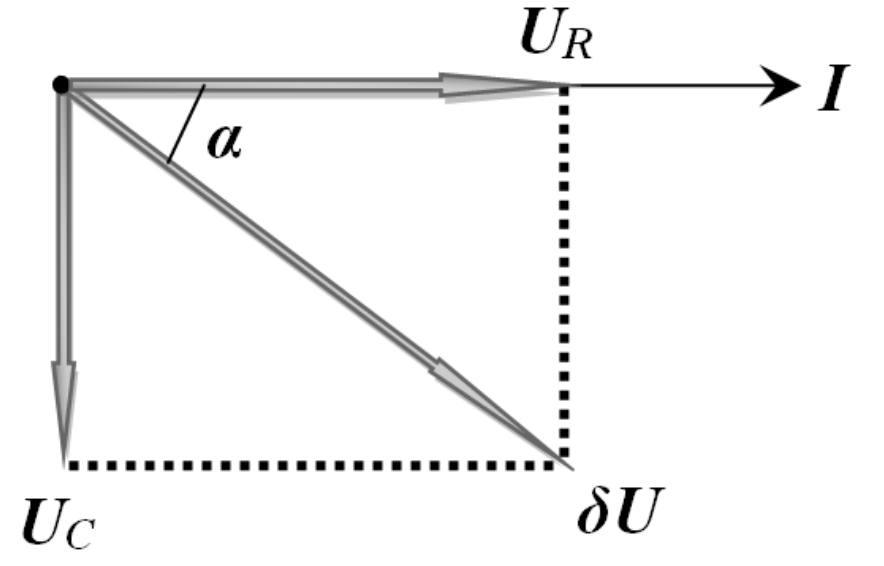
From this diagram the amplitude of the electric current is easily found as
and the corresponding phase shift between the current and the voltage is obtained as
Finally, the dependence of the electric current on the time is derived as
- [0.5 points] The amplitude of the voltage oscillation on the capacitor is obtained from the vector diagram as
Finally, taking into account the constant component of the voltage drop on the capacitor one gets
Grading scheme
| № | Content | points | |
|---|---|---|---|
| 1 | Equation (1) | 0.25 | 0,75 |
| Equation (2) | 0.25 | ||
| Equation (3) | 0.25 | ||
| 2 | Уравнение (4) . | 0.25 | 0,25 |
| 3 | Equation (5) | 0.25 | 3.0 |
| Equation (6) | 0.25 | ||
| Equation (7) with the function | 0.25 | ||
| Equation (8): it is found that | 1.25 | ||
| Equation (9) | 0.25 | ||
| Equation (10) | 0.25 | ||
| Equation (11) | 0.25 | ||
| Numerical value in equation (11) мс | 0.25 | ||
| 4 | Equation (12) | 0.25 | 0.5 |
| Numerical value in equation (12) | 0.25 | ||
| 5 | Equation (14) | 0.25 | 0.5 |
| Numerical value in equation (14) | 0.25 | ||
| 6 | Equations (15), (16) or equivalent | 0.25 | 0.5 |
| Equation (17) | 0.25 | ||
| 7 | Equation (18) В | 0,25 | 4.0 |
| Equation (20) | 1,5 | ||
| Equation (21): correct numerical value | 0.25 | ||
| Equation (22) | 0,25 | ||
| Correct vector diagram or impedances | 0,5 | ||
| Equation (23) | 0,25 | ||
| Equation (23): correct numerical value | 0,25 | ||
| Equation (24) | 0,25 | ||
| Equation (24): correct numerical value | 0,25 | ||
| Equation (25) | 0,25 | ||
| 8 | Equation (26) | 0.25 | 0.5 |
| Equation (27) | 0.25 | ||
| Total | 10,0 |
Оригинал в Архива: IZhO-2016-Theory_eng.pdf · официални решения: IZhO-2016-Theory_eng_sol.pdf