IZhO 2017, Експеримент — Задача 1. Torsion pendulum
XIII International Zhautykov Olimpiad/Experimental Competition · 15 януари 2017 г. · 15 т.
Please read the instructions first:
The Experimental competition consists of one problem. This part of the competition lasts 3 hours.
Please only use the pen that is provided to you.
You can use your own non-programmable calculator for numerical calculations. If you don’t have one, please ask for it from Olympiad organizers.
You are provided with Writing sheet and additional papers. You can use the additional paper for drafts of your solutions but these papers will not be checked. Your final solutions which will be evaluated should be on the Writing sheets. Please use as little text as possible. You should mostly use equations, numbers, figures and plots.
Use only the front side of Writing sheets. Write only inside the bordered area.
Fill the boxes at the top of each sheet of paper with your country (Country), your student code (Student Code), the question number (Question Number), the progressive number of each sheet (Page Number), and the total number of Writing sheets (Total Number of Pages). If you use some blank Writing sheets for notes that you do not wish to be evaluated, put a large X across the entire sheet and do not include it in your numbering.
At the end of the exam, arrange all sheets for each problem in the following order:
- Used Writing sheets in order;
- The sheets you do not wish to be evaluated
- Unused sheets and the printed question.
Place the papers inside the envelope and leave everything on your desk. You are not allowed to take any paper or equipment out of the room
Условие
Instruments and equipment: two bolts and coupling nut, tripod with two holders or ring holders, thread, 2 wooden ruler of the length of 40 cm each, stopwatch, weight of 100 g, clay.
The torsion pendulum is two bolts rigidly joined by the nut and suspended on two threads,. Make sure that the pendulum makes only torsional oscillations in a horizontal plane. The free fall acceleration due to gravity is .
Part 1. Free small oscillations (5.0 points) (5 т.)
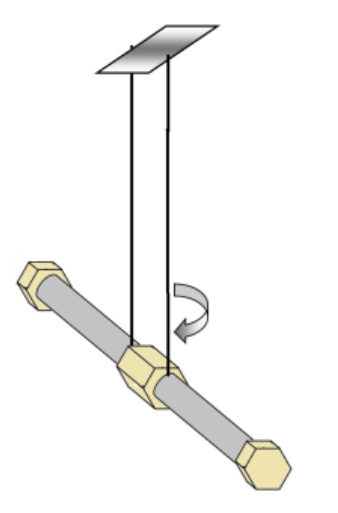
1.1 Measure dependence of the period of small torsional oscillations of the pendulum on the length of threads in the range from 10 to 50 cm. [2 т.]
1.2 Derive the theoretical formula for the period of small torsional oscillations. [0,5 т.]
1.3 Prove graphically that the derived formula correctly describes the experimental data. [1 т.]
1.4 Calculate the radius of gyration of the pendulum and evaluate the experimental error. [1,5 т.]
Hint: The moment of inertia of a rigid body about a certain axis may be represented in the form , where is the body mass and stands for the radius of gyration.
In all following parts error analysis is not required!
.
Part 2. Small oscillations with additional tension (5.0 points) (5 т.)
Tie another two threads from below the bolts. They must also be parallel and located at the same distance as the two upper threads. At the bottom tie them to a wooden ruler of length 40 cm. To do this, fix the ruler tight in the tripod holder. You can also place the ruler under the tripod platform. The threads must be tied to the ruler at a distance of 4-5 cm from the holder. The lengths of the threads at the top and bottom of the bolts must be the same and equal to about 20 cm. By raising or lowering the upper tripod holder, you can change the tension of the threads. Tension of threads is measured by the magnitude of the ruler bending, as shown in the figure below.
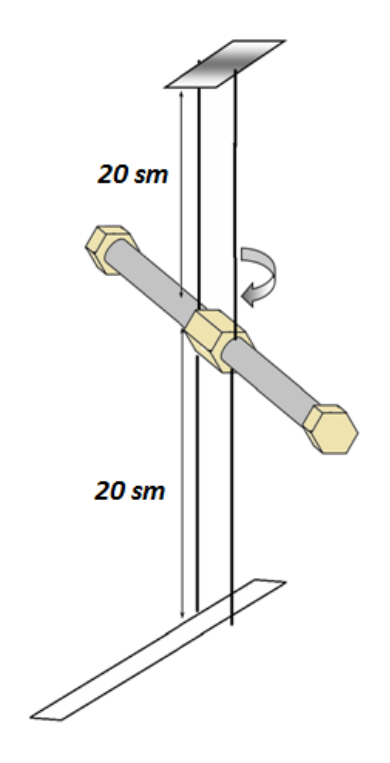
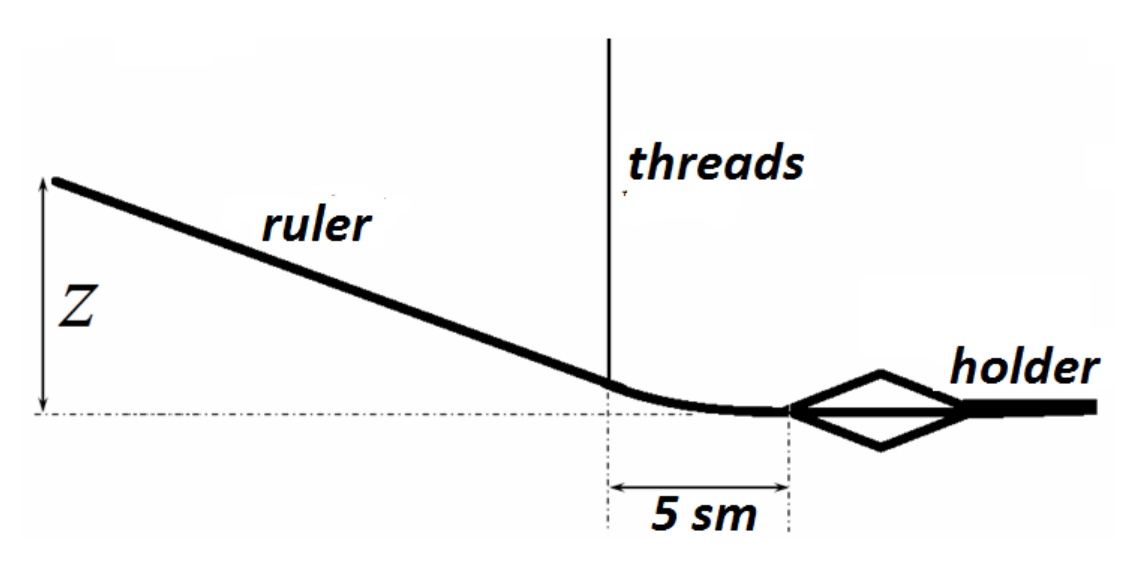
2.1 Measure the dependence of the period of small torsional oscillations on the threads tension, i.e. on the ruler bending . [2 т.]
2.2 Derive the theoretical dependence of the oscillation period on the threads tension. [1 т.]
2.3 Present the experimental data on the graph in such a way that it confirms the derived theoretical dependence. [2 т.]
Part 3. Twisting at large angles (5.0 points) (5 т.)
In this part the pendulum should be twisted at large angles, which are measured by the number of half-turns . The measurements should be carried out with a chosen moderate thread tension that you should exactly state.
3.1 Study the dependence of the time of the pendulum untwisting on the initial twisting angle . Plot the graph of the resulting dependence. [1 т.]
3.2 It can be approximately assumed that the potential energy of elastic deformation depends on the twisting angle as
where is a constant. Based on the experimental data, decide which range the exponent falls in: a) ; b) ; c) . [0,3 т.]
If the pendulum is initially twisted to a certain angle , the pendulum unwinds such that the threads turn in parallel again, and then due to inertia the pendulum is re-twisted to some smaller angle .
3.3 Study the dependence of the re-twisting angle on the initial twisting angle . The measurements must be taken at two different magnitudes of the threads tension (but you should state them). Plot the graphs of the obtained dependencies. Propose a simple formula to describe the resulting dependence. Evaluate the numerical values of the parameters in your dependence. [1,5 т.]
Adjusting the threads tension during torsional oscillations of the pendulum can provide some intake of energy. Place the tripod with the pendulum at the edge of the table. At the bottom the thread should cover the ruler, fixed in the holder or under the tripod platform. Suspend the weight of 100 g to the thread below the ruler.
3.4 Study the dependence of the re-twisting angle on the initial twisting angle in this case. Plot the graph of the obtained dependence. Propose a simple formula to describe the resulting dependence. Evaluate the numerical values of the parameters in your dependence. [1 т.]
3.5 Repeat the experiment described in section 3.4, but lift the suspended weight up at the stage of re-twisting and do not touch the weight at the stage of untwisting. Study the dependence of the re-twisting angle on the initial twisting angle in this case. Plot the graph of the obtained dependence in the same graph as in section 3.4. Propose a simple formula to describe the resulting dependence. Evaluate the numerical values of the parameters in your dependence. [1,2 т.]
Отговори
Part 1. Free small oscillations (5.0 points), 1.2
From the official solution, formula (4); l is the threads length, h the distance between the threads.
Part 1. Free small oscillations (5.0 points), 1.4 4.33 cm
Official experimental value R = 4,33 sm with ΔR = 0,16 sm (the source writes "sm" for centimetres); the marking scheme accepts 4,2 – 4,4 sm.
Part 2. Small oscillations with additional tension (5.0 points), 2.2
From the official solution, formula (10); C, A are constants.
Part 3. Twisting at large angles (5.0 points), 3.2
Official solution: the untwisting time grows with the amplitude, so the potential energy grows slower than for harmonic oscillations.
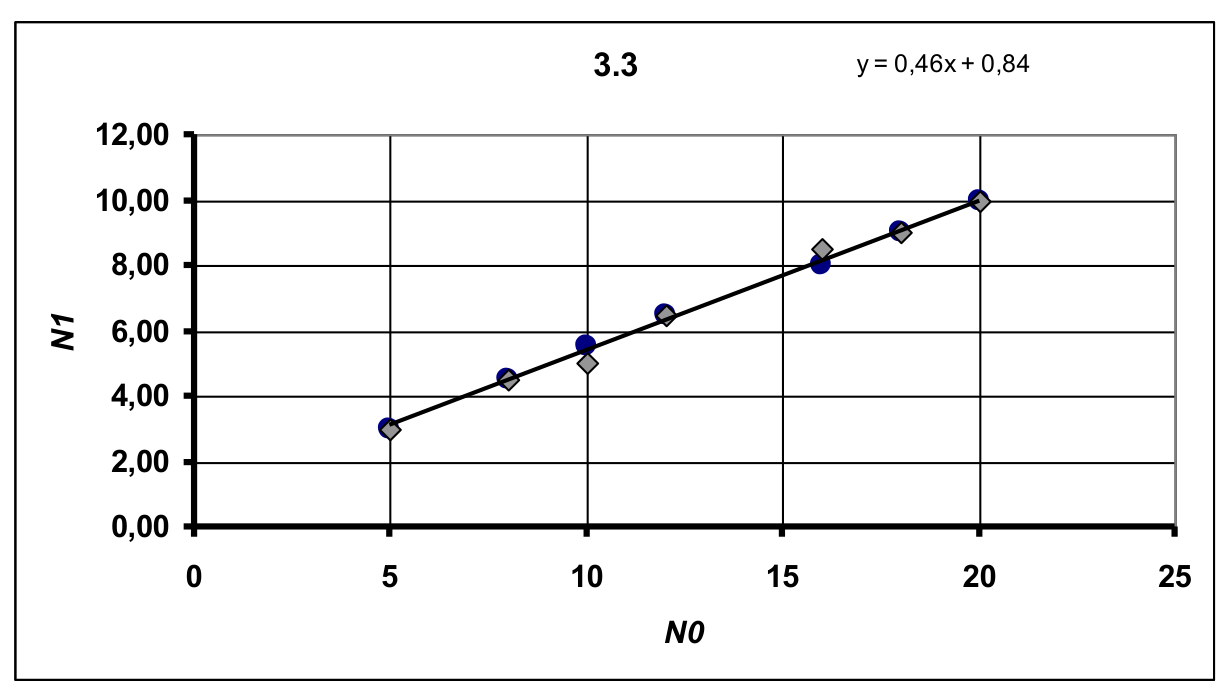
Part 3. Twisting at large angles (5.0 points), 3.3
Official experimental fit, formula (11); practically independent of the threads tension.
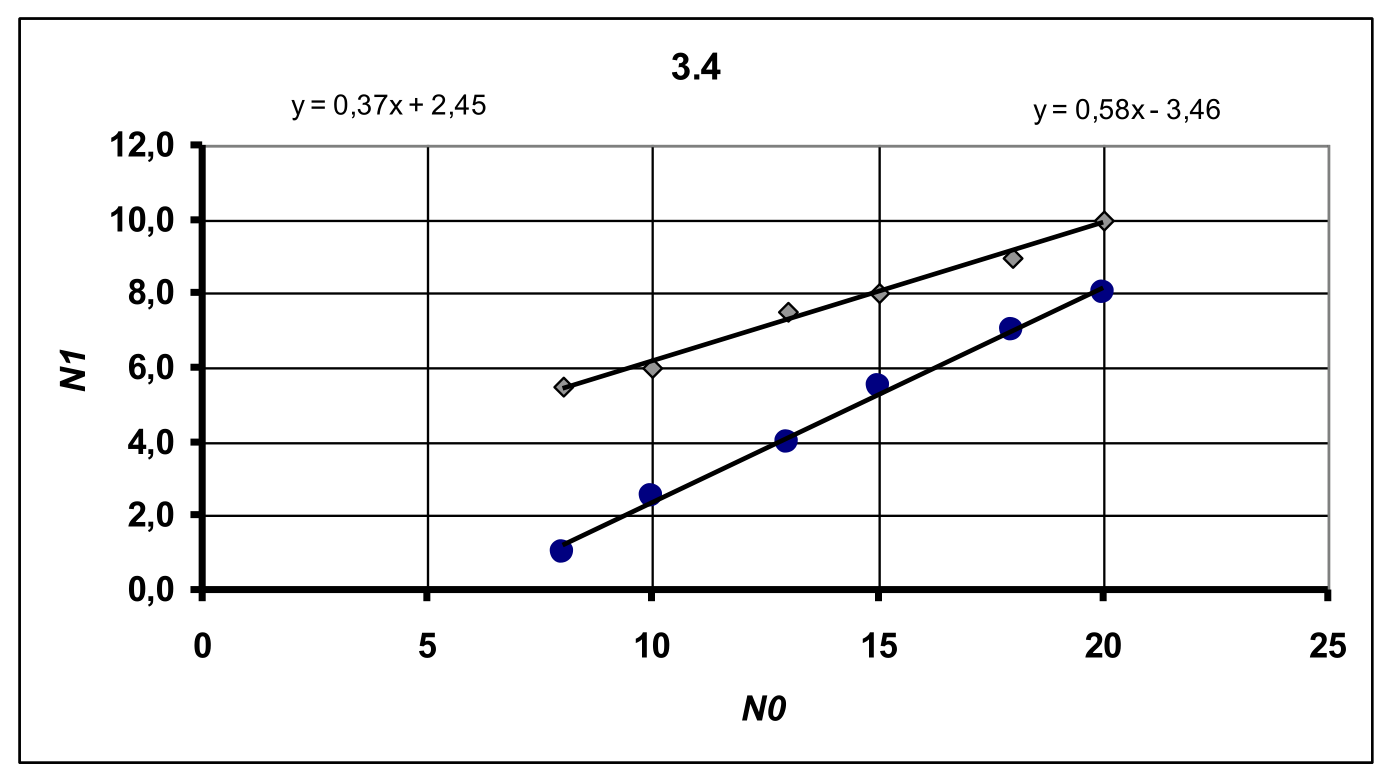
Part 3. Twisting at large angles (5.0 points), 3.4
Official experimental fit for the case with the weight (Table 5, column „С грузом“), formula (12).
Part 3. Twisting at large angles (5.0 points), 3.5
Official experimental fit for the case with the weight lifted (Table 5, column „Без груза“), formula (12).
Решение
SOLUTION TO THE EXPERIMENTAL COMPETITION
Torsion pendulum (15.0 points)
Part 1. Free small oscillations (5.0 points)
1.1 The measurement results showing the dependence of the oscillation period on the length of threads are shown in Table 1. For each threads length the measurement are taken 3 times for 10 oscillations. The oscillation period is calculated as an average of the measured time.
Table 1.
| , sm | , s | , s | , s | ||
|---|---|---|---|---|---|
| 61 | 48,19 | 48,02 | 48,34 | 4,82 | 23,22 |
| 49 | 43,57 | 43,31 | 43,81 | 4,36 | 18,98 |
| 39 | 38,56 | 38,34 | 38,37 | 3,84 | 14,76 |
| 28 | 33,1 | 32,94 | 32,78 | 3,29 | 10,85 |
| 19 | 26,44 | 27,03 | 26,62 | 2,67 | 7,13 |
| 10 | 18,91 | 19,35 | 19,22 | 1,92 | 3,67 |
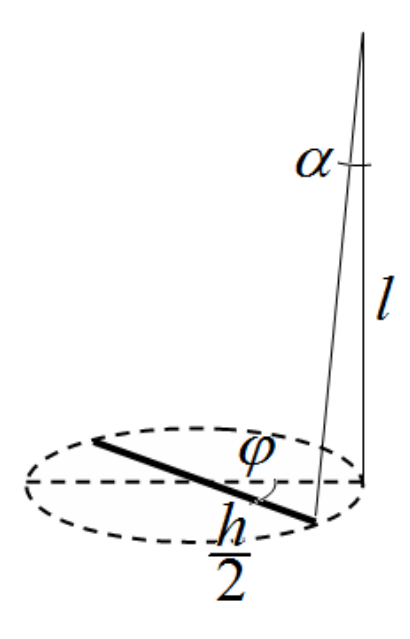
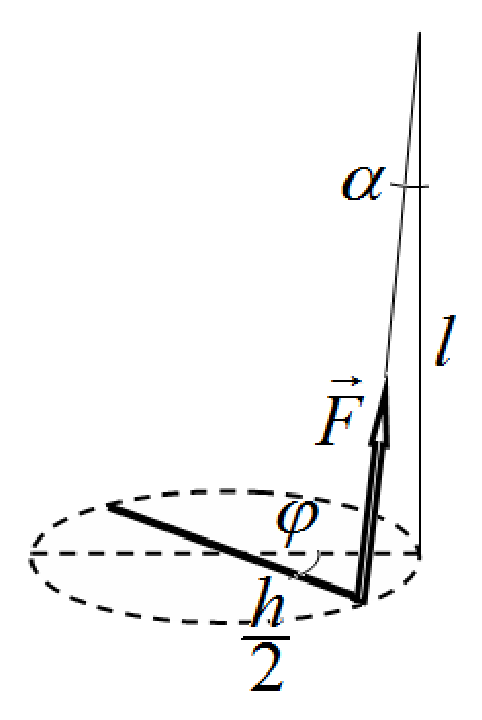
1.2 By turning the bolts in a horizontal plane at a small angle the threads deviate from the vertical by a small angle . The relationship between these angles are geometrically found in the form
where denotes the threads length and stands for distance between them.
Deviation from the vertical results in the following increase of the potential energy
The equation of energy conservation for the torsional oscillations is written as
where designates the moment of inertia of the pendulum.
The law of energy conservation (3) corresponds to the harmonic oscillations with the period
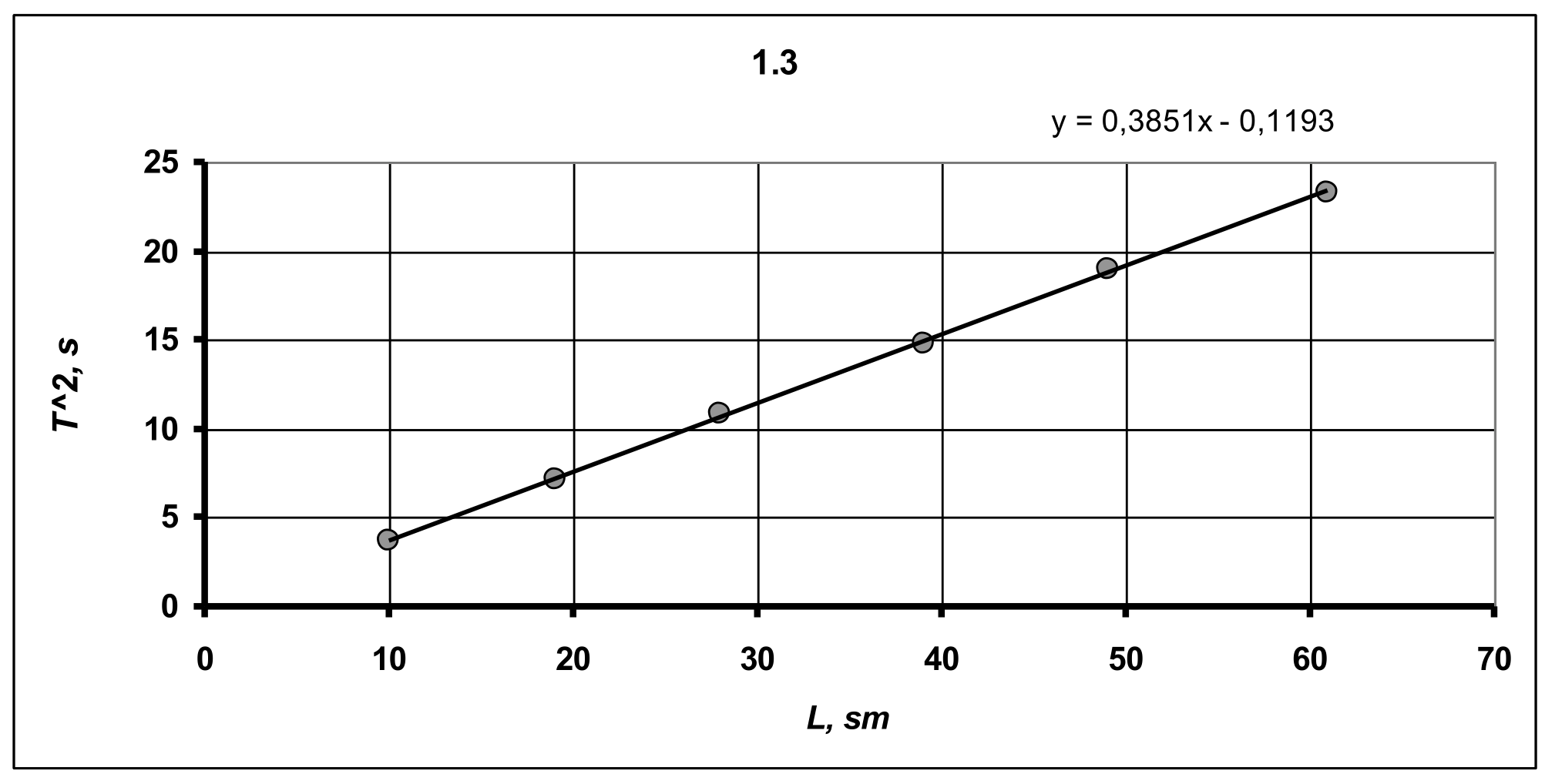
1.3 To verify the resulting formula the graph must be plotted of the square of the period on the threads length (see Fig. 1.1). The obvious linear dependence proves the validity of the formula (4).
The coefficients of the linear dependence , calculated using the least square method, are obtained as
Since holds, the dependence is considered linear.
1.4 It follows from formula (4) that the period of oscillations can be expressed in terms of the radius of gyration as follows:
Therefore, the slope found in 1.3 allows one to calculate the radius of gyration as
The distance between threads is measured as .
The experimental error is calculated according to the formula
Part 2. Small oscillations with additional tension (5.0 points)
The results of measurements showing the dependence of the oscillation period on the threads tension are shown in Table 2.
Table 2.
| , mm | , s | , s | , s | ||
|---|---|---|---|---|---|
| 12 | 10,22 | 10,28 | 10,40 | 1,03 | 0,94 |
| 20 | 7,10 | 7,03 | 7,18 | 0,71 | 1,98 |
| 27 | 5,63 | 5,62 | 5,69 | 0,56 | 3,14 |
| 37 | 4,53 | 4,50 | 4,53 | 0,45 | 4,89 |
| 52 | 3,75 | 3,88 | 3,87 | 0,38 | 6,81 |
2.2 Torque of the restoring force depends on the threads tension and the twisting angle. Change in the tension force when twisting is the correction of the higher order.
Therefore, the rotational equation of motion in this case has the form
Consequently, the period of those oscillations is inversely proportional to the square root of the threads tension
where are some constant values.
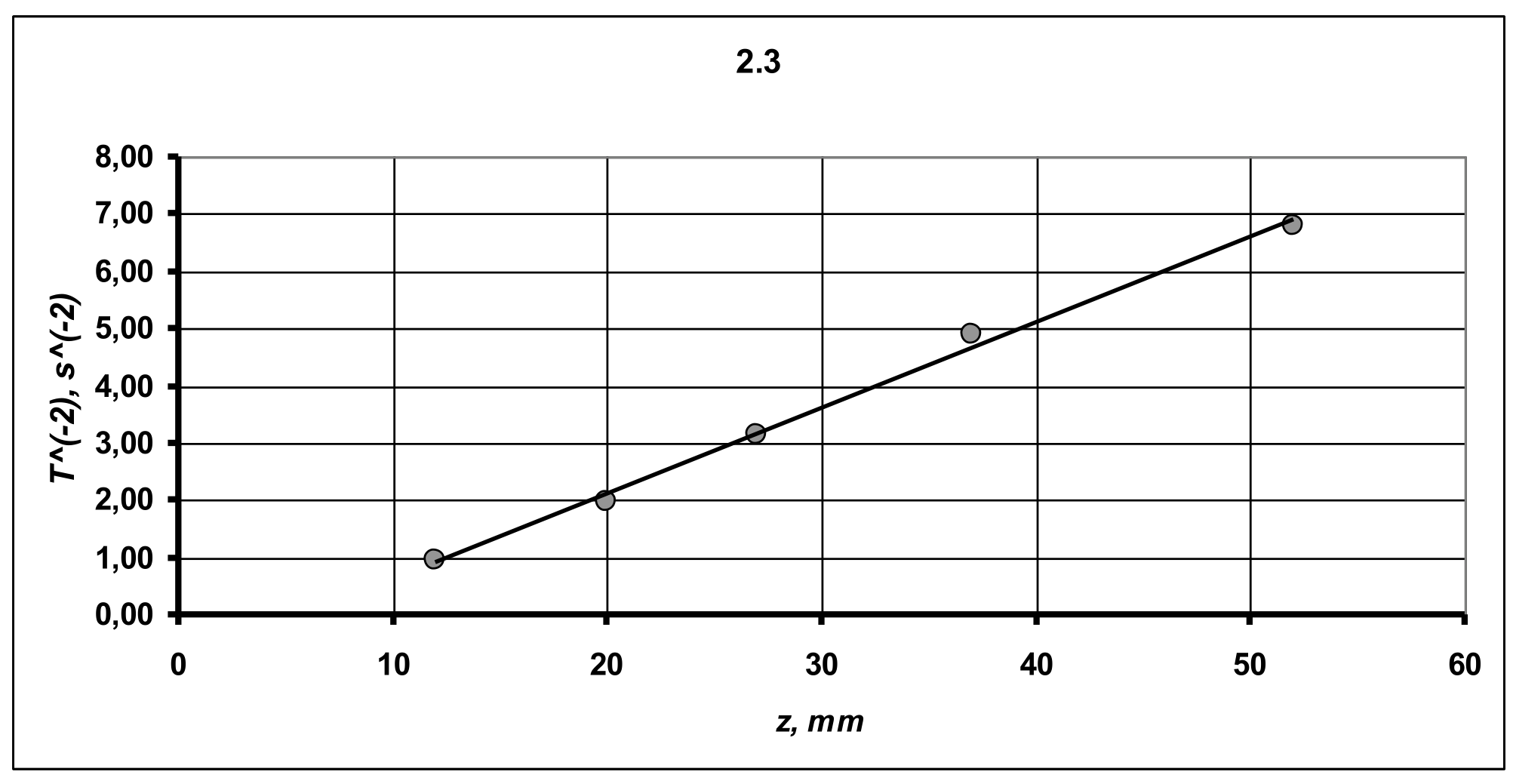
2.3 To confirm this dependence the dependence should be plotted. Other ways of linearization in this case are less reliable because when the bending is measured, the constant deviation is inevitable.
The graph of is shown in Fig. 2.3.
The resulting linear relationship confirms the theoretical conclusion that the period is a linear function of the threads tension.
Part 3. Twisting at large angles (5.0 points)
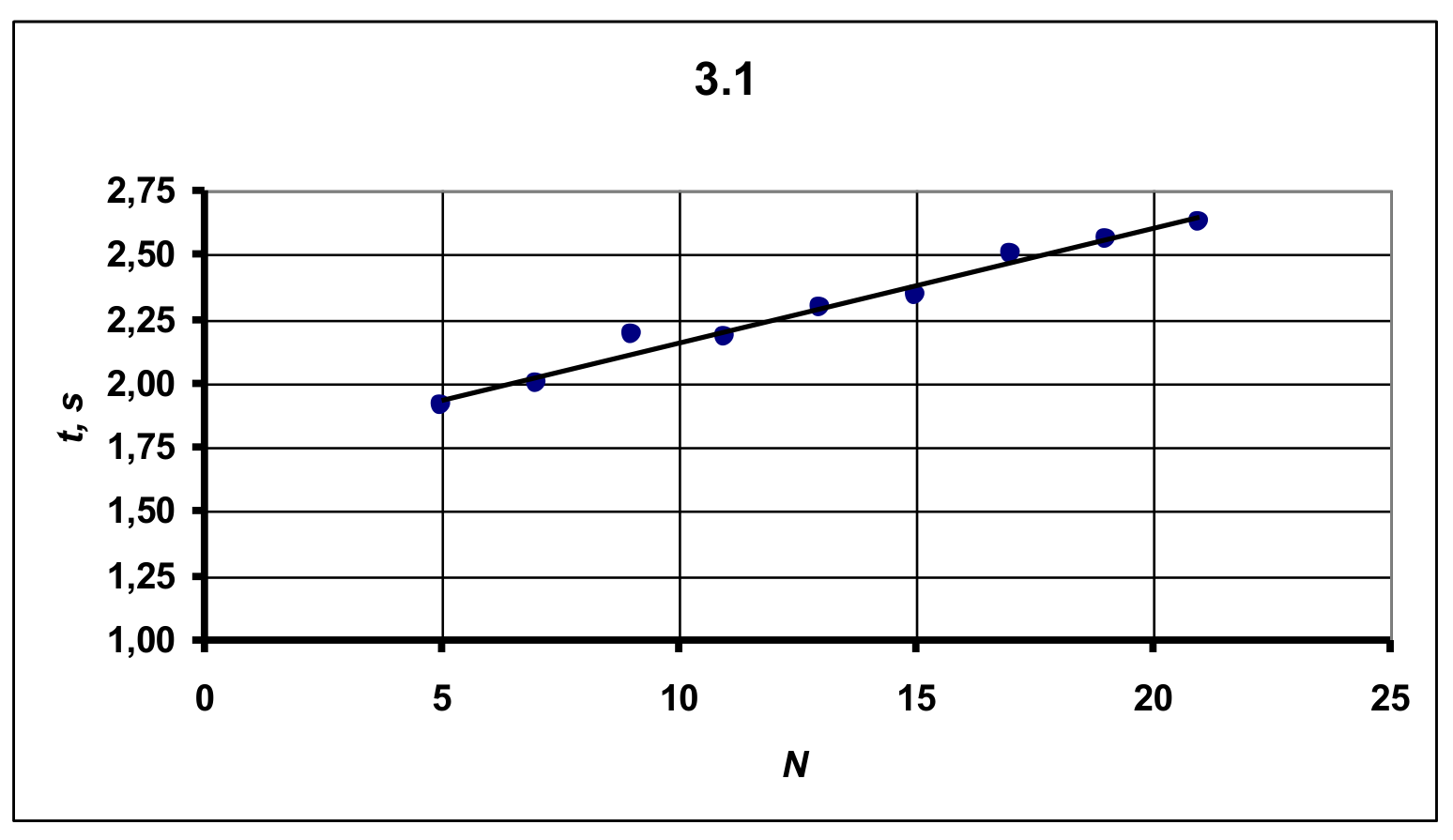
3.1 Dependence of the untwisting time on the twisting angle is shown in Table 3 and Fig. 3.1.
Table 3.
| 5 | 1,91 |
| 7 | 2,00 |
| 9 | 2,19 |
| 11 | 2,18 |
| 13 | 2,29 |
| 15 | 2,34 |
| 17 | 2,50 |
| 19 | 2,56 |
| 21 | 2,63 |
3.2 The untwisting time can be considered as a quarter of the oscillation period. Since the untwisting time increases with the "amplitude", this means that the potential energy increases slower than in the case of harmonic oscillations, i.e. . .
3.3 The dependence of re-twisting half-turns on the initial twisting half-turns is shown in Table 4 and in graph 3.3. The resulting dependence is practically independent of the threads tension.
Table 4.
| 20 | 10,0 | 10,0 |
| 18 | 9,0 | 9,0 |
| 16 | 8,0 | 8,5 |
| 12 | 6,5 | 6,5 |
| 10 | 5,5 | 5,0 |
| 8 | 4,5 | 4,5 |
| 5 | 3,0 | 3,0 |
This dependence can be described by a linear function
3.4-3.5 The dependencies of half-turns on the initial twisting angle at lifting/unlifting the weight are summarized in Table 5 and in graph 3.4. These dependencies are linear. It is significant that during the ascent without the additional weight the corresponding values of lie significantly higher, indicating that the intake of energy appears during the weight unlifting. In addition, the last relationship can not be exactly considered proportional.
Table 5.
| С грузом | Без груза | |
|---|---|---|
| 20 | 8,0 | 10,0 |
| 18 | 7,0 | 9,0 |
| 15 | 5,5 | 8,0 |
| 13 | 4,0 | 7,5 |
| 10 | 2,5 | 6,0 |
| 8 | 1,0 | 5,5 |
These dependencies can be described by linear functions
Marking scheme
| Content | Total | Points | |
|---|---|---|---|
| Part 1. Free small oscillations. | 5 | ||
| 1.1 | Marked only if the difference of measurements results from the official ones does not exceed 25% | 2 | |
| Number of different lengths of the pendulum: 5 or more (3-4; less than 3); | 0,8 (0,4;0) | ||
| The periods are measured by 10 oscillations or more (5-9; less than 5); | 0,3 (0,1;0) | ||
| The periods are calculated for all measurements; | 0,2 | ||
| The range of length of the pendulum 40 sm or more (30-40 sm, 20-30 sm; less than 20 см) | 0,7 (0,5;0,3;0) | ||
| 1.2 | Derivation of the theoretical formula: | 0,5 | |
| The exact formula is obtained ; | 0,5 | ||
| Only dependence is predicted (or wrong coefficient at ) | (0,2) | ||
| 1.3 | Marked only if the measurements in 1.1 have been marked! | 1 | |
| Correct linearization , ; | 0,5 | ||
| Another linearization | (0,2) | ||
| Proved that the power is 1/2 | (0,3) | ||
| Graph plotting (not linearized dependence is not marked): | |||
| - axis are named and ticked; | 0,1 | ||
| - experimental data are drawn; | 0,1 | ||
| - the line is drawn; | 0,1 | ||
| The linear dependence is confirmed; | 0,2 | ||
| 1.4 | Marked only if the measurements in 1.1 have been marked! | 1,5 | |
| The radius of gyration is calculated for all periods; | 0,3 | ||
| Only for 2 periods; | (0,2) | ||
| Only for 1 period; | (0,1) | ||
| The slope is found for the linearized dependence using: | |||
| Least square method; | 0,2 | ||
| From the graph; | (0,1) | ||
| The distance between the threads is measured | 0,1 | ||
| The accuracy is stated | 0,1 | ||
| Formula for calculation of the radius of gyration | 0,1 | ||
| Numerical value for the radius of gyration in the range: 4,2 – 4,4 sm (4,0 – 4,6 sm; out of range) | 0,4 (0,2;0) | ||
| Error evaluation: | |||
| - error for the slope; | 0,1 | ||
| - error for the distance between threads; | 0,1 | ||
| - final error; | 0,1 | ||
| Part 2. Small oscillations with additional tension | 5 | ||
| 2.1 | Marked only if the difference of measurements results from the official ones does not exceed 50% | 2 | |
| Number of different threads tensions: 5 or more (3-4; less than 3); | 0,8 (0,4;0) | ||
| The periods are measured by 10 oscillations or more (5-9; less than 5); | 0,3 (0,1;0) | ||
| The periods are calculated for all measurements; | 0,2 | ||
| The range of variation of the periods Not less than 2,5 times (2,0 times, 1,5 times; less) | 0,7 (0,5;0,3;0) | ||
| 2.2 | Derivation of the theoretical formula: | 1 | |
| The dependence is justified threads tension is taken constant, the torque is proportional to , the equation for oscillations); | 1,0 (0,3; 0,3; 0,4) | ||
| Simply stated that (no proof is provided) | (0,2) | ||
| 2.3 | Marked only if the measurements in 2.1 have been marked!! | 2 | |
| Correct linearization ; | 1,0 | ||
| Another linearization | (0,5) | ||
| The linearization is used, Proved that the power is 1/2 | (0,3+0,2) | ||
| Graph plotting (not linearized dependence is not marked): | |||
| - axis are named and ticked; | 0,1 | ||
| - experimental data are drawn; | 0,1 | ||
| - the line is drawn; | 0,1 | ||
| The linear dependence is confirmed; | 0,7 | ||
| Part 3. Twisting at large angles | 5 | ||
| 3.1 | Marked only if the difference of measurements results from the official ones does not exceed 50% | 1,0 | |
| Number of different values of : 5 or more (3-4; less than 3); | 0,4 (0,2;0) | ||
| The measurements are repeated 3 times; | 0,1 | ||
| Growing dependence of is obtained | 0,2 | ||
| Graph plotting (marked only if the measurements results have been marked): | |||
| - axis are named and ticked; | 0,1 | ||
| - experimental data are drawn; | 0,1 | ||
| - the line is drawn; | 0,1 | ||
| 3.2 | The power in potential energy | 0,3 | |
| 0,2 | |||
| Justification: grows slowly than for harmonic oscillations | 0,1 | ||
| 3.3 | Marked only if the slope falls in the range 0,35-0,65 | 1,5 | |
| Number of different values of : 5 or more (3-4; less than 3); | 0,5 (0,2;0) | ||
| The measurements are repeated 3 times or more; | 0,1 | ||
| Growing linear dependence is obtained; | 0,2 | ||
| Graph plotting (marked only if the measurements results have been marked): | |||
| - axis are named and ticked; | 0,1 | ||
| - experimental data are drawn; | 0,1 | ||
| - the line is drawn; | 0,1 | ||
| The linear function is proposed; | 0,1 | ||
| Numerical values for the parameters are found; | 0,2 | ||
| The slopes are equal for both threads tensions; | 0,1 | ||
| 3.4 | Marked only if the slope falls in the range 0,25-0,65 | 1 | |
| Number of different values of : 5 or more (3-4; less than 3); | 0,3 (0,1;0) | ||
| Growing linear dependence is obtained; | 0,1 | ||
| Graph plotting (marked only if the measurements results have been marked): | |||
| - axis are named and ticked; | 0,1 | ||
| - experimental data are drawn; | 0,1 | ||
| - the line is drawn; | 0.1 | ||
| The linear function is proposed; | 0,1 | ||
| Numerical values for the parameters are found; | 0,2 | ||
| 3.5 | Marked only if the slope falls in the range 0,25-0,75 and there is a shift of line up! | 1,2 | |
| Number of different values of : 5 or more (3-4; less than 3); | 0,4 (0,2;0) | ||
| Growing linear dependence with the upper shift is obtained; | 0,2+0,1 | ||
| Graph plotting (marked only if the measurements results have been marked): | |||
| - experimental data are drawn; | 0,1 | ||
| - the line is drawn; | 0,1 | ||
| The linear function is proposed; | 0,1 | ||
| Numerical values for the parameters are found; | 0,2 |
Теми и трудност
Трудност: неоценена.
Механика · Механични трептения · Въртене на твърдо тяло
Предпоставки: Гимназиална подготовка
Оригинал в Архива: IZhO-2017-Exp_eng.pdf · официални решения: IZhO-2017-Exp_eng_sol.pdf