IZhO 2017, Теория — Задача 3. Problem 3. Resistance of a prism
XIII International Zhautykov Olympiad/Theoretical Competition · 10 т.
Внимание: Бележка към темата
Problem 1C refers to a separate answer sheet with the points S1, S2, A1, A2 and a highlighted oval area; that sheet is not in the archive. The grid drawing in the official solution shows its layout.
THEORETICAL COMPETITION. January 14, 2017. Please read this first:
The time available for the theoretical competition is 4 hours. There are three questions.
Use only the pen provided.
You can use your own calculator for numerical calculations. If you don’t have one, please ask for it from Olympiad organizers.
You are provided with Writing sheet and additional paper. You can use the additional paper for drafts of your solutions but these papers will not be checked. Your final solutions which will be evaluated should be on the Writing sheets. Please use as little text as possible. You should mostly use equations, numbers, figures and plots.
Use only the front side of Writing sheets. Write only inside the boxed area.
Begin each question on a separate sheet of paper.
Fill the boxes at the top of each sheet of paper with your country (Country), your student code (Student Code), the question number (Question Number), the progressive number of each sheet (Page Number), and the total number of Writing sheets used (Total Number of Pages). If you use some blank Writing sheets for notes that you do not wish to be evaluated, put a large X across the entire sheet and do not include it in your numbering.
At the end of the exam, arrange all sheets for each problem in the following order:
- Used Writing sheets in order;
- The sheets you do not wish to be evaluated
- Unused sheets and the printed question.
Place the papers inside the envelope and leave everything on your desk. You are not allowed to take any paper out of the room.
SOLUTIONS TO THE PROBLEMS OF THE THEORETICAL COMPETITION
Attention. Points in grading are not divided!
Условие
1. Mathematical introduction (3 т.)
By definition, it is believed that terms of the numerical sequence obey the recurrence relation if each successive term is expressed through the previous ones. For example, for a well known geometric progression we have
where , stands for a fixed number and zeroth term of the numerical sequence has some value of , i.e. .
1.1 Obtain an explicit formula for an arbitrary term of the sequence , i.e. express it through the successive number , the initial value and . [0,2 т.]
Let us consider the number . Taking its natural power of , the result can be presented in the following form
where denote some integer numbers.
1.2 Find the recurrence relations, expressing the values of through the previous values . Find also the inverse relations, expressing through . [0,4 т.]
1.3 Calculate the numerical values of the coefficients for . [0,7 т.]
1.4 Express the number in terms of . [0,2 т.]
Let the terms of a certain numerical sequence obey the recurrence relation
where it is known that is some integer number, and , designate some values.
1.5 Obtain an explicit formula for an arbitrary term of the sequence (3), i.e. express it in terms of the number and values . [1 т.]
1.6 Obtain an explicit formula for an arbitrary term of the sequence (3) through , found in.1.2-1.3. [0,5 т.]
Hint. The solution to the recurrence relation (3) must be sought in the form , where is a constant. Determine at what values of it is possible and construct an exact solution that satisfies all above stated conditions.
2. Wire frame in the shape of a prism (7 т.)
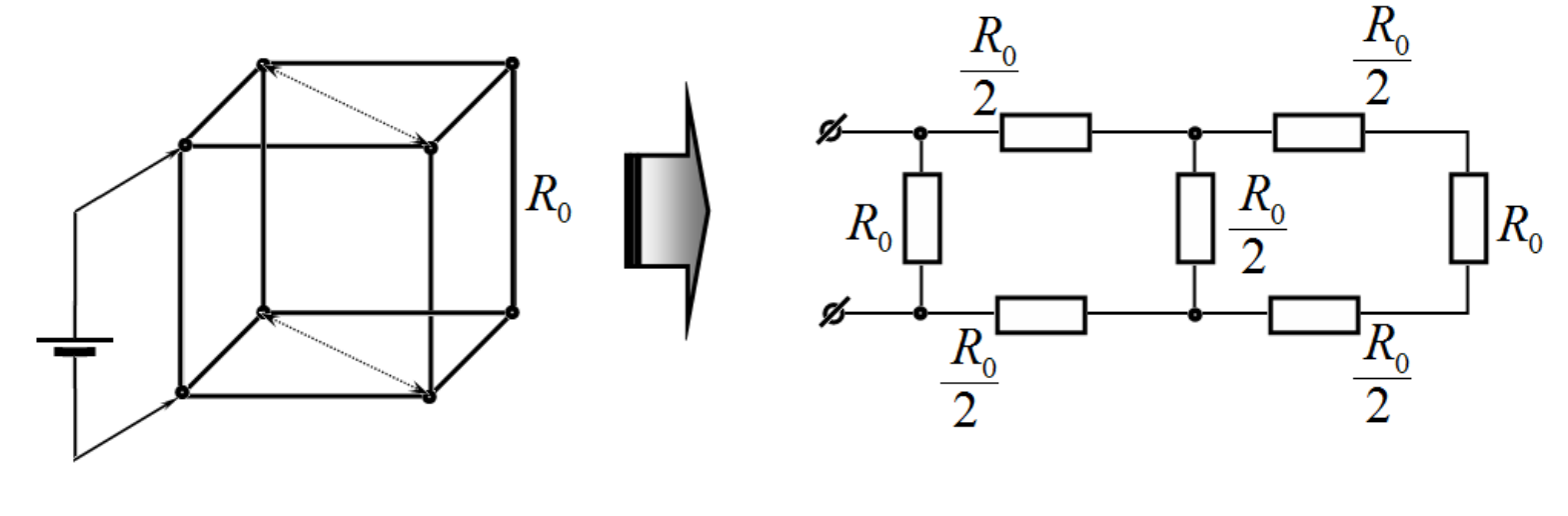
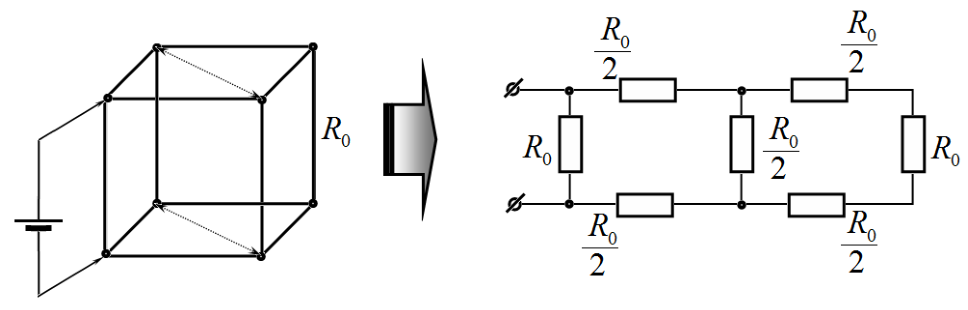
Problems are widely known in which you are asked to find the electrical resistance of a simple wire frame. An example of such a frame shaped in the form of a cube is shown below. Let the electric resistance of each edge be equal to .
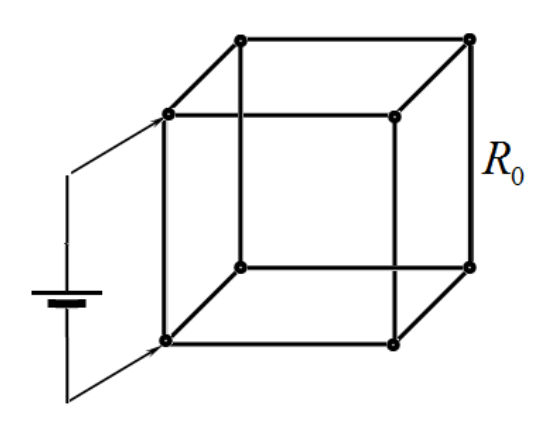
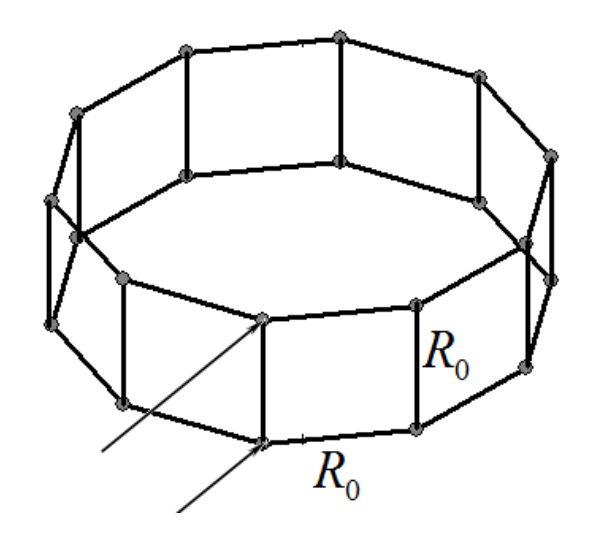
2.1 Find the total resistance of the cube when the source is connected to the two adjacent cube vertices as shown on the right. [0,8 т.]
Let us now consider a more general case of the wire frame in the form of the regular prism with an arbitrary number of side faces and determine its electrical resistance when the source is connected to the adjacent vertices of the side edge, as shown in the figure below. The resistance of each frame edge is equal to .
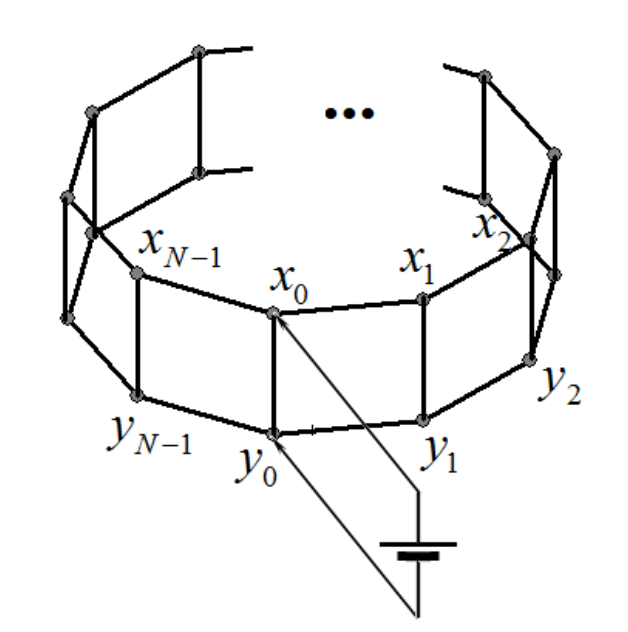
For convenience, the vertices of the prism and their electric potentials on the upper and the bottom sides are consequently numbered and denoted, as shown in the figure below. DC voltage source is applied to zeroth vertices such that the source sets the potentials of the vertices equal to and , respectively.
2.2 Find the relation between the potentials and . Find the relation between the potentials and [0,2 т.]
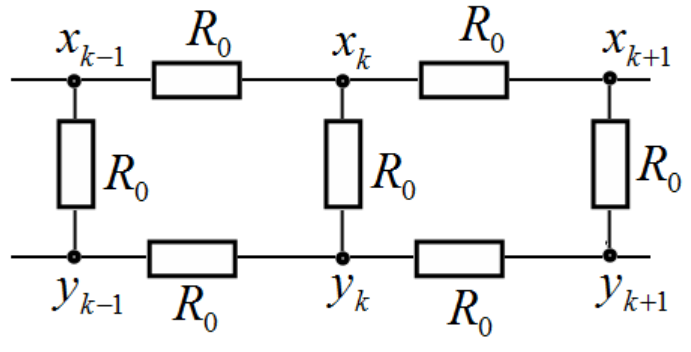
Consider an arbitrary lateral edge, except zeroth () and the last () ones. The corresponding circuit diagram is shown below.
2.3 Find an recurrence relation for the potential as expressed in terms of the neighboring vertices potentials for . [1 т.]
2.4 Find boundary conditions at and necessary for unambiguous determination of the potential . [0,2 т.]
2.5 Find explicit expressions for the potentials and for all possible numbers . [0,2 т.]
2.6 Express the source current in terms of . Use the appropriate numbers .obtained in the Mathematical introduction to this problem. [0,4 т.]
2.7 Derive an explicit formula for the resistance of the wire frame, expressed in terms of . [0,2 т.]
2.8 Find and tabulate the exact values of the frame resistances for . [1 т.]
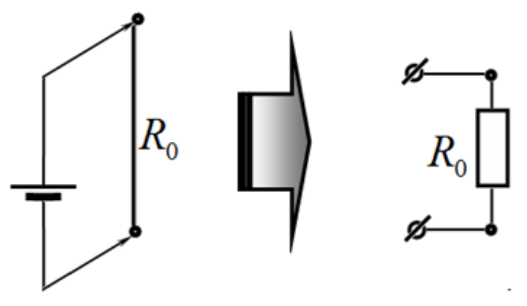
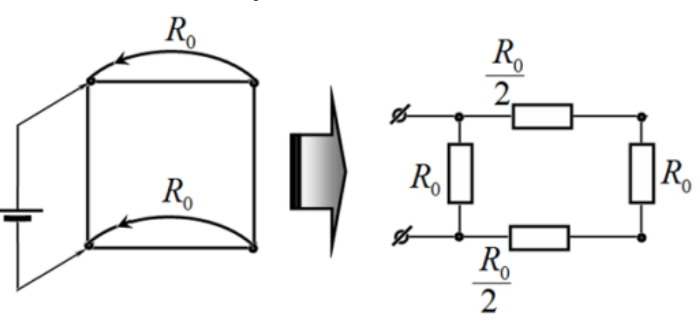
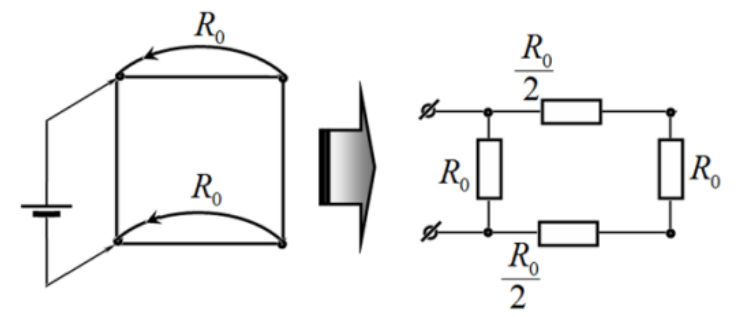
2.9 Draw the equivalent circuits for the exotic prisms with and . [0,5 т.]
2.10 Find the resistance of the wire frame at . [1 т.]
2.11 Find the minimum value of at which the prism resistance deviation from does not exceed 2%. [1,5 т.]
Отговори
1. Mathematical introduction, 1.1
1. Mathematical introduction, 1.2
1. Mathematical introduction, 1.3 p: 2, 7, 26, 97, 362; q: 1, 4, 15, 56, 209 (k = 1…5; p0 = 1, q0 = 0)
1. Mathematical introduction, 1.4
1. Mathematical introduction, 1.5
1. Mathematical introduction, 1.6
2. Wire frame in the shape of a prism, 2.1
2. Wire frame in the shape of a prism, 2.2
2. Wire frame in the shape of a prism, 2.3
2. Wire frame in the shape of a prism, 2.4
2. Wire frame in the shape of a prism, 2.5
2. Wire frame in the shape of a prism, 2.6
2. Wire frame in the shape of a prism, 2.7
2. Wire frame in the shape of a prism, 2.8 R1 = R0, R2 = 2/3 R0, R3 = 3/4 R0, R4 = 7/12 R0, R5 = 11/19 R0
2. Wire frame in the shape of a prism, 2.10
2. Wire frame in the shape of a prism, 2.11 4
The solution states that already at the relative error is 1% ().
Решение
1. Mathematical introduction (3 т.)
1.1 [0.2 points] From the course of school mathematics it is known that geometrical progression terms are explicitly expressed as
1.2 [0.4 points] Let us express recurrently in terms of :
and transform it as follows
This equality implies the required recurrence relations in the form
Inverse relations are obtained analogously
and, thus,
1.3 [0.7 points] Calculation of the coefficients is much easier to carry out in series, given that . The results are shown in Table 1.
Table 1.
| 0 | 1 | 0 |
| 1 | 2 | 1 |
| 2 | 7 | 4 |
| 3 | 26 | 15 |
| 4 | 97 | 56 |
| 5 | 362 | 209 |
1.4 [0.2 points] Note that
therefore,
1.5 [1.0 points] Using the hint, we substitute into the recurrence relation and obtain the equation to determine in the form
After reduction the following quadratic equation is derived
which has two solutions
Consequently, the general solution to the recurrence relation (3) is explicitly written by
where are arbitrary constants that are determined by the boundary conditions:
Solving the linear set of equation yields
Substituting this solution into (11), it is possible to rewrite it in the following symmetrical form
The derivation of the last relation takes into account that according to the Vieta theorem .
1.6 [0.5 points] In view of the above formulas for the , we find that
and, finally,
2. Wire frame in the shape of a prism (7 т.)
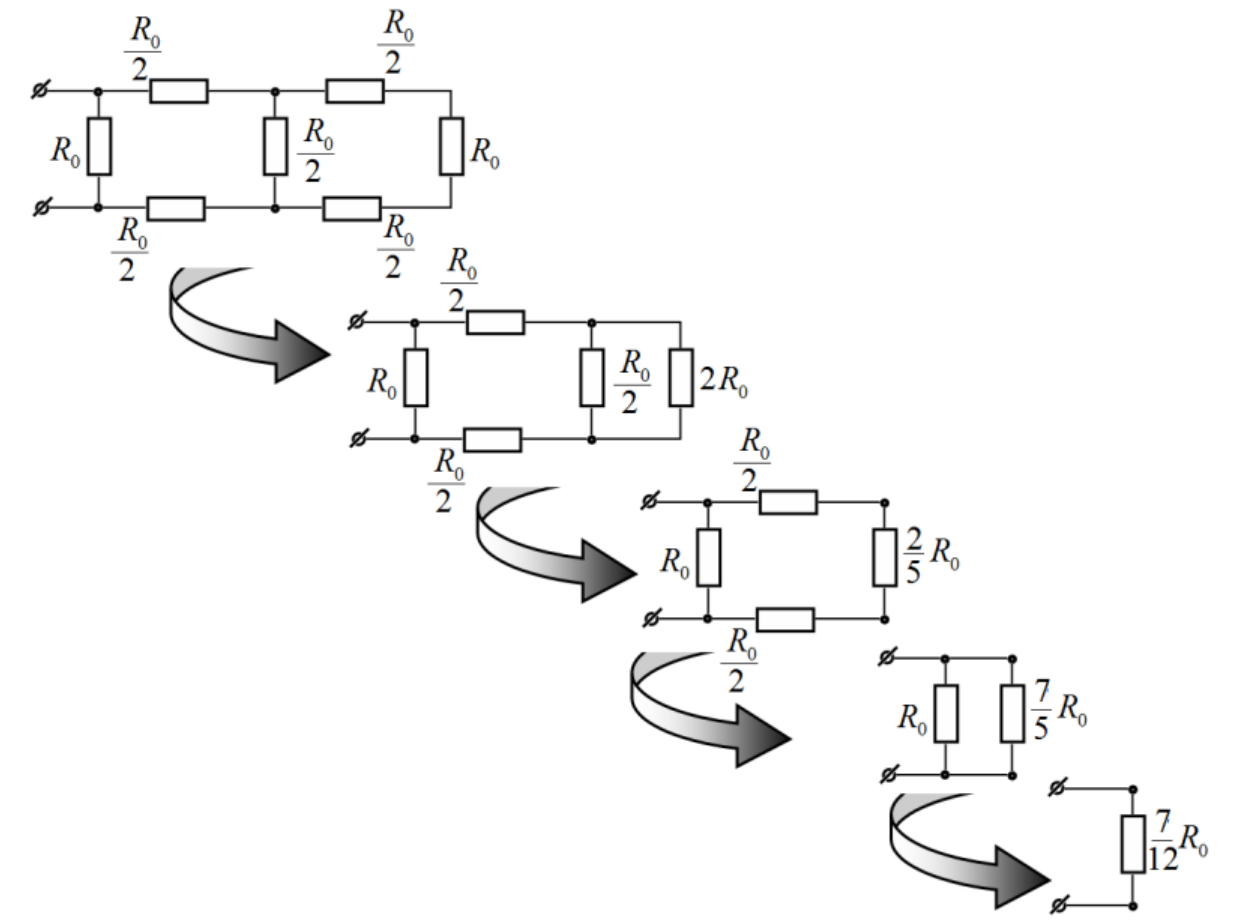
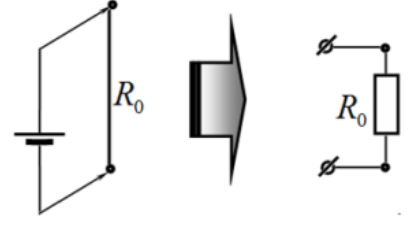
2.1 [0.8 points] If the vertices of the cube with the same potentials are connected, then, the following equivalent circuits are obtained
and easily calculated using the standard method as
Ultimately, the cube resistance for the given connection is found as
2.2 [0.2 points] Visual symmetry of the circuit and of the initial conditions provides obvious relations
2.3 [1.0 points] The algebraic sum of the currents entering a node is equal to zero, thus, using Ohm's law, the following equation is obtained for the node
Since , the recurrence relation holds
2.4 [0.2 points] For an unambiguous determination of all values , we need to explicitly specify two boundary conditions. One of those is the initial potential defined as
whereas the other follows from the symmetry condition (19), which is valid for any , and, in particular, for (despite the fact that the node with the number does not exist in the circuit!)
2.5 [0.2 points] The recurrence relation (21) has been considered in the Mathematical introduction. Therefore, you can use the obtained solution (16) by setting:
2.6 [0.4 points] The current in the source circuit is found as the sum of the currents flowing from the node :
Here it has been taken into account that . Substituting the values for , results in
At the last step the relation (5) has been used, .
2.7 [0.2 points] By formulation, the input voltage for the given circuit is
consequently, the resistance is found in the following elegant form
2.8 [1.0 points] Calculations are easily performed using numerical values in Table 1.
Table 2. Resistances of prisms.
| 1 | 2 | 1 | |
| 2 | 7 | 4 | |
| 3 | 26 | 15 | |
| 4 | 97 | 56 | |
| 5 | 362 | 209 |
Note that for a cubic prism with the resistance coincides with that previously found in 2.1.
2.9 [0.5 points] For the circuit is obvious:
but for the prism should be additionally closed as:
In both cases the corresponding resistances coincide with the values shown in Table 2.
2.10 [1.0 points] The limit of the formula (28) can be found in various ways, for example, expressing
where .
Then,
2.11 [1.5 points] Evaluation gives rise to
Then, we carry out the calculation of the relative error of the approximate expression for different values of listed in Table 2.
Table 3.
| 1 | 1.000 | -0.423 | |
| 2 | 0.667 | -0.134 | |
| 3 | 0.750 | -0.038 | |
| 4 | 0.583 | -0.010 | |
| 5 | 0.579 | -0.004 |
It is seen that already at the relative error is 1%. Consequently, in this problem four is equal to infinity!
| Content | points | ||
|---|---|---|---|
| 1.1 | Formula (1) | 0.2 | 0.2 |
| 1.2 | Formula (3) | 0.2 | 0.4 |
| Formulas (5) | 0.2 | ||
| 1.3 | Correct initial values | 0.2 | 0.7 |
| Correct values in Table 1. | 0.5 | ||
| 1.4 | Formula (7) | 0.2 | 0.2 |
| 1.5 | Formula (10) | 0.2 | 1.0 |
| Formula (11) | 0.2 | ||
| Formula (12) | 0.2 | ||
| Solution (13) | 0.2 | ||
| Formula (14) | 0.2 | ||
| 1.6 | Formula (16) | 0.5 | 0.5 |
| 2.1 | Equivalent circuit | 0.3 | 0.8 |
| Formula (17) | 0.5 | ||
| 2.2 | Formula (18) | 0.1 | 0.2 |
| Formula (19) | 0.1 | ||
| 2.3 | Formula (20) | 0.5 | 1.0 |
| Formula (21) | 0.5 | ||
| 2.4 | Formula (22) | 0.1 | 0.2 |
| Formula (23) | 0.1 | ||
| 2.5 | Formula (24) | 0.2 | 0.2 |
| 2.6 | Formula (25) | 0.2 | 0.4 |
| Formula (26) | 0.2 | ||
| 2.7 | Formula (27) | 0.1 | 0.2 |
| Formula (28) | 0.1 | ||
| 2.8 | Correct values in Table 2. | 1.0 | 1.0 |
| 2.9 | Equivalent circuit for | 0.1 | 0.5 |
| Equivalent circuit for | 0.4 | ||
| 2.10 | Formula (29) | 0.5 | 1.0 |
| Formula (30) | 0.5 | ||
| 2.11 | Formula (31) | 0.2 | 1.5 |
| Correct values in Table 3. | 1.0 | ||
| Formula (32) | 0.3 | ||
| Total | 10.0 |
Оригинал в Архива: IZhO-2017-Theory_eng.pdf · официални решения: IZhO-2017-Theory_eng_sol.pdf