IZhO 2017, Теория — Задача 2. Problem 2. Fantastic trip through the Universe
XIII International Zhautykov Olympiad/Theoretical Competition · 10 т.
Внимание: Бележка към темата
Problem 1C refers to a separate answer sheet with the points S1, S2, A1, A2 and a highlighted oval area; that sheet is not in the archive. The grid drawing in the official solution shows its layout.
THEORETICAL COMPETITION. January 14, 2017. Please read this first:
The time available for the theoretical competition is 4 hours. There are three questions.
Use only the pen provided.
You can use your own calculator for numerical calculations. If you don’t have one, please ask for it from Olympiad organizers.
You are provided with Writing sheet and additional paper. You can use the additional paper for drafts of your solutions but these papers will not be checked. Your final solutions which will be evaluated should be on the Writing sheets. Please use as little text as possible. You should mostly use equations, numbers, figures and plots.
Use only the front side of Writing sheets. Write only inside the boxed area.
Begin each question on a separate sheet of paper.
Fill the boxes at the top of each sheet of paper with your country (Country), your student code (Student Code), the question number (Question Number), the progressive number of each sheet (Page Number), and the total number of Writing sheets used (Total Number of Pages). If you use some blank Writing sheets for notes that you do not wish to be evaluated, put a large X across the entire sheet and do not include it in your numbering.
At the end of the exam, arrange all sheets for each problem in the following order:
- Used Writing sheets in order;
- The sheets you do not wish to be evaluated
- Unused sheets and the printed question.
Place the papers inside the envelope and leave everything on your desk. You are not allowed to take any paper out of the room.
SOLUTIONS TO THE PROBLEMS OF THE THEORETICAL COMPETITION
Attention. Points in grading are not divided!
Условие
A reconnaissance spacecraft of the well developed civilization plows the universe. In this problem, you are asked to consider a few situations of that interstellar travel from the physical point of view. For all numerical calculations consider the gravitational constant known and equal to .
1. Planets with strange shapes (3,9 т.)
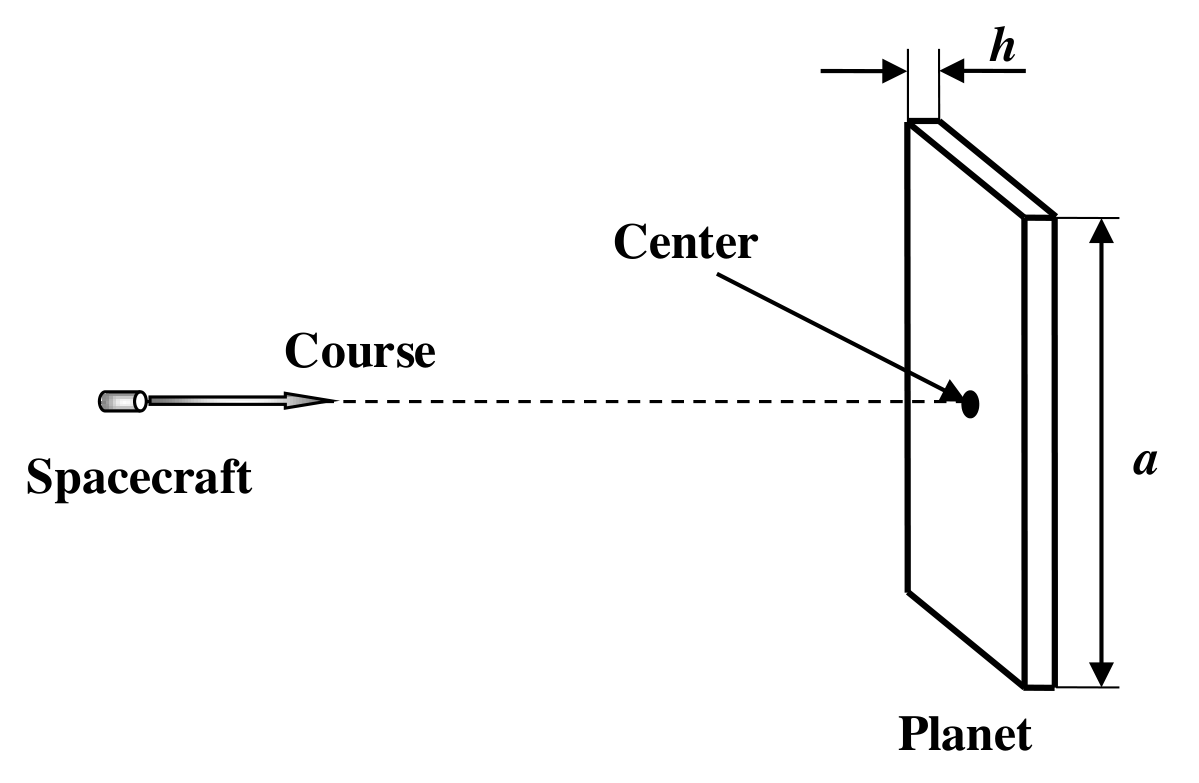
At some distance from the spacecraft the crew captain discovers the first planet that has a strange shape of a parallelepiped with a square base of side and a very small thickness . The captain gives the order to pursue a course to planet's center as shown in the figure below.
It has been revealed after turning off the engine that the spacecraft acceleration of the free fall , that the planet provides at distances much greater , remains proportional to the solid angle , at which the planet is seen from the spacecraft, that is:
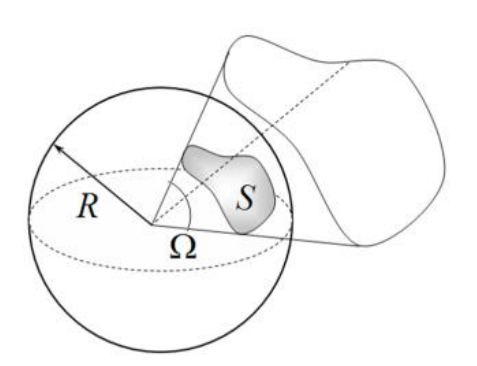
The solid angle is a part of the space, which unites all the rays emanating from a given point (the vertex) and intersecting a surface (which is called a surface subtending the solid angle). The boundary of the solid angle is a certain conical surface.
The solid angle is measured by the ratio of the area of the sphere centered at the vertex, which is cut by this solid angle, to the square of the sphere radius:
Solid angles are measured by abstract dimensionless quantities. The unit of the solid angle is a steradian, which, in SI units, is equal to the solid angle cutting out the surface area of from the sphere of radius . The whole sphere corresponds to the solid angle of steradian (full solid angle) from any vertex, situated inside the sphere, in particular, for the center of the sphere.
After landing on the planet surface and taking the soil samples, the scientists reported to the captain that the planet is composed of homogeneous material of the density and the free fall acceleration near the geometric surface center of the planet remains almost constant and is equal to .
1.1 Find and calculate the thickness of the planet . [0,7 т.]
1.2 Find and calculate the coefficient . [0,5 т.]
After leaving the first planet, the captain and his crew meet another exotic planet that shapes a regular pyramid with a square base of the side and of the height .
1.3 Find and calculate the free fall acceleration measured at the top of the uniform pyramidal planet, if its density is equal to . [0,7 т.]
The spacecraft has left the pyramidal planet from its top, starting with the characteristic parabolic velocity . The next planet the spacecraft has met on its way is the one shaped like a perfect uniform cube with the side . After accurate measurements, the captain and his crew have found that the density of the cubic planet is .
1.4 Find and calculate the parabolic velocity for the spacecraft to start from one of the vertices of the cubic planet. [2 т.]
2. Dusty cloud (6,1 т.)
The spacecraft encounters a very large massive dust cloud of radius and of homogeneous density . The speed of the spacecraft at a large distance from the cloud reaches the value of , and the impact parameter measured from the cloud center is equal to . The engine remains switched off.
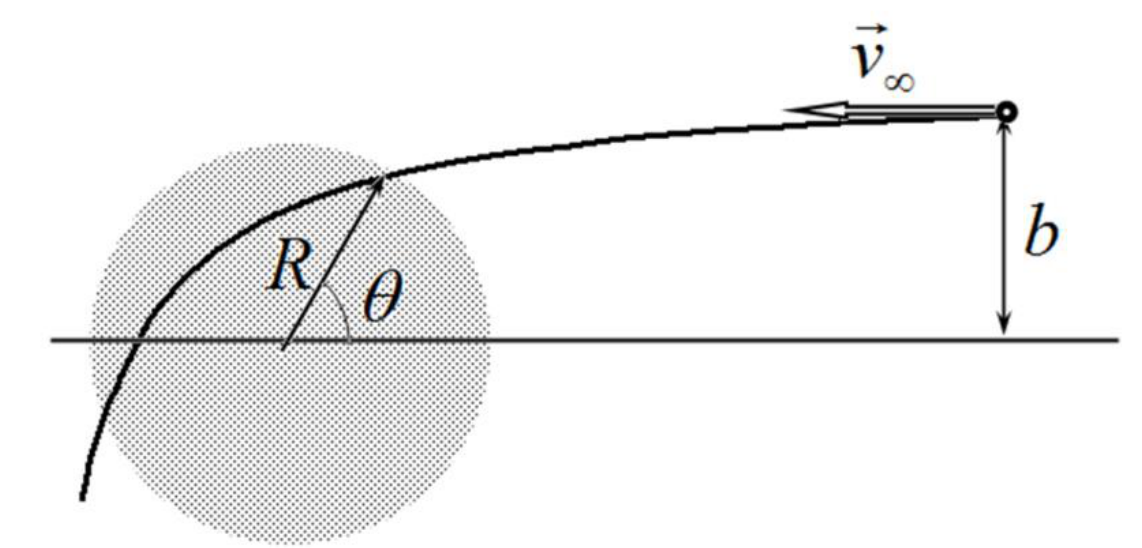
2.1 Find and calculate the coordinate of the spacecraft entry into the dust cloud, characterized by the angle . [2,5 т.]
2.2 Find and calculate the minimum distance , the spacecraft flies by from the cloud center. Resistance to the motion of the spacecraft caused by the cloud particles can be neglected. [2 т.]
Making sure that it is impossible to avoid a collision with the cloud, the captain of the spacecraft takes the decision to turn on the engine, thereby increasing the speed .
2.3 Find and calculate the minimum speed , at which the spacecraft passes safely by the dust cloud. [1 т.]
Successfully passing the obstacle, the captain and his crew have discovered that the particles of the dust clouds contain valuable elements.
2.4 Find the minimum work , which must be performed in order to gradually bring all the dust particles onto a very remote processing plant. [0,6 т.]
Отговори
1. Planets with strange shapes, 1.1 78 km
1. Planets with strange shapes, 1.2 0.0156 m/s²
or
1. Planets with strange shapes, 1.3 3.14 m/s²
1. Planets with strange shapes, 1.4 6.3 km/s
2. Dusty cloud, 2.1 0.789 rad
2. Dusty cloud, 2.2 m
2. Dusty cloud, 2.3 252 km/s
2. Dusty cloud, 2.4 J
Решение
1. Planets with strange shapes (4 т.)
1.1 [0.7 points] The easiest approach to the solution of the problem is the analogy between Coulomb force and Newton's law of gravitation:
Further, it is a well known result from the Gauss theorem that the electric field strength of an infinite charged plane, with the surface density is found as
By analogy to the charged plane, the result for the planet is similarly obtained as:
***
The same result is easily achieved by cutting an infinite plane into thin rings and further integrating:
The attracting force of the ring of mass , and of radius at the distance is written as:
We divide the plane of the height into thin rings of thickness . Then the force of gravity caused by the ring of the radius is equal to
It follows from the trigonometric considerations that , .
Substituting the above expression and integrating we find the total force acting on the body of mass :
This is identical to the answer obtained from the analogy with the electrostatic field.
1.2 [0.5 points] For an observer that is located close to the infinite plane, the solid angle is obviously equal to
and from the problem formulation we get
1.3 [0.7 points] We divide the pyramid into thin layers of thickness parallel to the base. All of these layers are visible from the top of the pyramid with the same solid angle , which is equal to one sixth of the full solid angle (as if the observer was located inside the cube at its center!):
The free fall acceleration of the single layer is found as
or after the summation over all the layers of the pyramid
1.4 [2.0 points] Let the interaction energy between the spacecraft and the pyramidal planet at the time of take-off from its top be equal to , and its speed be . It follows from the law of the energy conservation for the parabolic velocity that:
Similarly, the law of the energy conservation for a spacecraft to start from the cubic planet is written as
where stands for the corresponding interaction energy with the cubic planet.
Let us show that there is a simple relationship between and . To prove so, we consider the position of the spacecraft at the center of the cubic planet. On the one hand the position at the center of the cube is equivalent to finding the spacecraft at the tops of the six pyramids. Taking into account the change in the density of matter, the potential energy of the spacecraft at the center of the cube is obtained as
On the other hand the position of the spacecraft at the center of the cube is equivalent to being at the tops of the eight identical adjacent cubes with the side . In general, the potential energy of the spacecraft in the field of the cubic planet is proportional to the square of its size since
Thus, for the cube of the half size, the interaction energy is 4 times less, which means that the potential energy of the spacecraft at the center of the cube is found as
Equating the expressions (12) and (14) yield
Solving together equations (10), (11) and (15), we finally obtain
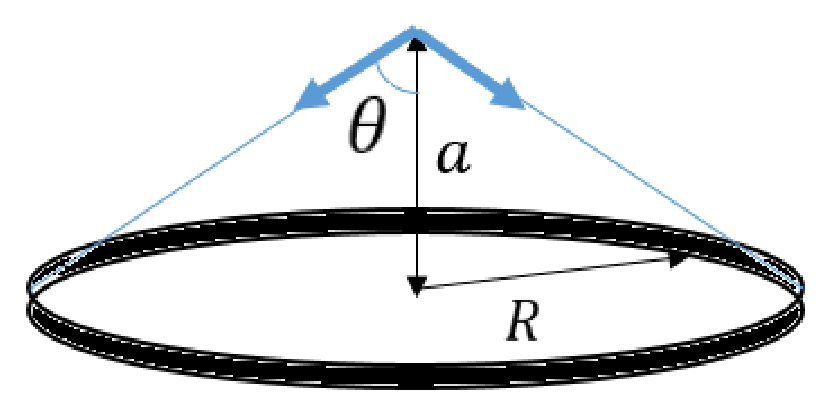
2. Dusty cloud (6 т.)
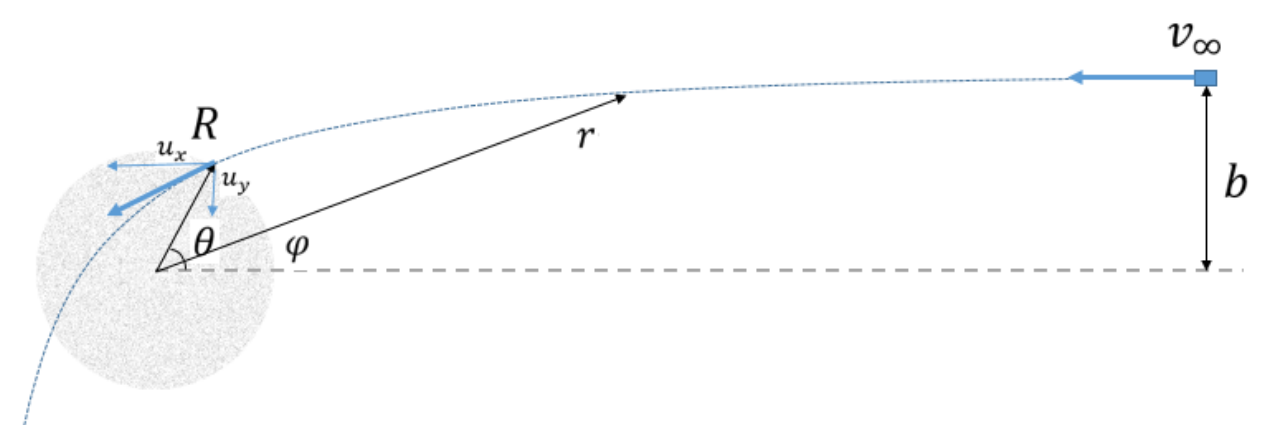
2.1 [2.5 points] For this problem, we use a mixture of the polar and Cartesian coordinate systems as shown below.
The conservation of energy is written as:
where denotes the total mass of the cloud.
Change in the spacecraft momentum projection on the x-axis of the Cartesian coordinate system is given by
The law of the angular momentum conservation for a system with the central force is written as
Thus,
Similarly for the -axis projection:
To simplify further analysis the following dimensionless quantity is introduced
and then
Substitution of (23) and (24) into (17) gives rise to
Solving this equation for , we find
or
It should be noted that the angle θ, just as the total angle of deflection of the trajectory when moving through the dust cloud, can be obtained by integrating the equation obtained from the combination of the laws of conservation of energy and angular momentum written in the polar coordinates. Expressions are not presented here because the resulting integrals are quite cumbersome.
2.2 [2.0 points] To begin with we find the dependence of the potential energy of interaction between the cloud and the spacecraft at distances from its center. It is known that a spherical cloud layers, lying at a distance greater than r, does not affect the spacecraft, so the total active force is derived as
and the corresponding potential energy is found in the form
To determine the integration constant , we recall that the potential energy must be a continuous at the point , such that
or finally for
At the time moment when the distance to the cloud center reaches its minimum value, the radial velocity turns zero. Then, from the laws of conservation of energy and angular momentum we have
which results in the following equation
with the solution
The meaningful root is only the smallest one because there must be at . Thus, we finally obtain
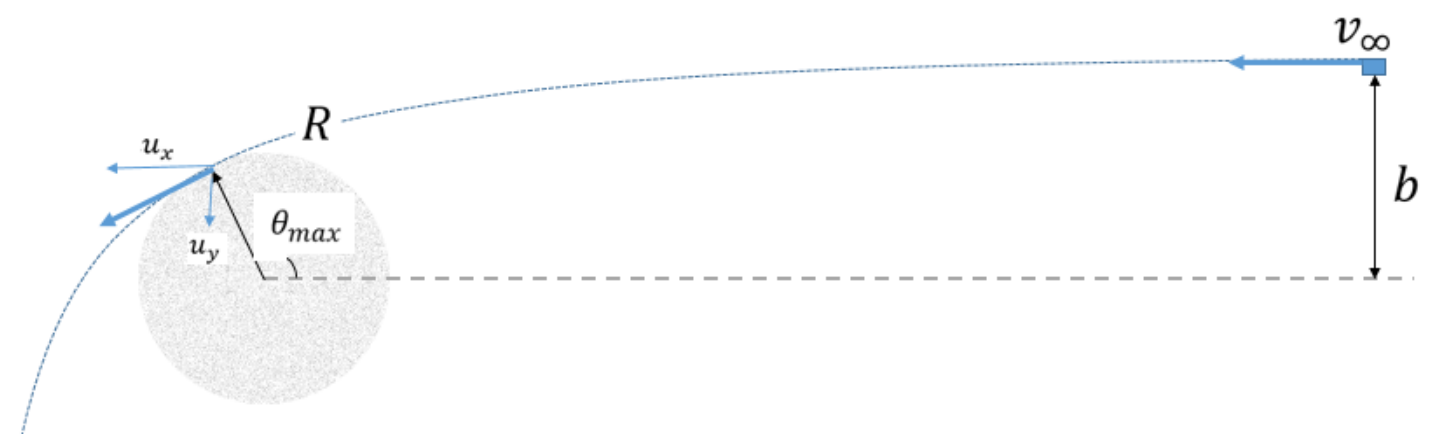
2.3 [1.0 points] Minimum velocity , that allows the spacecraft to avoid a collision, corresponds to a situation when the spacecraft just touches the cloud as shown below.
In this case, the radial component of the velocity again turns zero, and the laws of conservation of energy and angular momentum can be written as:
which yields
2.4 [0.6 points] Assume that the cloud is pulled apart at distances by small layers of thickness so that the cloud always remains symmetrical. To remove a single thin layer at the moment when the cloud has a radius , it is necessary to do the work
and to pull apart the whole cloud the following work must be done
| Content | points | ||
|---|---|---|---|
| 1.1 | The analogy between the Coulom law and the gravitation law of Newton (1): and . | 0.2 | 0.7 |
| Formula (2) | 0.2 | ||
| Formula (4) | 0.2 | ||
| Numerical value of | 0.1 | ||
| 1.2 | Formula (5) | 0.2 | 0.5 |
| Formula (6) or | 0.2 | ||
| Numerical value of | 0.1 | ||
| 1.3 | Formula (7) | 0.2 | 0.7 |
| Formula (8) | 0.2 | ||
| Formula (9) | 0.2 | ||
| Numerical value of | 0.1 | ||
| 1.4 | Formulas /(10) and (11) | 0.2 | 2.0 |
| Formula (12) | 0.4 | ||
| Formula (13) | 0.4 | ||
| Formula (14) | 0.2 | ||
| Formula (15) | 0.4 | ||
| Formula (16) | 0.3 | ||
| Numerical value of | 0.1 | ||
| 2.1 | Formula (17) | 0.2 | 2.5 |
| Formula (18) | 0.4 | ||
| Formula (19) | 0.2 | ||
| Formula (20) | 0.4 | ||
| Formula (21) | 0.4 | ||
| Formula (23) or analogous | 0.3 | ||
| Formula (24) or analogous | 0.3 | ||
| Formula (26) or formula (27) or | 0.2 | ||
| Numerical value of | 0.1 | ||
| 2.2 | Formula (28) | 0.4 | 2.0 |
| Formula (29) | 0.3 | ||
| Formula (30) | 0.4 | ||
| Formula (32) , | 0.2 | ||
| Formula (33) | 0.2 | ||
| Formula (35) | 0.2 | ||
| Correct root is chosen, formula (36) | 0.2 | ||
| Numerical value of | 0.1 | ||
| 2.3 | Formula (37) | 0.4 | 1.0 |
| Formula (38) | 0.3 | ||
| Formula (39) | 0.2 | ||
| Numerical value of | 0.1 | ||
| 2.4 | Formula (40) | 0.3 | 0.6 |
| Formula (41) | 0.2 | ||
| Numerical value of | 0.1 | ||
| Total | 10.0 |
Оригинал в Архива: IZhO-2017-Theory_eng.pdf · официални решения: IZhO-2017-Theory_eng_sol.pdf