IZhO 2018, Теория — Задача 1
XIV International Zhautykov Olympiad/Theoretical Competition · 12 януари 2018 г. · 10 т.
Please read this first:
THEORETICAL COMPETITION
January 12, 2018
The time available for the theoretical competition is 4 hours. There are three questions.
Use only the pen provided.
You can use your own calculator for numerical calculations. If you don’t have one, please ask for it from Olympiad organizers.
You are provided with Writing sheet and additional paper. You can use the additional paper for drafts of your solutions but these papers will not be checked. Your final solutions which will be evaluated should be on the Writing sheets. Please use as little text as possible. You should mostly use equations, numbers, figures and plots.
Use only the front side of Writing sheets**.** Write only inside the boxed area.
Begin each question on a separate sheet of paper.
Fill the boxes at the top of each sheet of paper with your country (Country), your student code (Student Code), the question number (Question Number), the progressive number of each sheet (Page Number), and the total number of Writing sheets used (Total Number of Pages). If you use some blank Writing sheets for notes that you do not wish to be evaluated, put a large X across the entire sheet and do not include it in your numbering.
At the end of the exam, arrange all sheets for each problem in the following order:
- Used Writing sheets in order;
- The sheets you do not wish to be evaluated
- Unused sheets and the printed question.
Place the papers inside the envelope and leave everything on your desk. You are not allowed to take any paper out of the room.
SOLUTIONS TO THE PROBLEMS OF THE THEORETICAL COMPETITION
Attention. Points in grading are not divided!
Условие
This problem consists of three independent parts.
Problem 1A (3.0 points)
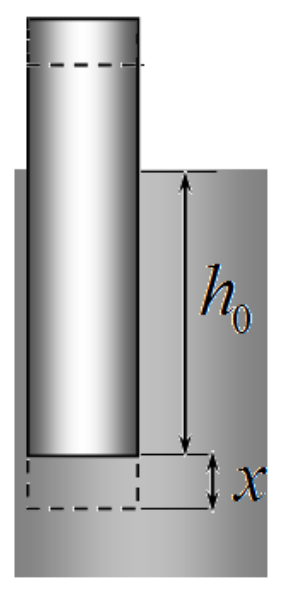
A1 A narrow cylindrical test-tube with a displaced center of mass floats vertically in water in a very wide vessel. In equilibrium state, the test-tube is immersed into water to a depth . The cross-sectional area of the tube is . Determine the period of small vertical oscillations of the test-tube.
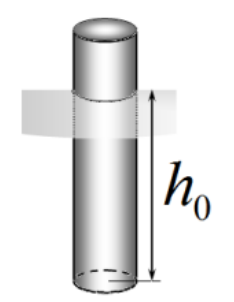
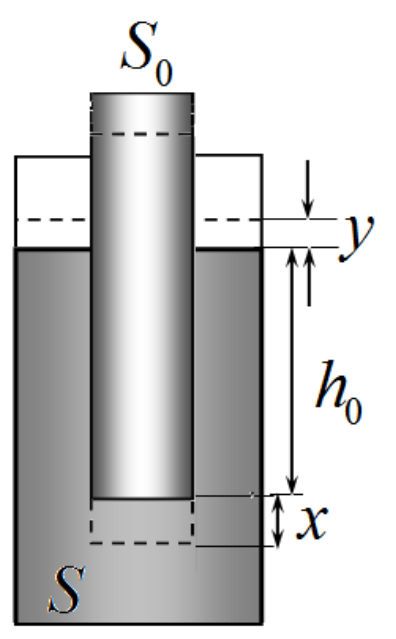
A2 The same test-tube is placed in a narrow cylindrical vessel with a cross-sectional area filled with water. The test-tube makes small oscillations along the axis of the vessel.
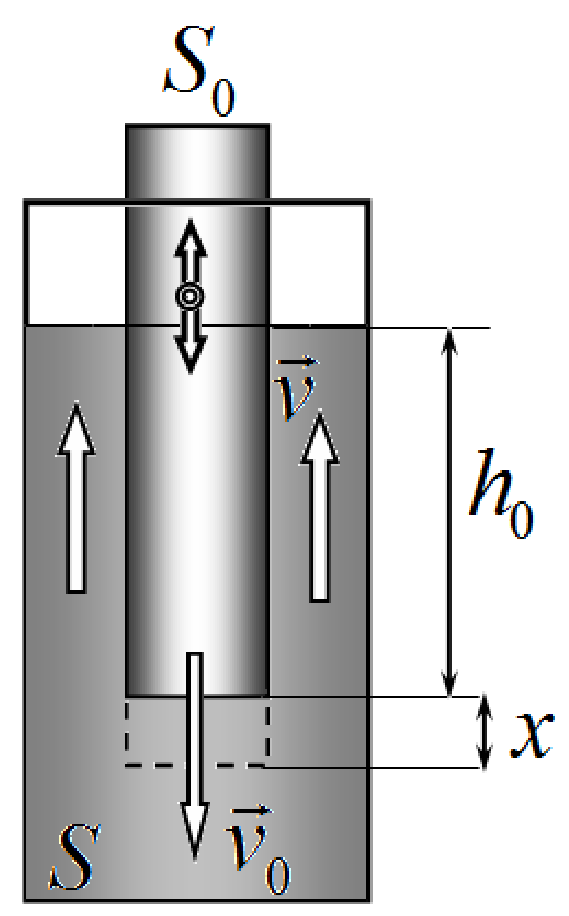
A2.1 The test-tube sinks by some small value . Express the change in the potential energy of the system through , the initial depth of immersion , cross-sectional areas , , the water density and the acceleration of gravity .
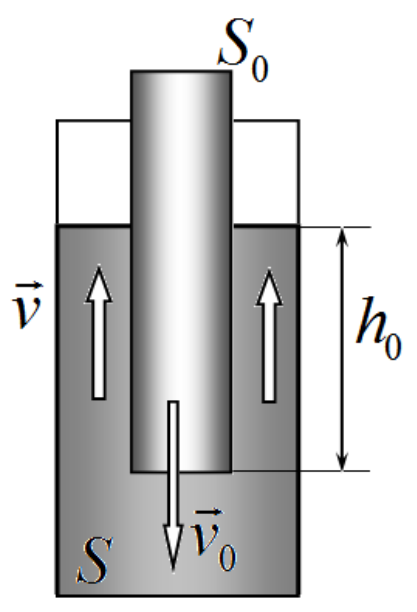
A2.2 Let the speed of the test-tube be near its equilibrium position. Express the kinetic energy of the system through the speed of the test tube , the depth of immersion , the cross-sectional areas , , and the water density . Consider that in the gap between the test-tube and the walls of the vessel all liquid moves with the same speed .
A2.3 Find the period of small oscillations of the test-tube in the narrow vessel.
Problem 1B (4.0 points)
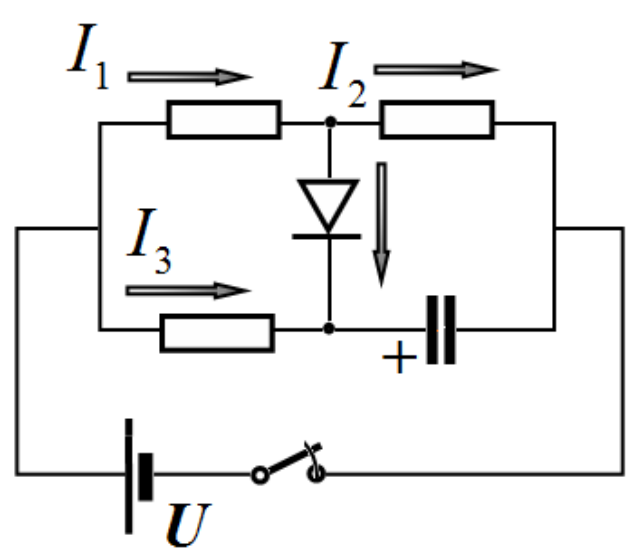
The circuit, shown in the figure on the left, consists of a capacitor with the capacitance , an ideal diode, a constant voltage source , three identical resistors with the resistance and a switch. At the initial moment, the capacitor is not charged and the switch is open. When the switch is shorted, the current through the diode goes for the time interval , and then stops.
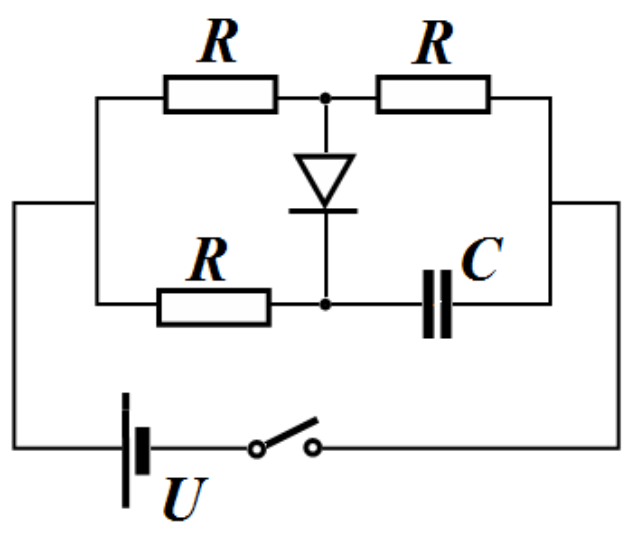
1. Find the current through the diode immediately after shorting the switch.
2. Find the total charge that has flowed through the diode.
Problem 1C (3.0 points)
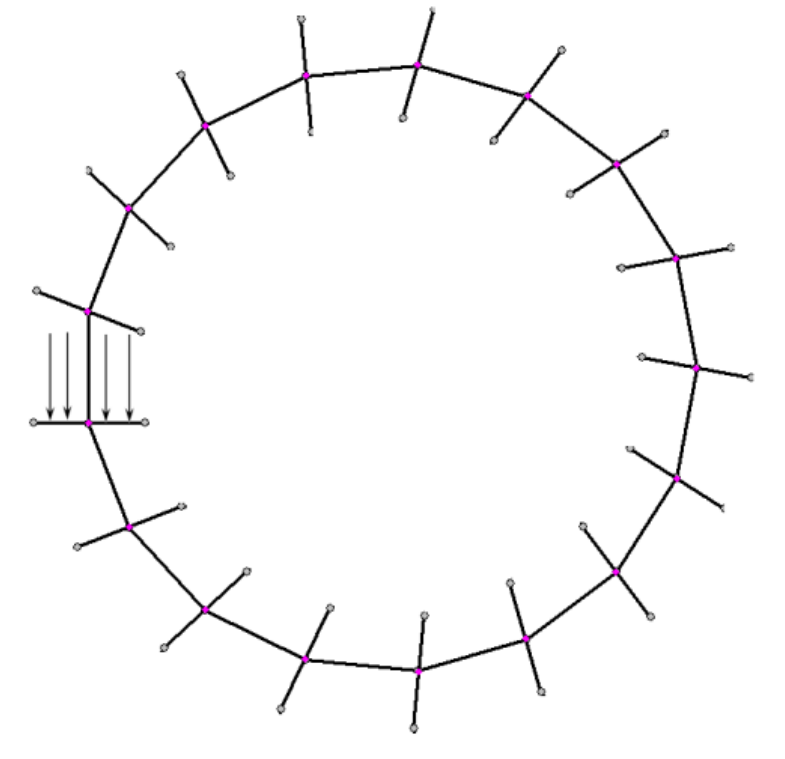
1C At the vertices of the regular 17-gon, there are 17 identical lenses. The optical centers of the lenses are located exactly at the vertices of the polygon, the planes of all lenses are perpendicular to one of the sides adjacent to the lens. The focal lengths of the lenses are all equal to and coincide with the length of the side of the 17-gon. One of the lenses is illuminated by a parallel light flux directed along its optical axis. It turns out that one of the rays has a closed trajectory. Determine the radius of the circle inscribed in this trajectory. Consider two cases: all of the lenses are collecting; all of the lenses are diverging. Consider all angles small such that . [3 т.]
Отговори
A1
A2.1
A2.2
A2.3
1. 1 mA
2. ≈ μC
The official solution prints the unit as “μCl”.
1C Collecting lenses: R = F(1 + α²)/α = 30,8 sm; diverging lenses: R = F(1 − α²)/α = 23,4 sm, with α = 2π/17.
The source writes the unit centimetre as “sm” (and “см” once in the solution).
Решение
Problem A (3.0 points)
A1. When the test-tube is immersed to the depth , it experiences the Archimedes' force and the force of gravity. Therefore, the equation of Newton's second law for the test-tube has the form
Here is the mass of the test-tube and stands for the water density.
In the equilibrium position, the following condition holds
It is thus immediately obtained that
This is the equation of harmonic oscillations with the period
A2.1 When the test-tube is lowered to the depth , its potential energy is reduced by an amount
If the test-tube is lowered to the depth , the water level in the vessel rises to a height that satisfies the condition (the condition of constancy of the water volume)
Consequently, the water that was under the test tube rises above the original water level in the vessel. The mass of this water is found as
Its center of mass rises to a height
The change in the potential energy of water is derived as
The total change in the potential energy (with relation (2)) is finally obtained as:
A2.2 If the tube drops with the velocity , then the water between the walls and the test-tube rises at the speed of
The mass of rising water reads as
The total kinetic energy of the test-tube and the rising water is equal to
A2.3 The equation of the law of conservation of energy for the system under consideration is written as
This equation is also an equation of harmonic oscillations with the same period
| Part | Content | Points | |
|---|---|---|---|
| A1 | Formula (1) | 0,2 | 0,8 |
| Formula (2) | 0,2 | ||
| Formula (3) | 0,2 | ||
| Formula (4) | 0,2 | ||
| A2.1 | Formula (5) | 0,2 | 1,2 |
| Formula (6) | 0,2 | ||
| Formula (7) | 0,2 | ||
| Formula (8) | 0,2 | ||
| Formula (9) | 0,2 | ||
| Formula (10) | 0,2 | ||
| A2.2 | Formula (11) | 0,2 | 0,6 |
| Formula (12) | 0,2 | ||
| Formula (13) | 0,2 | ||
| A2.3 | Formula (14) | 0,2 | 0,4 |
| Formula (15) | 0,2 | ||
| Total | 3,0 |
Problem B (4.0 points)
Let be the current through the resistor number k (see Fig.), be the charge that has flowed through it up to the moment of closing the diode, be the charge that has flowed through the diode, and be the charge of the capacitor.
Immediately after shortening the switch, the voltage across the capacitor is zero, the is true for the second resistor. Thus, and the answer to the first question is simply found as
В момент, когда ток через диод станет нулевым, токи через первый и второй резисторы будут одинаковы, поэтому будут одинаковы и напряжения на них: . Такое же напряжение будет на конденсаторе и его заряд в этот момент: At the moment when the current through the diode becomes zero, the currents through the first and second resistors are equal, therefore, the voltages across them are also equal: . The same voltage is across on the capacitor and its charge at this moment:
Kirchhoff's rules give:
Integrating the last equation in time from 0 to , we obtain:
Solving the obtained set of equations, we obtain the final answer as
| Content | Points |
|---|---|
| Formula (1) | 0.5 |
| Numerical value | 0.1 |
| Formula (2) | 0.5 |
| Formula (3) | 0.5 |
| Formula (4) | 0.5 |
| Formula (5) | 0.5 |
| Formula (6) | 0.2 |
| Formula (7) | 0.5 |
| Formula (8) | 0.5 |
| Numerical value | 0.2 |
| Total | 4.0 |
Problem C (3.0 points)
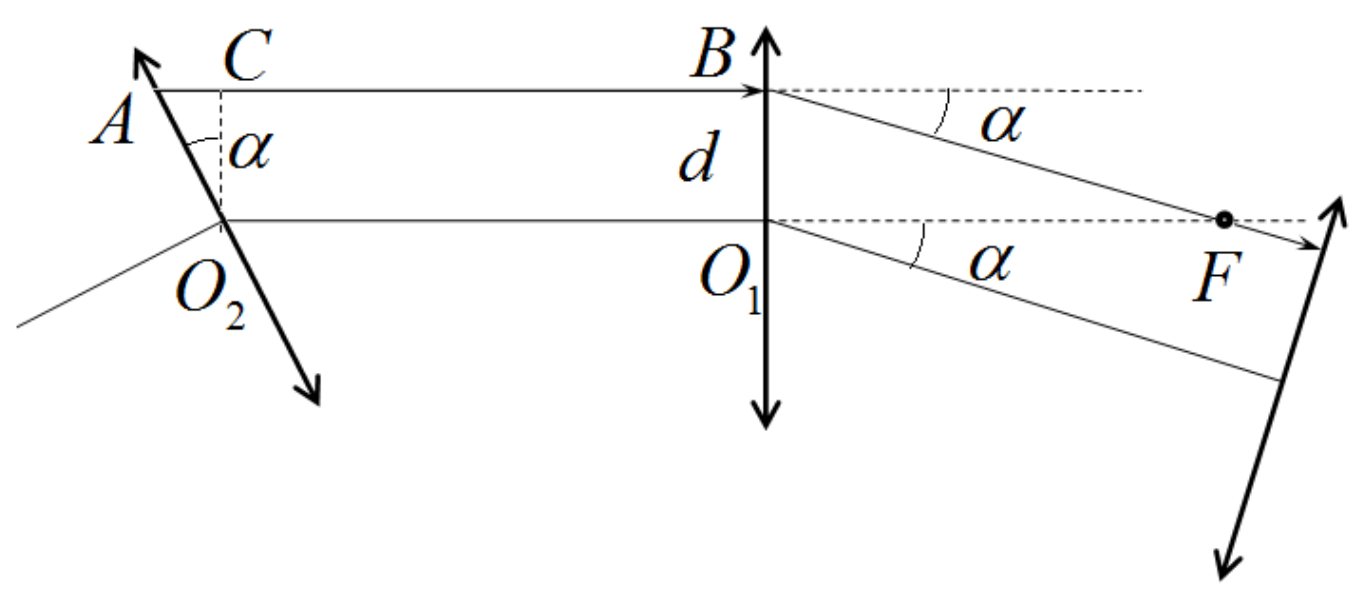
Consider a ray passing parallel to one of the sides of the polygon. To describe a closed trajectory, it is necessary that, after refraction in the lens, the ray should run parallel to the next side. To do this, the ray must be deflected by an angle
Since this ray is parallel to the optical axis, after the refraction it passes through the focus . The required condition is satisfied by the ray moving at a distance
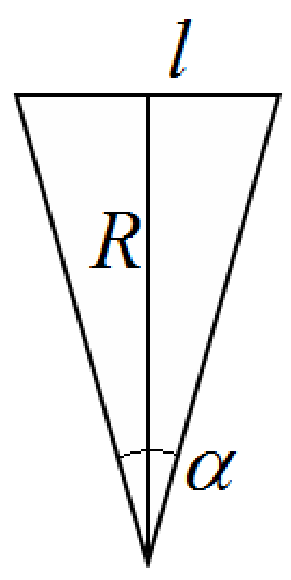
From the optical axes. Obviously, this ray propagates along the sides of the regular 17-gon, whose side length is equal to the length of the segment , or
The radius of the circle, inscribed in this 17-gon, is finally found as
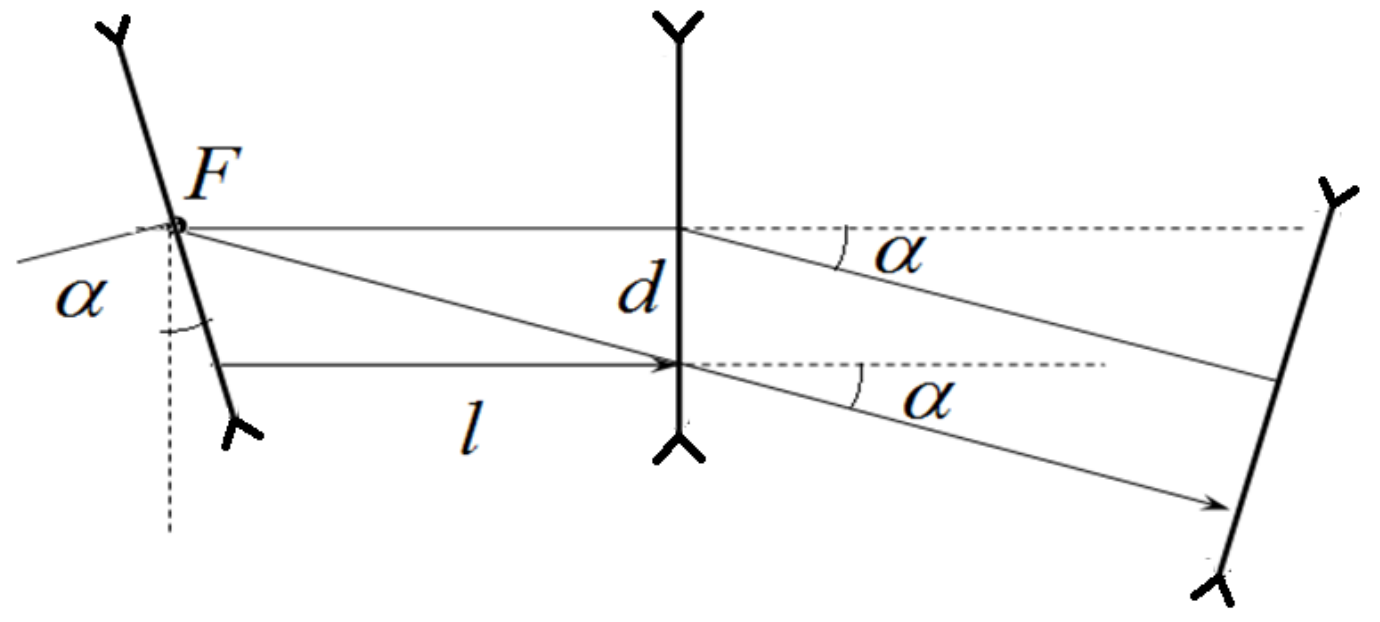
For diverging lenses, the solution is similar, but we should only consider a ray that hits the lens below the optical axis.
In this case, the length of the side of the 17-gon, formed by the trajectory of the ray, is equal to
then, the radius of the inscribed circles found as
| Content | Points |
|---|---|
| Formula (1) | 0,2 |
| Formula (2) | 0,6 |
| Formula (3) | 0,4 |
| Formula (4) | 0,4 |
| is neglected | (-0,2) |
| Numerical value | 0,2 |
| Formula (5) | 0,6 |
| Formula (6) | 0,4 |
| is neglected | (-0,2) |
| Numerical value | 0,2 |
| Total | 3,0 |
Оригинал в Архива: IZhO-2018-Theory_eng.pdf · официални решения: IZhO-2018-Theory_eng_sol.pdf