IZhO 2018, Теория — Задача 2. Physics in the mountains
XIV International Zhautykov Olympiad/Theoretical Competition · 12 януари 2018 г. · 10 т.
Please read this first:
THEORETICAL COMPETITION
January 12, 2018
The time available for the theoretical competition is 4 hours. There are three questions.
Use only the pen provided.
You can use your own calculator for numerical calculations. If you don’t have one, please ask for it from Olympiad organizers.
You are provided with Writing sheet and additional paper. You can use the additional paper for drafts of your solutions but these papers will not be checked. Your final solutions which will be evaluated should be on the Writing sheets. Please use as little text as possible. You should mostly use equations, numbers, figures and plots.
Use only the front side of Writing sheets**.** Write only inside the boxed area.
Begin each question on a separate sheet of paper.
Fill the boxes at the top of each sheet of paper with your country (Country), your student code (Student Code), the question number (Question Number), the progressive number of each sheet (Page Number), and the total number of Writing sheets used (Total Number of Pages). If you use some blank Writing sheets for notes that you do not wish to be evaluated, put a large X across the entire sheet and do not include it in your numbering.
At the end of the exam, arrange all sheets for each problem in the following order:
- Used Writing sheets in order;
- The sheets you do not wish to be evaluated
- Unused sheets and the printed question.
Place the papers inside the envelope and leave everything on your desk. You are not allowed to take any paper out of the room.
SOLUTIONS TO THE PROBLEMS OF THE THEORETICAL COMPETITION
Attention. Points in grading are not divided!
Условие
The atmosphere of a real planet, such as the Earth, has a rather complex structure in view of the great variety of processes and phenomena involved in its formation. In this problem we will consider two simple models of the lower layer of the atmosphere, called the troposphere, which extends to an altitude of 10-15 km above the Earth's surface. To understand the physics of some phenomena it is sufficient to consider the Earth's atmosphere consisting of a single-component diatomic gas with the molar mass .
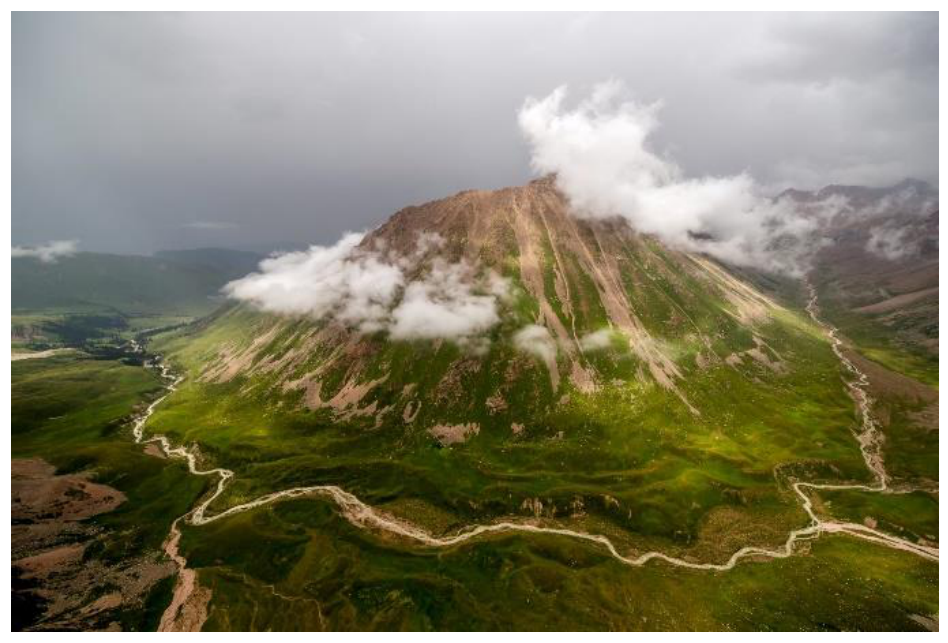
Part 1. Isothermal atmosphere
In the atmosphere, the lowest near-surface layer has an almost constant temperature, as it is heated up by the surface of the Earth. Therefore, we assume in this part that the temperature of the atmosphere remains the same over its entire altitude and is equal to , and the air pressure at the Earth's surface is . Assume that the acceleration of gravity is independent of the altitude above the Earth's surface, since the total height of the atmosphere is much less than the Earth's radius . The universal gas constant is .
1.1 Find and calculate the mass of the Earth's atmosphere.
1.2 Find and calculate the air pressure at the altitude of above the Earth's surface.
From the physical point of view, the interesting question is how fast the atmosphere warms up with the change of day and night. From space observations, the so-called solar constant is known, which is the total power of the solar radiation in the region of the Earth's orbit passing through a unit of a surface oriented perpendicular to its flow.
1.3 Estimate the amount of heat needed to heat the atmosphere by .
1.4 Find and calculate the time interval for the Sun to shine in order to provide the Earth with the amount of heat .
Part 2. Adiabatic atmosphere
The real troposphere is not isothermal at all and the air temperature decreases with altitude. Due to the constantly flowing convective processes, the troposphere can be considered practically adiabatic. Let the air temperature and pressure at the Earth's surface be and , respectively. Consider the acceleration of gravity be still independent of the altitude above the Earth's surface.
2.1 Find and calculate the air temperature at the altitude of above the Earth's surface.
2.2 Find and calculate the air pressure at the altitude of above the Earth's surface.
In the constructed model, the height of the Earth's troposphere is determined by reaching a certain critical temperature, at which other physical processes begin to play an important role.
2.3 Estimate the height difference of the Earth's troposphere at day and night if the surface temperature changes within this period of time by .
A mountain climber starts climbing on a fairly high mountain, at the foot of which the temperature and the air pressure are equal to and . At the altitude of , he decides to make a halt in order to boil some water and discovers that it boils faster than usual. He opens the handbook on physics available at the moment and finds that at temperature , the saturated water vapor pressure is , and at temperature it is equal to .
2.4 Find and calculate the boiling temperature of water at the altitude of .
After having resumed his climbing, the mountain climber discovers that snow appears at a certain altitude and special equipment is needed to proceed further.
2.5 Find and calculate the altitude , at which the climber noticed the appearance of a snow cover on the mountain.
The climber recalled the conversation with the locals right before climbing, in which he was informed that the snow cover completely disappears from the mountain at temperatures at the foot of the mountain.
2.6 Find and calculate the height of the mountain on which the climber ascends.
Having risen even higher along the slope of the mountain to some altitude , the climber notices the appearance of fog. Looking around, he realizes that there are no clouds and there is no wind. The climber knows that the molar mass of water is , and according to the weather forecast, the relative humidity at the foot of the mountain was equal to . In the handbook on physics, he finds a formula for the pressure of saturated water vapor in the temperature range , which has the following form
where denotes the saturated vapor pressure at temperature , stands for the saturated vapor pressure at temperature , , are constants. In the calculations, consider that the water vapor is always in thermodynamic equilibrium with the surrounding air.
2.7 Find and calculate the altitude .
2.8 Find and calculate the minimum air humidity at the foot of the mountain such that the fog is still observed somewhere on the mountain slope.
Mathematical hint
You may need knowledge of the following integral .
Отговори
- 1.1 kg
- 1.2 85000 Pa
- 1.3 J
- 1.4 30300 s
- 2.1 278 K
- 2.2 84600 Pa
- 2.3 2050 m
- 2.4 368 K
- 2.5 2050 m
- 2.6 3780 m
- 2.7 2550 m
- 2.8 0.119
Решение
Part 1. Isothermal atmosphere (3,2 points)
1.1 [1,0 points] The air pressure on the Earth's surface is caused by its gravity acting on the atmosphere, such that the equilibrium condition requires
where
designates the Earth’s surface.
From (1) and (2) one obtains
1.2 [1,0 points] The pressure of the atmosphere varies with altitude due to the action of gravity on the gas. Let us consider the equilibrium of a layer of gas of thickness . The pressure difference at these altitudes must compensate for the gravitational forces of the gas layer of density , which leads to the equation
On the other hand, from the equation of an ideal gas we find the relation between its density and pressure
From expressions (4) and (5), we find that the pressure of the atmosphere at an altitude is determined by the so-called barometric formula
and at the altitude of it is equal to
1.3 [0,6 points] In a homogeneous gravity field, the pressure of the atmosphere is determined by the mass of air above it, so the heating process can be considered isobaric, which means
where the adiabatic index of the diatomic gas is
1.4 [0,6 points] For the time interval the amount of solar energy, absorbed by the Earth, is equal to
and the time interval sought is obtained as
Part 2. Adiabatic atmosphere (6,8 points)
2.1 [1,2 points] The temperature of the atmosphere does not remain constant with altitude, so equation (5) should be rewritten in the form
Since the atmosphere is assumed adiabatic, one can write that
Solving together equations (4), (12) and (13) yields
Formula (14) proves that the temperature of the adiabatic atmosphere decreases with altitude as
and is found at to be equal
2.2 [0,4 points] The pressure distribution over the altitude is determined by the adiabatic equation (13)
and is found at to be equal
2.3 [0,8 points] Since the temperature of the upper part of the troposphere is fixed, it follows from (15) that its height is determined by the condition
Thus, the change in the height of the troposphere at daytime and nighttime is derived as
2.4 [0,6 points] In the stated range of temperatures and pressures, one can approximate the saturated water vapor pressure by a linear function of the form
The boiling of the liquid begins when the saturated vapor pressure is equalized with the external pressure of the atmosphere, which allows an intensive vaporization process to occur in the emerging bubbles. Equating expressions (18) and (21) gives rise to
2.5 [0,8 points] The melting point of ice varies little with the external pressure, so snow appears when the temperature reaches 0 °C, i.e.
Consequently, using formula (15), we determine the altitude at which the snow cover appears as
2.6 [0,4 points] If the air at the foot of the mountain is quite hot, then the temperature over the entire mountain slope cannot fall to zero degrees Celsius. Then, formula (24) provides the height of the mountain to be
2.7 [2,0 points] Since the water vapor is in thermodynamic equilibrium with the surrounding air, their temperatures are equal at all altitudes. The equilibrium condition for the vapor is written analogously to (4) as
and its density is obtained from the ideal gas equation of state in the following form
in which the temperature dependence on the altitude is governed by formula (15).
By formulation, the pressure of unsaturated water vapor at the foot of the mountain reads as
whereas the saturated vapor pressure at the altitude is denoted as
Integrating equation (25) with the aid of (26) and (15) and initial conditions (28) and (29), it is found that
On the other hand, it is known from the handbook that
and solving it together with (30) provides the following temperature at the altitude
Then, the altitude itself is delivered by formula (15) as
2.8 [0,6 points] For the fog to be absent on the mountain, one has to put in formula (33)
from which we obtain the desired expression for the air humidity
| Content | Points | ||
|---|---|---|---|
| 1.1 | Formula (1) | 0,4 | 1,0 |
| Formula (2) | 0,2 | ||
| Formula (3) | 0,2 | ||
| Correct numerical value | 0,2 | ||
| 1.2 | Formula (4) | 0,2 | 1,0 |
| Formula (5) | 0,2 | ||
| Formula (6) | 0,4 | ||
| Correct numerical value | 0,2 | ||
| 1.3 | Formula (8) | 0,2 | 0,6 |
| Correct numerical value | 0,2 | ||
| Formula (9) or equivalent | 0,2 | ||
| 1.4 | Formula (10) | 0,2 | 0,6 |
| Formula (11) | 0,2 | ||
| Correct numerical value | 0,2 | ||
| 2.1 | Formula (12) | 0,2 | 1,2 |
| Formula (13) | 0,2 | ||
| Formula (14) | 0,4 | ||
| Formula (15) | 0,2 | ||
| Correct numerical value | 0,2 | ||
| 2.2 | Formula (17) | 0,2 | 0,4 |
| Correct numerical value | 0,2 | ||
| 2.3 | Formula (19) | 0,4 | 0,8 |
| Formula (20) | 0,2 | ||
| Correct numerical value | 0,2 | ||
| 2.4 | Formula (21) | 0,4 | 0,6 |
| Correct numerical value | 0,2 | ||
| 2.5 | Formula (23) | 0,2 | 0,8 |
| Formula (24) | 0,4 | ||
| Correct numerical value | 0,2 | ||
| 2.6 | Formula (25) | 0,2 | 0,4 |
| Correct numerical value | 0,2 | ||
| 2.7 | Formula (26) | 0,2 | 2,0 |
| Formula (27) | 0,2 | ||
| Formula (28) | 0,2 | ||
| Formula (30) | 0,6 | ||
| Formula (32) | 0,2 | ||
| Formula (33) | 0,4 | ||
| Correct numerical value | 0,2 | ||
| 2.8 | Formula (34) | 0,2 | 0,6 |
| Formula (35) | 0,2 | ||
| Correct numerical value | 0,2 | ||
| Total | 10,0 |
Оригинал в Архива: IZhO-2018-Theory_eng.pdf · официални решения: IZhO-2018-Theory_eng_sol.pdf