IZhO 2018, Теория — Задача 3. Optics of moving media
XIV International Zhautykov Olympiad/Theoretical Competition · 12 януари 2018 г. · 10 т.
Please read this first:
THEORETICAL COMPETITION
January 12, 2018
The time available for the theoretical competition is 4 hours. There are three questions.
Use only the pen provided.
You can use your own calculator for numerical calculations. If you don’t have one, please ask for it from Olympiad organizers.
You are provided with Writing sheet and additional paper. You can use the additional paper for drafts of your solutions but these papers will not be checked. Your final solutions which will be evaluated should be on the Writing sheets. Please use as little text as possible. You should mostly use equations, numbers, figures and plots.
Use only the front side of Writing sheets**.** Write only inside the boxed area.
Begin each question on a separate sheet of paper.
Fill the boxes at the top of each sheet of paper with your country (Country), your student code (Student Code), the question number (Question Number), the progressive number of each sheet (Page Number), and the total number of Writing sheets used (Total Number of Pages). If you use some blank Writing sheets for notes that you do not wish to be evaluated, put a large X across the entire sheet and do not include it in your numbering.
At the end of the exam, arrange all sheets for each problem in the following order:
- Used Writing sheets in order;
- The sheets you do not wish to be evaluated
- Unused sheets and the printed question.
Place the papers inside the envelope and leave everything on your desk. You are not allowed to take any paper out of the room.
SOLUTIONS TO THE PROBLEMS OF THE THEORETICAL COMPETITION
Attention. Points in grading are not divided!
Условие
Part 1. 4-dimensional vectors
Consider two inertial reference frames and of which the second one moves at a speed relative to the first one as shown in the figure on the right. It is assumed that the origins and coincide at the initial time moment by the clocks of both reference frames. It is known that the Lorentz transformation of space-time coordinates of any event in the frame into the space-time coordinates of the same event in the frame have the following form
where is the speed of light.
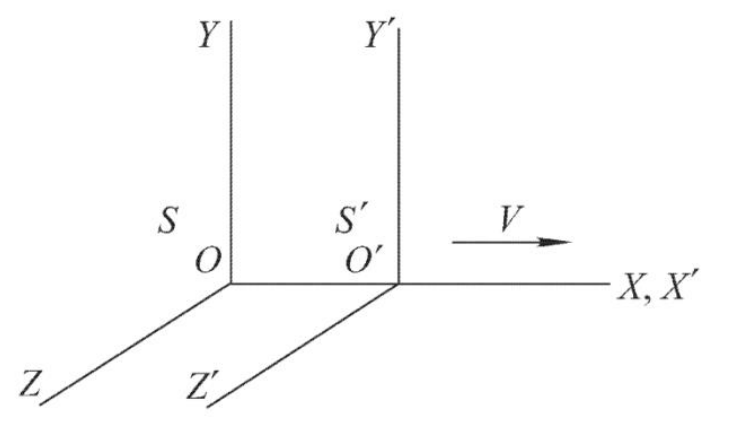
In the formulas of the Lorentz transformation the spatial coordinates and the time are intentionally brought to the same dimension as they together form components of the so-called 4-vector. It is known that all the components of 4-vectors are transformed in the same way at the transition from one inertial frame to the other. In particular, the momentum and the energy constitute the components of the 4-vector.
Suppose that an object moves in the reference frame such that it has the total energy and the momentum projections on the coordinate axes , and , respectively.
1.1 Write down the transformation of energy and momentum of the object from the reference frame to the reference frame .
Suppose an object of the rest mass moves in the reference frame such that it has the total energy and the momentum . When converting its energy and momentum from one reference frame to another the value remains invariant.
1.2 Express in terms of and .
Part 2. Doppler effect and light aberration
Let a plane electromagnetic wave (EMW) propagate in -plane of the reference frame so that it has the frequency and makes the angle with the axis .
2.1 Find the frequency of EMW registered by an observer in the reference frame .
2.2 Find the angle that EMW makes with the axis in the reference frame .
Astronomical observations have shown that the position of a newly discovered massive star on the celestial sphere (i.e. relative to very distant objects) does not remain constant throughout the year. It moves along an ellipse with axial ratio 0.900. Ecliptic latitude of a star is the angle between the direction to the star and the ecliptic plane, which can be assumed coincident with the plane of the Earth orbit around the Sun.
2.3 Find the ecliptic latitude of the star and evaluate it in arc degrees.
Observation of the emission spectrum of the star has shown that all frequency in its spectrum are shifted to the red. The relative frequency deviation is . It has independently been established that the recession velocity of the star from the Sun is equal to .
2.4 Find and evaluate the escape velocity at the surface of the star .
Part 3. Light in a moving medium
Consider the same two reference frames as in Part 1. Let an object move in the plane of the reference frame such that the projections of its velocity on the axis and are equal and , respectively.
3.1 Find the projections of the object velocity on the axis and on the axis in the reference frame .
Consider a water flow moving at the speed of relative to the bottom of the vessel. A plane EMW falls onto the water surface to make the angle to the normal in the laboratory reference frame. A detector is fixed at the bottom of the vessel. The refractive index of water is known to be .
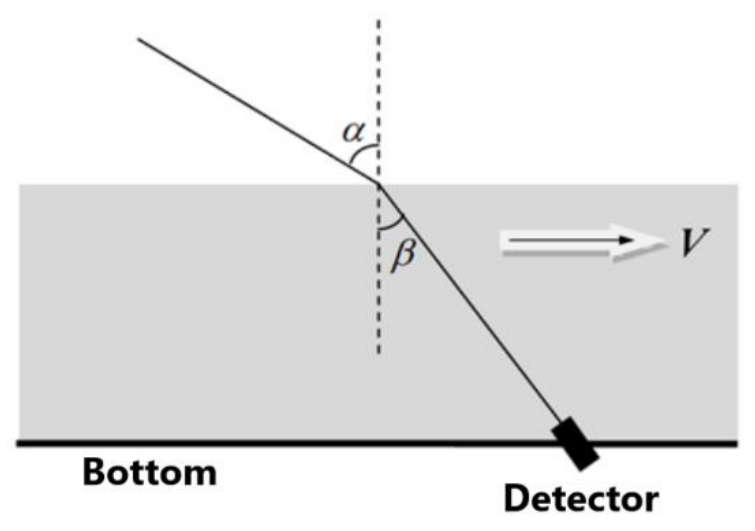
If the water velocity , the expression for the sine of the angle at which the detector registers the direction of EMW propagation, takes the form:
3.2 Find and express them in terms of and .
If the water velocity , the expression for velocity of the light propagation in the laboratory reference frame is found as
3.3 Find and express them in terms of .
In 1860 A. Fizeau set up the following experiment. A monochromatic beam with the wavelength comes out of the source and falls onto the semitransparent plate at which it is divided into two coherent beams. The first beam, being reflected from the plate , goes along the way ( and are the mirrors), whereas the second beam, passing through the plate , goes along the way . The first beam, when returning to the plate , is partially reflected from it and reaches the interferometer . The second beam, when returning to the plate , partially passes through it and reaches the interferometer . Both interfering beams travels the same distance in the laboratory reference frame, including section and in which the water flows with the velocity . The total distance covered by each beam in water in the laboratory reference frame is equal to .
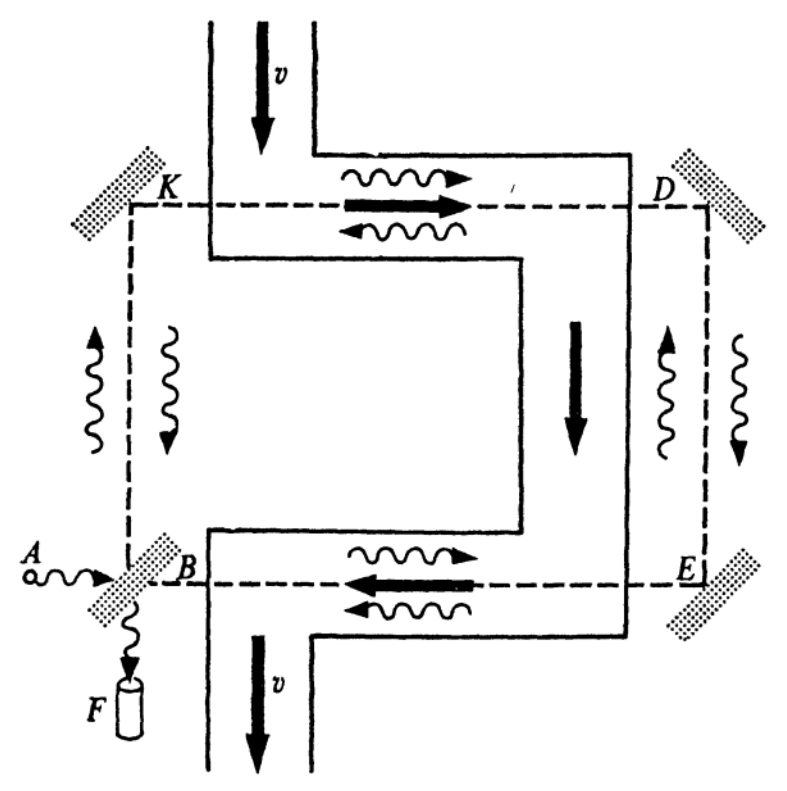
3.4 Find the number of bands the interference pattern is shifted by when the liquid velocity changes from 0 to and express it in terms of , and .
In his own experiment A. Fizeau obtained at , and .
3.5 Evaluate refractive index of water in Fizeau’s experiment.
Mathematical hint
You may need to know the following approximate equality: , at .
Отговори
1.1
1.2
2.1
2.2
2.3 64.2 °
2.4 m/s
The solution text gives 2.83·10⁶ m/s (formula (28)); the grading table prints “vII = 7.108×10⁻⁴ c = 21.31 km/s”, which disagrees with the text.
3.1
3.2
3.3
3.4
3.5 1.37
Решение
Part 1. 4-dimensional vectors (1,4 points)
1.1 [0,8 points] To bring the momentum and the energy to the same unit it is sufficient to divide the energy by the speed of light or to multiply the momentum by the speed of light. Moreover, by virtue of the principle of relativity, it is necessary to make the substitution . Thus, one gets
1.2 [0,6 points] In any inertial frame of reference the expression for the momentum is written as
and the expression for the total energy has the form
This implies that the invariant sought is equal to
Part 2. Doppler effect and light aberration (4,6 points)
2.1 [1,0 points] Since the rest mass of photons is zero, it follows from (7) that the momentum and energy of a photon are related as follows
It is known that the photon energy is given by the Planck formula as
The photon momentum projections on the coordinate axes are written as
and on substituting into (B1.4), one finds
This is the well known formula for the relativistic Doppler effect.
2.2 [0,4 points] It follows from (2), 8) and (9) that
Using (12), it is merely found that
Expression (14) is a classical formula for the light aberration.
2.3 [1,0 points] The position of the star on the celestial sphere varies throughout the year due to the orbital motion of the Earth around the Sun and the aberration of light which is schematically shown in the figure on the right. Since the speed of Earth's orbital motion is much less than the speed of light, it follows from (14) that the aberration angle is equal to
where denotes the angle between and the direction towards the star.
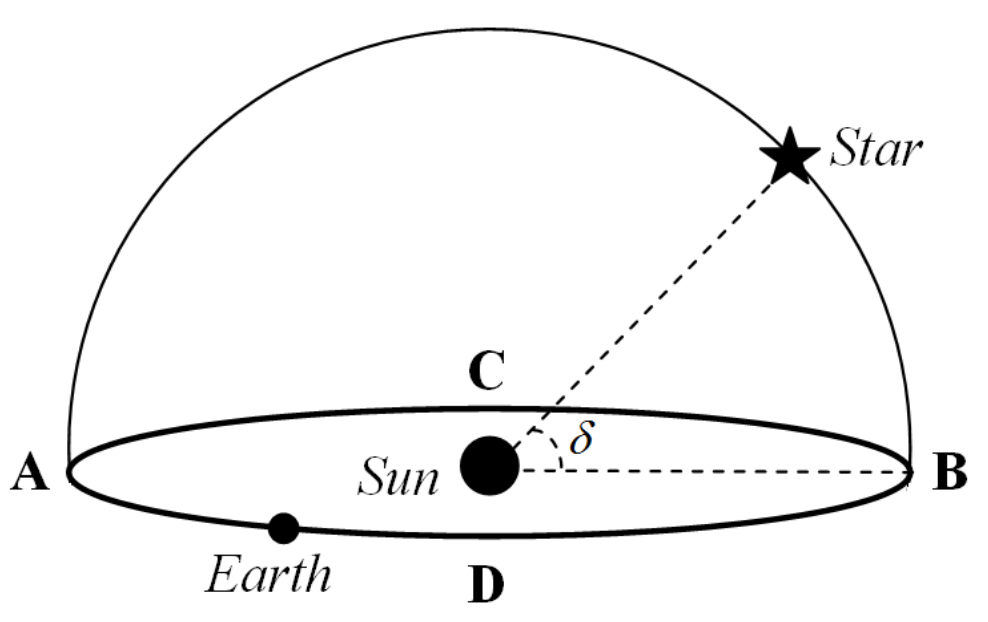
The figure shows that the angle varies periodically from a minimum value at the point , reaches the value of at the point , has a maximum value of at point , and finally becomes equal to at point . Hence, one can infer that the star apparent position on the celestial sphere moves along an ellipse with angular dimensions of the semi-axes
and
It is found from the given data that
2.4 [2,2 points] According to formula (12) for the Doppler effect the relative frequency shift at is found to be
This shows that the Doppler effect cannot fully explain the red shift in the spectrum of the star. It is natural to assume that when the light leaves the surface of the star the photon frequency decreases due to the gravitational redshift.
The gravitational mass is found from the principle of equivalence as
and the gravity force, acting on the photon at a distance from the star, is equal, according to the Newton law, to
The energy conservation law for the motion of the photon can be written as
Thus,
On integrating (B4.5) in the range of the stellar radius до leads to the following equation
where and stand for the frequencies of the photon on the stellar surface and at infinite distance from it, respectively.
Hence, the frequency of the photon at infinite distance from the star is obtained as
where the escape velocity is determined by the classical expression
Combining formulas (19) and (25) yields
On substituting numerical values, one gets
Part C. Light in a moving medium (4,0 points)
3.1 [1,1 points] By definition, the projections of the object velocity in the reference frame are defined as expressions
The same projections in the reference frame are given by
The Lorentz transformations can be rewritten in the form of finite differences as
On dividing term by term the left and right hand sides of (33)-(35) and using (29)-(32) yields
3.2 [1,4 points] Let us sit in the reference frame associated with the water. According to formula (14) the light aberration appears in this reference frame, whereby making the angle of incidence of a plane wave on the water surface equal to
In the reference frame associated with the water flow, the refraction law has a usual form
and the speed of light propagation is
Going back to the laboratory reference frame with the aid of (36) and (37) one finds
Using (38)-(42), it is finally obtained that
making
3.3 [0,4 points] Again using (38)-(42) yields
whereby
3.4 [0,9 points] When the light propagates in the direction of the water flow, the angle in formula (48) should be taken and the corresponding speed is found as
when the light propagates in the direction opposite to the water flow, the corresponding speed is obtained as
Since the total path covered by the two light beams in water is , the difference in their propagation time is equal to
and the corresponding path difference is derived as follows
Thus, the interference pattern is shifted by the number of bands equal to
3.5 [0,2 points] Using formula (53) the water refraction index is found to be
| Part | Content | Points | |
|---|---|---|---|
| 1.1 | Formula (1) | 0,2 | 0,8 |
| Formula (2) | 0,2 | ||
| Formula (3) | 0,2 | ||
| Formula (4) | 0,2 | ||
| 1.2 | Formula (5) | 0,2 | 0,6 |
| Formula (6) | 0,2 | ||
| Formula (7) | 0,2 | ||
| 2.1 | Formula (8) | 0,2 | 1,0 |
| Formula (9) | 0,2 | ||
| Formula (10) | 0,2 | ||
| Formula (11) | 0,2 | ||
| Formula (12) | 0,2 | ||
| 2.2 | Formula (13) | 0,2 | 0,4 |
| Formula (14) | 0,2 | ||
| 2.3 | Formula (15) | 0,2 | 1,0 |
| Formula (16) | 0,2 | ||
| Formula (17) | 0,2 | ||
| Formula (18) | 0,2 | ||
| Numerical value | 0,2 | ||
| 2.4 | Formula (19) | 0,2 | 2,2 |
| Formula (20) | 0,2 | ||
| Formula (21) | 0,2 | ||
| Formula (22) | 0,2 | ||
| Formula (23) | 0,2 | ||
| Formula (24) | 0,2 | ||
| Formula (25) | 0,2 | ||
| Formula (26) | 0,2 | ||
| Formula (27) | 0,2 | ||
| Formula (28) | 0,2 | ||
| Numerical value | 0,2 | ||
| 3.1 | Formula (29) | 0,1 | 1,1 |
| Formula (30) | 0,1 | ||
| Formula (31) | 0,1 | ||
| Formula (32) | 0,1 | ||
| Formula (33) | 0,1 | ||
| Formula (34) | 0,1 | ||
| Formula (35) | 0,1 | ||
| Formula (36) | 0,2 | ||
| Formula (37) | 0,2 | ||
| 3.2 | Formula (38) or | 0,2 | 1,4 |
| Formula (39) | 0,2 | ||
| Formula (40) | 0,2 | ||
| Formula (41) | 0,2 | ||
| Formula (42) | 0,2 | ||
| Formula (44) | 0,2 | ||
| Formula (45) | 0,2 | ||
| 3.3 | Formula (47) | 0,2 | 0,4 |
| Formula (48) | 0,2 | ||
| 3.4 | Formula (49) | 0,2 | 0,9 |
| Formula (50) | 0,2 | ||
| Formula (51) | 0,2 | ||
| Formula (52) | 0,2 | ||
| Formula (53) | 0,1 | ||
| 3.5 | Formula (54) | 0,1 | 0,2 |
| Numerical value | 0,1 | ||
| Total | 10,0 |
Оригинал в Архива: IZhO-2018-Theory_eng.pdf · официални решения: IZhO-2018-Theory_eng_sol.pdf