IZhO 2019, Теория — Задача 1
XV International Zhautykov Olympiad/Theoretical Competition · 11 януари 2019 г. · 10 т.
Please read this first:
THEORETICAL COMPETITION
January 11, 2019
The time available for the theoretical competition is 4 hours. There are three questions.
Use only the pen provided.
You can use your own calculator for numerical calculations. If you don’t have one, please ask for it from Olympiad organizers.
You are provided with Writing sheet and additional paper. You can use the additional paper for drafts of your solutions but these papers will not be checked. Your final solutions which will be evaluated should be on the Writing sheets. Please use as little text as possible. You should mostly use equations, numbers, figures and plots.
Use only the front side of Writing sheets**.** Write only inside the boxed area.
Begin each question on a separate sheet of paper.
Fill the boxes at the top of each sheet of paper with your country (Country), your student code (Student Code), the question number (Question Number), the progressive number of each sheet (Page Number), and the total number of Writing sheets used (Total Number of Pages). If you use some blank Writing sheets for notes that you do not wish to be evaluated, put a large X across the entire sheet and do not include it in your numbering.
At the end of the exam, arrange all sheets for each problem in the following order:
- Used Writing sheets in order.
- The sheets you do not wish to be evaluated.
- Unused sheets.
- The printed problems.
Place the papers inside the envelope and leave everything on your desk. You are not allowed to take any paper out of the room.
SOLUTIONS TO THE PROBLEMS OF THE THEORETICAL COMPETITION
Attention. Points in grading are not divided!
Условие
This problem consists of three independent parts.
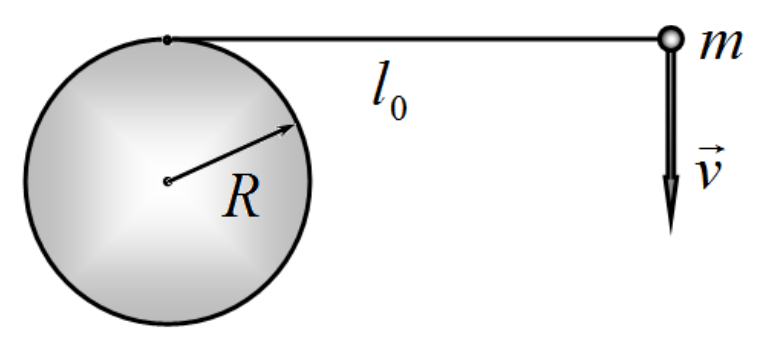
1A A vertical cylinder of radius is fixed on a smooth horizontal surface. A thread is tightly wound on the cylinder, the free end of which is long and attached to a small puck of mass . The puck is initially given a horizontal velocity , which is perpendicular to the thread (see figure). How long will it take for the thread to be torn up if the maximum tension force it can withstand is . [4 т.]
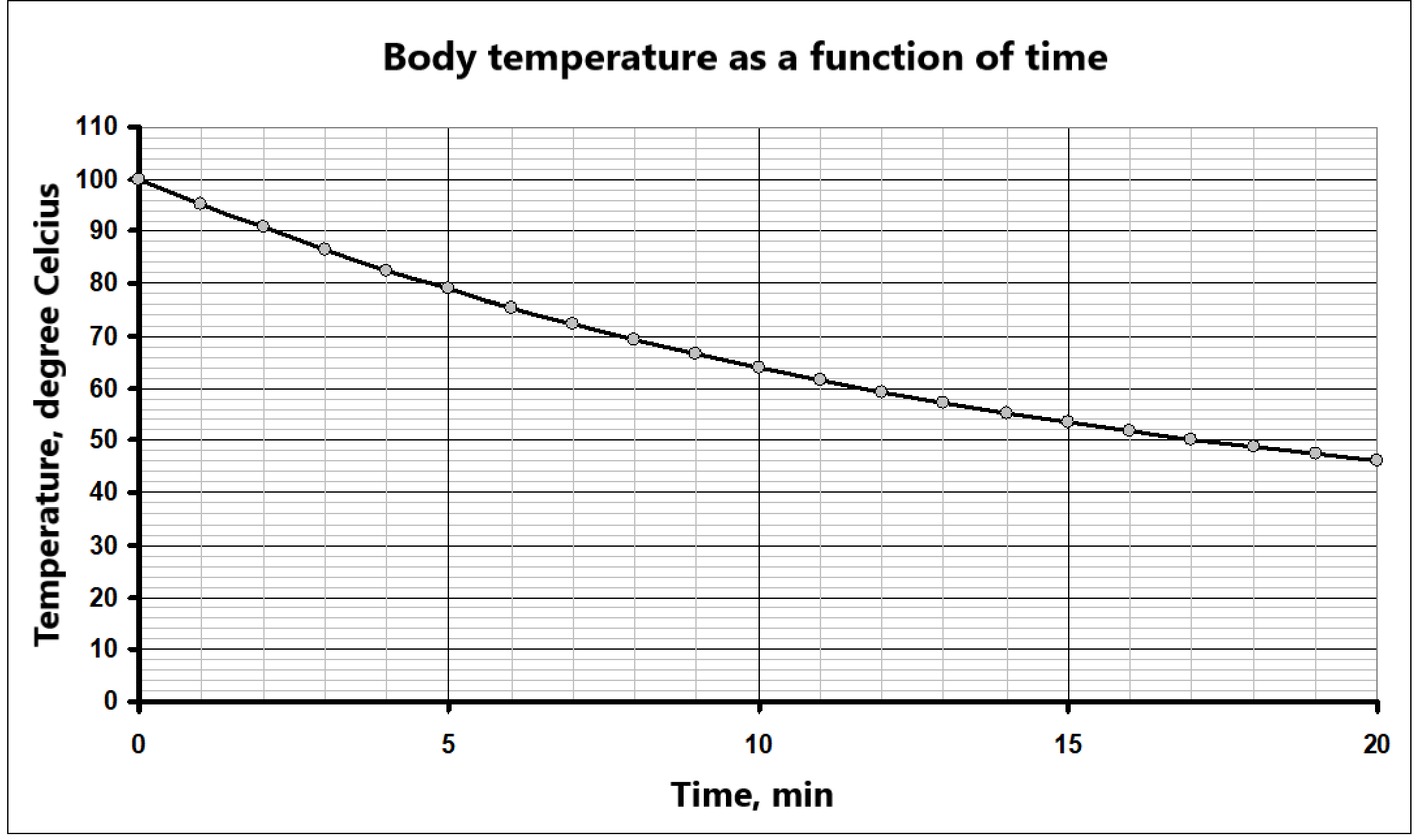
1B A body cools in the air so that the rate of heat transfer is proportional to the temperature difference between the body and the air. The graph below shows the dependence of the body temperature on time. Find the air temperature. [3 т.]
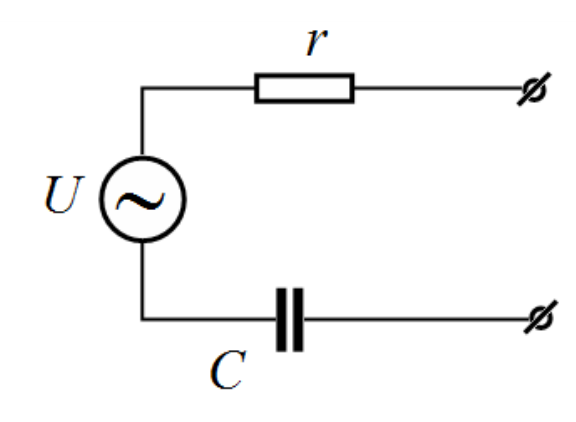
1C The equivalent circuit of a real source of alternating voltage of frequency consists of an ideal voltage source with the amplitude , of a resistor with the resistance Ohm and of a capacitor with the capacitance . Different circuits of resistors, capacitors and coils can be connected to the source as a load. Propose a load circuit, which assures maximum of the generated heat output in the load itself. Draw schematically your load circuit and evaluate parameters of its elements. If you have found several solutions, provide the simplest one. Find also the maximum power, which can be generated in a load. [3 т.]
Отговори
1A
1B 28 °C
Official answer: ; full marks for 27.5–28.5 °C.
1C A resistor of 2019 Ohms in series with a coil of inductance 1.00·10⁻² Hn; maximum power 13.9 mW.
Official: Hn, mW.
Решение
Problem 1A (4.0 points)
Since the thread is inextensible and under stress, then the speed of the puck is always perpendicular to the thread. Therefore, the tension force of the thread does not perform any work on the puck and its speed remains constant by modulus
The puck moves along its trajectory with the curvature radius equal to the length of the unwound thread, therefore, the condition for the thread to be torn up is found from Newton's second law as
The length of the thread changes as a result of winding on the cylinder according to
where
and the angular velocity of the thread rotation is obtained as follows
It follows from equations (3)-(5) that
and its integration entails
Substituting formula (1) into (7), the time moment sought is finally found as
| Content | Points |
|---|---|
| The puck speed remains unchanged | 1 |
| 0.5 | |
| 1 | |
| 0.5 | |
| 1 | |
| Total | 4.0 |
Problem 1B (3.0 points)
Possible solution. The power of the heat transfer from the body to the air is proportional to the difference between the body and the air temperatures with the factor , i.e.
as a result, the body with the heat capacity cools down by the temperature over time period , which obeys the heat balance equation
Equations (1) and (2) with the initial condition have a solution
where is a constant.
Let the body be cooled from the temperature to the temperature for a certain time interval, then it follows from (3) that
where is a constant.
Over the following same time interval, this difference will also change in times
Equations (4) and (5) result in the relation
which has the following solution
It is obtained from the graph provided: the initial temperature , in 10 minutes the temperature is equal to , and in 20 minutes it reaches the value of . Substituting these data into equation (7), the air temperature is finally calculated as
| Content | Points |
|---|---|
| Correct method for determining the air temperature | 1.5 |
| The air temperature lies in the interval | 1.5 |
| The air temperature lies in the interval | (1.0) |
| The air temperature lies in the interval | (0.5) |
| Out of the above intervals | 0 |
| Total | 3.0 |
Problem 1C (3.0 points)
Let be the active component of the load (the real part of the impedance), and be the reactive component of the entire circuit (the imaginary part of the total impedance). Then the current amplitude is found as
The average thermal power in the load reads as
It is seen that the maximum power is achieved at , i.e. there should be no phase shift in the circuit. The remaining expression has a maximum at .
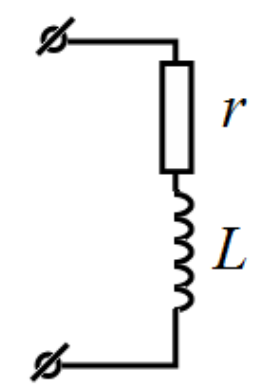
The phase shift would be zero if a coil was connected in series with the capacitor such that , and, thus, .
It turns out that the simplest load must consist of the resistor with the resistance of 2019 Ohms and the coil with the inductance of .
The maximum power is obtained as
| Content | Points |
|---|---|
| The phase shift is zero | 1 |
| Without justification | (0,5) |
| The inductance of the coil | 0,7 |
| Correct numerical value Hn | 0,3 |
| Maximum power at | 0,5 |
| The maximum power itself | 0,3 |
| Correct numerical value mW | 0,2 |
| Total | 3,0 |
Mathematical hint for the theoretical competition
You may need to know the following integrals:
Оригинал в Архива: IZhO-2019-Theory_eng.pdf · официални решения: IZhO-2019-Theory_eng_sol.pdf