IZhO 2021, Теория — Задача 1
XVII International Zhautykov Olympiad/Theoretical Competition — THEORETICAL COMPETITION, January 8, 2021 · 8 януари 2021 г. · 10 т.
Условие
This problem consists of three independent parts.
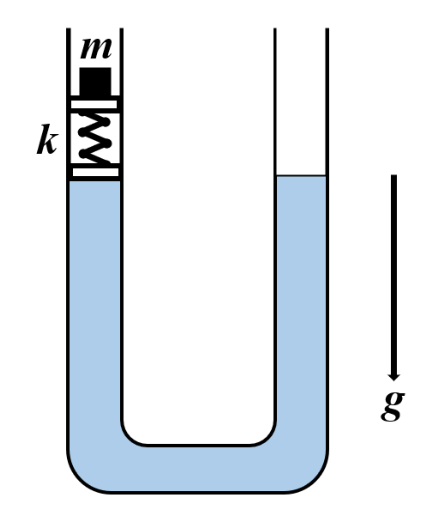
1.1 Water of mass density is poured into a vertical -shaped tube of small constant cross-section , such that the total length of water in both legs is . Two pistons are placed into one leg of the tube with the spring of stiffness in between. The pistons are watertight and can slide along the tube without friction. At the initial moment, a weight of mass is placed on the upper piston. Determine the possible frequencies of small harmonic vibrations of the system near a new equilibrium position. The mass of the pistons and the spring can be neglected, the acceleration of gravity is equal to . Consider water as an ideal incompressible liquid. [4 т.]
1.2 Some insects, such as water striders, are capable of moving freely on the water surface, because their legs are densely covered with non-wetting hairs. To understand why this turns possible, consider the following model problem. A square plate with the side and thickness is carefully laid on the water surface. The density of the plate material is equal to , the density of water is , and its surface tension constitutes . Find the maximum mass of a weight that can be put on the plate so that it still does not sink. Assume that the weight does not deform the plate, the acceleration of free fall is . [3 т.]
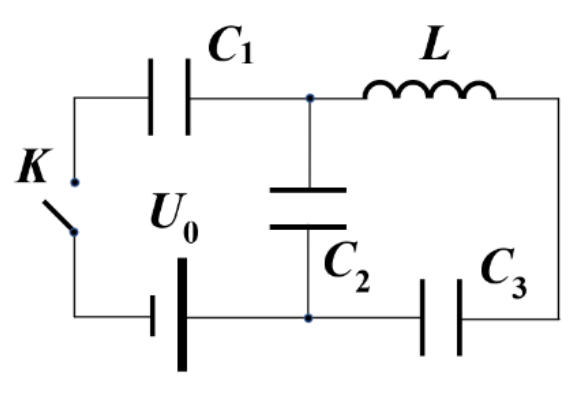
1.3 The electrical circuit shown schematically in the figure consists of three capacitors with capacities , and , a coil of inductance and a source of constant voltage . At the initial moment of time, the capacitors are not charged, and the current in the coil is zero. The switch is shorted. Find the maximum current through the coil and determine the minimum voltage across the capacitor . Assume that the resistance of the connecting wires is rather small. [3 т.]
Отговори
- 1.1 ,
- 1.2 52.6 g
- 1.3
Решение
Attention. Points in grading are not divided!
Problem 1.1 (4.0 points)
Let be the spring compression, and be the change in the water level in the tube leg in which the pistons are located. When water moves in a tube, an inertial force acts on the body, which is equal to
so that the equation of the weight motion is written as
The equation of motion of water in the tube has the form
The new equilibrium position is determined by the conditions and , so that substitution into equations (2) and (3) gives rise to
According to the problem statement, it is said that the system performs harmonic oscillations about the new equilibrium position, therefore, a solution to equations (2) and (3) is sought in the following form
and after substitution we obtain the following set of equations
where , , .
After dividing equations (8) and (9), we obtain a quadratic equation for a possible oscillation frequencies
which admits the solution
Note that both roots are always positive and give the following possible frequencies of harmonic oscillations
In reality, the motion of the system is represented by the addition of harmonic oscillations with frequencies (12) and (13).
| Content | Points |
|---|---|
| Formula (1): | 0.3 |
| Formula (2): | 0.3 |
| Formula (3): | 0.3 |
| Formula (4): | 0.3 |
| Formula (5): | 0.3 |
| Formula (6): | 0.3 |
| Formula (7): | 0.3 |
| Formula (8): | 0.2 |
| Formula (9): | 0.2 |
| Formula (10): | 0.4 |
| Formula (11): | 0.3 |
| Formula (12): | 0.2 |
| Numerical value in formula (12): | 0.2 |
| Formula (13): | 0.2 |
| Numerical value in formula (13): | 0.2 |
| Total | 4.0 |
Problem 1.2 (3.0 points)
The plate has volume
and it is subject to the gravity force
At the line of contact between the plate and water, a difference in water levels occurs, as shown in the figure below.
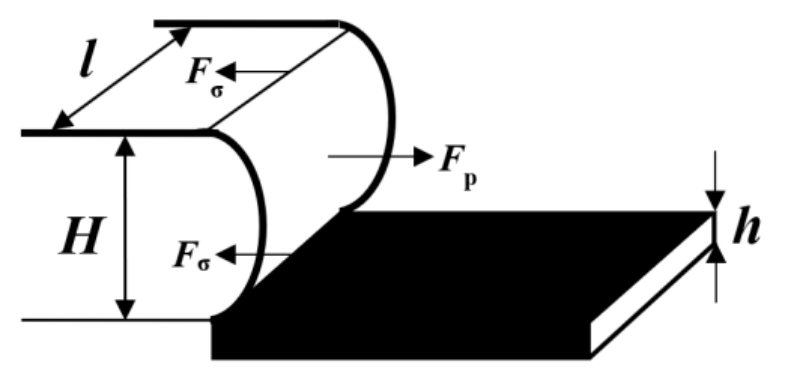
As a result, on the lower surface of the plate with the area
differential pressure applies
which results in a vertically upward force
To determine the value of , we select a certain volume of water with the width near its contact line with the plate. It is subject to the surface tension force equal to
as well as the force due to the pressure of the liquid column
where the average pressure ia found as
together with the cross-sectional area
From the water equilibrium condition
it follows that the height difference is obtained as
The additional weight on the plate is acted upon by the gravity force
and equilibrium condition
the mass of the weight is finally derived as
| Content | Points |
|---|---|
| Formula (1): | 0.2 |
| Formula (2): | 0.2 |
| Formula (3): | 0.2 |
| Formula (4): | 0.2 |
| Formula (5): | 0.2 |
| Formula (6): | 0.2 |
| Formula (7): | 0.2 |
| Formula (8): | 0.2 |
| Formula (9): | 0.2 |
| Formula (10): | 0.2 |
| Formula (11): | 0.2 |
| Formula (12): | 0.2 |
| Formula (13): | 0.2 |
| Formula (14): | 0.2 |
| Numerical value in formula (14): | 0.2 |
| Total | 3.0 |
Problem 1.3 (3.0 points)
The current through the coil cannot change instantly and immediately after the key is shorted it remains equal to zero. At the same time, since the resistance of the connecting wires is very small, the capacitors and are almost instantly charged up to charges and respectively, whereas the capacitor remains uncharged
since it can only be charged through the coil. Note that Joule heat is generated in the connecting wires.
Thus, at the initial moment of time, the capacitors and are connected in series to a constant voltage source and their charges are equal
and the corresponding voltages add up, so that
Thus, we find from equations (2) and (3) that
The total energy of the system immediately after the key shortening turns out to be
After charging the capacitors and , the current through the coil starts to increase and harmonic oscillations are generated in the system, at which Joule losses can already be neglected, since the resistance of the connecting wires is very small.
Note that at that moment in time when the current in the coil is maximum, the voltage across it is zero and the capacitors and turn out to be connected in parallel. For such a connection of capacitors, the following relations for charges are satisfied
Solving together the set of equations (6)-(8), we find the charges of the capacitors
and the energy of the system in this state is obviously equal to
In this case, the work of the source is found as
and the energy conservation law is written in the following form
which provides the maximum current
Finding the minimum voltage across the capacitor is a slightly more difficult task that has a rather simple solution. It is obvious that harmonic oscillations occur in the system, at which the potential energy is constantly transformed into kinetic energy and backwards. For the presented electrical circuit, the role of the kinetic energy is played by the energy of the coil. Therefore, when the current through the coil is zero, then the system is in its large deviation from equilibrium, while the voltage across the capacitor is
Note that the zero coil current corresponds to the initial moment when the key is just shorted.
After a quarter of a period has passed, the current in the coil becomes maximum and the system passes the equilibrium position, whereas the voltage across the capacitor drops to the value
that is, it falls by . After another quarter of the period, the voltage across the capacitor will further drop by the same amount, which is, at the same time, equal to , so the minimum voltage is ultimately obtained as
| Content | Points |
|---|---|
| Formula (1): | 0.2 |
| Formula (2): | 0.2 |
| Formula (3): | 0.2 |
| Formula (4): | 0.2 |
| Formula (5): | 0.2 |
| Formula (6): | 0.2 |
| Formula (7): | 0.2 |
| Formula (8): | 0.2 |
| Formula (10): | 0.2 |
| Formula (12): | 0.2 |
| Formula (13): | 0.2 |
| Formula (14): | 0.2 |
| Formula (15): | 0.2 |
| Formula (18): | 0.2 |
| Formula (18): | 0.2 |
| Total | 3.0 |
Mathematical hints for the theoretical problems
The following formulas may be useful:
Оригинал в Архива: IZhO-2021-Theory_eng.pdf · официални решения: IZhO-2021-Theory_eng_sol.pdf