IZhO 2021, Теория — Задача 2. Thermodynamics of one-component plasma
XVII International Zhautykov Olympiad/Theoretical Competition — THEORETICAL COMPETITION, January 8, 2021 · 8 януари 2021 г. · 10 т.
Условие
Plasma, considered a fourth state of matter, is an ionized gas containing electrons, ions and neutral particles. In a plasma, particle concentrations and temperatures vary over a very wide range, so that a great variety of physical effects can play an essential role. Therefore, at present, a great deal of plasma models have been developed, and this problem deals with one of them, which is called a one-component plasma model. Namely, let us consider a fully ionized plasma with no neutral particles present, which consists of positively charged deuterium nuclei moving against a neutralizing uniformly charged background formed by electrons. This model is a very good approximation for ultrahigh-pressure plasmas occurring at the center of white dwarfs and giant planets like Jupiter. Let the charge and the mass of deuterium nuclei be and respectively, and their concentration be at temperature . Under these conditions, an essential role is played by the interaction between deuterium nuclei, which are located at the sites of a cubic lattice, whose two-dimensional projection is shown in Figure 2.1. Plasma must preserve its neutrality, therefore, each cube with a nucleus located in its center is neutral and referred to as a unit cell. The field produced by each cubic cell is rather complicated, and instead the system is formally reduced to spherical cells, whose two-dimensional projection is depicted in Figure 2.2. The justification of such a replacement is not obvious and depends on the type of problems under investigation.
In numerical calculations, consider the following known: Boltzmann's constant , the vacuum permittivity .
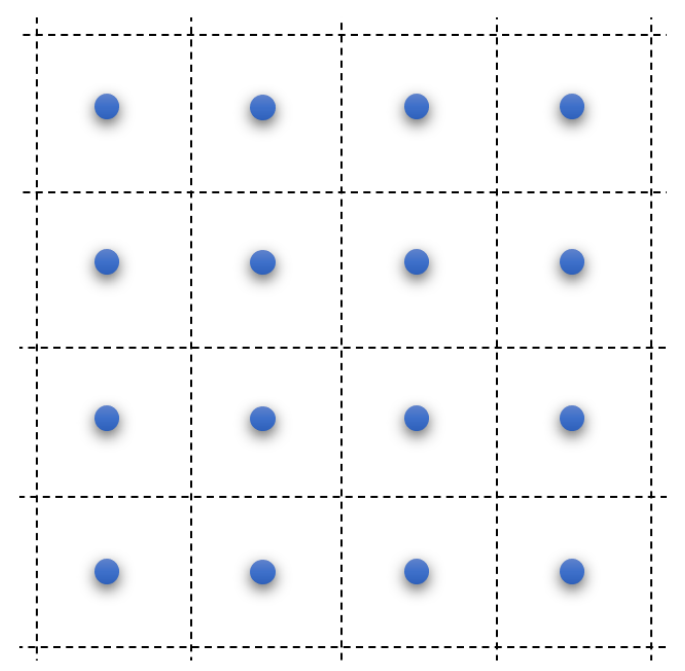
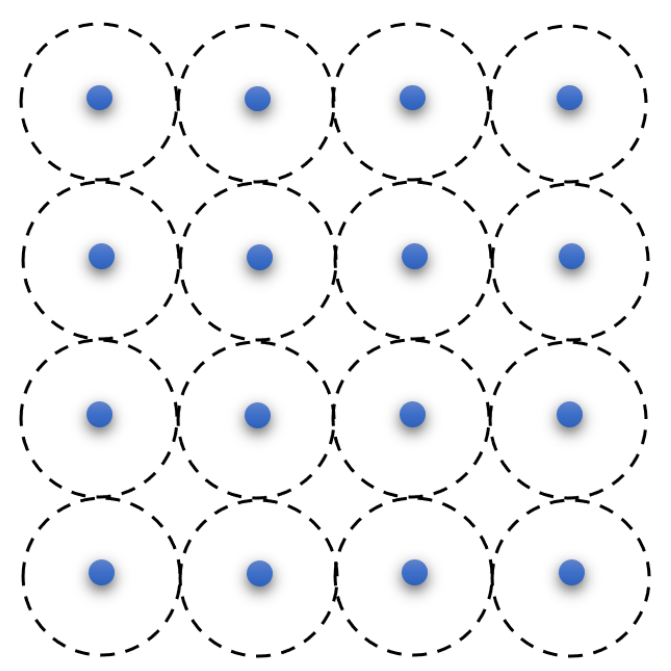
2.1 Calculate the smallest distance between neighboring nuclei.
2.2 Show that interaction energy between nuclei plays a significant role under the given conditions. To do this, estimate the ratio of the interaction energy of neighboring nuclei to their thermal energy. Neglect the presence of a neutralizing background.
2.3 Calculate the bulk charge density of a spherical cell in a one-component plasma model.
2.4 Calculate the potential difference between two points of a spherical cell located at distances and respectively.
2.5 Calculate the frequency of small oscillations of a nucleus near the equilibrium position in a spherical cell.
2.6 At the given plasma temperature, estimate the rms amplitude of oscillations of nuclei near their equilibrium position.
2.7 The internal energy of a one-component plasma, containing spherical cells in the volume , has the form
Determine constants and .
The plasma state of matter is a promising working body for the controlled nuclear fusion. The main problem in the implementation of nuclear fusion is to overcome the so-called Coulomb barrier, which is the Coulomb repulsion between positively charged nuclei. Note that the presence of the neutralizing background of nuclei results in lowering of the Coulomb barrier, since the repulsive force between nuclei decreases. Consider the process of two fusing cells, which occurs as follows. Two cells fuse into one spherical cell with the same bulk density of the neutralizing background, and a new nucleus appears in its center, formed by the fusion of two initial nuclei.
2.8 Calculate the Coulomb barrier lowering for the fusion of two deuterium nuclei cells under given conditions.
The expression for the internal energy of a one-component plasma in the cell model in 2.7 above is interesting in that it explicitly depends on the volume, which is characteristic for nonideal systems. Let a thermodynamic state of the system, whose composition remains unchanged, be depicted by a dot on the pressure () – volume () diagram. In this diagram consider a process consisting of two isotherms and , as well as two adiabats and . Variations in volumes, temperatures and pressures in this process may be considered so small that the quadrilateral can be assumed a parallelogram.
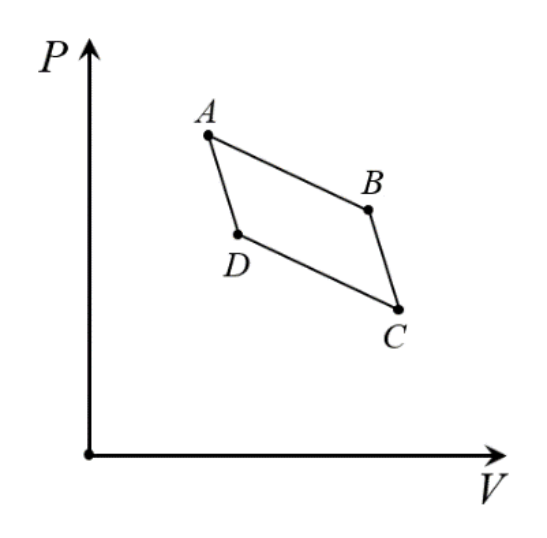
2.9 Using the above cycle, express the derivative of the internal energy with respect to volume at a fixed temperature in terms of the derivative of the pressure with respect to temperature at a fixed volume as well as the temperature and pressure of the system.
2.10 The pressure of a one-component plasma, containing spherical cells in the volume , has the form
Determine constants , and . Calculate the numerical value of the pressure for the plasma parameters given in the problem statement.
Отговори
- 2.1 m
- 2.2 111
- 2.3 C/m³
- 2.4 211 V
- 2.5 s⁻¹
- 2.6 m
- 2.7
- 2.8 J
- 2.9
- 2.10
Решение
2.1 The smallest distance between neighboring deuterium nuclei coincides with the edge of the cube, and since there is 1 nucleus per cube, their concentration is
therefore
2.2 The electrostatic energy of interaction of two nuclei located at the distance from each other is found as
and their thermal energy is evaluated by the formula
whence the sought ratio is obtained in the form
2.3 In general, the spherical cell is neutral, and its radius is equal to
with the corresponding volume
therefore, the bulk charge density is expressed as
2.4 Let us apply Gauss’s theorem
to the sphere of radius centered at the location of the nucleus. The flux of the electric field strength through this sphere, due to symmetry, is delivered by
and the net charge inside the sphere is obtained as
It follows from equations (9)-(11) that
and the sought potential difference is determined by the expression
which finally yields
2.5 The second term on the right-hand side of expression (12) determines the strength of the electric field created by the uniform charge distribution; therefore, the equation of motion of the nucleus projected onto the radial direction has the form
which is an equation of harmonic oscillations with a frequency
2.6 At a fixed temperature, the mean square thermal velocity of the nucleus is derived as
and the corresponding amplitude of deviation from the equilibrium position is determined as
It can be seen that the condition holds, i.e. the deuterium nuclei do indeed perform small oscillations near their equilibrium positions.
2.7 The internal energy of the system consists of the thermal energy of the thermal motion of nuclei and the electrostatic energy of each cell. In turn, the electrostatic energy of each cell consists of the interaction energy of nuclei with the surrounding electron neutralizing background and the energy of the background itself.
Let us divide the cell into spherical layers and consider the layer located at the distance from the cell center and having the thickness . Its charge is obtained as
and the corresponding interaction energy with the nucleus is
The energy density of the electric field is found by the formula
and since the electric field strength of the uniform background is determined by the second term in expression (12) and outside the sphere has the form like that of a point-дшлу charge, which formally coincides with the first term of expression (12),, then the electrostatic energy of the uniform background is evaluated as follows
Thus, the total electrostatic energy of a single cell is written as
and is equal to the work that must be done to create it.
As shown above, the nucleus in the cell center is a three-dimensional harmonic oscillator, so its thermal chaotic energy is determined as
and hence the internal energy of cells has the form
Thus, the sought constants are found as
2.8 In the absence of the neutralizing backgrounds of two nuclei, their fusion corresponds to the bare Coulomb barrier. The presence of neutralizing backgrounds leads to a decrease in the Coulomb barrier, which is obviously determined by the interaction of nuclei with their backgrounds and the self-energy of the backgrounds, i.e. by expression (23). In this case, the thermal energy of nuclei remains small in comparison with the lowering of the Coulomb barrier.
Each of the two cells before fusing has the electrostatic energy
After fusion, a new cell is formed with the volume
with a helium nucleus in the center having an electric charge
In accordance with the general formula, the electrostatic energy of the formed cell is derived as
whence the following expression for the Coulomb barrier lowering is obtained
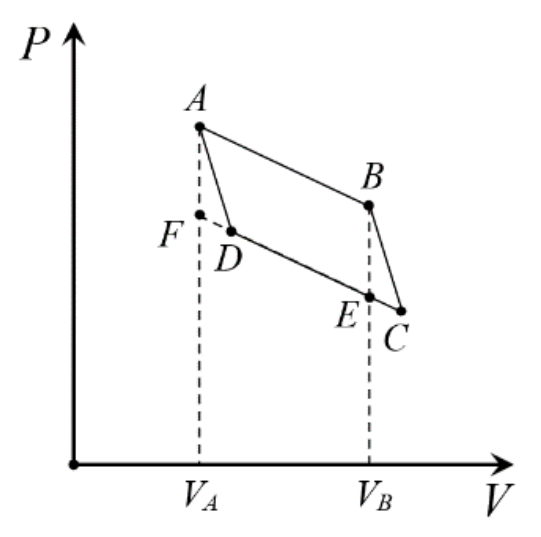
2.9 The circular process is the Carnot cycle. Let us denote the temperature on the isotherm as , and on the isotherm as , while they differ very little from each other, so that and . The work done in the cycle is equal to the area of the parallelogram , which is, in turn, equal to the area of the parallelogram . Since , the work in the cycle is derived as
In the process , the temperature is constant, so the change in internal energy is expressed as
and the supplied amount of heat according to the first law of thermodynamics takes the form
Since the process is a Carnot cycle, its efficiency is written as
and combining equations (33) - (36), we obtain the required relation
2.10 Substituting formula (25) into equation (37), we obtain the first-order differential equation
whose solution takes the form
where refers to some constant, which, in principle, can depend on the volume of the system.
In the absence of interaction between the nuclei, the pressure of the system should be reduced to the pressure of an ideal gas
and we immediately find
Thus, the sought constants are obtained as
Substituting the numerical values, we obtain the numerical value for the pressure
The pressure turns out to be negative! In fact, the pressure of the entire system includes the pressure of the electronic component and is definitely positive.
| Content | Points | ||
|---|---|---|---|
| 2.1 | Formula (2): | 0.2 | 0.4 |
| Numerical value in formula (2): | 0.2 | ||
| 2.2 | Formula (3): | 0.2 | 0.8 |
| Formula (4): | 0.2 | ||
| Formula (5): | 0.2 | ||
| Numerical value in formula (5): | 0.2 | ||
| 2.3 | Formula (6): | 0.1 | 0.6 |
| Formula (7): | 0.1 | ||
| Formula (8): | 0.2 | ||
| Numerical value in formula (8): | 0.2 | ||
| 2.4 | Formula (9): | 0.2 | 1.4 |
| Formula (10): | 0.2 | ||
| Formula (11): | 0.2 | ||
| Formula (12): | 0.2 | ||
| Formula (13): | 0.2 | ||
| Formula (14): | 0.2 | ||
| Numerical value in formula (14): | 0.2 | ||
| 2.5 | Formula (15): | 0.2 | 0.6 |
| Formula (16): | 0.2 | ||
| Numerical value in formula (16): | 0.2 | ||
| 2.6 | Formula (17): | 0.2 | 0.6 |
| Formula (18): | 0.2 | ||
| Numerical value in formula (18): | 0.2 | ||
| 2.7 | Formula (19): | 0.2 | 1.8 |
| Formula (20): | 0.2 | ||
| Formula (21): | 0.2 | ||
| Formula (22): | 0.2 | ||
| Formula (23): | 0.2 | ||
| Formula (24): | 0.2 | ||
| Formula (25): | 0.2 | ||
| Formula (26): | 0.2 | ||
| Formula (27): | 0.2 | ||
| 2.8 | Formula (28): | 0.2 | 1.2 |
| Formula (29): | 0.2 | ||
| Formula (30): | 0.2 | ||
| Formula (31): | 0.2 | ||
| Formula (32): | 0.2 | ||
| Numerical value in formula (32): | 0.2 | ||
| 2.9 | Formula (33): | 0.2 | 1.0 |
| Formula (34): | 0.2 | ||
| Formula (35): | 0.2 | ||
| Formula (36): | 0.2 | ||
| Formula (37): | 0.2 | ||
| 2.10 | Formula (38): | 0.2 | 1.6 |
| Formula (39): | 0.2 | ||
| Formula (40): | 0.2 | ||
| Formula (41): | 0.2 | ||
| Formula (42): | 0.2 | ||
| Formula (43): | 0.2 | ||
| Formula (44): | 0.2 | ||
| Numerical value in formula (45): | 0.2 | ||
| Total | 10.0 |
Mathematical hints for the theoretical problems
The following formulas may be useful:
Оригинал в Архива: IZhO-2021-Theory_eng.pdf · официални решения: IZhO-2021-Theory_eng_sol.pdf