IZhO 2021, Теория — Задача 3. Optical waveguide
XVII International Zhautykov Olympiad/Theoretical Competition — THEORETICAL COMPETITION, January 8, 2021 · 8 януари 2021 г. · 10 т.
Условие
At present, various waveguides are widely used to transmit energy and information. The propagation of electromagnetic waves in waveguides differs significantly from the propagation of waves in free space, and in this problem you are asked to describe the propagation of electromagnetic waves in the simplest plane waveguide.
Description of waves
A plane monochromatic electromagnetic wave propagating along the axis is described by the formula
Here denote the electric field strength of the wave and its amplitude, respectively, the magnitude of is called the wavenumber, refers to the circular wave frequency, signifies the initial phase, and the expression in the cosine is called the wave phase.
3.1 Express the wavenumber in terms of the wavelength and the period of oscillation in terms of the angular frequency .
3.2 Express the velocity of wave propagation in terms of and .
In a more general case, a monochromatic plane wave is described by the function
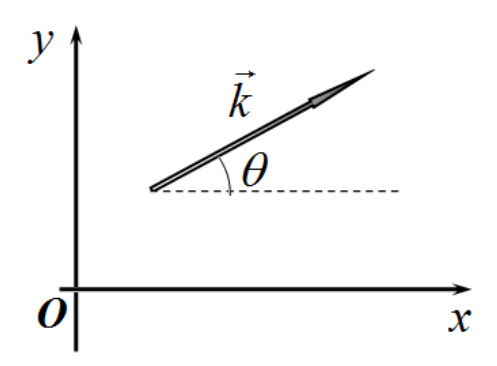
In this expression, stands for the radius vector of an arbitrary point in space, designates the wave vector equal in magnitude to the wavenumber and pointing to the direction of wave propagation.
Let the wave vector lie in the plane and be directed at an angle to the axis , as shown in the figure to the right.
3.3 Draw schematically a family of equidistant wave surfaces, which are surfaces of equal wave phases, for a plane wave described by function (2).
3.4 Write down explicitly the expression for the electric field strength of wave (2) as a function of coordinates .
An ideal monochromatic wave is infinite in time and space, therefore, it cannot carry information. To transmit information, it is necessary to use either separate pulses (restricted in time) or variate the wave amplitude (wave modulation). In these cases, the wave ceases to be monochromatic, and can be represented as a sum (superposition) of monochromatic waves.
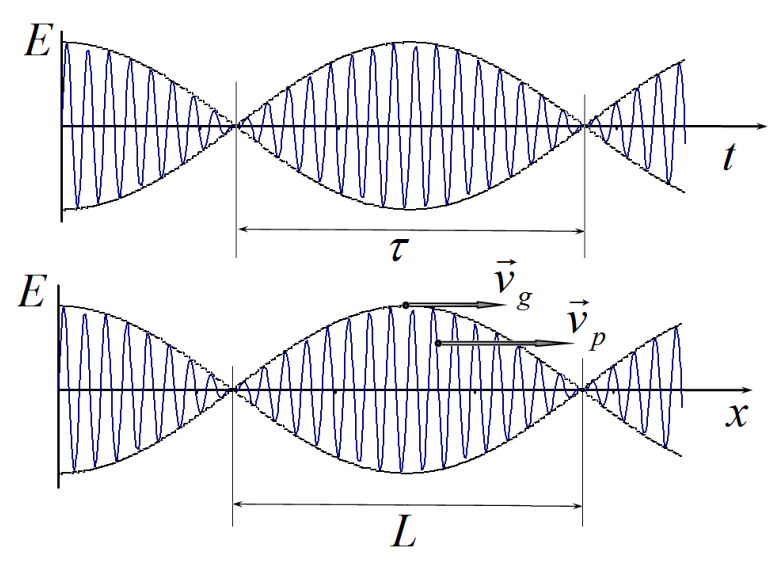
Consider a wave that is the sum of two waves propagating along the axis : the first one having the angular frequency and wavenumber ; the second wave frequency is , , with the wavenumber . Note that, in the general case, the wavenumber is a certain function of frequency .
3.5 Show that the sum of these two monochromatic waves is a modulated wave consisting of separate wave packets. Write down the formula describing the slow variation of the amplitude of the resulting wave in space and time (it is called an envelope).
3.6 Determine the time duration of an individual wave packet . Write down the relationship between the duration and the frequency difference .
3.7 Determine the spatial length of the wave packet .
It turns out that the speed of the wave surface of constant phase , which is called the phase velocity, differs from the speed of the wave packet , which is called the group velocity. The speed of the envelope maximum can be considered a group velocity.
3.8 Find the phase velocity of the considered modulated wave and express it in terms of .
3.9 Find the group velocity of the considered modulated wave and express it in terms of .
3.10 Establish a relationship between phase and group velocities for electromagnetic waves in a vacuum.
Plane waveguide
In this part, consider the propagation of electromagnetic waves in a plane waveguide. The waveguide is formed by two infinite parallel conductive plates located at a distance from each other. Assume a vacuum in between the plates.
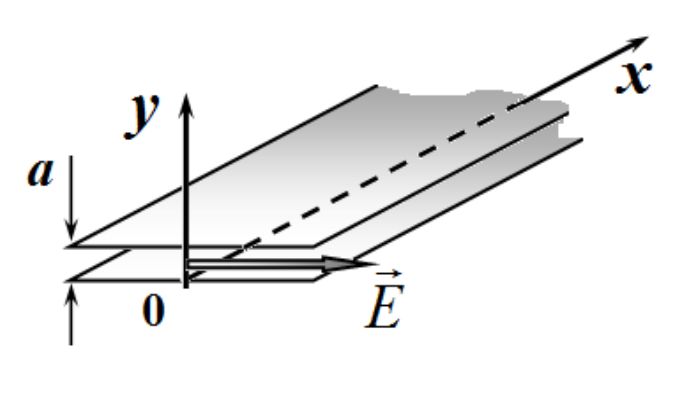
Under investigation are electromagnetic waves, whose electric field strength vectors are directed parallel to the plates (they are called TE waves). Let us introduce a coordinate system, whose axis lies in one of the plates, and whose axis is directed perpendicular to the plates.
A wave propagating along the axis in between the plates is described by the function
where is the known circular frequency of the wave. For this wave to propagate in the waveguide without energy losses, the electric field strength on the plates must be zero.
3.11 Find the values at which the wave can propagate in the waveguide without energy losses.
A set of possible values is discrete and characterized by some integer . Waves corresponding to different values of this number are called modes (types of possible waves).
3.12 Show that the wave described by function (3) can be represented as a superposition of two plane waves and with the wave numbers , propagating symmetrically at angles to the plates, see figure below.
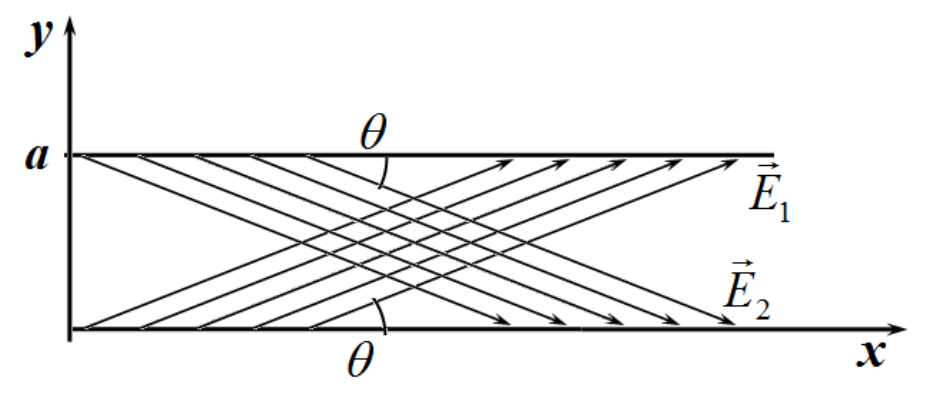
3.13 Express the values in terms of the wavenumber and angle .
3.14 Determine the possible angles at which the wave can propagate in the waveguide without energy losses. Express the values of these angles in terms of the distance between the plates and the wavelength in vacuum.
3.15 Determine the phase velocities of the waves of each mode. Express these velocities in terms of the wave frequency and the speed of light in a vacuum.
Short pulses with a carrier frequency are supplied to the waveguide input. Since these pulses have a finite time duration , they cannot be treated as a monochromatic wave, but instead contain a set of monochromatic components in a certain frequency range . These input pulses form a set of pulses in each of the possible waveguide modes.
3.16 Determine the speed of the pulse propagation in the mode number .
3.17 At what minimum distance from the waveguide input the number of pulses is to be doubled if . Express your answer in terms of the speed of light and the pulse duration .
To avoid the appearance of "extra" pulses at the information transmission process, waveguides are used to operate in a single-mode regime, in which only one mode can propagate.
3.18 Find ratios at which only one mode can propagate in the waveguide.
Отговори
- 3.1
- 3.2
- 3.3 A family of planes, perpendicular to the wave vector.
- 3.4
- 3.5
- 3.6
- 3.7
- 3.8
- 3.9
- 3.10
- 3.11
- 3.13
- 3.14
- 3.15
- 3.16
- 3.17
- 3.18
Решение
Description of waves
3.1 The function
describing a wave at a fixed moment in time gives the distribution of the electric field strength in space. When the coordinate is changed by the wavelength , the argument of the cosine must change to , therefore
It follows from this relation that
Fixing a point in space and reasoning similarly, we can write
which yields
3.2 The speed of propagation of a monochromatic wave is the speed of motion of a certain wave surface of constant phase. This surface satisfies the equation
It follows from this relation that the wave propagation speed is
3.3 The surface of the constant phase at a fixed time instant satisfies the equation
and this is a family of planes perpendicular to the wave vector.
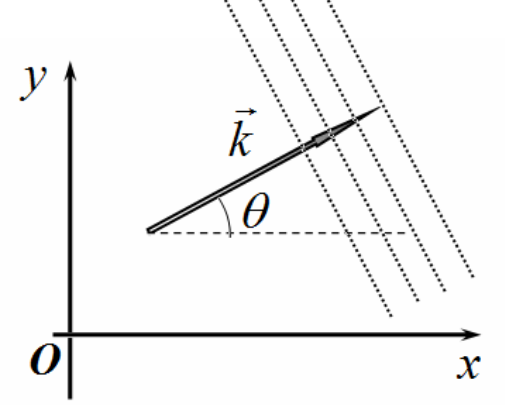
3.4 Expanding the scalar product, we obtain the wave equation in the coordinate representation:
3.5 Since the superposition principle is valid for the electric field strength, we can write for a composite wave
Taking into account that , and, consequently, , we rewrite this expression as:
Here the following notation is used
for slowly varying wave amplitude.
3.6 To determine the time duration of the packet, it should be taken into account that when passing from one "zero" of the cosine to the next, the argument of the cosine changes to , therefore
Taking into account that , we obtain from expression (13) the relationship between the packet duration and its spectral width as
3.7 For a similar reasoning, it is not difficult to find that
3.8 The phase velocity can be found as the velocity of motion of the wave surface of constant phase. It is derived from function (11) that this surface satisfies the condition
which results in the phase velocity
3.9 To determine the group velocity, we write down the condition that the wave amplitude, for example, is maximum
It is concluded from this expression that the group velocity is given by the formula
3.10 For electromagnetic waves in vacuum, the relation is fulfilled, which validates
and it is finally obtained that
i.e. both the phase and group speeds are equal to the speed of light in a vacuum.
Plane waveguide
3.11 The function proposed in the problem statement describes the field in a plane waveguide
and satisfies one boundary condition: at the electric field strength . Therefore, one should choose such values of so that the second boundary condition is fulfilled: at the field strength should also vanish. This condition is satisfied when
In the expressions above stands for a positive integer,
3.12 Let us write the equations of symmetric waves
where is the wavenumber for waves, propagating at an angle to the planes of the waveguide, and summing them up yields
with the following relation
Note that there should be .
3.13 Comparison of the obtained formulas (23) and (27) implies that they coincide if
3.14 Comparing the values of in formulas (24) and (30), we find
The wavenumber of the considered waves in vacuum is related to the wavelength by
then the values of the possible angles are given by the formula
3.15 Equation (23) implies that the phase velocity of wave propagation in the waveguide is given by the formula
Expressing the value of the cosine of the angle in terms of its sine, which is determined by formula (33), we obtain
Finally, using formulas relating frequencies, wavelengths and the speed of light in a vacuum , , it is derived that
Thus, it turns out that the phase velocity of propagation of an undamped wave in the waveguide is greater than the speed of light in vacuum.
3.16 The propagation velocity of a pulse is the group velocity, therefore, it is determined by formula (19), in which the ratio of the increments can be replaced by the derivative
To evaluate the velocity using this formula, it is necessary to obtain explicitly the dependence of the wavenumber on the frequency, . To do so, we use the general formula for the phase velocity and obtain
and the pulse propagation velocity is written as
As follows from this formula, the group velocity is naturally less than the speed of light in a vacuum. Also, it should be indicated that this speed is equal to , which is quite obvious.
3.17 Let us turn to formula (33) and substitute the given ratio
Since the sine of any argument does not exceed unity, it follows from the obtained expression that only two modes with and can propagate in a given waveguide, and, in other words, the input pulse generate two pulses of these modes in the waveguide. The propagation velocities of pulses in these modes differ markedly. First of all, let us express these velocities in terms of a given ratio in the form
At the waveguide input, pulses in both modes are excited simultaneously, but since they move at different speeds, as the distance traveled increases, they diverge in time. The number of pulses doubles when pulses in different modes diverge for a time exceeding the pulse duration, hence, the minimum distance can be found from the condition
which leads to the final answer
3.18 For a waveguide to operate in a single-mode regime, it is necessary to satisfy the following condition
which yields the inequality
| Content | Points | ||
|---|---|---|---|
| 3.1 | Formula (2): | 0.2 | 0.8 |
| Formula (3): | 0.2 | ||
| Formula (4): | 0.2 | ||
| Formula (5): | 0.2 | ||
| 3.2 | Формула (6): | 0.2 | 0.4 |
| Formula (7): | 0.2 | ||
| 3.3 | A family of planes, perpendicular to the wave vector.. | 0.2 | 0.2 |
| 3.4 | Formula (9): | 0.2 | 0.2 |
| 3.5 | Formula (10): | 0.2 | 0.4 |
| Formula (12): | 0.2 | ||
| 3.6 | Formula (13): | 0.2 | 0.4 |
| Formula (14): | 0.2 | ||
| 3.7 | Formula (15): | 0.2 | 0.2 |
| 3.8 | Formula (16): | 0.2 | 0.4 |
| Formula (17): | 0.2 | ||
| 3.9 | Formula (18): | 0.2 | 0.4 |
| Formula (19): | 0.2 | ||
| 3.10 | Formula (20): | 0.2 | 0.6 |
| Formula (21): | 0.2 | ||
| Formula (22): | 0.2 | ||
| 3.11 | Formula (24): | 0.2 | 0.2 |
| 3.12 | Formula (25): | 0.2 | 0.8 |
| Formula (26): | 0.2 | ||
| Formula (28): | 0.2 | ||
| Condition: | 0.2 | ||
| 3.13 | Formula (29): | 0.2 | 0.4 |
| Formula (30): | 0.2 | ||
| 3.14 | Formula (31): | 0.3 | 0.6 |
| Formula (33): | 0.3 | ||
| 3.15 | Formula (34): | 0.3 | 0.6 |
| Formula (36): | 0.3 | ||
| 3.16 | Formula (37): | 0.3 | 1.0 |
| Formula (38): | 0.4 | ||
| Formula (39): | 0.3 | ||
| 3.17 | Формула (40): | 0.2 | 1.8 |
| Possible modes with and | 0.4 | ||
| Formula (41): | 0.4 | ||
| Formula (42): | 0.4 | ||
| Formula (43): | 0.4 | ||
| 3.18 | Formula (44): | 0.3 | 0.6 |
| Formula (45): | 0.3 | ||
| Total | 10.0 |
Mathematical hints for the theoretical problems
The following formulas may be useful:
Оригинал в Архива: IZhO-2021-Theory_eng.pdf · официални решения: IZhO-2021-Theory_eng_sol.pdf