IZhO 2023, Теория — Задача 1
XIX International Zhautykov Olympiad/Theoretical Competition · 2 февруари 2023 г. · 10 т.
Please read this first:
THEORETICAL COMPETITION
February 2, 2023
- The duration of the theoretical competition is 4 hours. There are three problems.
- You can use your own calculator for numerical calculations.
- You are provided with Writing sheet and additional white sheets of paper. You can use the additional sheets of paper for drafts of your solutions, but these sheets will not be graded. Your final solutions should be written on the Writing sheets. Please use as little text as possible. You should mostly use equations, numbers, figures, and plots.
- Use only the front side of Writing sheets**.** Write only inside the boxed areas.
- Start putting down your solution to each problem on a new Writing sheet.
- Fill in the boxes at the top of each Writing sheet with your country (Country), your student code (Student Code), problem number (Question Number), the progressive number of each Writing sheet (Page Number), and the total number of Writing sheets used (Total Number of Pages). If you use some blank Writing sheets for notes that you do not wish to be graded, put a large X across the entire sheet and do not include it in your numbering.
SOLUTIONS TO THE PROBLEMS OF THE THEORETICAL COMPETITION
Attention. Points in grading are not divided!
Условие
This problem consists of three independent parts.
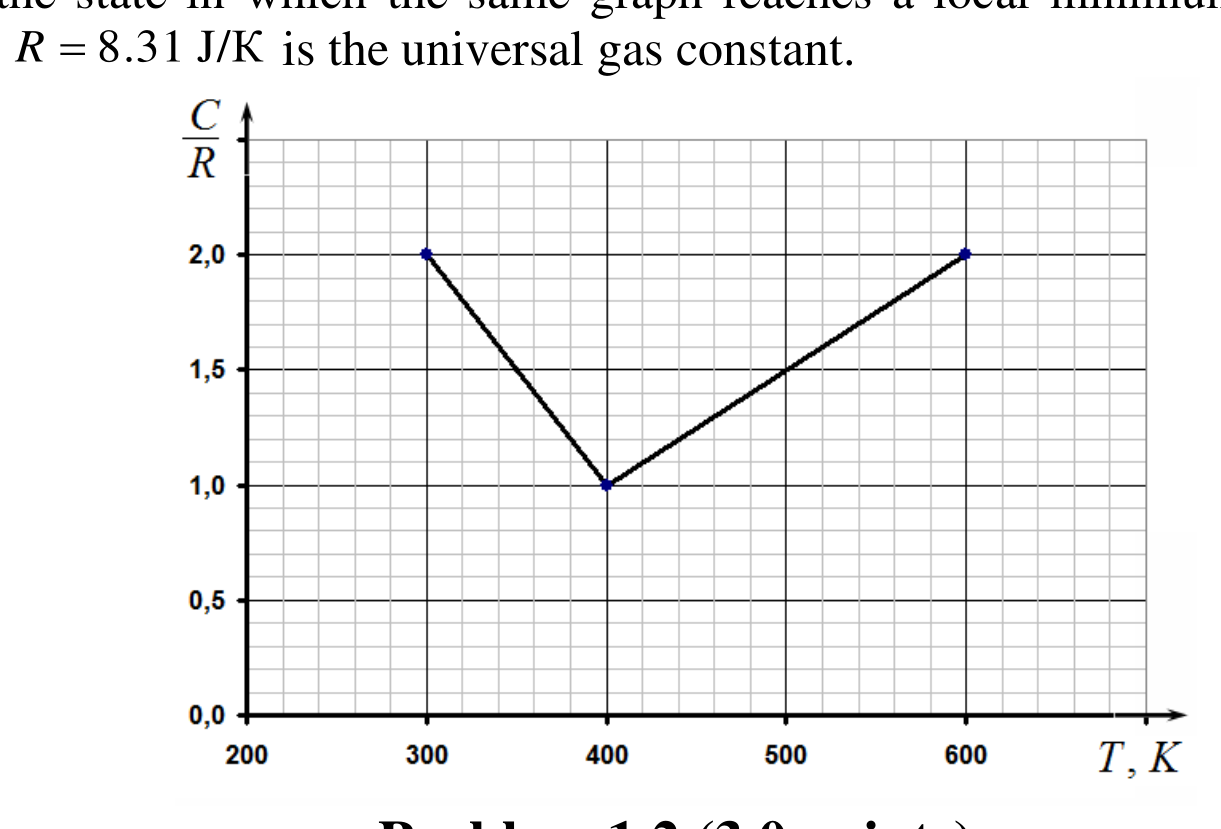
1.1 One mole of an ideal monatomic gas, located in the cylinder under the piston, is quasi-statically heated from the temperature to , changing its volume in such a way that the dependence of the heat capacity of the gas on its temperature has the form shown in the figure below. Find the work done on the gas from the state in which the graph of its volume versus temperature reaches a local maximum, to the state in which the same graph reaches a local minimum. Express your answer in joules assuming that is the universal gas constant. [4 т.]
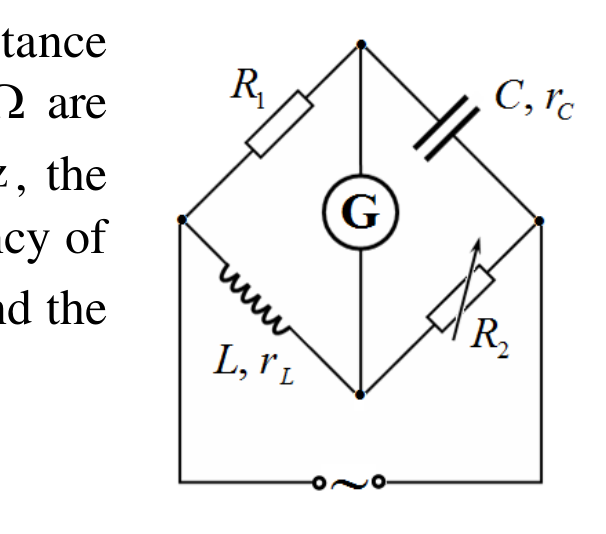
1.2 The figure on the right shows an AC bridge circuit. The resistance , the inductance , the resistance of the inductance are all known. At the frequency of the alternating sinusoidal voltage , the balance of the bridge occurs at . It turns out that when the frequency of the alternating current is doubled, the balance of the bridge is not violated. Find the leakage resistance of the capacitor and its capacitance . [3 т.]
1.3 The Nobel Prize in Physics for 2019 was awarded to the Swiss astronomers M. Major and D. Quelo for the discovery of non-luminous satellite planets (exoplanets) around stars. Consider the planet Jupiter in our solar system as an exoplanet for the Sun. The orbital period of Jupiter is at a mass of , while the mass of the Sun is equal to . Consider also known the speed of the Earth on its orbit , and assume that the orbits of all planets are circular. Let an observation be carried out by a spectrometer located far away from outside the solar system so that the observer is in the plane of motion of the Sun–Jupiter system. Find the minimum resolution of the spectrometer , which allows one to positively detect the presence of the massive exoplanet Jupiter near the Sun. Consider the speed of light to be .
Note: The resolution of a spectrometer is its ability to distinguish between two closely spaced spectral lines, which is characterized by a dimensionless parameter , where denotes the smallest difference between the wavelengths of two lines still recorded as separate by the instrument, and stands for the average wavelength of those two resolvable lines. [4 т.]
Отговори
1.1 312 J
1.2
1.3
Official result: .
Решение
Problem 1 (10.0 points)
Problem 1.1 (3.0 points)
It follows from the first law of thermodynamics that
where is the amount of heat supplied, is the change in internal energy, is the work done by the gas.
For one mole of an ideal gas, these quantities can be written in terms of a change in volume and temperature at a known pressure in the following form
By definition of heat capacity, we have
then from relations (1)-(4) one obtains
at the molar heat capacity of a monatomic gas at a constant volume equal to
From the graph given in the problem statement, it can be seen that at a temperature
the heat capacity is and, accordingly, . When passing through this temperature, the derivative sign changes from plus to minus. This means that at this temperature the gas volume reaches a local maximum: .
At a temperature
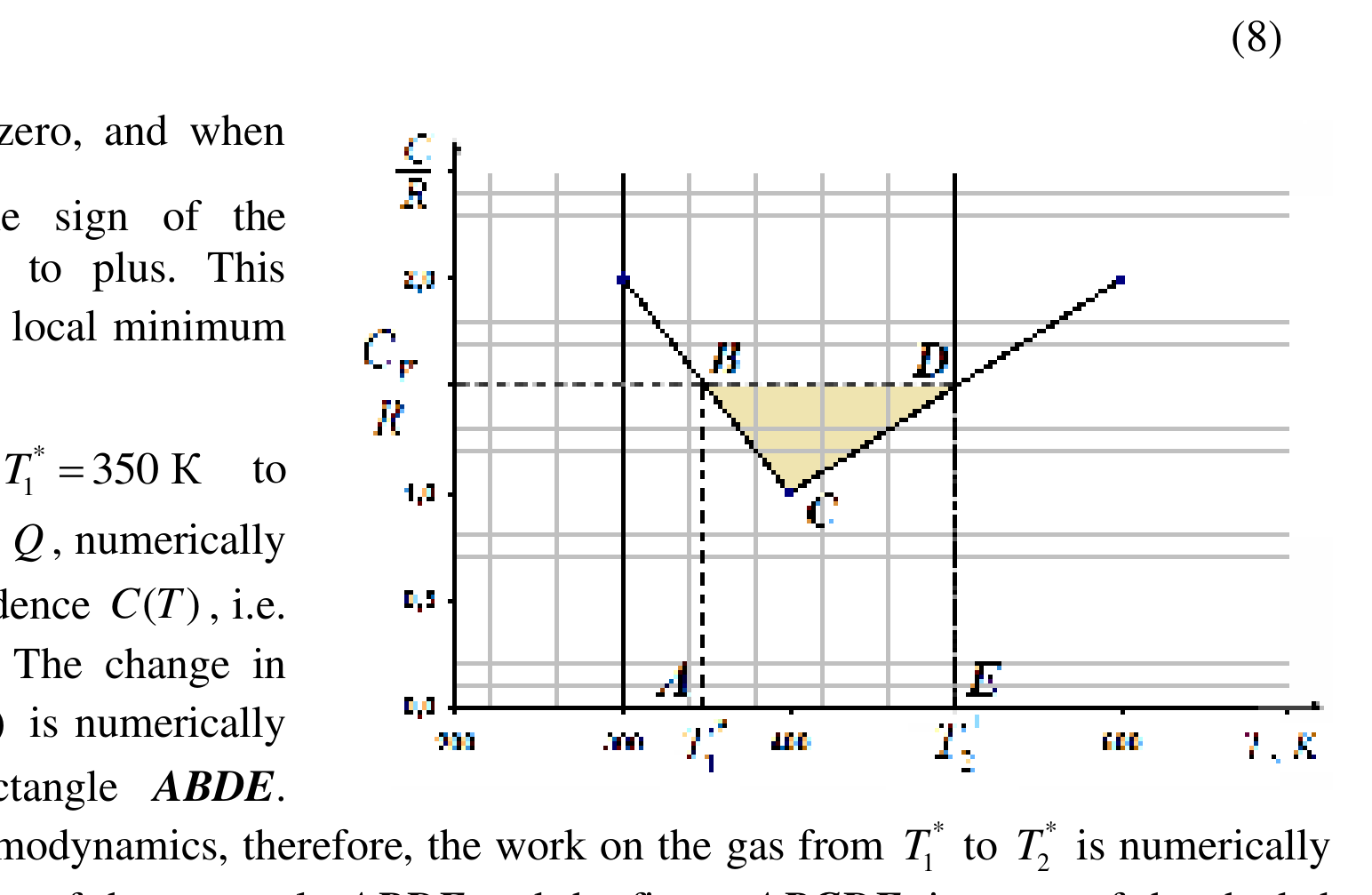
the derivative also equals zero, and when passing through this point, the sign of the derivative changes from minus to plus. This means that is the point of the local minimum of the volume: .
In the section from to , the gas receives heat , numerically equal to the area under the dependence , i.e. the area of the figure ABCDE. The change in internal energy is numerically equal to the area of the rectangle ABDE. According to the first law of thermodynamics, therefore, the work on the gas from to is numerically equal to the difference in the areas of the rectangle ABDE and the figure ABCDE, i.e. area of the shaded figure BDC:
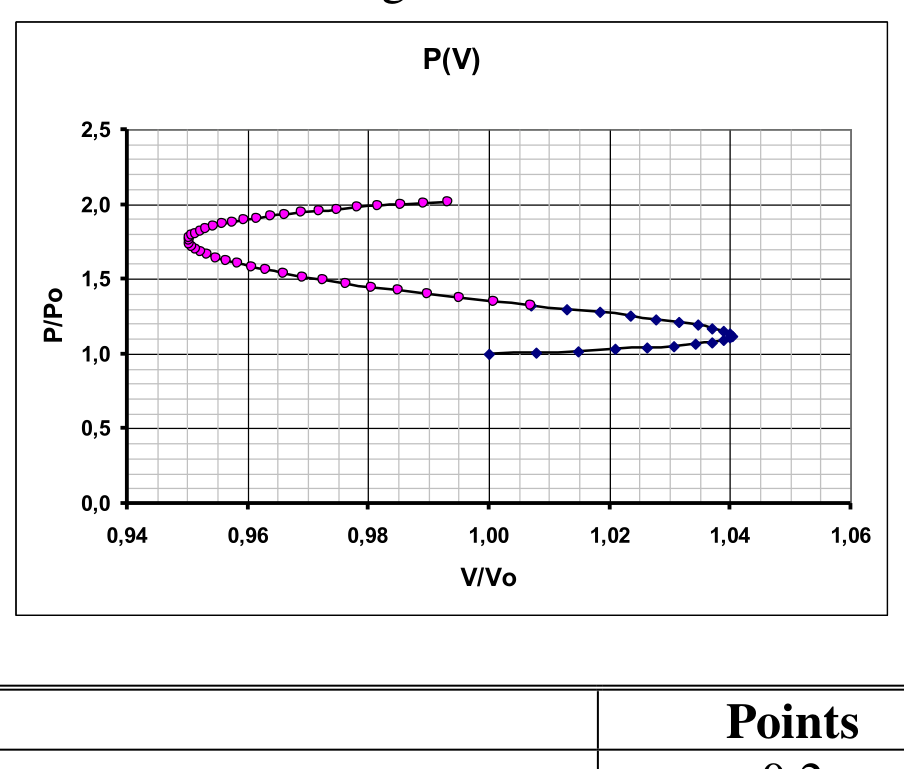
Note: Exact dependence :
, at and ;
, at and .
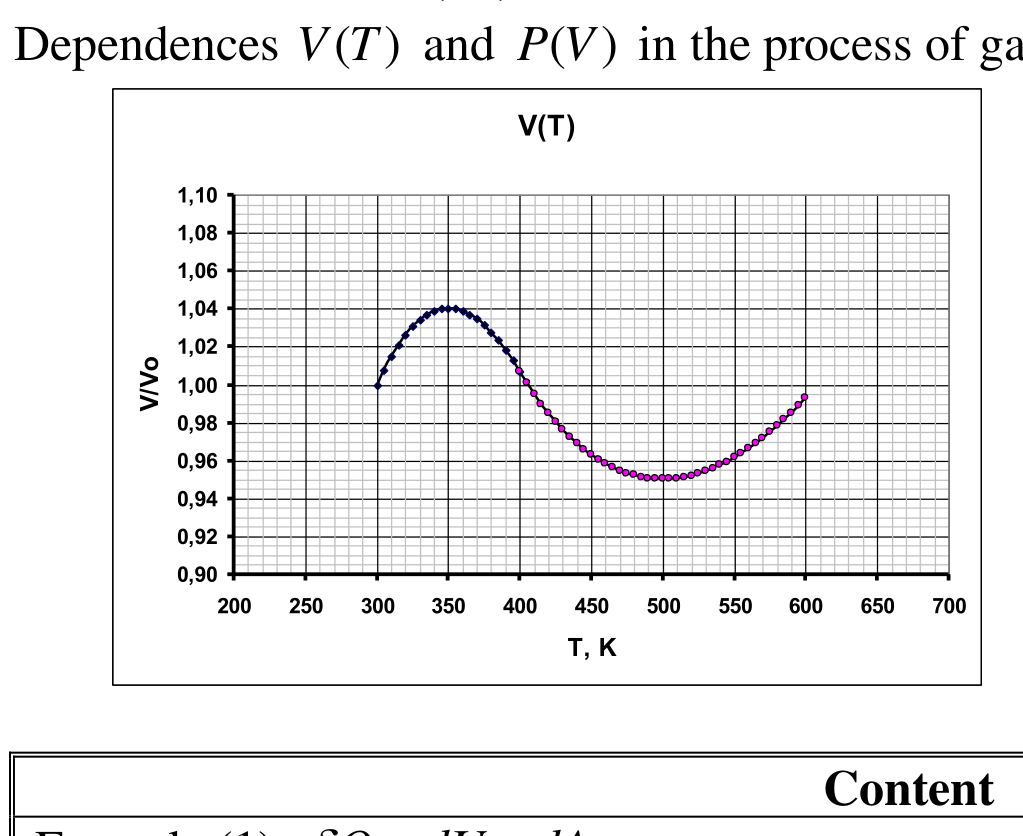
Dependences and in the process of gas heating are shown in the figures below.
| Content | Points |
|---|---|
| Formula (1): | 0.2 |
| Formula (2): | 0.2 |
| Formula (3): | 0.2 |
| Formula (4): | 0.2 |
| Formula (5): | 0.4 |
| Formula (6): | 0.2 |
| Formula (7): | 0.4 |
| Formula (8): | 0.4 |
| Formula (9): | 0.4 |
| Numerical value in formula (9): | 0.4 |
| Total | 3.0 |
Problem 1.2 (3.0 points)
The equivalent circuit of the bridge is shown in the figure below, which takes into account that the non-ideal inductance circuit is equivalent to an ideal coil and resistor connected in series, whereas the equivalent circuit of a leaky capacitor is a resistor connected in parallel to an ideal capacitor .
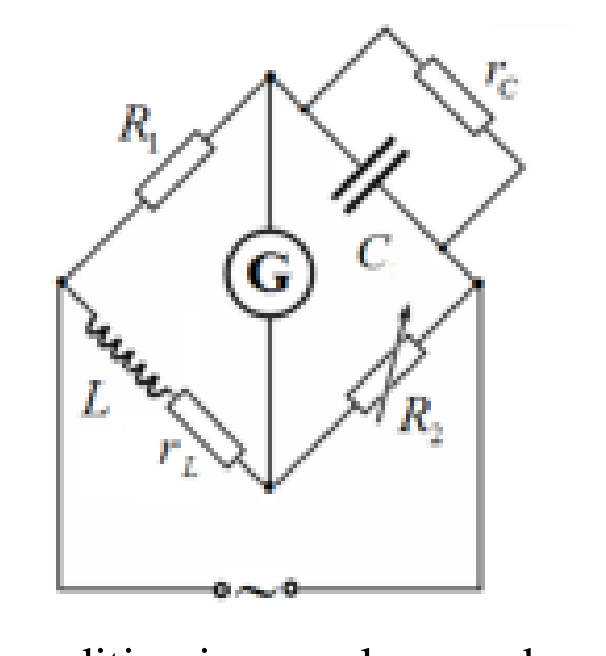
Solution 1. The bridge balance condition in complex numbers is written as
where the impedances are respectively
and
After some transformation we get from expressions (1)-(3):
While varying the frequency, this equality is not violated if both sides of the equation are equal to zero, therefore
Solution 2. Let the voltage across the capacitor be
then current through it is found as
and the current through its leakage resistance is
The total current through the upper arm containing the capacitor is
and since the bridge is balanced, the same current flows through the resistance , therefore
On the other hand, this voltage is equal to the voltage drop across the arm with the inductance
for which the voltage drop is given by
in which the current is determined by the balance equation
since
Collecting equations (1)-(9) together, we obtain
It can be seen from this equality that the frequency-independent balance condition is satisfied if both sides of the equation are equal to zero, that is, one obtains the final answer
| Content | Points |
|---|---|
| Solution 1 | |
| Equivalent circuit: All elements are correctly connected | 0.5 |
| Formula (1): | 0.3 |
| Formula (2): | 0.3 |
| Formula (3): | 0.3 |
| Formula (4): | 0.4 |
| Formula (5): | 0.4 |
| Numerical value in formula (5): | 0.2 |
| Formula (6): | 0.4 |
| Numerical value in formula (6): | 0.2 |
| Total | 3.0 |
| Solution 2 | |
| Equivalent circuit: All elements are correctly connected | 0.5 |
| Formula (1): | 0.1 |
| Formula (2): | 0.1 |
| Formula (3): | 0.1 |
| Formula (4): | 0.1 |
| Formula (5): | 0.1 |
| Formula (6): | 0.1 |
| Formula (7): | 0.1 |
| Formula (8): | 0.1 |
| Formula (9): | 0.1 |
| Formula (10): | 0.4 |
| Formula (11): | 0.4 |
| Numerical value in formula (11): | 0.2 |
| Formula (12): | 0.4 |
| Numerical value in formula (12): | 0.2 |
| Total | 3.0 |
Problem 1.3 (4.0 points)
Let a planet of mass move around the Sun in a circular orbit of radius with a speed , then the equation of motion of the planet in the projection onto the radial direction is written as
which results in
with being the gravitational constant.
Writing formula (2) for Jupiter with the index J and Earth with the index E, we get after dividing
and, on the other hand, we have according to Kepler's third law for the ratio of rotation periods
The motion of Jupiter cannot be detected with a spectrometer, but it can be done for the Sun, since it also moves around the center of mass of the Sun-Jupiter system. The speed of the Sun is easy to find from the expression
Since the Sun moves around the common center of mass of the system, and the observer is located in the same plane, according to the Doppler effect formula, the following condition is satisfied for detection
Putting together equations (3)-(6), we get the final answer
Such resolution is achievable for many modern spectrometers manufactured in different countries of the world.
| Content | Points |
|---|---|
| Formula (1): | 0.2 |
| Formula (2): | 0.2 |
| Formula (3): | 0.2 |
| Formula (4): | 0.4 |
| Formula (5): | 1.0 |
| Formula (6): | 1.0 |
| Formula (7): | 0.5 |
| Numerical value in formula (7): | 0.5 |
| Total | 4.0 |
Mathematical hints for the theoretical problems
The following formulas may be useful:
, where is a fixed number, refers to an arbitrary constant;
, where stands for an arbitrary constant;
, where stand for arbitrary constants;
, for and arbitrary ;
, for .
Оригинал в Архива: IZhO 2023 PhysTheory_eng.pdf · официални решения: IZhO-2023-Theory_multi_sol.pdf