IZhO 2023, Теория — Задача 3. Magnetron
XIX International Zhautykov Olympiad/Theoretical Competition · 2 февруари 2023 г. · 10 т.
Please read this first:
THEORETICAL COMPETITION
February 2, 2023
- The duration of the theoretical competition is 4 hours. There are three problems.
- You can use your own calculator for numerical calculations.
- You are provided with Writing sheet and additional white sheets of paper. You can use the additional sheets of paper for drafts of your solutions, but these sheets will not be graded. Your final solutions should be written on the Writing sheets. Please use as little text as possible. You should mostly use equations, numbers, figures, and plots.
- Use only the front side of Writing sheets**.** Write only inside the boxed areas.
- Start putting down your solution to each problem on a new Writing sheet.
- Fill in the boxes at the top of each Writing sheet with your country (Country), your student code (Student Code), problem number (Question Number), the progressive number of each Writing sheet (Page Number), and the total number of Writing sheets used (Total Number of Pages). If you use some blank Writing sheets for notes that you do not wish to be graded, put a large X across the entire sheet and do not include it in your numbering.
SOLUTIONS TO THE PROBLEMS OF THE THEORETICAL COMPETITION
Attention. Points in grading are not divided!
Условие
Both electric and magnetic fields act on moving charged particles, which in a certain way change the character of their motion. Everywhere below it is assumed that charged particles move in a vacuum, and the radiation of electromagnetic waves can be neglected.
In this problem, the motion of electrons, which are classical point-like particles, is considered. When carrying out numerical calculations, consider, where necessary, that an electron has a negative electric charge, whose modulus is equal to , and its mass is . The electric and magnetic constants are equal and , respectively, the Boltzmann constant is denoted as .
Electron motion in electric and magnetic fields
At the initial moment of time an electron is at rest at the origin of coordinates, and a uniform electric field with the strength is applied along the positive direction of the axis. The electron is given an initial velocity , also directed in the positive direction of the axis.
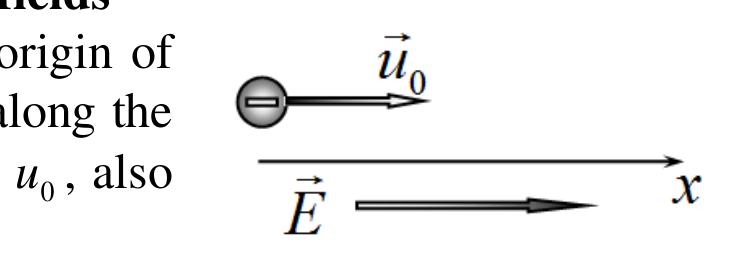
3.1 Determine the maximum value of the electron coordinate for the entire time of its motion.
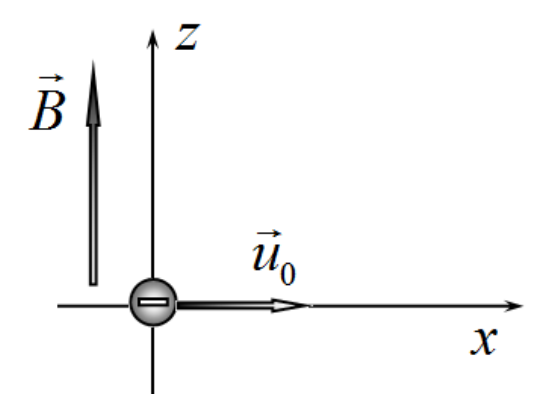
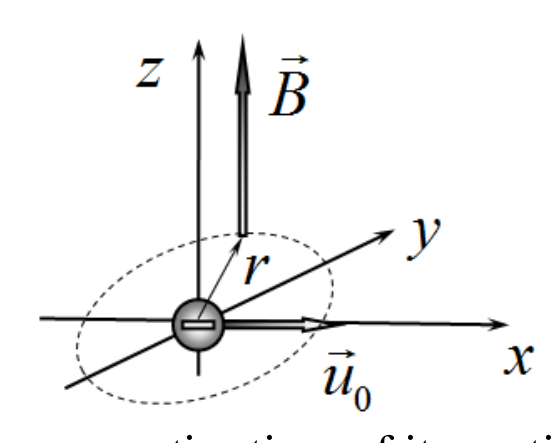
Now, at the initial moment of time , an electron is at rest at the origin of coordinates, and a uniform magnetic field with the induction is applied along the positive direction of the axis. The electron is given an initial velocity directed in the positive direction of the axis.
3.2 Determine the maximum value of the electron coordinate for the entire time of its motion.
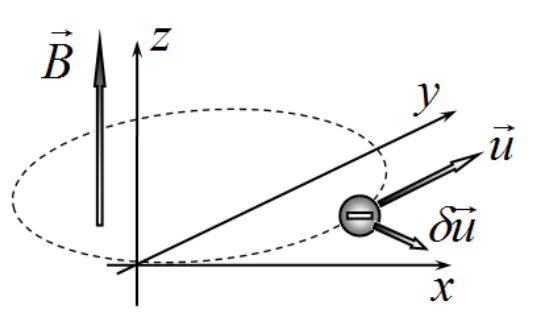
3.3 In the process of moving along the trajectory, at some moment of time, an additional velocity is given to the electron in the direction perpendicular to its current velocity and lying in the plane of its initial trajectory, such that . Determine the period of the arisen two-dimensional oscillations of the electron with respect to its initial unperturbed trajectory.
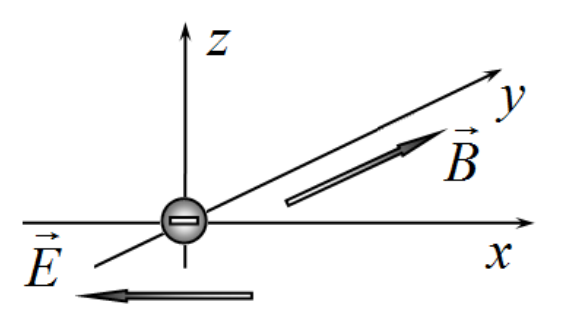
Again, at the initial moment of time an electron is at rest at the origin of coordinates, and a uniform electric field with the strength is applied along the negative direction of the axis. In addition, a uniform magnetic field with induction is created along the positive direction of the axis. The electron is released with the zero initial velocity.
3.4 Determine the maximum value of the electron coordinate for the entire time of its motion.
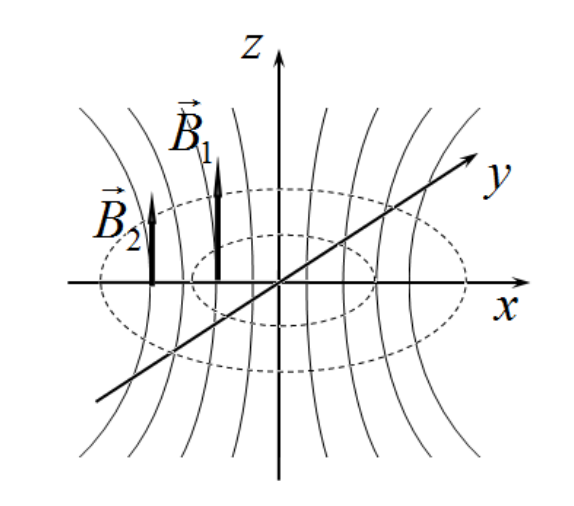
At the initial moment of time an electron is at rest at the origin of coordinates, and a magnetic field is applied along the positive direction of the axis, such that the induction in the plane depends on the distance to the axis according to the law . The electron is given an initial velocity directed in the positive direction of the axis.
3.5 Determine the maximum distance from the electron to the axis for the entire time of its motion.
In some region of space, an axisymmetric magnetic field is created with respect to the axis. At the moment of time , the magnetic field is absent, and then it begins to slowly increase, such that at all points in the plane the field induction vector is directed along the axis. After a certain period of time, the induction of the magnetic field reaches its final value and ceases to change. The final field distribution in the plane has the form
where denotes the distance to the axis, and are known quantities.
At a moment in time , the electron is at rest at some point lying in the plane. When the field is turned on, the electron begins to move along a circle in the plane, whose center lies on the axis.
3.6 Determine under what conditions for the ratio the described situation turns possible.
Cylindrical magnetron
Magnetron is an electronic electrovacuum device, in which the amount of flowing current is controlled by electric and magnetic fields. Let us consider the simplest magnetron, consisting of a conducting coaxial long cylindrical cathode and anode with radii and , respectively, located inside a vacuum tube. The lamp is placed in the center of a cylindrical solenoid, whose axis coincides with the axes of the cathode and anode, and the number of turns is with the length being equal and the diameter of . The potential difference between the cathode and the anode is constant and equal to . Consider that the electrons leaving the cathode are formed due to thermionic emission and have a zero initial velocity, neglect the space charge of the electron cloud in the lamp.
3.7 Calculate the potential difference between the cathode and a point in space located at a distance мм from the common axis of the solenoid and the lamp.
3.8 Calculate the smallest solenoid current at which the current in the magnetron between the cathode and anode vanishes completely.
3.9 Find the condition for the cathode temperature , under which the initial electron velocity can indeed be considered zero.
Отговори
Electron motion in electric and magnetic fields, 3.1
Electron motion in electric and magnetic fields, 3.2
Electron motion in electric and magnetic fields, 3.3
Electron motion in electric and magnetic fields, 3.4
Electron motion in electric and magnetic fields, 3.5
Electron motion in electric and magnetic fields, 3.6
Cylindrical magnetron, 3.7
Cylindrical magnetron, 3.8
The official solution prints the value as “0,701 А” with a decimal comma and a Cyrillic letter А for the ampere.
Cylindrical magnetron, 3.9
The official solution prints with (an extra factor ; the value K corresponds to ) and the unit with a Cyrillic letter К.
Решение
Problem 3. Magnetron
Electron motion in electric and magnetic fields
3.1 Under the action of a uniform electric field, an electron moves with a constant acceleration
which is directed in the negative direction of the axis, so the maximum value of the achieved coordinate is determined by the expression
3.2 When moving in a uniform magnetic field, the Lorentz force acts on an electron, equal to
and it moves in a circle whose radius is determined from Newton's second law
which yields
It is obvious that the maximum value of the coordinate in this case is equal to
3.3 The problem is most easily solved in the laboratory reference frame, in which the electron moves along the circle with the frequency determined by formula (5) in the form
When an electron is given a small additional speed, it begins to move along a circle that is close to the original one and intersects with it at two diametrically opposite points, which can be considered as motion along a closed two-dimensional trajectory with the period
3.4 В момент, когда координата максимальна, скорость частицы направлена вдоль оси и по закону сохранения энергии равна At the moment when the coordinate is maximum, the particle velocity is directed along the axis and, according to the law of conservation of energy, is equal to
In the projection onto the axis, the equation of motion is written in finite differences in the form
which, with account of , leads to the relation
which for the time moment sought takes the form
Solving equations (9) and (12) simultaneously, we finally obtain
3.5 Since the magnetic field does not perform any work, the electron velocity remains constant in absolute value and equal to its initial value
Let us divide the total velocity into radial and azimuthal components. The angular momentum of the electron relative to the origin is obviously equal to
and the torque of the Lorentz force about the same point is
According to the moment equation, we have
which together with the use of provides to the relation
At the moment of time when the distance to the axis is maximum, the radial velocity vanishes, and the azimuthal velocity is equal to the initial one in accordance with formula (14), so the integration of relation (18) leads to the equation
which finally gives rise to
3.6 Since the electron moves all the time along a circle, then, according to equation (5), with an increase in the magnetic field at its orbit, the derivative of the momentum changes according to the law
The electron is set in motion due to the vortex electric field, whose strength is determined by the relation
which, according to the Faraday law, includes the flux of magnetic induction through the electron orbit, equal to
The equation of Newton's second law for the acceleration of an electron in orbit has the form
The joint solution of equations (21)-(24) leads to the following equality for the magnetic field, which is called the cyclotron condition
From formula (25) we conclude that its satisfaction is possible only in the case when the electron moves in the region of a magnetic field with induction , therefore, integrating the magnetic induction given in the formulation as a function of distance, we obtain the relation
whose solution has the following form
The motion of an electron in a circle is possible only in the area in which the induction is equal , that is, at , which means that the ratio sought must lie in the interval
Cylindrical magnetron
3.7 Let the unit length of the cylindrical cathode and anode have a charge equal to , and the total length of the electrodes is . Then, according to the Gauss theorem, the electric field strength in the space between the cathode and anode is determined by the equation
which immediately yields
Here stands for the distance to the magnetron axes.
The dependence of the potential difference on the distance , by definition, is written as an integral
which in particularly for gives rise to
Solving equations (31) and (32) together, we obtain
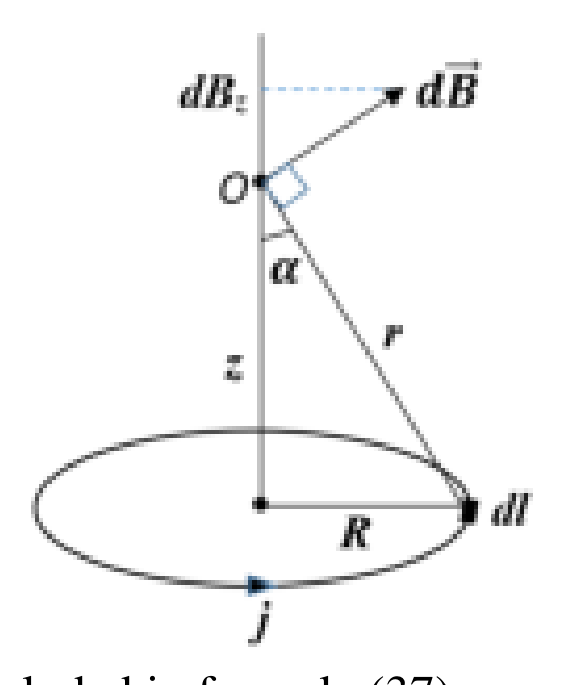
3.8 Рассмотрим тонкое кольцо радиуса , по которому протекает ток , и рассчитаем величину магнитной индукции в точке на оси кольца, отстоящей то его центра на расстоянии . Разобьем кольцо на малые элементы , тогда магнитная индукция определяется следующим законом Био-Саварра Consider a thin ring of radius , through which the current flows, and calculate the magnitude of the magnetic induction at a point on the axis of the ring, which is located at a distance from its center. Let us divide the ring into small elements , then the magnetic induction is determined by the following Biot-Savart law
in which the vector is drawn from the location of the current element to the point where the magnetic induction is sought.
It follows from geometric relations that
and since the resulting magnetic induction is directed along the axis of the ring
then, using the geometric relation , we finally obtain
Considering that the distances included in formula (37) are constant and
then after summing over all elements of the ring one finds
Let us now calculate the magnetic field induction at the center of the solenoid, since this is where the magnetron lamp is located. To do this, consider the turns located at a distance from the center from to , through which the current flows
These turns can be considered as a ring, whose magnetic induction is determined by formula (39), such that
which after integration gives the final expression
where the expression is used for the diameter.
For the motion of electrons in a magnetron, a formula is valid that is similar to formula (18) and has the form
whose integration under the conditions of constant magnetic induction and gives
On the other hand, it follows from the law of conservation of energy that
At the moment when the critical value of the current is reached, the magnetic induction near the anode becomes such that the radial velocity of the electrons vanishes, which leads to the conditions
which, using expressions (44) and (45), results in the critical value of the magnetic field
Using formula (42), we find the corresponding current in the solenoid
3.9 The initial energy of electrons in a lamp near the cathode is determined by the temperature of the cathode itself and is on the order of
This energy is obviously must be much less than the energy of electrons near the anode, i.e.
where , whence we obtain the desired estimate
which actually means the applicability of the approximation used, since the cathode temperature is usually at least two orders of magnitude lower.
| Content | Points | ||
|---|---|---|---|
| 3.1 | Formula (1): | 0.1 | 0.2 |
| Formula (2): | 0.1 | ||
| 3.2 | Formula (3): | 0.1 | 0.4 |
| Formula (4): | 0.1 | ||
| Formula (5): | 0.1 | ||
| Formula (6): | 0.1 | ||
| 3.3 | Formula (7): | 0.2 | 0.4 |
| Formula (8): | 0.2 | ||
| 3.4 | Formula (9): | 0.2 | 1.0 |
| Formula (10): | 0.2 | ||
| Formula (11): | 0.2 | ||
| Formula (12): | 0.2 | ||
| Formula (13): | 0.2 | ||
| 3.5 | Formula (14): | 0.2 | 1.4 |
| Formula (15): | 0.2 | ||
| Formula (16): | 0.2 | ||
| Formula (17): | 0.2 | ||
| Formula (18): | 0.2 | ||
| Formula (19): | 0.2 | ||
| Formula (20): | 0.2 | ||
| 3.6 | Formula (21): | 0.2 | 1.6 |
| Formula (22): | 0.2 | ||
| Formula (23): | 0.2 | ||
| Formula (24): | 0.2 | ||
| Formula (25): | 0.2 | ||
| Formula (26): | 0.2 | ||
| Formula (27): | 0.2 | ||
| Formula (28): | 0.2 | ||
| 3.7 | Formula (29): | 0.1 | 1.0 |
| Formula (30): | 0.1 | ||
| Formula (31): | 0.2 | ||
| Formula (32): | 0.2 | ||
| Formula (33): | 0.2 | ||
| Numerical value in formula (33): | 0.2 | ||
| 3.8 | Formula (34): | 0.2 | 3.2 |
| Formula (35): | 0.2 | ||
| Formula (36): | 0.2 | ||
| Formula (37): | 0.2 | ||
| Formula (38): | 0.2 | ||
| Formula (39): | 0.2 | ||
| Formula (40): | 0.2 | ||
| Formula (41): | 0.2 | ||
| Formula (42): | 0.2 | ||
| Formula (43): | 0.2 | ||
| Formula (44): | 0.2 | ||
| Formula (45): | 0.2 | ||
| Formula (46): | 0.2 | ||
| Formula (47): | 0.2 | ||
| Formula (48): | 0.2 | ||
| Numerical value in formula (48): | 0.2 | ||
| 3.9 | Formula (49): | 0.2 | 0.8 |
| Formula (50): | 0.2 | ||
| Formula (51): | 0.2 | ||
| Numerical value in formula (51): | 0.2 | ||
| Total | 10.0 |
Mathematical hints for the theoretical problems
The following formulas may be useful:
, where is a fixed number, refers to an arbitrary constant;
, where stands for an arbitrary constant;
, where stand for arbitrary constants;
, for and arbitrary ;
, for .
Оригинал в Архива: IZhO 2023 PhysTheory_eng.pdf · официални решения: IZhO-2023-Theory_multi_sol.pdf