IZhO 2024, Теория — Задача 1
XX International Zhautykov Olympiad/Theoretical Competition · 9 януари 2024 г. · 10 т.
Please read this first
THEORETICAL COMPETITION
January 9, 2024
Please read this first:
The time available for the theoretical competition is 4 hours. There are three questions.
Use only the pen provided.
You can use your own calculator for numerical calculations. If you don't have one, please ask for it from Olympiad organizers.
You are provided with Writing sheet and additional paper. You can use the additional paper for drafts of your solutions but these papers will not be checked. Your final solutions which will be evaluated should be on the Writing sheets. Please use as little text as possible. You should mostly use equations, numbers, figures and plots.
Use only the front side of Writing sheets. Write only inside the boxed area.
Begin each question on a separate sheet of paper.
Fill the boxes at the top of each sheet of paper with your country (Country), your student code (Student Code), the question number (Question Number), the progressive number of each sheet (Page Number), and the total number of Writing sheets used (Total Number of Pages). If you use some blank Writing sheets for notes that you do not wish to be evaluated, put a large X across the entire sheet and do not include it in your numbering.
At the end of the exam, arrange all sheets for each problem in the following order:
- Used Writing sheets in order.
- The sheets you do not wish to be evaluated.
- Unused sheets.
- The printed problems.
Place the papers inside the envelope and leave everything on your desk. You are not allowed to take any paper out of the room.
Attention
SOLUTIONS TO THE PROBLEMS OF THE THEORETICAL COMPETITION
Attention. Points in grading are not divided!
Условие
This problem consists of three independent parts.
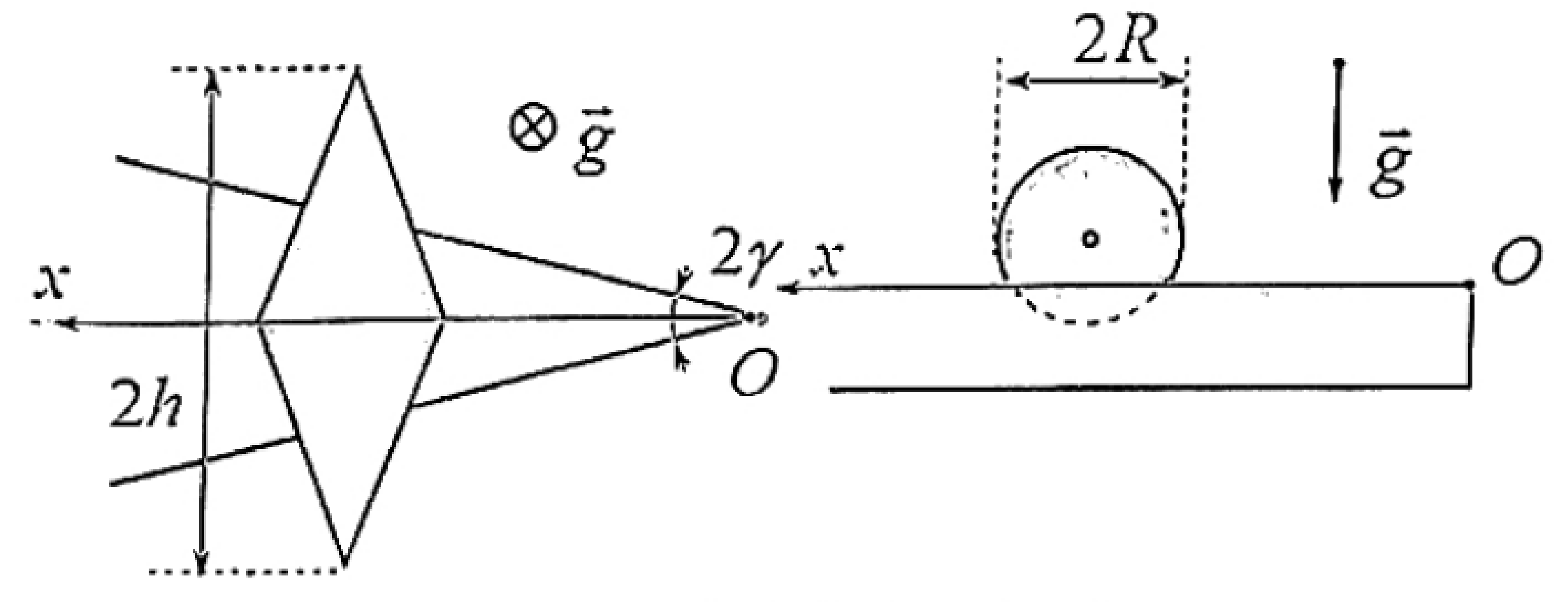
1.1 On two identical horizontal V-shaped slats (see figure below), forming a dihedral angle of (), there is a solid bicone with a base diameter of and a distance between the vertices of , representing two identical homogeneous cones, rigidly fastened by their bases. First, the bicone is held so that its center of mass is right above the vertex of the dihedral angle, symmetrically relative to its bisectoral plane. Then it is released and it begins to roll along the slats without slipping. Find the dependence of the bicone speed of translational motion of the on the coordinate measured horizontally from the vertex of the dihedral angle to the center of mass of the bicone. Calculate the speed of the bicone at . Determine the maximum angular velocity , that the bicone is to reach during its motion. Consider that the height of the slats exceeds the radius of the cone bases, and the acceleration of gravity is . [3 т.]
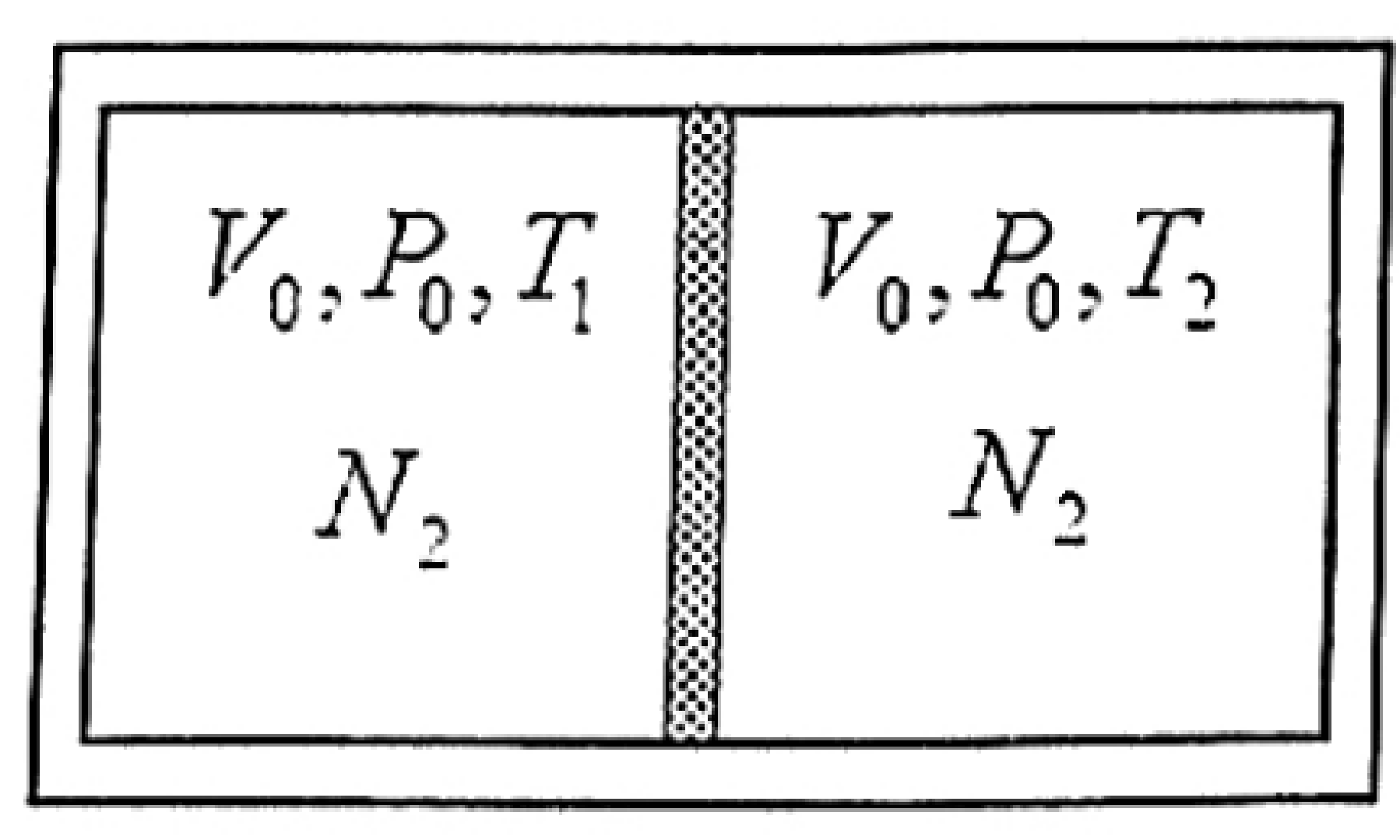
1.2 A thermally insulated vessel with a volume of is divided by a thin weightless movable heat-conducting partition into two equal parts, each containing nitrogen at a pressure . The initial temperature of nitrogen in one half of the vessel is , and it is in the other. As a result of heat exchange, the partition begins to move slowly without friction. 1) Determine the amount of heat that will be exchanged between parts of the vessel by the time complete thermodynamic equilibrium is established; 2) Calculate the minimum work that must be done to return the partition to its original position. Neglect the heat capacities of the vessel and partition. [4 т.]
1.3 An electric motor connected to a battery lifts a load of mass at a constant speed to a certain height in time . In this case, the load is tied to a thread that is wound on a uniformly rotating electric motor shaft. The time it takes to lift two loads with a total mass of to the same height turns out to be longer. 1) Find the maximum number of loads of the same mass that such an electric motor can lift; 2) Calculate the time that the electric motor is to require to uniformly lift the maximum number of loads to the height . Consider that the torque of an electric motor is proportional to the current flowing through its winding. [3 т.]
Отговори
1.1
1.2
The official solution prints the unit of Q in eq. (11) as „Дж“; the marking table gives 70.0 J.
1.3
Решение
Problem 1.1 (3.0 points)
Since the bicone rolls along the slats without slipping, its translational speed and angular speed of rotation are related through the rolling radius by the relation
The kinetic energy of the translational motion of the bicone is equal to
and the corresponding rotational energy is written as
where the moment of inertia of the bicone is introduced
The change in potential energy of the bicone during its motion is
and according to the law of conservation of energy the relation must be satisfied
From the geometric relationships the relation between the rolling radius and the coordinate is obtained in the following form
so, putting together equations (1)-(7), we get
In particular, for the value the calculations
From the same expressions (1)-(7) the dependence of the square of the angular velocity of rotation on the rolling radius is found as
which has a maximum value at , equal to
It is interesting to note that the bicone in this position actually rotates in one place, that is, its translational speed actually becomes zero in accordance with formula (1).
| Content | Points |
|---|---|
| Formula (1): | 0.2 |
| Formula (2): | 0.2 |
| Formula (3): | 0.2 |
| Formula (4): | 0.5 |
| Formula (5): | 0.2 |
| Formula (6): | 0.2 |
| Formula (7): | 0.5 |
| Formula (8): | 0.2 |
| Formula (9): | 0.2 |
| Formula (10): | 0.2 |
| Formula (11): | 0.2 |
| Numerical value in formula (11): | 0.2 |
| Total | 3.0 |
Problem 1.2 (4.0 points)
- The total internal energy of the system as a whole does not change during the process of temperature equalization, since it does not do any external work and no heat is supplied to it, that is
It follows that when the partition moves, the gas pressures in each part of the vessel, which are equal to each other in this quasi-static process, do not change. Indeed, the initial internal energy of the system is equal to
where
The internal energy at an arbitrary moment of time is
where stands for the gas pressure in both parts of the vessel, which is obtained from equations (1)-(4)
that is, the processes occurring with gases are isobaric.
Let us write down the equation of state of an ideal gas for each part of the vessel at the initial moment of time as
where and denote the number of moles of nitrogen in each half of the vessel, respectively.
In the final state, the gas is at a certain temperature and its equation of state has the form
where the total number of moles of nitrogen in the vessel is equal to
From formulas (6)-(9) we determine the final temperature of the gas in the vessel
Since the process is isobaric, the amount of heat exchanged between the two parts of the vessel is derived as
where
- When the partition returns to its original position, the work of external forces is to be minimal if the movement process is slow, quasi-equilibrium without disturbing the thermal equilibrium between both parts of the vessel
that is, unlike the previous case, in both parts of the vessel the pressure is not the same, but the temperature is, which, however, changes.
The initial volumes of each part of the vessel are determined by the Gay-Lussac law and are equal to
Let us denote the pressure in parts of the vessel as and , and the corresponding volumes as and . In accordance with the equation of state, at an arbitrary moment of time the following relations must be satisfied
In this process, the change in the internal energy of the gas in the system is equal to
and if the gas does work on external bodies, then according to the first law of thermodynamics, under the conditions of vessel thermal insulation as a whole, the supplied amount of heat becomes zero
In a quasi-static process, the work of the gas as a whole consists of the work of the gases in each part of the vessel
Writing (18)-(20) together and using equations (3), (6), (7), (9), (10), (14) and (15)-(17), we obtain
whose integration gives the final temperature
The work done by external forces on the partition to move it is opposite in sign to the work done by the gas itself, therefore, from expressions (16) and (17) the work can easily be found in the form
- Alternative solution. The process of returning the partition to its original position is adiabatic, i.e. occurs without change in entropy
The total change in entropy of an ideal gas in both parts of the vessel is equal to:
from where, using (6), (7), (10), (14), (15) we obtain the final temperature of the system
The work of the external force is spent on changing the internal energy of the gas:
| Content | Points |
|---|---|
| Formula (1): | 0.1 |
| Formula (2): | 0.1 |
| Formula (3): | 0.1 |
| Formula (4): | 0.1 |
| Formula (5): | 0.4 |
| Formula (6): | 0.1 |
| Formula (7): | 0.1 |
| Formula (8): | 0.1 |
| Formula (9): | 0.1 |
| Formula (10): | 0.4 |
| Formula (11): | 0.4 |
| Numerical value in formula (11): | 0.1 |
| Formula (12): | 0.1 |
| Formula (13): | 0.4 |
| Formula (14): | 0.1 |
| Formula (15): | 0.1 |
| Formula (16): | 0.1 |
| Formula (17): | 0.1 |
| Formula (18): | 0.1 |
| Formula (19): | 0.1 |
| Formula (20): | 0.1 |
| Formula (21): | 0.1 |
| Formula (22): | 0.2 |
| Formula (23): | 0.2 |
| Numerical value in formula (23): | 0.2 |
| Alternative solution to 2) | |
| Formula (13): | 0.4 |
| Formula (14): | 0.1 |
| Formula (15): | 0.1 |
| Formula (24): | 0.2 |
| Formula (25): | 0.4 |
| Formula (26): | 0.2 |
| Formula (27): | 0.2 |
| Numerical value in formula (27): | 0.2 |
| Total | 4.0 |
Problems 1.3 (3.0 points)
The power of the battery is spent on mechanical work of lifting the load, as well as on the power of thermal losses on the internal resistance of the battery and on the ohmic resistance of the motor winding. If the torque required to uniformly lift a load of mass is equal to and the shaft rotates at an angular speed , where is the angle of rotation of the shaft when lifting the load to the height , then according to the law of conservation of energy:
where is the emf of the battery, designates the current strength that creates the torque necessary to lift a load of mass .
Taking into account the proportionality of torque to current strength
with being the proportionality coefficient, equation (1) is rewritten in the form
Obviously, to uniformly lift a load of mass , twice the torque and, accordingly, twice the current are required. If the shaft rotation speed is equal to , where is the time of lifting the load , then the corresponding equation has the form:
For uniform lifting of a load with a mass of , the required current is equal to . If this load is lifted in time at a speed of , then the corresponding equation looks like this:
From equations (3)-(5) is easily expressed through :
whence the time for lifting a load of mass is equal to
From the condition
we find that , which means that the number of loads should not exceed
The lifting time of loads is equal to
| Content | Points |
|---|---|
| Formula (1): | 0.3 |
| Formula (2): | 0.1 |
| Formula (3): | 0.2 |
| Formula (4): | 0.2 |
| Formula (5): | 0.2 |
| Formula (6): | 0.2 |
| Formula (7): | 0.2 |
| Formula (8): | 0.4 |
| Formula (9): | 0.4 |
| Numerical value in formula (9): | 0,2 |
| Formula (10): | 0,4 |
| Numerical value in formula (10): | 0,2 |
| Total | 3.0 |
Mathematical hint for the theoretical competition
Mathematical hint for the theoretical competition
The following formulas may be useful:
, where is a fixed number, refers to an arbitrary constant;
, where stands for an arbitrary constant;
, for and any value of ;
, for ;
, for .
Оригинал в Архива: IZhO-2024-Th_eng.pdf · официални решения: IZhO-2024-Theory_multi_sol.pdf