IZhO 2024, Теория — Задача 2. Lagrange points
XX International Zhautykov Olympiad/Theoretical Competition · 9 януари 2024 г. · 10 т.
Please read this first
THEORETICAL COMPETITION
January 9, 2024
Please read this first:
The time available for the theoretical competition is 4 hours. There are three questions.
Use only the pen provided.
You can use your own calculator for numerical calculations. If you don't have one, please ask for it from Olympiad organizers.
You are provided with Writing sheet and additional paper. You can use the additional paper for drafts of your solutions but these papers will not be checked. Your final solutions which will be evaluated should be on the Writing sheets. Please use as little text as possible. You should mostly use equations, numbers, figures and plots.
Use only the front side of Writing sheets. Write only inside the boxed area.
Begin each question on a separate sheet of paper.
Fill the boxes at the top of each sheet of paper with your country (Country), your student code (Student Code), the question number (Question Number), the progressive number of each sheet (Page Number), and the total number of Writing sheets used (Total Number of Pages). If you use some blank Writing sheets for notes that you do not wish to be evaluated, put a large X across the entire sheet and do not include it in your numbering.
At the end of the exam, arrange all sheets for each problem in the following order:
- Used Writing sheets in order.
- The sheets you do not wish to be evaluated.
- Unused sheets.
- The printed problems.
Place the papers inside the envelope and leave everything on your desk. You are not allowed to take any paper out of the room.
Attention
SOLUTIONS TO THE PROBLEMS OF THE THEORETICAL COMPETITION
Attention. Points in grading are not divided!
Условие
Two body problem
Consider the two-body problem. Two massive bodies with masses , and respectively, move only under the influence of the force of gravitational interaction in circular orbits around a common center of mass . The distance between the bodies remains unchanged and equal to .
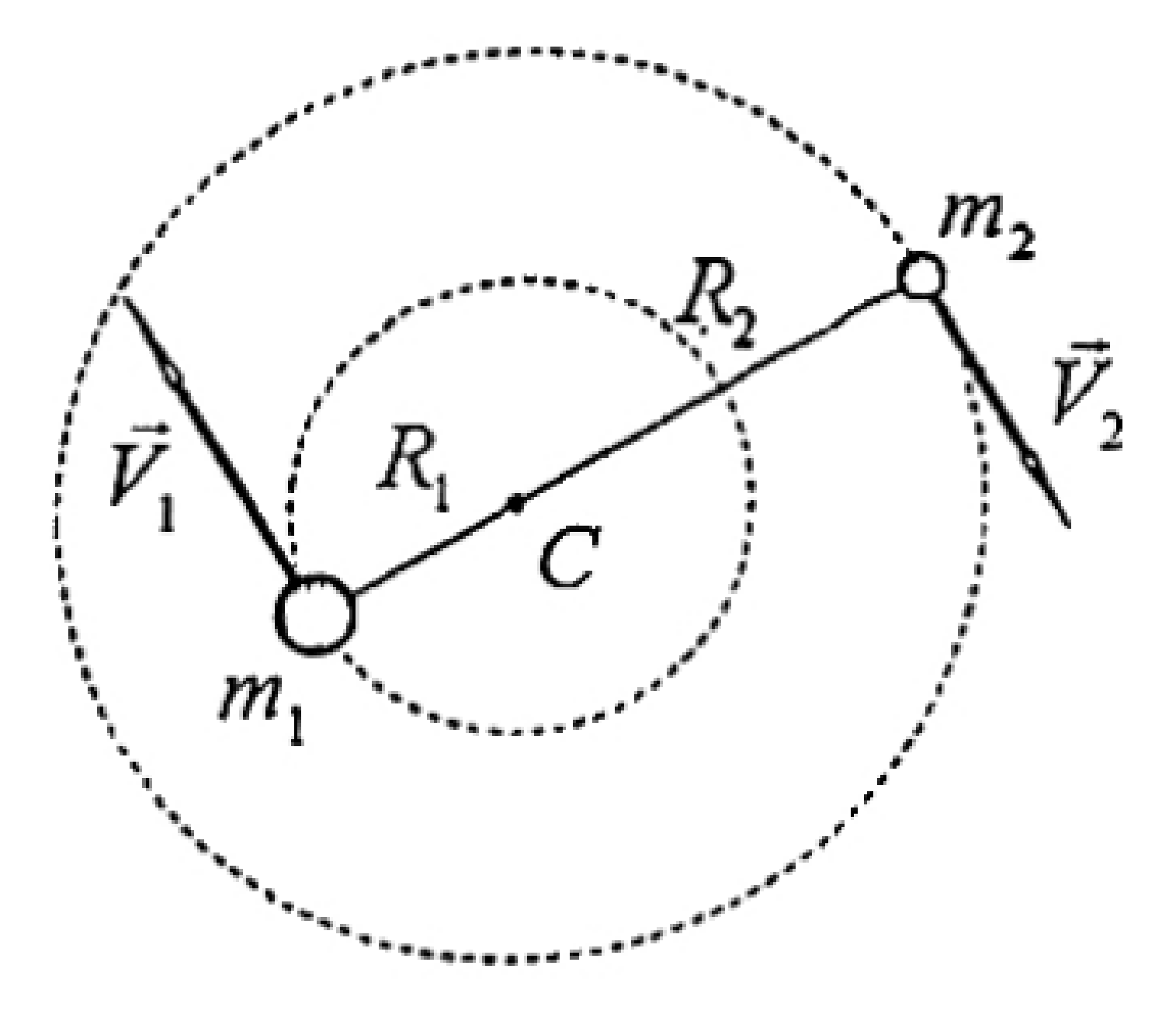
2.1 Find the radii and of the trajectories of the bodies. Express your answer through the quantities . [0,4 т.]
2.2 Find the angular velocity of the bodies rotations. Express your answer through the quantities and the gravitational constant . [0,2 т.]
Lagrange points in a three-body system
Lagrange points, libration points (Latin librātiō – swinging) or L-points are points in the space of a system of two massive bodies in which a third body with negligible mass, not affected by any other forces other than gravitational ones from the first two, can remain motionless relative to these bodies.
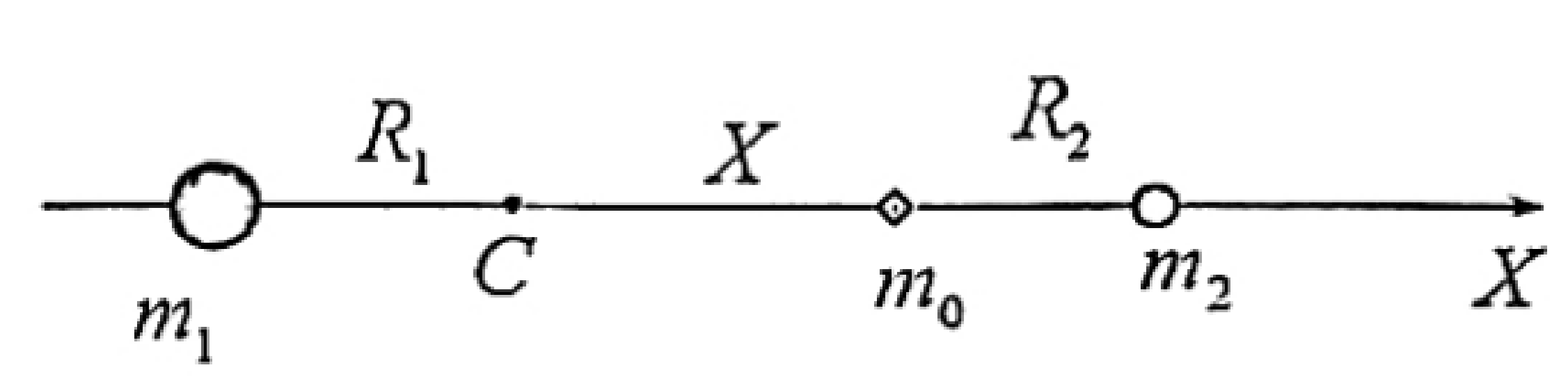
Consider adding a third body to the system described above, the mass of which is significantly less than the masses of the first two bodies, . Introduce the axis along a straight line passing through the bodies , as shown in the figure. The origin is compatible with the center of mass . To simplify mathematical transformations, use the following quantities:
- as a unit of length, use the distance between bodies ; the position of a small body is determined by the dimensionless coordinate , which can vary from minus to plus infinity;
- as a unit of force use the quantity ;
- introduce the dimensionless parameter .
2.3 Obtain an exact equation for determining the coordinates of Lagrange points lying on the axis. In addition to the desired coordinate, this equation should include only the parameter . [2 т.]
2.4 Draw a schematic graph of the projection onto the axis of the force acting on a small body from two massive bodies at . Express your answer in terms of relative units and . [0,8 т.]
2.5 Determine the possible number of Lagrange points that exist on the axis. [0,3 т.]
2.6 Calculate the numerical values of the coordinates of these points with an error not exceeding if . [0,9 т.]
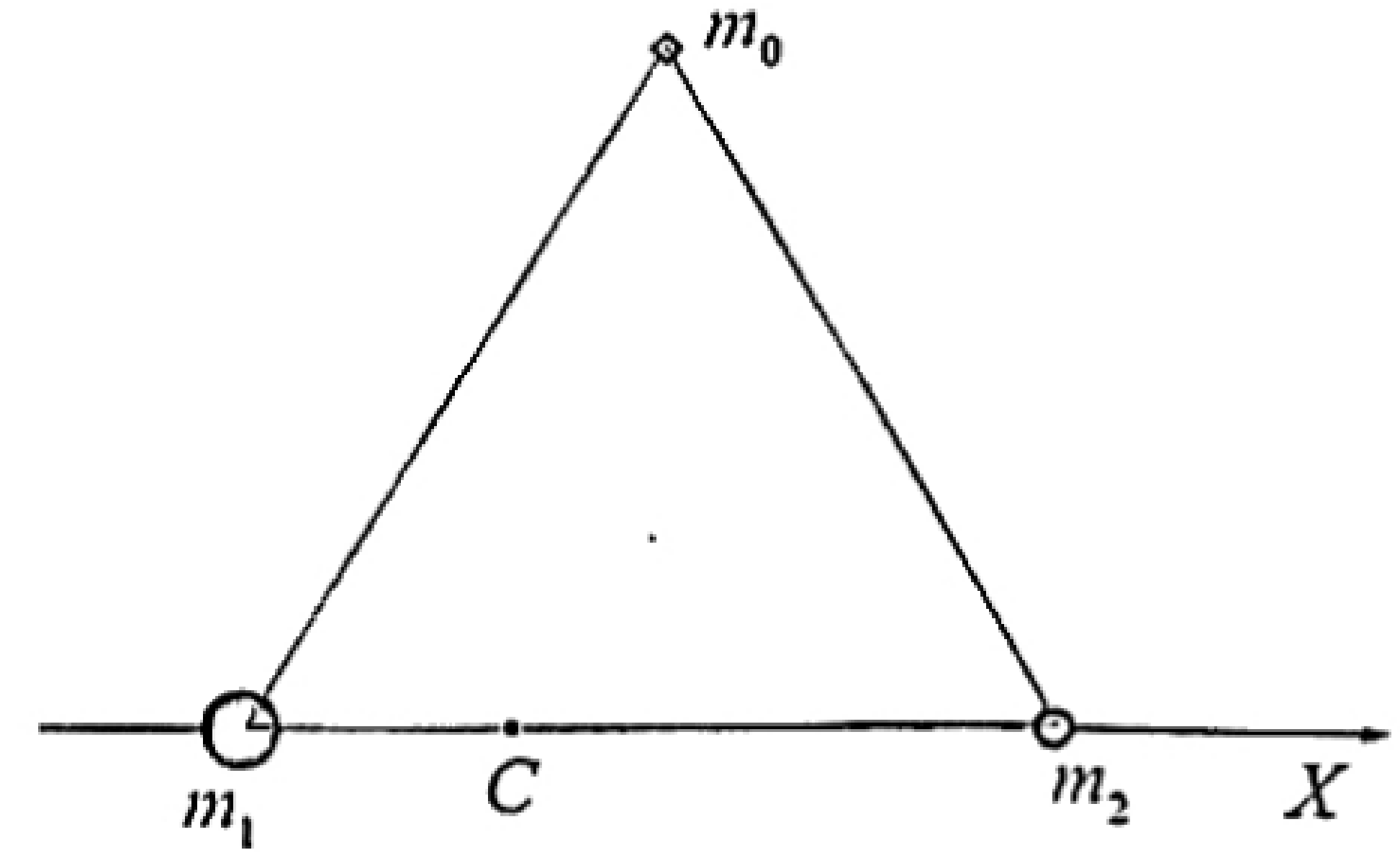
2.7 Prove that the point lying at the vertex of a regular triangle constructed on the segment is a Lagrange point. [1 т.]
Lagrange points in the Solar System
For calculations, use the following numerical values of astronomical quantities: solar mass ; Earth mass ; the Earth's orbit can be considered a circle with radius ; Jupiter's orbital period around the Sun is 11.9 Earth years.
SOHO is a solar observing spacecraft, a joint project of ESA and NASA, which was launched on December 2, 1995 and began operations in May 1996. The device is located on the straight line connecting the Sun and the Earth, its position relative to the Earth remains practically unchanged over time.
2.8 Determine at what distance from the Earth the SOHO spacecraft is located. Express the formula in terms of the ratio of the masses of the Earth and the Sun and the radius of the Earth's orbit. Calculate the numerical value of this distance. [1,6 т.]
On December 25, 2021, a spacecraft equipped with the James Webb infrared telescope was successfully launched from the Kourou spaceport using an Ariane 5 rocket. In January 2022, this device reached its permanent deployment point. The position of the telescope is to remain virtually unchanged relative to the Earth, and it is assumed to stay in the Earth shadow all the time.
2.9 Determine at what distance from the Earth the James Webb telescope is located. Express your answer in terms of the Earth-to-Sun mass ratio and the radius of the Earth's orbit. Calculate the numerical value of this distance. [1,4 т.]
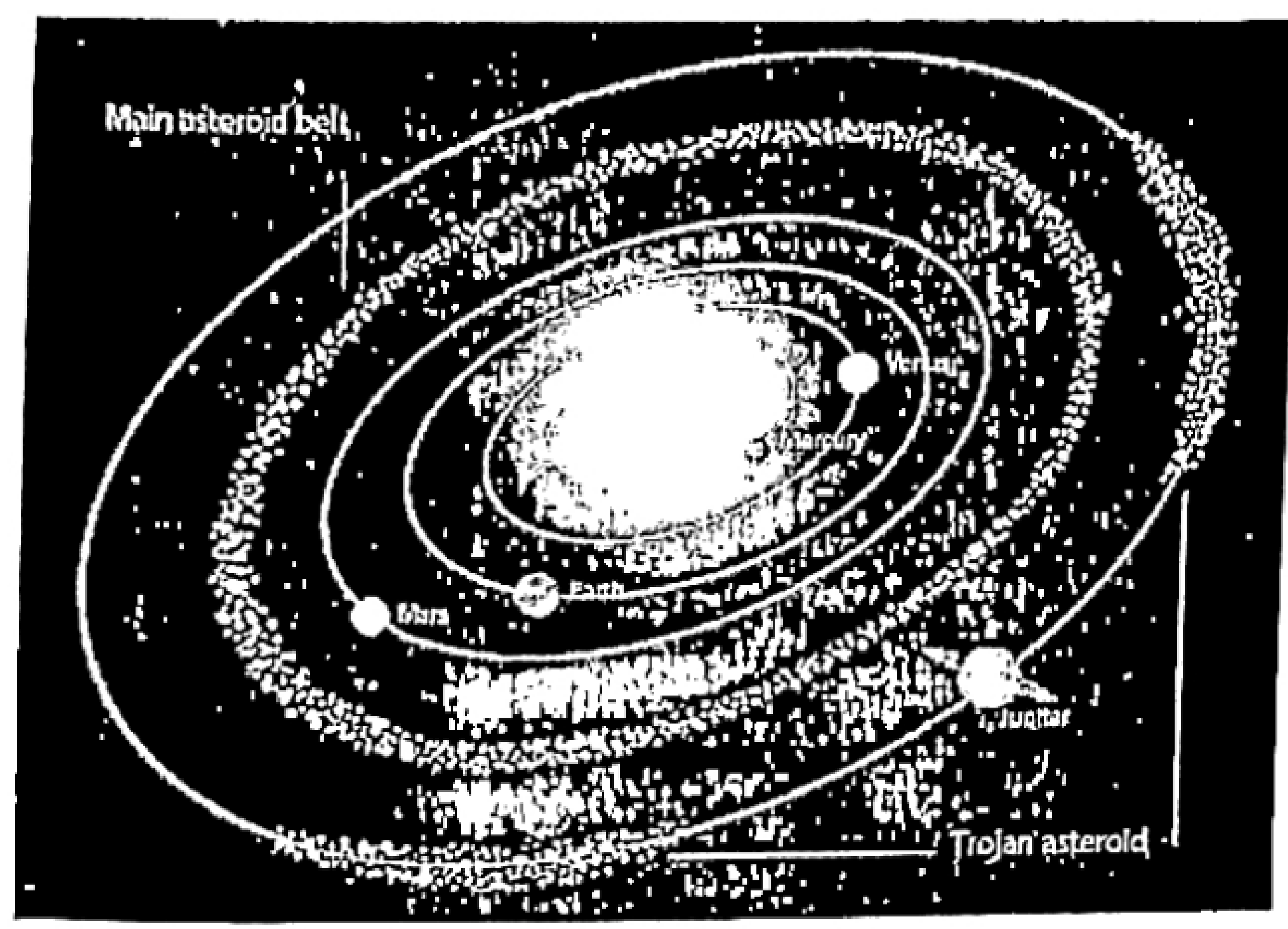
Small planets, called asteroids, are distributed extremely unevenly in the Solar System: in addition to the well-known asteroid belt, located between the orbits of Mars and Jupiter, there are two large groups of asteroids moving near the orbit of Jupiter. These groups of asteroids are called "Trojan" asteroids.
2.10 Calculate the distances from Jupiter to the centers of groups of Trojan asteroids. [1,4 т.]
Отговори
2.1
2.2
2.3
2.4 Graph of with three branches and vertical asymptotes at and (see the official solution).
2.5 3
2.6
For the official solution reverses the direction of the axis, so is measured on the side of .
2.7 Proof: the angular velocity of at the vertex equals (official solution, eqs. (17)–(20)).
2.8
2.9
2.10
Решение
Two body problem
2.1 The radii of the bodies' orbits are equal to the distances from the bodies to the center of mass and are determined from the equations
and we find the required radii of trajectories
2.2 To calculate the angular velocity of bodies rotation, we write the equation of Newton's second law for one of the bodies, for example for the first, in the form
which, taking into account equation (3), gives
Lagrange points in a three-body system
2.3 The expression for the projection of the force acting on a small body follows from Newton's law of universal gravitation, which, taking into account the direction of the forces, yields
Taking into account the dimensionless relations given in the problem formulation, we obtain an expression for the projection of force in relative units
The equation of Newton's second law for a small body is
having nondimensionalized it by the given values, we obtain the required equation for determining the coordinate
2.4 To construct a graph of function (8), it is enough to construct graphs of functions describing attraction to the body (two branches with an asymptote at – graph 1 in the figure) and attraction to the body (two branches with an asymptote at – graph 2 in the figure) and sum them up (graph 3 in the figure). This graph has three branches.
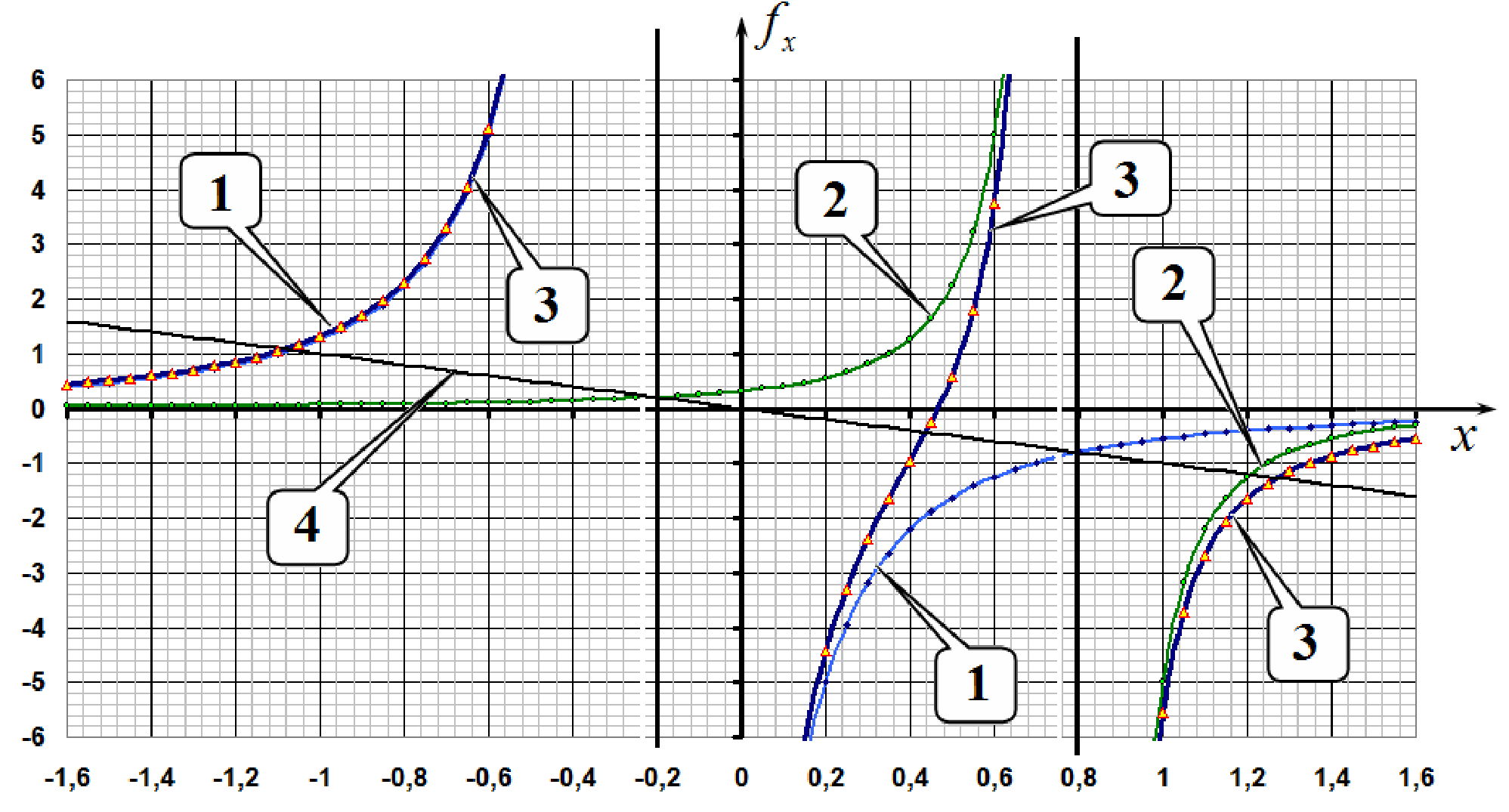
2.5 On the constructed graph we draw a straight line described by the equation . The coordinates of the points of intersection of this line with the graph of the dependence are the real roots of equation (10), i.e. are the coordinates of Lagrange points lying on the axis. As follows from the construction, there are exactly 3 such points.
2.6 Equation (10) is a fifth degree equation and therefore cannot be solved analytically. However, the problem formulation requires calculating numerical values with a low error. To do this, it is enough to calculate the numerical values of the force acting on a small body with a step of change in equal to 0.1, and determine the interval in which the corresponding root is located.
Let us calculate the value of the coordinate of the Lagrange point , located between the bodies and . For this point, equation (10) can be rewritten as
The table below shows the values of the left and right hand sides of equation (11) at
| 0,2 | 0,3 | 0,4 | 0,5 | 0,6 | |
|---|---|---|---|---|---|
| 4,44 | 2,40 | 0,97 | -0,59 | -3,75 |
It follows from the table that the root of the equation lies in the range from 0.4 to 0.5, i.e.
For the coordinate of the point lying behind the body ,, we have the equation
and in the following table the values of the left and right hand sides of this equation are calculated
| 1 | 1,1 | 1,2 | 1,3 | 1,4 | |
|---|---|---|---|---|---|
| 5,56 | 2,70 | 1,66 | 1,16 | 0,87 |
From the data in this table it follows that the root of this equation lies in the range between 1.2 and 1.3, i.e.
Finally, for point lying behind body we have the equation (here the direction of the axis is changed)
and the following table shows the results of similar calculations
| 0,8 | 0,9 | 1 | 1,1 | 1,2 | |
|---|---|---|---|---|---|
| 2,30 | 1,70 | 1,31 | 1,04 | 0,85 |
from which it follows that the root of equation (15) lies in the range from 1.0 to 1.1, and, therefore, the coordinate of the Lagrange point is found as
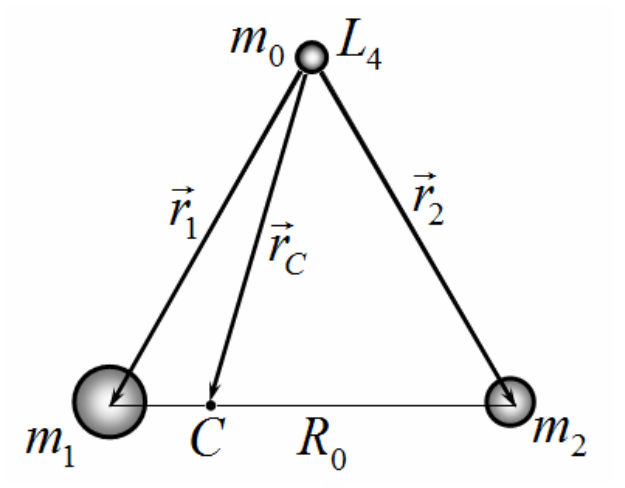
2.7 To prove that the vertex of an equilateral triangle is the Lagrange point , we write the expression for the total force acting on a body of small mass in a vector form:
The expression on the right hand side of formula (17) is expressed through the radius vector of the center of mass
then the equation of Newton's second law for this body in projection onto the direction of the vector has the form:
From this equation it follows that the angular velocity of the body is equal to
which coincides with the angular velocity of rotation of massive bodies (6), therefore the position of the body remains unchanged relative to the massive bodies. Therefore, the vertex of an equilateral triangle is indeed a Lagrange point.
Lagrange points in the Solar System
2.8 In order for the SOHO spacecraft to remain unchanged relative to the Earth and the Sun, it must be at the Lagrange point . In order to determine its position, it is necessary to solve equation (11). First we calculate the value of the parameter for the Sun-Earth system:
This value is significantly less than 1, so the distance from the spacecraft to the Earth is significantly less than the radius of the Earth's orbit. In the used system of units we denote , then from equation (11) we obtain
Since , we can use the expansion and in this case equation (22) is significantly simplified and its solution is obtained as , that is, the required distance is equal to
2.9 Obviously, the James Webb telescope is located at the Lagrange point , therefore, to determine its position, it is necessary to solve equation (13) using a method similar to the method in 2.8:
i.e. the space telescope is located at the same distance from the Earth (only on the other side):
2.10 If an asteroid accidentally ends up at the Lagrange point , or the point symmetrical to it for the Jupiter-Sun system, then its position relative to Jupiter and the Sun remains unchanged for a long time. Asteroids located at other points constantly change their position relative to Jupiter and the Sun. Consequently, the centers of groups of Trojan asteroids are located at the lateral Lagrange points. Therefore, the distance from Jupiter to these points is equal to the distance from Jupiter to the Sun. The mass of Jupiter is significantly less than the mass of the Sun, so the distance between them is almost equal to the radius of Jupiter's orbit, which can be found using Kepler's third law
where year stands for the period of rotation of the Earth around the Sun.
| Content | Points | ||
|---|---|---|---|
| 2.1 | Formula (1): | 0.1 | 0.4 |
| Formula (2): | 0.1 | ||
| Formula (3): | 0.1 | ||
| Formula (4): | 0.1 | ||
| 2.2 | Formula (5): | 0.1 | 0.2 |
| Formula (6): | 0.1 | ||
| 2.3 | Formula (7): | 0.5 | 2.0 |
| Formula (8): | 0.5 | ||
| Formula (9): | 0.5 | ||
| Formula (10): | 0.5 | ||
| 2.4 | Positions of vertical asymptotes on the graph | 0.2 | 0.8 |
| 3 branches of the graph | 3x0.2=0,6 | ||
| 2.5 | Straight line on the graph | 0.2 | 0.3 |
| Three intersection points are indicated, corresponding to 3 Lagrange points | 0.1 | ||
| 2.6 | For each point: - position is pointed; - numerical value is obtained. | 3x(0.1+0.2) =0.9 | 0.9 |
| 2.7 | Formula (17): | 0.2 | 1.0 |
| Formula (18): | 0.2 | ||
| Formula (19): | 0.3 | ||
| Formula (20): | 0.3 | ||
| 2.8 | Numerical value in equation (21): | 0.2 | 1.6 |
| Exact equation (22): | 0.2 | ||
| Formula (23): | 0.7 | ||
| Numerical value in formula (23): . | 0.5 | ||
| 2.9 | Formula (24): | 0.2 | 1.4 |
| Formula (25): | 0.7 | ||
| Numerical value in formula (25): . | 0.5 | ||
| 2.10 | Formula (26): | 1.0 | 1.4 |
| Numerical value in formula (26): | 0.4 | ||
| Total | 10.0 |
Mathematical hint for the theoretical competition
Mathematical hint for the theoretical competition
The following formulas may be useful:
, where is a fixed number, refers to an arbitrary constant;
, where stands for an arbitrary constant;
, for and any value of ;
, for ;
, for .
Оригинал в Архива: IZhO-2024-Th_eng.pdf · официални решения: IZhO-2024-Theory_multi_sol.pdf