IZhO 2024, Теория — Задача 3. Geometric optics and photodetector
XX International Zhautykov Olympiad/Theoretical Competition · 9 януари 2024 г. · 10 т.
Please read this first
THEORETICAL COMPETITION
January 9, 2024
Please read this first:
The time available for the theoretical competition is 4 hours. There are three questions.
Use only the pen provided.
You can use your own calculator for numerical calculations. If you don't have one, please ask for it from Olympiad organizers.
You are provided with Writing sheet and additional paper. You can use the additional paper for drafts of your solutions but these papers will not be checked. Your final solutions which will be evaluated should be on the Writing sheets. Please use as little text as possible. You should mostly use equations, numbers, figures and plots.
Use only the front side of Writing sheets. Write only inside the boxed area.
Begin each question on a separate sheet of paper.
Fill the boxes at the top of each sheet of paper with your country (Country), your student code (Student Code), the question number (Question Number), the progressive number of each sheet (Page Number), and the total number of Writing sheets used (Total Number of Pages). If you use some blank Writing sheets for notes that you do not wish to be evaluated, put a large X across the entire sheet and do not include it in your numbering.
At the end of the exam, arrange all sheets for each problem in the following order:
- Used Writing sheets in order.
- The sheets you do not wish to be evaluated.
- Unused sheets.
- The printed problems.
Place the papers inside the envelope and leave everything on your desk. You are not allowed to take any paper out of the room.
Attention
SOLUTIONS TO THE PROBLEMS OF THE THEORETICAL COMPETITION
Attention. Points in grading are not divided!
Условие
In this problem, the laws of geometric optics are to be studied using a photodetector, which is a device for converting light energy into electrical energy. It is assumed that the absorbing surface of the photodetector is flat and when it is connected to a milliammeter, it shows a current value proportional to the power of the absorbed electromagnetic radiation.
Geometric optics is a branch of optics that studies the laws of light propagation in transparent media, the reflection of light from mirror-reflecting surfaces, and the principles of constructing images when light passes through optical systems without taking into account its wave properties. The basic concept of geometric optics is a light beam. This implies that the direction of the flow of radiant energy (path of the light beam) does not depend on the transverse dimensions of the light beam. Let us recall the laws of geometric optics necessary for this problem solution.
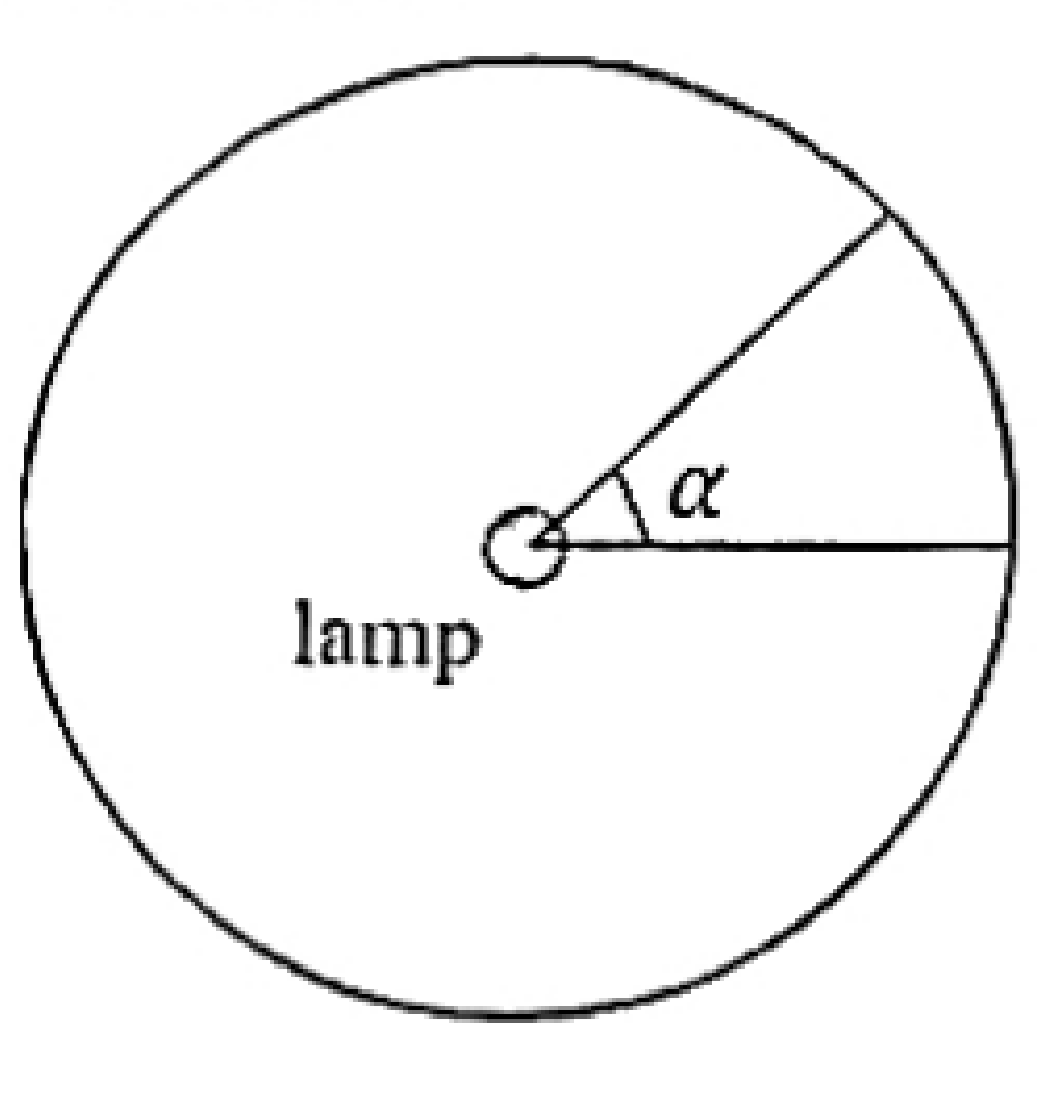
3.1 When reflected from a flat surface, the incident and reflected rays lie in the same plane with the normal at the point of incidence. Let the incident ray make an angle with the normal, and the reflected ray make an angle . Write down the relationship between these angles. [0,2 т.]
3.2 When light falls from air onto a flat surface of a material with refractive index n, the incident and refracted rays also lie in the same plane with .the normal at the point of incidence. Let the incident ray make an angle with the normal, and the refracted ray make an angle . Write down the relationship between these angles. [0,2 т.]
In the following parts of this problem, we consider only situations in which, in the processes of light refraction, the above-mentioned angles are small and the approximation of paraxial optics holds.
3.3 Rewrite the answer to 3.2 in the case of small angles of incidence and refraction. [0,2 т.]
In this problem, the radiation source is assumed to be a very long, thin cylindrical lamp, the surface of which emits equally in all directions.
3.4 Let the radiation power of the lamp from its entire surface be . Determine the radiation power concentrated in a plane angle as shown in the figure. [0,4 т.]
Thin plate
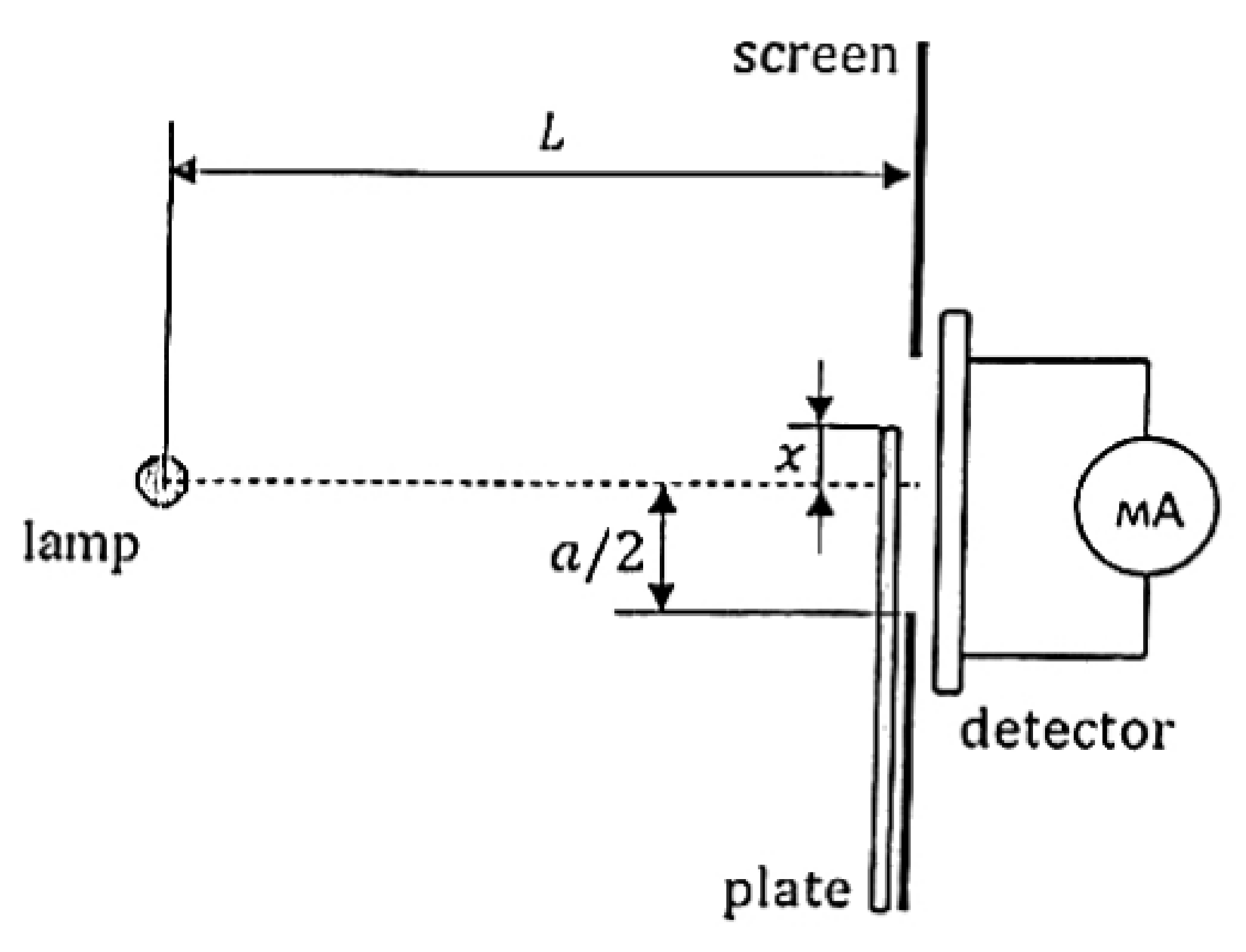
Let the light source described above illuminate an opaque screen in which a rectangular slit wide is made. The lamp is located parallel to the edges of the slit directly opposite its center at a distance of , and immediately behind the slit the surface of the photodetector is placed in such a way that it captures the entire luminous flux passing through the slit. The photodetector itself is connected to a milliammeter. A thin rectangular plate can move in parallel along the screen, the upper edge of which is parallel to the edges of the slit, while the material of the plate is translucent with a transmittance coefficient of . In the absence of the plate, the milliammeter shows the current value .
3.5 Let now be the coordinate from the center of the slit to the edge of the plate with the axis vertically directed upward. Plot a graph of the deviation of the milliammeter readings in milliammeteres from the initial reading from the coordinate in the range of to . Explicitly indicate the coordinates of all characteristic points on the graph. [3,5 т.]
Thick plate
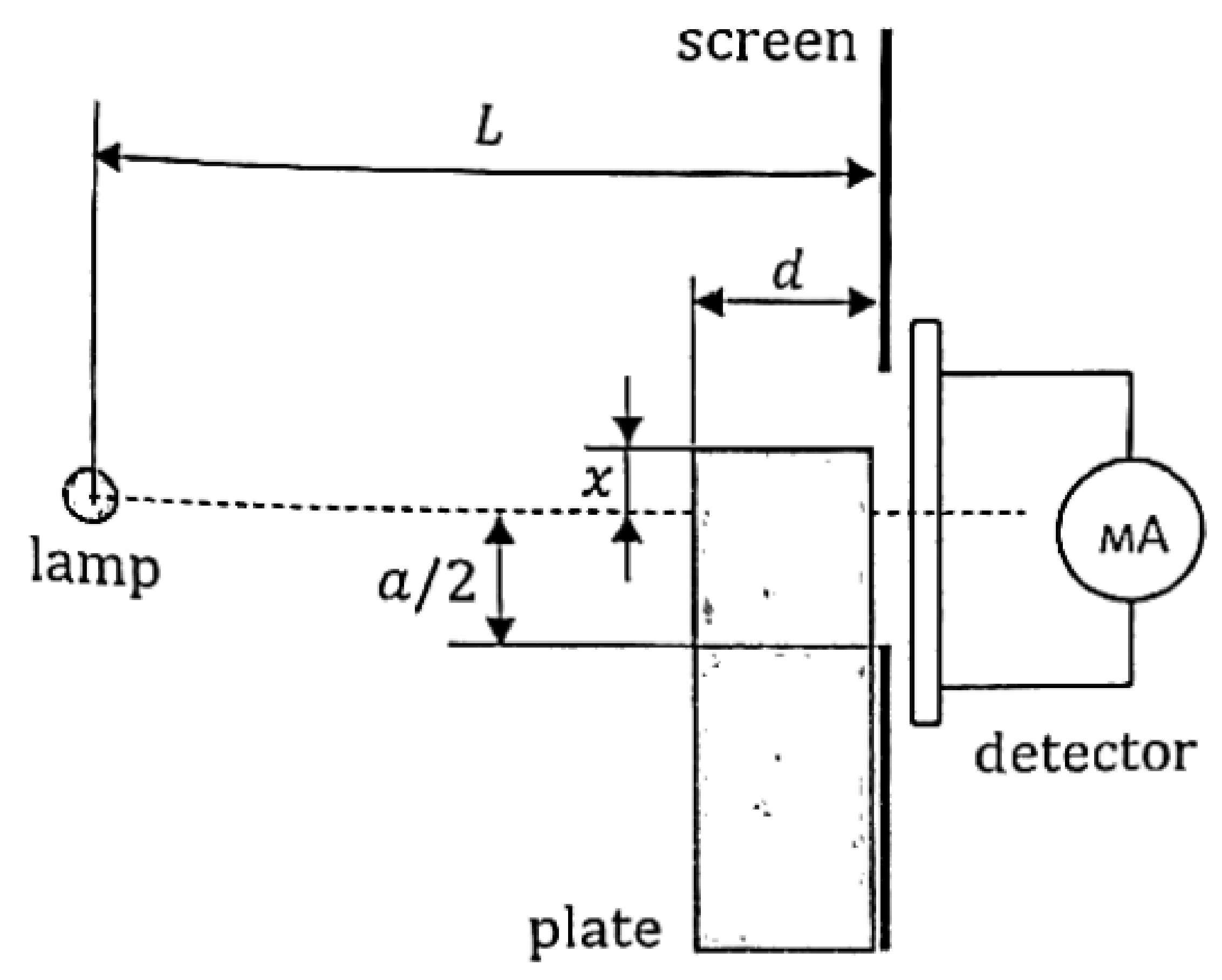
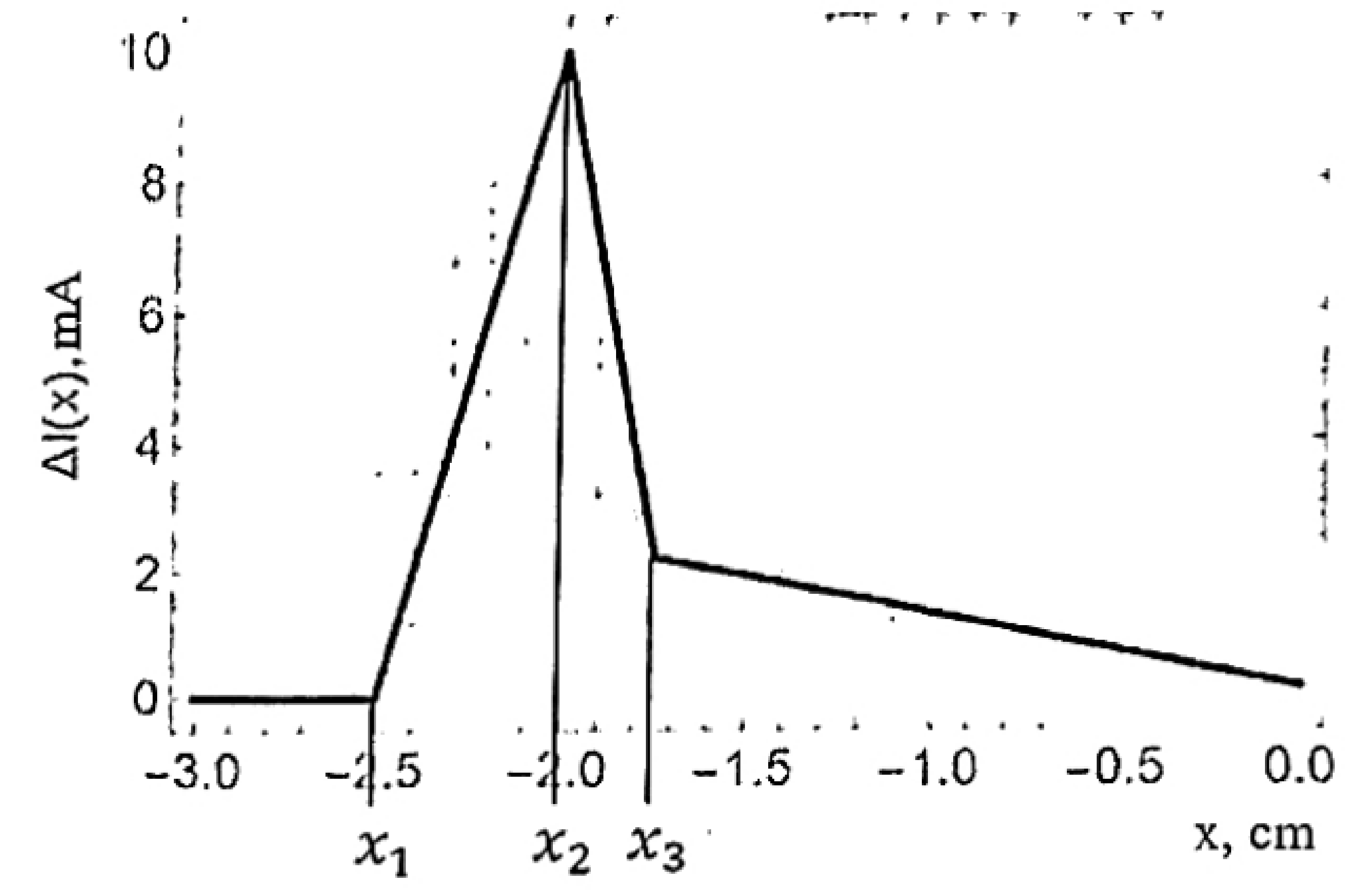
Let us leave the observation scheme the same, but replace the thin plate with a thick plate of thickness , while its horizontal surface is a perfectly reflective mirror on both sides, and the refractive index of the material is . For this part, consider the numerical values of the parameters and unknown. For clarity, the layout diagram is shown in Figure 1, and Figure 2 shows the corresponding measurement results in the range of changes in the coordinate from to and three characteristic points of the graph are marked. Here is the deviation of the milliammeter readings in milliammeteres from the initial reading in the absence of the plate.
3.6 Express the coordinate values of point in terms of the values . [0,2 т.]
3.7 Express the coordinate values of point in terms of the values . [0,1 т.]
3.8 Express the value of at point in terms of the quantities and . [0,4 т.]
3.9 Express the coordinate values of point in terms of the values . [0,8 т.]
3.10 Find the slope coefficient of the straight line in the area to the right of point and express it through the quantities . [0,8 т.]
3.11 Based on the graph and parameters obtained in 3.6-3.10, determine the numerical values of the parameters , as well as the ratio . [1 т.]
3.12 Based on the obtained numerical data, construct the right side of the graph as the coordinate changes from 0.00 cm to 3.00 cm, indicating the coordinates of all characteristic points on the graph. [2,2 т.]
Отговори
3.1
3.2
3.3
3.4
3.5
3.6
3.7
3.8
3.9
3.10
3.11
English official solution; the Kazakh-language copy gives n = 1.34, τ = 0.960, and the Russian copy n = 1.3.
3.12
Решение
3.1 According to the law of light reflection, the following relation holds
3.2 According to Snell's law of refraction of light, the following relation also holds
3.3 At small angles, the sines can be replaced by the arguments themselves, which leads to the expression
3.4 Since the lamp radiates uniformly in all directions, the required radiation power is
Thus, the radiation power of the lamp in a certain direction is determined by the corresponding angle.
Thin plate
3.5 To solve the problem, let's draw the figure shown below.
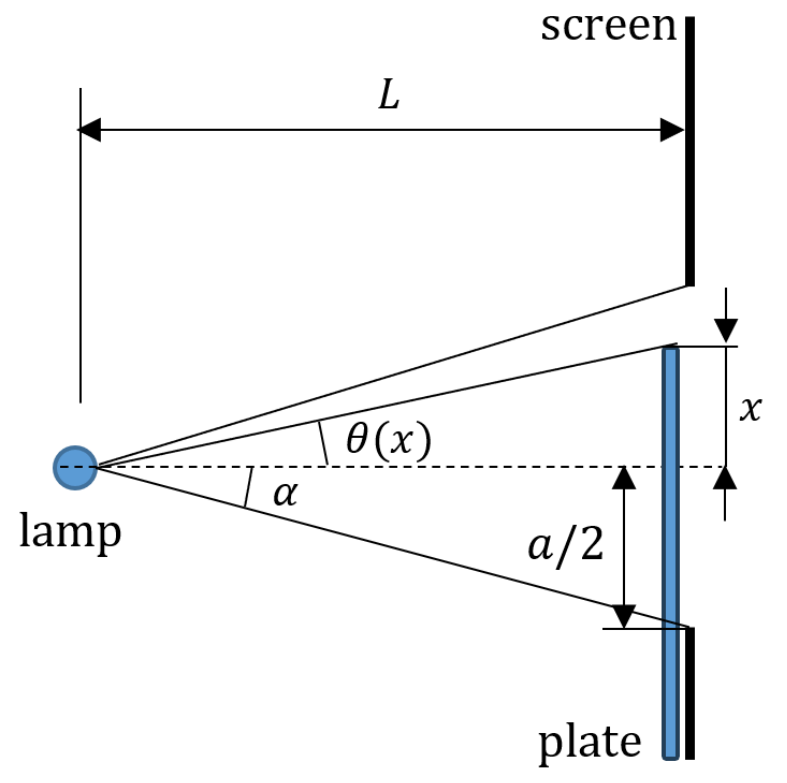
Here the following notation is used for angles, which, if they are small, are found from the relations:
In accordance with 3.4, the radiation power catched by the detector is proportional to the angle, therefore the formula for calculating the milliammeter readings has the form
and it is obvious that
and
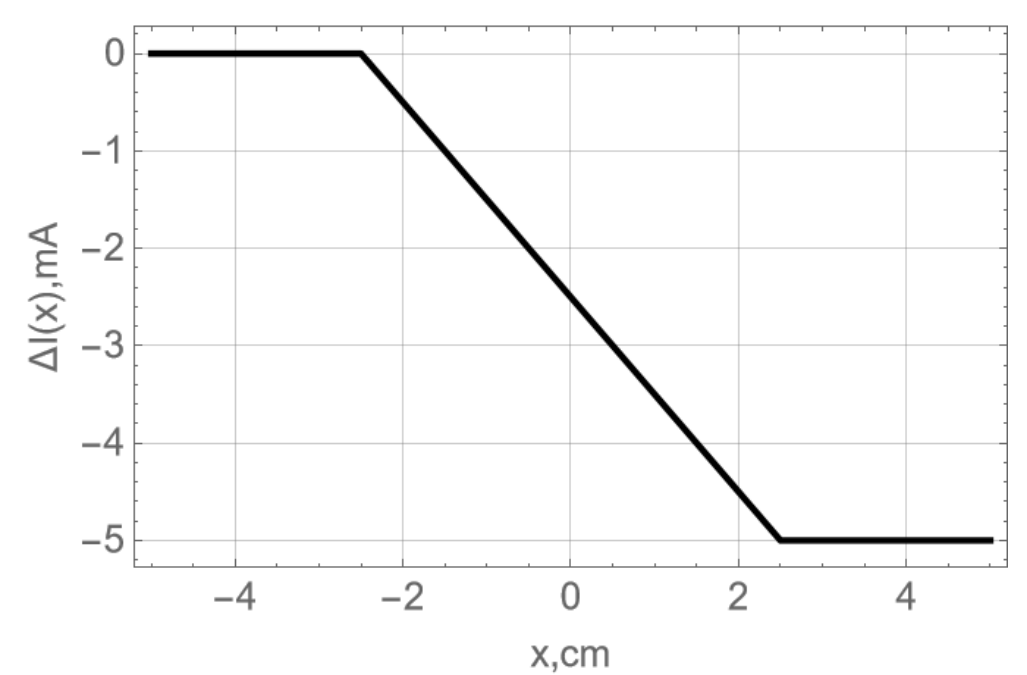
The graph of the corresponding function is presented in the figure below, while the coordinates of two characteristic points of the graph are found as
Thick plate
3.6 The appearance of point on the graph is due to the fact that light begins to be additionally reflected from the horizontal part of the plate, while the path of the beam from the lamp to the edge of the slit is shown in the figure below.
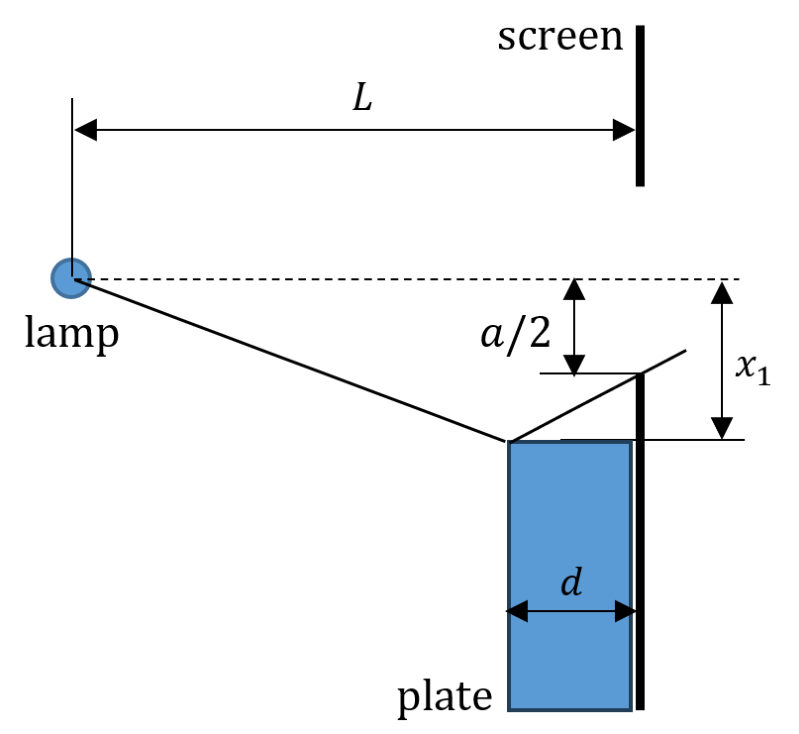
Since the angles are equal during reflection, we can easily find the desired value as
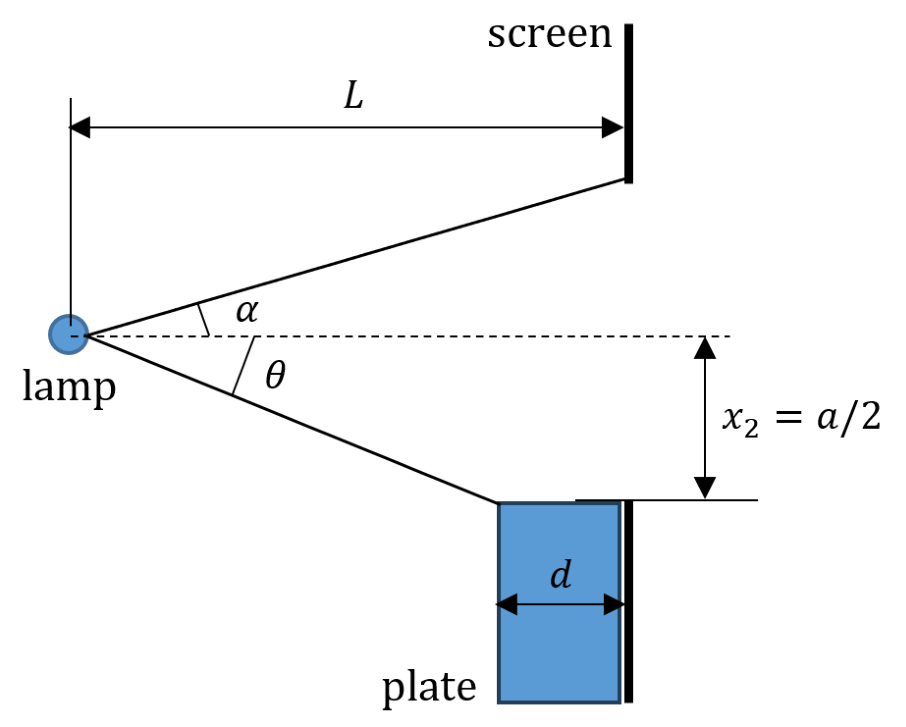
3.7 The first maximum is reached when all the light reflected by the horizontal surface of the plate enters the slit and then into the detector. The path of the rays is shown in the figure below, and the corresponding coordinate value is obviously equal to
3.8 The value of at point is found from the relation
where the angle is still determined by expression (5), and the angle is derived as
wherefrom we finally get
3.9 The coordinate is determined from the condition that the ray refracted in the plate first hits the lower edge of the slit; the path of the rays is shown in the figure below.
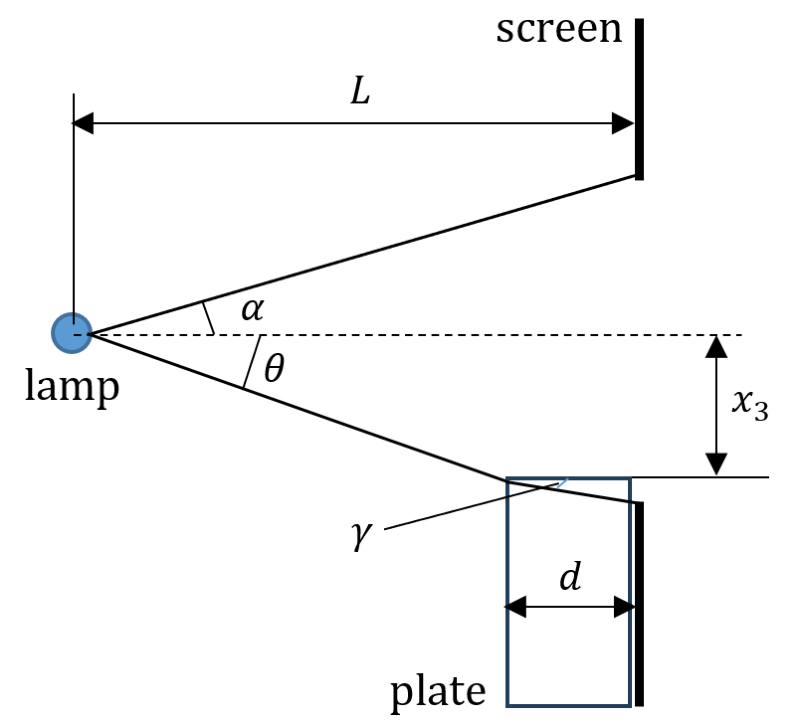
From the figure it follows that the angles are equal
and according to the law of refraction
Then from expressions (17)-(19), we finally obtain
3.10 The graph section from coordinate to zero is due to the fact that the light partially passes directly through the slit, and partially enters through the plate, being refracted and reflected in it. The path of the rays is shown in the figure below.
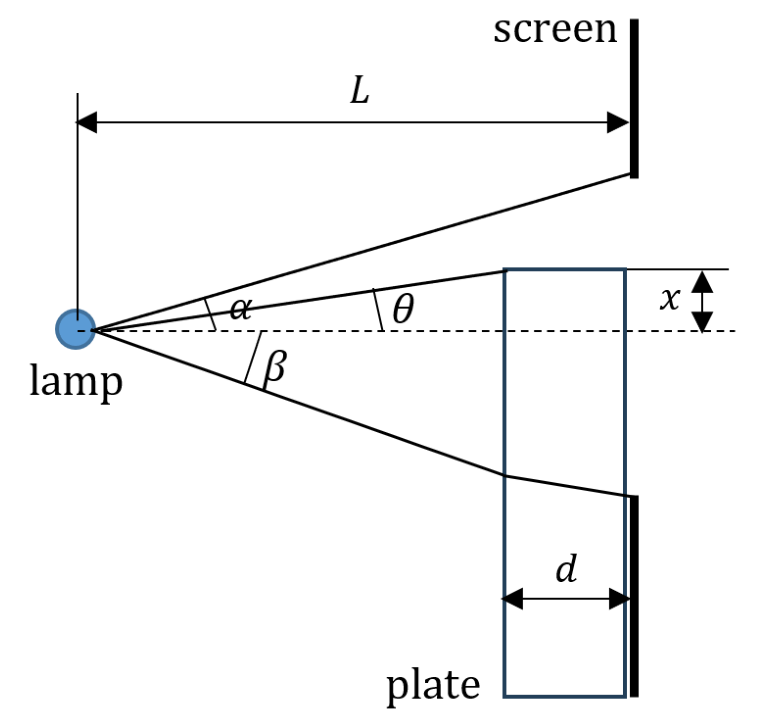
The angle is still determined by expression (5), and the corresponding angles in the figure are equal to
then the value takes the form
wherefrom we get the slope coefficient
3.11 Based on the graph given in the problem formulation, we have , , , and , we obtain the following values of the required parameters
3.12 To construct a complete graph, we have to establish all its characteristic points, shown in the figure below as .
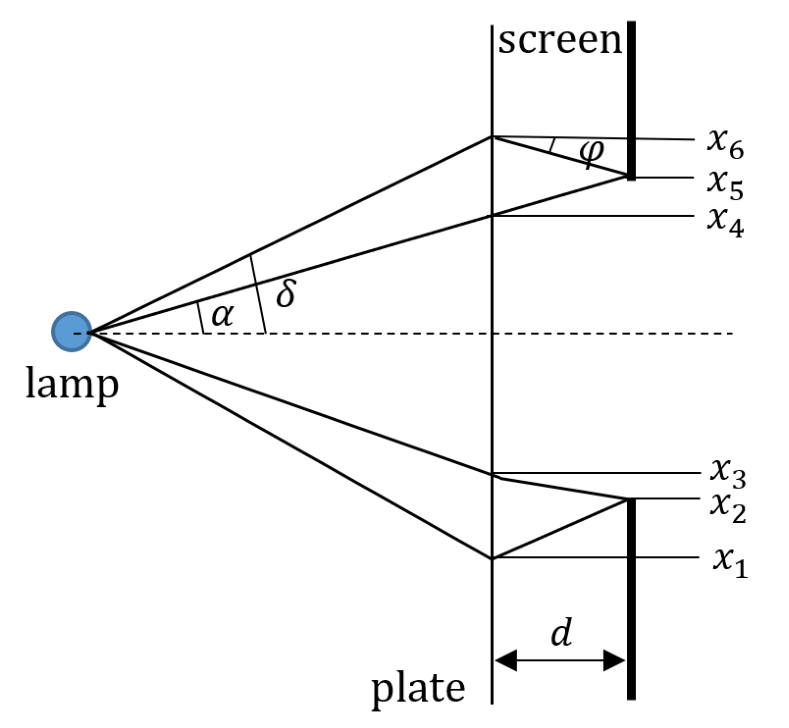
The coordinates of the points have been determined above; it is necessary to establish the coordinates of other characteristic points. To do this, we describe the appearance of various branches of the graph, gradually moving the plate from negative to positive values.
| Coordinates of the graph branch | Physical processes |
|---|---|
| from to | Full direct hit into the slit. |
| from to | Full direct hit into the slit; reflection from the horizontal section of the plate. |
| from to | Partial direct hit into the slit; reflection from the horizontal section of the plate. |
| from to | Partial direct hit into the slit; reflection from the horizontal section of the plate (directly from above and from below passing through the plate); passing through a plate with refraction. |
| from to | Full direct hit into the slit, passing through the plate; reflection from below from a horizontal section passing through the plate. |
| from to | Full direct hit into the slit, passing through the plate; partial reflection from below from a horizontal section passing through the plate. |
| from to | Full direct hit into the slit, passing through the plate. |
Let us find the coordinates of the corresponding characteristic points. The coordinate is easily found and is equal to
and the readings of the milliammeter are determined by the expression
The coordinate is obtained as
and the readings of the milliammeter are determined by the expression
The angles indicated in the figure are equal
and are related by the equation
Thus, the coordinate of point is found to be
whereas the readings of the milliammeter are determined by the expression
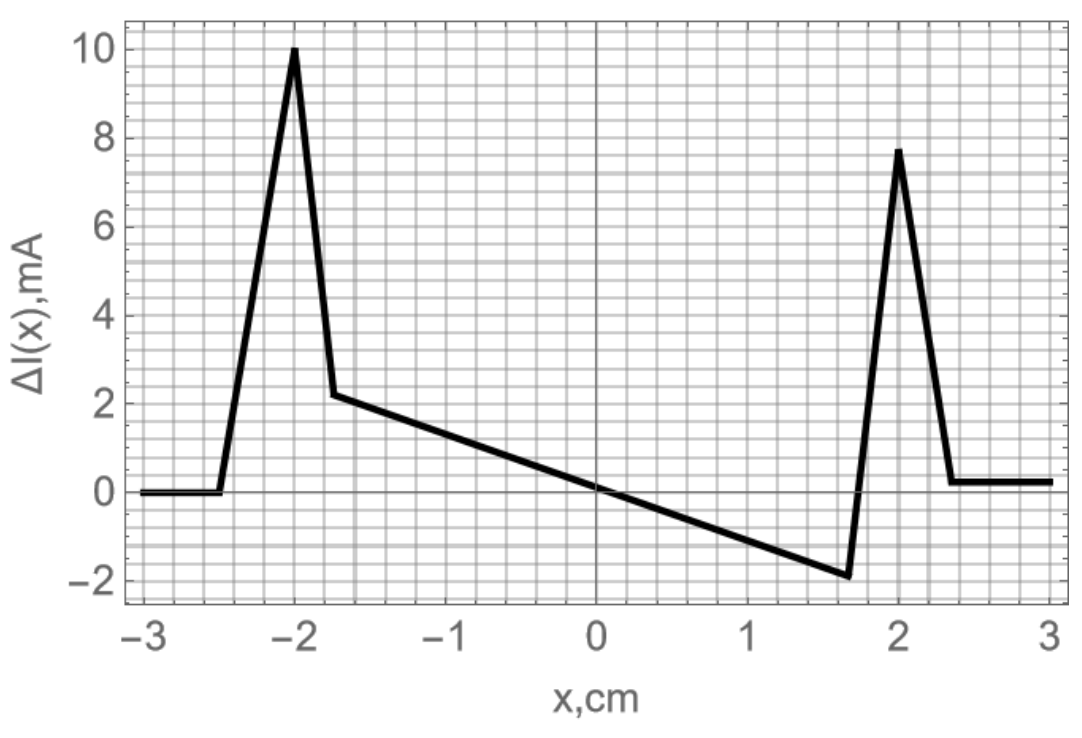
The full relationship graph is shown in the figure below.
| Содержание | Баллы | ||
|---|---|---|---|
| 3.1 | Formula (1): | 0.2 | 0.2 |
| 3.2 | Formula (2): | 0.2 | 0.2 |
| 3.3 | Formula (3): | 0.2 | 0.2 |
| 3.4 | Formula (4): | 0.4 | 0.4 |
| 3.5 | Formula (5): | 0.2 | 3.5 |
| Formula (6): | 0.2 | ||
| Formula (7): at | 0.4 | ||
| Formula (8): at | 0.4 | ||
| Formula (9): at | 0.4 | ||
| Graph: 0.5 for each correct line in numerical values | 1.5 | ||
| Formula (10): at | 0.2 | ||
| Formula (11): at | 0.2 | ||
| 3.6 | Formula (12): | 0.2 | 0.2 |
| 3.7 | Formula (13): | 0.1 | 0.1 |
| 3.8 | Formula (14): | 0.1 | 0.4 |
| Formula (15): | 0.1 | ||
| Formula (16): | 0.2 | ||
| 3.9 | Formula (17): | 0.2 | 0.8 |
| Formula (18): | 0.2 | ||
| Formula (19): | 0.2 | ||
| Formula (20): | 0.2 | ||
| 3.10 | Formula (21): | 0.2 | 0.8 |
| Formula (22): | 0.2 | ||
| Formula (23): | 0.2 | ||
| Formula (24): | 0.2 | ||
| 3.11 | Numerical value in formula (25): | 0.2 | 1.0 |
| Numerical value in formula (26): | 0.2 | ||
| Numerical value in formula (27): | 0.2 | ||
| Numerical value in formula (28): | 0.2 | ||
| Numerical value in formula (29): | 0.2 | ||
| 3.12 | Numerical value in formula (30): | 0.2 | 2.2 |
| Numerical value in formula (31): | 0.2 | ||
| Numerical value in formula (32): | 0.2 | ||
| Numerical value in formula (33): | 0.2 | ||
| Formula (34): | 0.2 | ||
| Formula (35): | 0.2 | ||
| Formula (36): | 0.2 | ||
| Numerical value in formula (37): | 0.2 | ||
| Numerical value in formula (38): | 0.2 | ||
| Correct 4 straight lines on the graph from 0.00 to 3.00 cm | 4x0.1 | ||
| Total | 10.0 |
Mathematical hint for the theoretical competition
Mathematical hint for the theoretical competition
The following formulas may be useful:
, where is a fixed number, refers to an arbitrary constant;
, where stands for an arbitrary constant;
, for and any value of ;
, for ;
, for .
Оригинал в Архива: IZhO-2024-Th_eng.pdf · официални решения: IZhO-2024-Theory_multi_sol.pdf