IZhO 2025, Теория — Задача 1
XXI International Zhautykov Olympiad/Theoretical Competition · 14 януари 2025 г. · 10 т.
Please read this first:
- The time available for the theoretical competition is 4 hours. There are three questions.
- You can use your own calculator for numerical calculations. If you don’t have one, please ask for it from Olympiad organizers.
- You are provided with Writing sheet and additional paper. You can use the additional paper for drafts of your solutions but these papers will not be checked. Your final solutions which will be evaluated should be on the Writing sheets. Please use as little text as possible. You should mostly use equations, numbers, figures and plots.
- Use only the front side of Writing sheets. Write only inside the boxed area.
- Each task should be solved starting from a new page of the Writing sheets
- Fill the boxes at the top of each sheet of paper with your country (Country), your student code (Student Code), the question number (Question Number), the progressive number of each sheet (Page Number), and the total number of Writing sheets used (Total Number of Pages). If you use some blank Writing sheets for notes that you do not wish to be evaluated, put a large X across the entire sheet and do not include it in your numbering.
Условие
This problem consists of three independent parts.
1.1 Problem 1.1 (3.0 points)
An interplanetary spacecraft takes off from the Earth's surface with the second cosmic velocity km/s. Moving along a ballistic trajectory, the spacecraft, due to calculation errors, is captured by the Moon's gravity and falls onto its surface. Find the possible minimum and maximum collision velocities of the spacecraft with the Moon. The ratio of the mass of the Earth to the mass of the Moon is ; the ratio of the radius of the Earth to the radius of the Moon is ; the distance from the Earth to the Moon is . Neglect the influence of the Sun. [3 т.]
1.2 Problem 1.2 (4.0 points)
A fully deflated balloon with a maximum volume of , made of soft, non-stretchable rubberized fabric, is connected through a valve to a gas holder, which is a very large vessel with nitrogen. Assume that the nitrogen pressure in the gas holder is constant and equal to atm, the ambient air pressure is atm, and the nitrogen temperature in the gas holder is equal to the ambient air temperature K. The gas holder valve opens and, after the balloon is quickly filled with nitrogen to its maximum volume and the nitrogen pressure in the balloon becomes equal to the pressure in the gas holder, the valve is closed. Find the number of moles of nitrogen in the balloon. Neglect heat exchange with the ambient air during the time the balloon is filled with nitrogen. [4 т.]
1.3 Problem 1.3 (3.0 points)
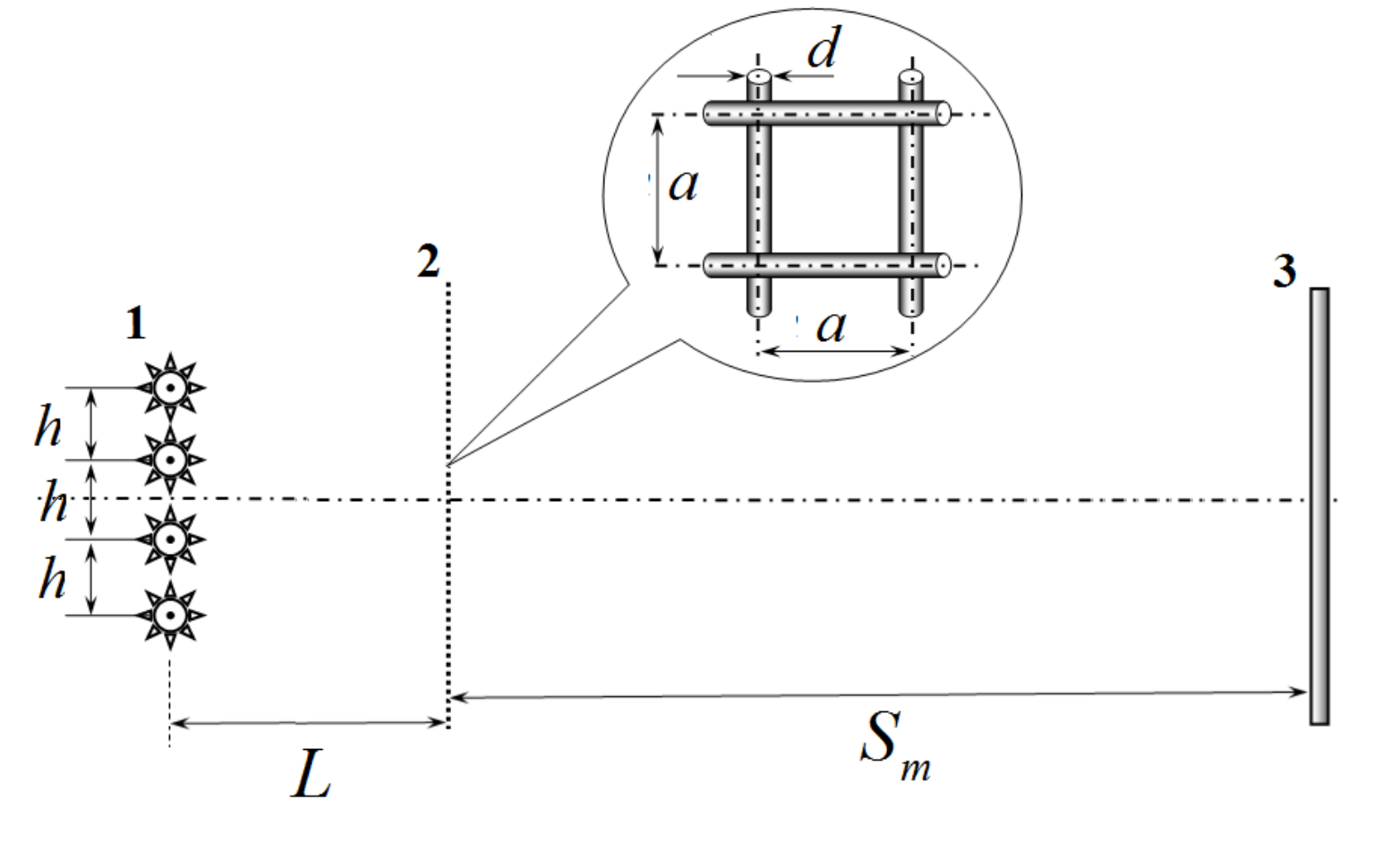
The light sources of flashlight 1 are four identical white LED bulbs located on one line at a distance of mm from each other. The bulbs can be considered point light sources. At a distance of cm, parallel to them, there is a metal grid 2 made of thin wire with a diameter of mm. The grid cells are square, whose side is equal to mm. Calculate at what distances ) the screen 3 should be located so that the grid image on it is the clearest and sharpest. [3 т.]
Отговори
1.1 vmin = 2.45 km/s, vmax = 3.45 km/s
1.2
1.3
S1 = 2.56 cm, S2 = 6.90 cm, S3 = 15.8 cm, S4 = 44.4 cm (official table).
Решение
Attention. Points in grading are not divided!
Problem 1.1 (3.0 points)
Let a spacecraft of mass start from the Earth surface. In order to be able to move away to infinity, it must have the second cosmic velocity at which its total energy becomes zero
where stands for the gravitational constant. From formula (1) we obtain an expression for the second cosmic velocity
Now let us find the speed of the Moon's orbital motion in the reference frame associated with the Earth, and to do this we apply Newton's second law in the following form
in which the force of gravitational interaction is determined by Newton's law of gravitation
From formulas (3) and (4), we find the speed of the Moon sought, which, with the aid of expression (2), takes the form
Let the apparatus cross the lunar trajectory far from the Moon, where the influence of its gravity can be neglected. The velocity of the apparatus relative to the Earth at the moment of crossing the Moon's orbit is found from the law of energy conservation as
which yields
The velocity of the spacecraft in the frame of reference associated with the Moon after its entry into the Moon orbit is determined by the vector difference in the velocities of the spacecraft and the Moon. Its minimum value is equal to
and the maximum value is
To find the desired quantities, we move to the reference system associated with the Moon and apply the law of energy conservation in the form
and introducing the second cosmic velocity for the Moon
we finally obtain the required values of the spacecraft speeds
| Content | Points |
|---|---|
| Formula (1): | 0.2 |
| Formula (2): | 0.2 |
| Formula (3): | 0.2 |
| Formula (4): | 0.2 |
| Formula (5): | 0.2 |
| Formula (6): | 0.2 |
| Formula (7): | 0.2 |
| Formula (8): | 0.2 |
| Formula (9): | 0.2 |
| Formula (10): | 0.2 |
| Formula (11): | 0.2 |
| Formula (12): | 0.2 |
| Numerical value in formula (13): | 0.8 |
| Numerical value in formula (14): | 0.8 |
| Total | 4.0 |
Problem 1.2 (3.0 points)
Let be the volume of nitrogen in the gas holder, which is then pumped into the balloon. Imaginarily, this volume can be placed in an elastic shell, then the surrounding nitrogen in the gas holder does work on this gas
When inflating a balloon, the atmosphere also does work on the gas, which is negative and equal to
According to the second law of thermodynamics, work on a gas goes towards changing its internal energy
The internal energy in the gas holder and in the ball are respectively found as
where the molar heat capacity of nitrogen at constant volume is expressed through the universal gas constant in the form
Note that immediately after the gas holder valve is closed, the temperature of the nitrogen in the ball differs from the temperature of the nitrogen in the gas holder itself.
Let us write the equation of state of an ideal gas for nitrogen in the gas tank and the balloon
and solving the resulting set of equations together, we find
Here the condition is used that a volume of 22.4 liters under normal conditions contains 1 mole of gas.
| Content | Points |
|---|---|
| Formula (1): | 0.4 |
| Formula (2): | 0.4 |
| Formula (3): | 0.2 |
| Formula (4): | 0.2 |
| Formula (5): | 0.2 |
| Formula (6): | 0.2 |
| Formula (7): | 0.2 |
| Formula (8): | 0.2 |
| Numerical value in formula (9): | 1.0 |
| Total | 3.0 |
Problem 1.3 (3.0 points)
Since each bulb is a point source of light, the light from each bulb at any position of the screen creates a clear picture of shadows in the form of an enlarged image of the grid. The size of one cell of the image is easily expressed through the specified distances
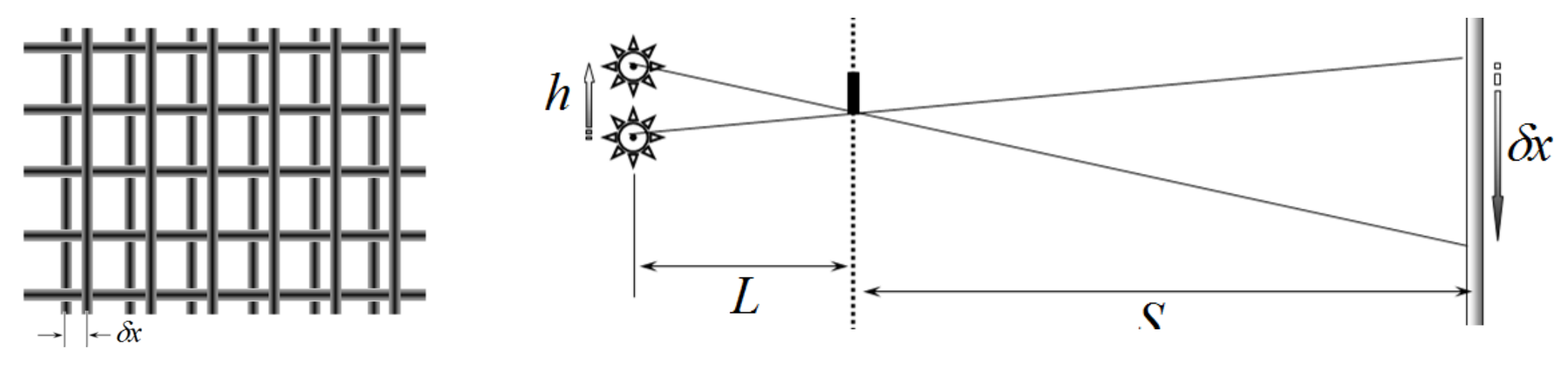
The image of the grid created by the light of another bulb will simply be shifted by some value . This shift is directed parallel to the "shift" when moving from one bulb to another. Therefore, the images of the grid wires parallel to the line of the bulbs will be clear at any position of the screen, the shadows perpendicular to the line of the bulbs will be "blurred".
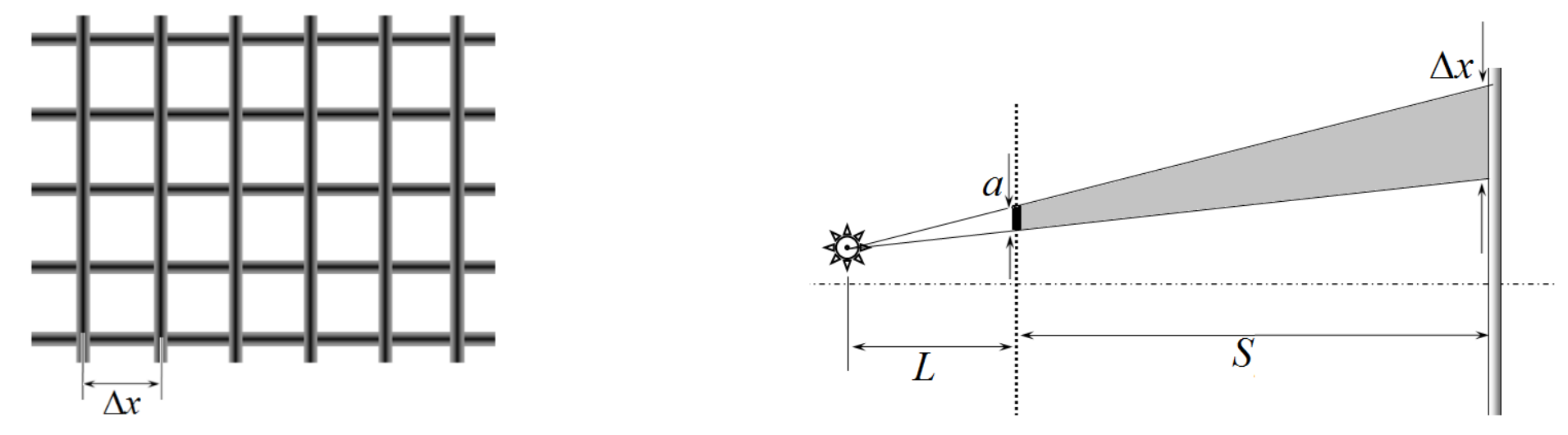
If the distance between the bulbs is , then the magnitude of the image shift will be equal to
It is easy to understand that the image created by all the bulbs will be clear and sharp if the amount of shift when moving from one bulb to another is an integer number of image cells, that is, when
Using the previously obtained formulas (1)-(2), we find
Given the numerical data given in the problem statement, the numerical values of possible screen positions are given in the table below.
| 1 | 2 | 3 | 4 | |
|---|---|---|---|---|
| , см | 2,56 | 6,90 | 15,8 | 44,4 |
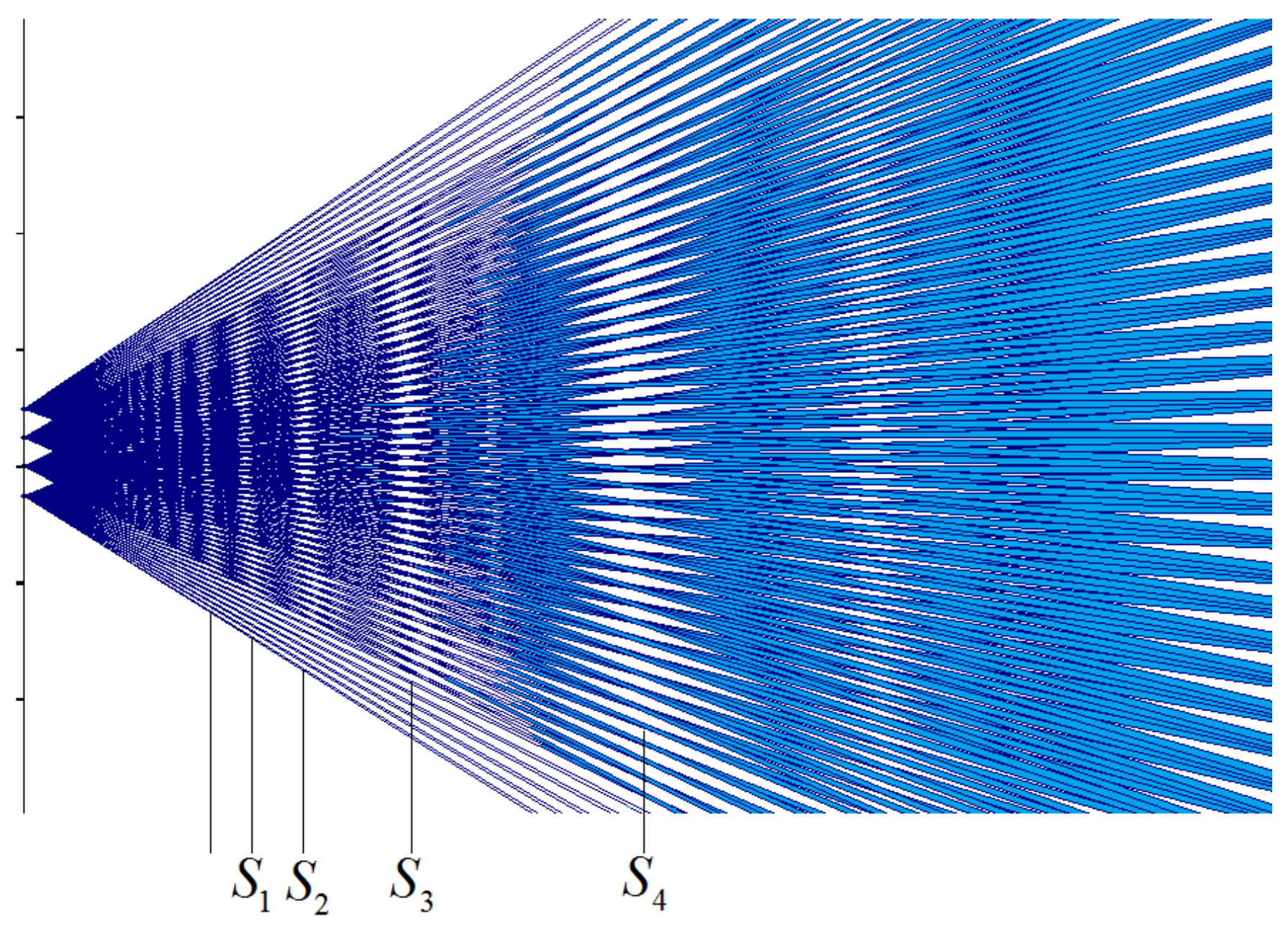
As an illustration, we present a drawing showing the “spread of shadows” from the grid (the proportions are not preserved, the vertical size is greatly increased).
| Content | Points |
|---|---|
| Formula (1): | 0.2 |
| Formula (2): | 0.2 |
| Formula (3): | 0.2 |
| Formula (4): | 0.4 |
| Numerical values in the table: 0.5 for each correct value | 2.0 |
| Total | 3.0 |
Mathematical hint for the theoretical competition
The following formulas may be useful:
, where is a fixed number, refers to an arbitrary constant;
, where stands for an arbitrary constant;
, where a – constant, – arbitrary constant;
, for and any value of ;
, for ;
, for .
List of physical constants
Speed of light in vacuum m/s;
Reduced Planck constant J·s;
Magnetic constant H·m;
Electric constant F/m;
Stefan-Boltzmann constant ;
Elementary charge C;
Electron mass kg.
Оригинал в Архива: IZhO 2025 Theory_eng.pdf · официални решения: IZhO 2025 Theory_eng_sol.pdf