IZhO 2026, Теория — Задача 1. Problem 1
XXII International Zhautykov Olympiad/Theoretical Competition · 11 януари 2026 г. · 10 т.
THEORETICAL COMPETITION
January 11, 2026
Please read this first:
- The time available for the theoretical competition is 4 hours. There are three questions.
- You can use your own calculator for numerical calculations. If you don’t have one, please ask for it from Olympiad organizers.
- You are provided with Writing sheet and additional paper. You can use the additional paper for drafts of your solutions but these papers will not be checked. Your final solutions which will be evaluated should be on the Writing sheets. Please use as little text as possible. You should mostly use equations, numbers, figures and plots.
- Use only the front side of Writing sheets. Write only inside the boxed area.
- Each task should be solved starting from a new page of the Writing sheets
- At the top of each sheet of paper your country (Country) and your student code (Student Code) are printed, you only need to fill in the progressive number of each sheet (Page Number), and the total number of Writing sheets used (Total Number of Pages). If you use some blank Writing sheets for notes that you do not wish to be evaluated, put a large X across the entire sheet and do not include it in your numbering.
Условие
This problem consists of three independent parts.
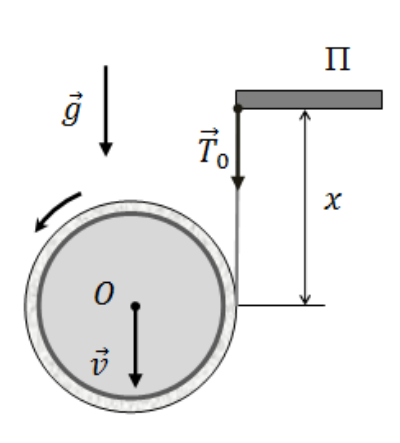
1.1 A thin cylindrical core of radius has a strip of foil tightly wound around it in a thin layer. The foil has thickness , mass , and length . One end of the foil is fixed to the core, while the other end is attached to the edge of a thin horizontal platform . Initially, the roll (the core with the wound foil) is held so that its axis is horizontal and at the same level as the platform. The roll is then released, and under the action of gravity it begins to unwind. Assuming that , find the length of the unwound part of the foil for which the force acting on the platform is equal to the weight of the roll, . Also determine the acceleration and the velocity of the downward motion of the roll's center of mass at that instant. [3 т.]
1.2 The readings of a multimeter () operating in ohmmeter mode and connected to a circuit change with time according to the law , where , , and . Using these data, determine the values of the resistances and , as well as the capacitance of the capacitor, which is initially uncharged. Also find the amount of heat released in the resistor during the measurement time .
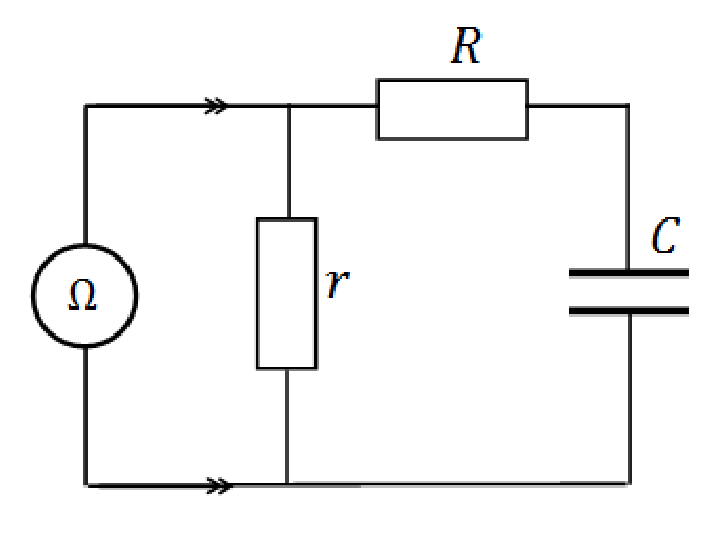
Note: In ohmmeter mode, the multimeter measures the voltage drop across an unknown resistor when a constant current flows through it. The instrument displays the value . [4 т.]
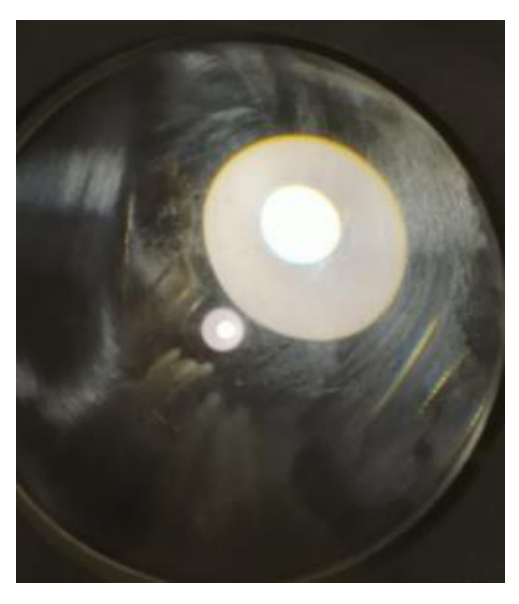
1.3 An observer (the eye) is located at a distance from a convex–concave lens and observes images of a distant street lamp formed due to reflections from both surfaces of the lens (see photo). The lamp and the eye are positioned close to the principal optical axis of the lens on the side of the concave surface. The radius of curvature of the concave surface is , and the radius of curvature of the convex surface is . Upon observation, two images of the lamp are visible: one real and the other virtual. The ratio of the apparent angular sizes of these images is , where is the angular size of the real image and is the angular size of the virtual image. Find the optical power of the lens. [3 т.]
Решение
Attention. Points in grading are not divided!
Problem 1 (10.0 points)
Problem 1.1 (3.0 points)
Let the -axis be directed downwards, and the initial position of the roll's center of mass correspond to the origin. If the velocity of the roll's center of mass at a given moment in time is , then its kinetic energy is
On the other hand, the potential energy of the roll relative to the initial position is equal to
At the initial moment of time the total energy is zero, therefore, according to the conservation law we get
from which the dependence of the speed of the roll center of mass on the coordinate is given by
The acceleration of the roll is determined by the expression
which after substitution (4) gives the following dependence
The total momentum of the roll is directed along the -axis and is equal to
and therefore the change in momentum over time takes the form
According to the conditions of the problem, the force acting on the platform from the roll is equal to the force of gravity, which means that the total external force on the roll itself is zero, and we obtain
Solving together (4), (6), (8) and (9), we derive the quadratic equation
whose positive root equals to
Substituting into (4) and (6) provides the final answers
| Content | Points |
|---|---|
| Formula (1): | 0.2 |
| Formula (2): | 0.2 |
| Formula (3): | 0.1 |
| Formula (4): | 0.2 |
| Formula (5): | 0.2 |
| Formula (6): | 0.2 |
| Formula (7): | 0.2 |
| Formula (8): | 0.2 |
| Formula (9): | 0.2 |
| Formula (10): | 0.1 |
| Formula (11): | 0.2 |
| Numerical value in formula (11): | 0.2 |
| Formula (12): | 0.2 |
| Numerical value in formula (12): | 0.2 |
| Formula (13): | 0.2 |
| Numerical value in formula (13): | 0.2 |
| Total | 3.0 |
Problem 1.2 (4.0 points)
At the initial moment of time the capacitor is not charged and the voltage drops across the connected resistances are the same, that is, they are connected in parallel, therefore
and the ohmmeter readings are
At time the capacitor is fully charged and no current flows through it, therefore
and the ohmmeter readings are
Solving (1)-(4) together, we obtain
At any given moment in time, the voltage drop across the resistance is equal to the voltage drop across the resistance and the voltage drop across the capacitor , that is,
On the other side according to Ohm's law we write
where denotes the current flowing through the resistor , and designates the current flowing through the capacitor and the resistance .
The voltage across the capacitor is equal to
Note that the capacitor is charged due to the flow of current generated by the ohmmeter, that is,
and the current flowing through the capacitor is equal to the derivative of its charge over time
From (7)-(12) we derive the differential equation for
whose solution yields the current through the capacitor
Here .
Thus, the capacitance is found as
The amount of heat released by the resistor is determined by the Joule-Lenz law and is equal to
Note that, in principle, there is no need to consider equations (1)-(4) separately; to find unknown resistances, it is sufficient to find the dependence , which is obtained as
| Content | Points |
|---|---|
| Formula (1): | 0.2 |
| Formula (2): | 0.2 |
| Formula (3): | 0.2 |
| Formula (4): | 0.2 |
| Formula (5): | 0.2 |
| Formula (6): | 0.2 |
| Formula (7): | 0.2 |
| Formula (8): | 0.2 |
| Formula (9): | 0.2 |
| Formula (10): | 0.2 |
| Formula (11): | 0.2 |
| Formula (12): | 0.2 |
| Formula (13): | 0.2 |
| Formula (14): | 0.4 |
| Formula (15): | 0.2 |
| Numerical value in equation (15): | 0.2 |
| Formula (16): | 0.4 |
| Numerical value in equation (16): | 0.2 |
| Total | 4.0 |
Problem 1.3 (3.0 points)
A real image with a smaller angular size is formed as a result of reflection at the air-glass boundary on the concave surface of the lens as from a concave mirror with a radius of curvature at a distance equal to the focal length of the mirror
which means the image is located at a distance from the observer
Let be the apparent angular size of the street lamp from the lens location. Then the linear size of the image of the lamp at the focus is
and therefore, the angular size of the visible image is found as
The second image, with a larger angular size of , is a virtual image of the lamp, formed as a result of reflection at the glass-air boundary from the convex surface of the lens. Considering that the rays that formed this image passed twice through a diverging lens with optical power , and the focal length of the convex surface is , the focal length of the system is
and the image itself is located at a distance from the observer
The linear size of the image of the lantern at focus is equal to
and therefore the angular size of the visible image is finally obtained as
Using the condition , the answer is derived as
| Content | Points |
|---|---|
| Formula (1): | 0.2 |
| Formula (2): | 0.2 |
| Formula (3): | 0.4 |
| Formula (4): | 0.4 |
| Formula (5): | 0.2 |
| Formula (6): | 0.2 |
| Formula (7): | 0.4 |
| Formula (8): | 0.4 |
| Formula (9): | 0.2 |
| Numerical value in formula (9): | 0.4 |
| Total | 3.0 |
Mathematical hint for the theoretical competition
The following formulas may be useful:
, where is a fixed number, refers to an arbitrary constant;
, where stands for an arbitrary constant;
, where – constant, – arbitrary constant;
, for and any value of ;
, for ;
, for .
List of physical constants
Acceleration of gravity ;
Universal gas constant ;
Speed of light in vacuum ;
Reduced Planck constant ;
Magnetic constant ;
Electric constant ;
Stefan-Boltzmann constant ;
Elementary charge ;
Electron mass .
Оригинал в Архива: IZhO-2026-Theory_eng.pdf · официални решения: IZhO-2026-Theory_eng_sol.pdf