OPhO 2021, Теория — Задача 3. Moving Media
2021 Online Physics Olympiad: Invitational Contest — v1.1 Theoretical Exam · 25 т.
Sponsors
This competition could not be possible without the help of our sponsors, who are all doing great things in physics, math, and education.
The original sponsor marks link to Jane Street, Wolfram, AwesomeMath, Beyond the Big Bang, Physics Olympiad, and AoPS Art of Problem Solving.
Instructions for Theoretical Exam
The theoretical examination consists of 4 long answer questions and 100 points over 2 full days from August 13, 0:01 am GMT.
- The team leader should submit their final solution document in this google form. We don’t anticipate a tie, but in the rare circumstance that there is one, the time you submit will be used to break it.
- If you wish to request a clarification, please use this form. To see all clarifications, view this document.
- Each question in this examination are equally worth 25 points. Be sure to spend your time wisely.
- Participants are given a google form where they are allowed to submit up-to 1 gigabyte of data for their solutions. It is recommended that participants write their solutions in LaTeX. However, handwritten solutions (or a combination of both) are accepted too. If participants have more than one photo of a handwritten solution (jpg, png, etc), it is required to organize them in the correct order in a pdf before submitting. If you wish a premade LaTeX template, we have made one for you here.
- Since each question is a long answer response, participants will be judged on the quality of your work. To receive full points, participants need to show their work, including deriving equations. As a general rule of thumb, any common equations (such as the ones in the IPhO formula sheet) can be cited without proof.
- Remember to state any approximations made and which system of equations were solved after every step. Explicitly showing every step of algebra is not necessary. Participants may leave all final answers in symbolic form (in terms of variables) unless otherwise specified. Be sure to state all assumptions.
Problems
- T1: Levitation
- T2: Thomas Precession
- T3: Moving Media
- T4: Missing Energy
List of Constants
- Proton mass,
- Neutron mass,
- Electron mass,
- Avogadro’s constant,
- Universal gas constant,
- Boltzmann’s constant,
- Electron charge magnitude,
- 1 electron volt,
- Speed of light,
- Universal Gravitational constant,
- Acceleration due to gravity,
- 1 unified atomic mass unit,
- Planck’s constant,
- Permittivity of free space,
- Coulomb’s law constant,
- Permeability of free space,
- Stefan-Boltzmann constant,
Problem writers
T1: Levitation — Ashmit Dutta
T2: Thomas Precession — Jacob Nie
T3: Moving Media — Eddie Chen
T4: Missing Energy — Kushal Thaman
Organizer clarification document — major notes
Separately quoted from the organizer clarification document, titled 2021 OPhO Invitational Theory Clarifications:
MAJOR NOTES
- Last updated: August 14, 9:45 pm GMT
- Version 1.1 of the exam has been posted to the website.
- We will only be adding clarifications that cannot already be found in the exam. If you are not seeing your clarification answered, try looking through the exam again to see if you did not miss anything.
The original Experimental Notes points to a separate experimental clarification document; it concerns the distinct experimental paper.
Условие
Interesting phenomena can arise in situations where there are 2 media that are moving with respect to each other. In particular, objects can move at much faster speeds than the relative speeds of the media, without using any energy. In this problem, we explore two such examples of this effect.
Moving Cylinders
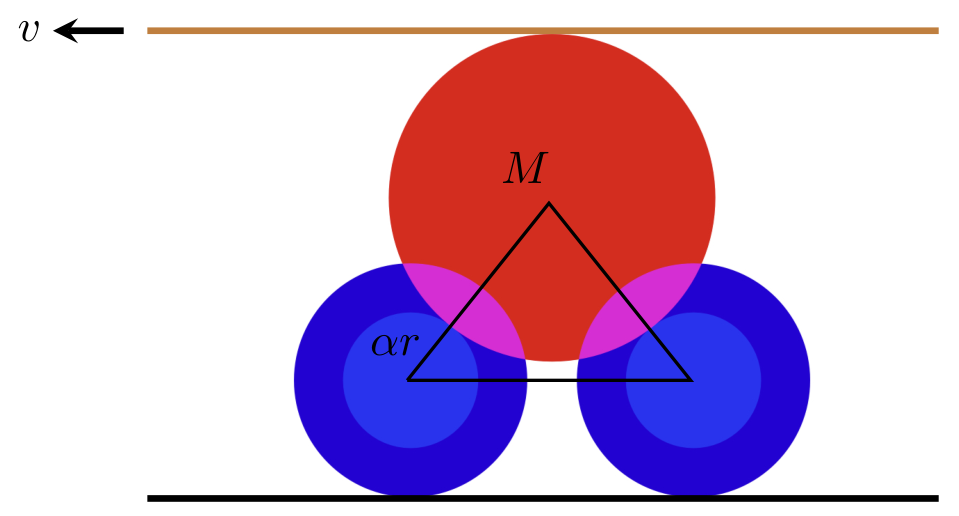
Suppose we have three cylinders, two small cylinders and a large cylinder, of radii and . The frictionless pivots (centers) of the cylinders are attached to a massless triangular frame, such that the large cylinder is in contact with the two small cylinders but the two small cylinders are not touching each other. The small cylinders each have a thin groove along their circumferences (which does not affect the moment of inertia significantly), so that the large cylinder makes contact with the small cylinder at a point with radial distance from the center of the small cylinder. The axes of all cylinders are perpendicular to the plane of the triangular frame. The system is placed on a level ground and a long flat horizontal board is put on top of the large cylinder, with the two small cylinders touching the ground (making contact at their outer edge with radial distance , not ). Assume that the friction due to contact between all surfaces is large enough to prevent any slipping.
1. (4 pts.) The board is moved with speed in a direction perpendicular to the axes of the cylinders. Find the speed of the cylinder system.
2. (5 pts.) The mass of the small and large cylinders are and , respectively. The mass of the board is . If at a moment in time the board is pushed with speed and acceleration , find the power required to push the board. Assume the cylinders have uniform mass distribution.
Windsurfing
In windsurfing, it is possible to sail faster than the wind without using any energy. Suppose we have a sailboat moving on a large, motionless body of water. The air of density is moving at a speed uniformly in one direction. If the sailboat is pointed in a certain direction and moves in that direction with velocity , the drag force from the water satisfies , where can be assumed to be a constant drag coefficient.
3. (10 pts.) If the wind is moving in the direction, what is the maximum possible sustainable -component of velocity for the sailboat? Assume that the sailboat can neither generate nor store energy in its interaction with the air. Also, the effective cross-sectional area of the sail is (this is the component of cross-sectional area that is perpendicular to the wind in the reference frame of the sailboat).
4. (3 pts.) What is the power dissipated due to the interaction with the water?
5. (3 pts.) It seems that the law of conservation of energy is being violated, as the speed of the sailboat isn’t changing despite heat generation in the water. Explain why energy is still conserved.
Published organizer clarifications (separate source, page 2)
Quoted from the organizer clarification document:
Moving Cylinders:
- The thin groove does not affect the moment of inertia significantly.
- The triangle frame is massless and rigid. The large cylinder only contacts the small cylinder at the distance from the center of the small cylinder. The ground only contacts the small cylinder at the distance from the center of the small cylinder.
Windsurfing:
- “Maximum possible sustainable” refers to the fact that the sailboat needs to stay in equilibrium.
- This is a theoretical calculation: Do not assume any details about the sail’s geometry or operation. (You can design the sail however you want). The only limitations are that the sail intercepts an effective cross-section of air ( is constant) and that the sailboat cannot generate or store energy.
- and may not be parallel due to the long and thin shape of the sailboat’s bottom
- Since the math is complicated, full credit will be awarded if you solve the problem numerically for a small value of (such as ). Note that graphing calculators such as Desmos are allowed. The answer only depends on the variables provided.
Решение
Moving Cylinders — (a)
Consider the reference frame of the cylinder system. Since friction is large enough to prevent any slipping, if the speed of the edge of the large cylinder is , then the speed of the edge of the small cylinder is . Thus, the difference in speeds . The speed of the cylinder system is .
(b)
The power is equal to the rate of change of kinetic energy of the system. The board increases kinetic energy at a rate , the cylinders increase rotational kinetic energy at rates . The rate of increase of translational kinetic energy of the cylinder system is . Adding up all the contributions, one gets
Windsurfing — (c)
Suppose the sailboat is pointed at some angle from the direction of the wind. We work in the reference frame of the sailboat throughout this solution, and consider the system containing the air and the sailboat. The water does no work on this system, because it is only in contact with the sailboat, which is not moving in this frame. To achieve the optimal state, we want no energy to be lost (except the heat in the water). Thus, the only thing that the sailboat can do is change the direction of the velocity vector of the wind it intercepts, leaving the magnitude the same! Suppose the wind is coming in at a speed , and the water is moving at a speed (all speeds are relative to the sailboat). Let be the angle between these two velocities. Then by law of cosines, we get . For the sailboat to get the maximum push from the air, the air must be thrown back directly parallel to . Thus, the force is the rate of momentum transfer, which is . Simplifying, we get . Taking differentials, we get . Also, by geometric relations, we get that the -component speed of the boat relative to the water in excess of the wind speed is . Thus, this is maximized when its derivative is zero, which is when . Combining this with the previous differential, we get
This gives us the following two equations and two variables ( and ):
Using the numerical value , we can graph the two equations on a graphing calculator (such as Desmos) and we obtain the solution that maximizes . Thus, the maximum -component of the velocity of the sailboat is approximately .
(d)
The power dissipated is given by . This is approximately .
(e)
Energy conservation is not violated, because in the frame of the water, the air had a lot of kinetic energy to begin with, and during the process, the sailboat reduced the speed of part of the air, thus taking energy from the air.
Grading Scheme
| A1 | Correct ideas when finding the speed of smaller and larger cylinder | 2.0 |
| A2 | Correct answer for the entire speed of the cylinder system | 2.0 |
| B1 | Uses the fact that | 1.0 |
| B2 | Considers the increase in energy of | 1.0 |
| B3 | Considers the increase in energy of | 1.0 |
| B4 | Considers the increase in energy of | 1.0 |
| B5 | Correct final answer | 1.0 |
| C1 | Correct idea that the energy of the sail comes from wind | 1.0 |
| C2 | Correct idea that wind velocity’s direction can change, but not magnitude | 4.0 |
| C3 | Expression for maximum force due to wind | 2.0 |
| C4 | Expression for drag force from water | 1.0 |
| C5 | Correct answer within 2% (1 pt removed if final equations are correct but not answer and vice versa) | 2.0 |
| D1 | Correct formula for power () | 2.0 |
| D2 | Correct answer (within 4%) | 1.0 |
| E1 | Correct explanation that energy comes from wind | 3.0 |
Organizer clarification document — other notes
Separately quoted from the organizer clarification document:
Other Notes
- You are allowed to refer to Wikipedia (but not any other sources). You should typically rederive proofs instead of citing them.
- Uploading images: View this link to find how to upload images on overleaf.
- You are allowed to mix LaTeX and handwritten PDFs for your answer sheet. Note that you need to write your solution to the problem alongside your final answers. If you desire a LaTeX template, we have made one for you here. Make a copy of the project to edit the document.
- You can use basic formulae related to topics on the IPhO syllabus without derivation but all other formulae which go beyond that must be derived.
- If you find that space is running out on your LaTeX file, try to use and see if that fixes it.
Оригинал в Архива: theory.pdf · официални решения: theory_sol.pdf · допълнителни данни: Clarifications.pdf