OPhO 2021, Теория — Задача 4. Missing Energy
2021 Online Physics Olympiad: Invitational Contest — v1.1 Theoretical Exam · 25 т.
Sponsors
This competition could not be possible without the help of our sponsors, who are all doing great things in physics, math, and education.
The original sponsor marks link to Jane Street, Wolfram, AwesomeMath, Beyond the Big Bang, Physics Olympiad, and AoPS Art of Problem Solving.
Instructions for Theoretical Exam
The theoretical examination consists of 4 long answer questions and 100 points over 2 full days from August 13, 0:01 am GMT.
- The team leader should submit their final solution document in this google form. We don’t anticipate a tie, but in the rare circumstance that there is one, the time you submit will be used to break it.
- If you wish to request a clarification, please use this form. To see all clarifications, view this document.
- Each question in this examination are equally worth 25 points. Be sure to spend your time wisely.
- Participants are given a google form where they are allowed to submit up-to 1 gigabyte of data for their solutions. It is recommended that participants write their solutions in LaTeX. However, handwritten solutions (or a combination of both) are accepted too. If participants have more than one photo of a handwritten solution (jpg, png, etc), it is required to organize them in the correct order in a pdf before submitting. If you wish a premade LaTeX template, we have made one for you here.
- Since each question is a long answer response, participants will be judged on the quality of your work. To receive full points, participants need to show their work, including deriving equations. As a general rule of thumb, any common equations (such as the ones in the IPhO formula sheet) can be cited without proof.
- Remember to state any approximations made and which system of equations were solved after every step. Explicitly showing every step of algebra is not necessary. Participants may leave all final answers in symbolic form (in terms of variables) unless otherwise specified. Be sure to state all assumptions.
Problems
- T1: Levitation
- T2: Thomas Precession
- T3: Moving Media
- T4: Missing Energy
List of Constants
- Proton mass,
- Neutron mass,
- Electron mass,
- Avogadro’s constant,
- Universal gas constant,
- Boltzmann’s constant,
- Electron charge magnitude,
- 1 electron volt,
- Speed of light,
- Universal Gravitational constant,
- Acceleration due to gravity,
- 1 unified atomic mass unit,
- Planck’s constant,
- Permittivity of free space,
- Coulomb’s law constant,
- Permeability of free space,
- Stefan-Boltzmann constant,
Problem writers
T1: Levitation — Ashmit Dutta
T2: Thomas Precession — Jacob Nie
T3: Moving Media — Eddie Chen
T4: Missing Energy — Kushal Thaman
Organizer clarification document — major notes
Separately quoted from the organizer clarification document, titled 2021 OPhO Invitational Theory Clarifications:
MAJOR NOTES
- Last updated: August 14, 9:45 pm GMT
- Version 1.1 of the exam has been posted to the website.
- We will only be adding clarifications that cannot already be found in the exam. If you are not seeing your clarification answered, try looking through the exam again to see if you did not miss anything.
The original Experimental Notes points to a separate experimental clarification document; it concerns the distinct experimental paper.
Условие
Part A
1. (3 pts.) Consider a simple circuit with two parallel-plate capacitors of capacitance and connected to each other using purely conducting wires and a switch. One of the capacitors is initially charged to a voltage , while the other one is completely uncharged. The circuit is kept in a square shaped figure of side length throughout the problem, while the diameter of the conducting wires is . Find the initial total energy of the circuit when the switch is open, given by , and a sufficiently long time after the switch is closed, given by . Calculate the remaining energy . What is for the case ?
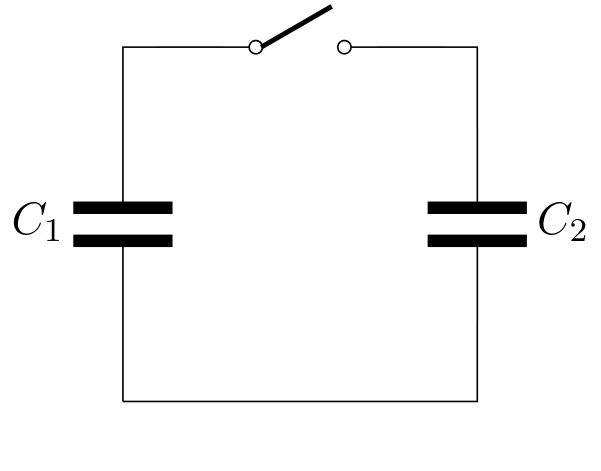
It seems odd for there to be a difference in energy as the circuit is a closed system. Three young scientists Fermi, Jackson, and Feynman have created different theories to find and verify the correct source of this missing energy.
Thermal Losses: Fermi
To investigate the cause of this missing energy, Fermi assumes that there must be an ohmic resistive load and a self-inductance in the circuit responsible for .
2. (3 pts.) Find the current in the circuit as a function of time and for the circuit.
3. (1 pt.) For small values of , find the oscillation frequency of .
4. (1 pt.) For , can Fermi’s reasoning be correct for any value of ? If yes, what is this value of ?
Dipole Radiation Losses: Jackson
Jackson believes that the missing energy is dissipated in the form of dipole radiation losses due to the charges accelerating. He assumes that the electric dipole moment of the system remains constant during the process, but the magnetic moment is allowed to vary. Thus, he seeks to determine the maximal possible radiation losses. For this he uses Larmor’s formula, which states that for small velocities relative to the speed of light , total power radiated which the radiation power is defined as:
where is the magnetic moment of the circuit as a function of time. Ignore all relativistic effects and the possible charge accumulation in the wires compared to that on the capacitor plates. Moreover, note that he does not assume any resistance or self-inductance in the circuit in his model.
5. (4 pts.) Find the total energy dissipation due to this radiation.
6. (1 pt.) For what value of time interval taken by the charges to move from one capacitor to another, can Jackson’s theory be reasoned true?
Kinetic Energy: Feynman
Feynman has the following hypothesis:
The missing energy goes into the kinetic energy of the charge carriers going from to . Assume that the mean free path of collisions of the carriers is .
7. (4 pts.) Find the total kinetic energy gained by the carriers during a total charge transfer from to .
8. (1 pt.) Could this be a valid hypothesis to explain the cause of the missing energy? When the charges get completely deposited on the plates of , what happens to this kinetic energy?
Part B
Instead of charging one capacitor using the other, we take an ideal parallel-plate capacitor such that the surface charge density on its plates is uniform throughout both plates, and that the charges are ‘fixed’ to the surface as the plate expands. The dimensions of the plates are and the plate separation distance is . The plate is now stretched quasi-statically by a factor of in one of the dimensions such that the dimensions of the capacitor plates are now but the plate separation remains .
1. (6 pts.) Calculate the work done during stretching the plates of this capacitor. Also write a simplified form of this expression for .
2. (1 pt.) In this case, there are no resistive loads, and since the process of plate expansion is quasi-static, there is no gain in kinetic energy of the charge carriers. Where does the energy disappear in this case?
Published organizer clarifications (separate source, pages 2–3)
Quoted from the organizer clarification document:
Part A
- There seems to be a numbering issue. This will be fixed when the document is updated.
- “Find the energy of the circuit before the switch is open” is a typo. It should properly read: “Find the energy of the circuit when the switch is open”. is initially charged to .
- Diameter of the cross-section of the current-carrying wire should be taken as .
- In the first part, “fate of the remaining energy” refers to the calculation of .
- Report the value of in the last part of Fermi’s hypothesis. If the expression for in Fermi’s hypothesis is left as an integral, it may not receive full points.
- All quantities must be calculated in terms of and , not unless specified.
- For Jackson’s hypothesis, .
- Refer to the wikipedia page for the non-relativistic version of Larmor’s frequency, i.e, do not use the formula given in the question paper (this will be updated in the final version). The formula in the version 1.1 of the question paper is off, use . Perform all calculations in SI units.
Part B
- The initial surface charge density of the capacitor plates is .
- By “ideal capacitor”, we mean that the surface charge density of both the plates remains uniform. Also, the charges on the surface remain “fixed” to it as the capacitor plate is stretched.
- Calculation of for must be performed after finding an answer in the general scenario. You may submit the general answer in the form of an integral, or otherwise, whichever suitable.
Решение
Внимание: Непълно решение
The complete available printed key is retained. For question5, its two accepted approaches give radiation power/resistance and an instruction to integrate Pr, but no evaluated total radiated energy Er.
Dipole Radiation Losses: Jackson
Jackson believes that the missing energy is dissipated in the form of dipole radiation losses due to the charges accelerating. He assumes that the electric dipole moment of the system remains constant during the process, but the magnetic moment is allowed to vary. Thus, he seeks to determine the maximal possible radiation losses. For this he uses Larmor’s formula, which states that for small velocities relative to the speed of light , total power radiated which the radiation power is defined as:
where is the magnetic moment of the circuit as a function of time. Ignore all relativistic effects and the possible charge accumulation in the wires compared to that on the capacitor plates. Moreover, note that he does not assume any resistance or self-inductance in the circuit in his model.
T4: Part A — Problem 1
When the switch is open, there is charge on one of the capacitors, while the other capacitor is uncharged. At this time, we have
A long time after the switch is switched on, the potential across both capacitors must be equal. Moreover, by charge conservation we have
Hence the energy after a long time is
This means that
where is the equivalent capacitance of the circuit. For , this loss is minimal and equal to . For , the whole energy is lost. In the following problems, we will investigate why there is a loss of energy and work out different explanations of it.
Problem 2
Let be the charge on the first capacitor at any time . By conservation of charge, the charge on the second capacitor must be . Apply Kirchoff’s Voltage Law on the circuit, we have
and
Differentiating the DE gives us
To solve this standard second order DE, we write its auxillary quadratic equation in :
Upon solving this we get
Substituting back we obtain
Using Euler’s identity and imposing the boundary conditions , we get the current of the form
for overdamping, critical damping, and underdamping. For small values of and , the system is likely to undergo underdamping. Also note that
Substituting value of from any of the cases, we find that
as found in the first part. This means that Fermi’s explanation may be a valid one, if the experimental values suggest the existence of non-zero and .
Problem 3
For small values of , we must have
On a first degree of approximation for , this gives us
Problem 4
Fermi’s reasoning should hold true for all finite values of for . But note that for zero self-inductance in the circuit, it behaves as a simple RC-circuit with time constant . Since relativistic effects are negligible, we must also simultaneously have .
Problem 5
Due to discrepancy in Larmor’s formula during the competition, the following solutions to this problem will be given full credit:
Solution 1:
Magnetic moment of the circuit is , and thus . Since the capacitors are arranged symmetrically and the current in the wires flows uniformly, the electric dipole of the system must remain constant. Hence, radiation arises from the magnetic dipole radiation. Assume the voltage drop due to this radiation as . We write
where is called the radiation resistance of the circuit and . From our assumption, since is small, the characteristic time of the circuit must be large compared to the oscillation period. Thus we approximate as follows:
Thus . The voltage drop is approximated to
The dissipated power is given by
and
Noting that , we have that where is the wavelength of radiation. In practice, is very small.
Solution 2: The net resistance in the system is zero. We have
Hence, we write the work energy theorem as follows:
Substituting into Larmor’s formula, the power radiated by each charge is
We obtain by integrating the same from to .
Problem 6
For Jackson’s hypothesis to be true:
where is the radius of an electron. Thus, all of the missing energy can appear as dipole radiation iff the charges move from one capacitor to the other in the time in which light travels times the radius of an electron. However, this is theoretically impossible. Thus, Jackson’s hypothesis cannot be true.
Problem 7
Let the charge on the capacitor with capacitance be . At equilibrium, final charge on is given by . The potential difference between the plates after the charge has been transferred is given by:
The kinetic energy gained by the charges is then simply
Problem 8
This could be a possible explanation of the missing energy since the energy gained by the charge carriers comes out to be the same as . When the charge gets deposited on the plate of the second capacitor, it accumulates there and dissipates thermal energy as it interacts with the charges on the plate of this capacitor.
Grading Scheme
| A1 | Correct answers for and case | 2.5 |
| A2 | Correct analysis of case | 0.5 |
| B1 | Correct expression for | 1.5 |
| B2 | Considered underdamping, critical damping and overdamping | 0.5 |
| B3 | Correct simplified expression of | 1.0 |
| C1 | Correct frequency approximated to the first order | 1.0 |
| D1 | Noted that all non-zero finite values work | 0.5 |
| D2 | Second constraint from characteristic time constant | 0.5 |
| E1 | Correct idea of radiative voltage and resistance | 1.0 |
| E2 | Correct approximation for large characteristic time constant | 1.0 |
| E3 | Correct calculation of power and energy dissipated | 2.0 |
| F1 | Correct use of work energy theorem | 0.5 |
| F2 | Correct final expression for | 0.5 |
| G1 | Exact expression of | 1.0 |
| G2 | Correct limits on charge transferred | 1.0 |
| G3 | Calculation of | 1.0 |
| G4 | Correct simplified final expression for kinetic energy | 1.0 |
| H1 | Correct explanation of why the Feynman scenario is possible | 1.0 |
Problem 9 (question Part B, 1)
Let us assume that the capacitor plates are lying in the plane, and the electric field between the plates is in the -direction. The initial potential energy of the system is given as . There are repulsive forces on the charges of the plates parallel to its surface. Usually, these are ignored. But in this case, with the stretching of the plates, work will be performed by these forces. These forces are small near the centre of the plate surface, but as we will find out, appreciable as we go towards the plate edges performing a significant amount of work. The field is thus, fringing.
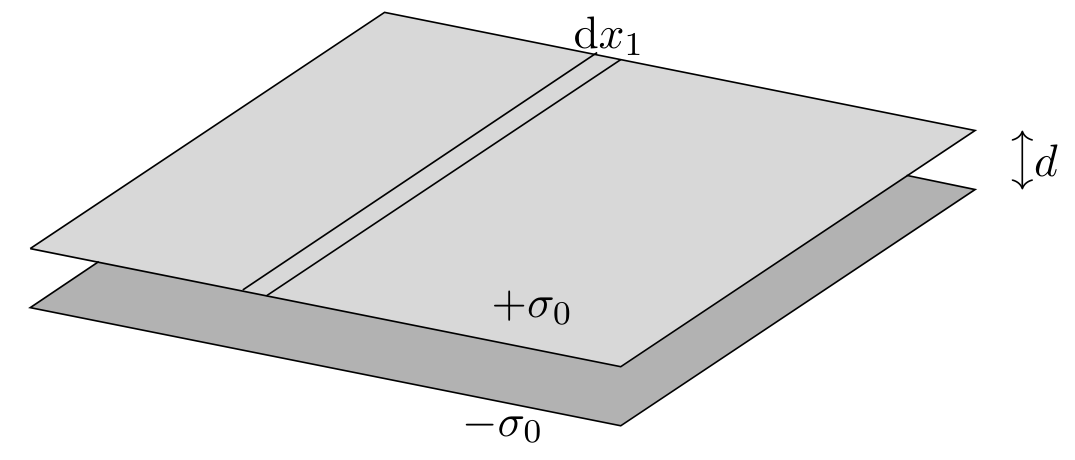
Since the expansion is done in one dimension, only the -component of the forces is important. Take a line charge at with linear charge density . At on both plates, we also consider line charges. Net force of repulsion due to both the plates is then given by
Now the plates are expanded quasi-statically such that the following transformations occur , . As the expansion factor goes from to , the line of charge at moves a distance . The work done by the repulsive forces during expansion of both plates is then
Now we use the substitution , solve the indefinite integrals and simplify our result to obtain:
This can be written as
This is our answer for the general case.
Thus, for , we have
Problem 10 (question Part B, 2)
There is work done against the repulsive forces between the charges on a plate within each capacitor, and the missing energy is used up as work done against them as the plates are expanded quasi-statically.
This analysis is very similar to what we did in Part A. In this case, there was no thermal, radiative losses or gain in kinetic energy due to the quasi-static nature of the process. Instead, the repulsive forces on the capacitor plates were significant and proportional to the plate dimensions. If some other external agency such as “magic tweezers” had been used to pick up charges from one capacitor to the another quasi-statically, the source of missing energy would have been the work done using the magic tweezers.
Grading Scheme
| A1 | Realize that repulsive forces between charges on plates are significant | 1.0 |
| A2 | Write forces between line charges considering both plates | 1.5 |
| A3 | Correct calculation for the work done in expansion | 2.5 |
| A4 | Correct final simplified expression of and answer for the case | 1.0 |
| B1 | Correct explanation of work done against repulsive forces | 1.0 |
Organizer clarification document — other notes
Separately quoted from the organizer clarification document:
Other Notes
- You are allowed to refer to Wikipedia (but not any other sources). You should typically rederive proofs instead of citing them.
- Uploading images: View this link to find how to upload images on overleaf.
- You are allowed to mix LaTeX and handwritten PDFs for your answer sheet. Note that you need to write your solution to the problem alongside your final answers. If you desire a LaTeX template, we have made one for you here. Make a copy of the project to edit the document.
- You can use basic formulae related to topics on the IPhO syllabus without derivation but all other formulae which go beyond that must be derived.
- If you find that space is running out on your LaTeX file, try to use and see if that fixes it.
Оригинал в Архива: theory.pdf · официални решения: theory_sol.pdf · допълнителни данни: Clarifications.pdf