OPhO 2022, Експеримент — Задача 2. Mass Flow Conservation
OPhO Invitational: Fluid Dynamics · 15 т.
1 Introduction
Fluid dynamics is an important area in physics and engineering, and being able to simulate fluids properly is a challenging task that is applicable for rocketry, airplanes, cars, and even in designing pipes for air conditioning! The most popular technique is computational fluid dynamics (CFD), which numerically solves the Navier-Stokes equation. However, it is very difficult to set up and is very slow.
In this experiment, we will use a very simple simulation software that simulates fluids in two dimensions through the Lattice-Boltzmann algorithm (and is thus, not CFD), which you can find here.
Please take time to read the description on the page. Make sure to keep all settings as default. By dragging your cursor around, you can create different types of barriers, and clicking start will run the simulation. The first dropdown menu tells us the number of pixels. While a higher resolution will lead to more accurate results, it will be more strenuous for the computer and harder to create boundaries. We recommend you to draw the barriers on a lower resolution but run the simulation on a higher resolution.
On the last row, we recommend checking Flowlines and Sensor. Enabling sensor will result in a cursor to appear on the screen that you can drag around, where the density , horizontal speed , and vertical speed will all be shown. If for some reason the simulation is unstable, you may also check the Data button, which will record the data on the cursor as a function of time.
Условие
We will first investigate if this implementation of the Lattice-Boltzmann algorithm correctly simulates the conservation of mass.
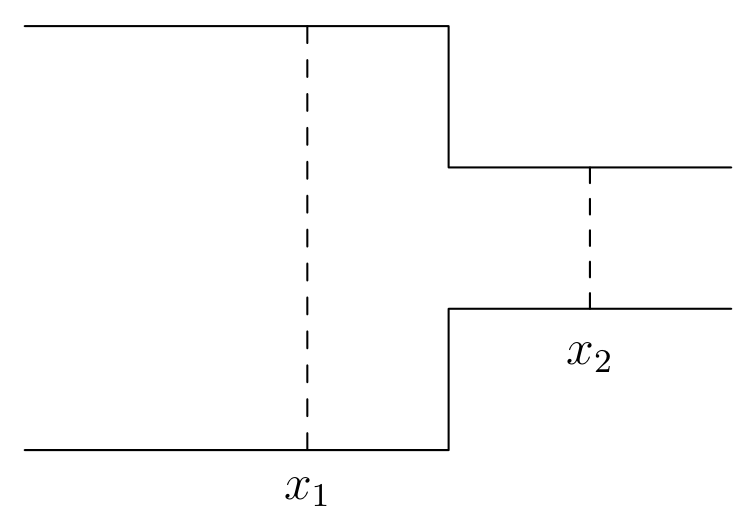
1. Create a tube that either opens up or closes down very abruptly such as in the diagram above. Pick two locations and such that one is in the wider section and the other is in the more narrow section. Compute the flow past both these points. (10 pts)
2. Do the two mass flow rates agree with each other? If not, suggest a possible reason why. (5 pts)
Note:
- You are free to pick the shape and dimensions of the tube and it does not need to be perfect.
- Please report your figures with uncertainties and make clear how you estimated and/or obtained them! You do not need to show your computations.
- Provide a screenshot of the boundaries and the parameters.
Решение
Внимание: Непълно решение
В архива няма официално решение на тази задача.
Оригинал в Архива: experiment.pdf