OPhO 2022, Теория — Задача 1. Maxwell’s Demon
2022 Online Physics Olympiad: Invitational Contest — Theoretical Examination · 25 т.
Sponsors
This competition could not be possible without the help of our sponsors, who are all doing great things in physics, math, and education.
The original sponsor marks link to Jane Street, Wolfram, AwesomeMath, Beyond the Big Bang, Physics Olympiad, and AoPS Art of Problem Solving.
Instructions for Theoretical Exam
The theoretical examination consists of 5 long answer questions and 110 points over 2 full days from July 30, 0:01 am GMT.
- The team leader should submit their final solution document in this google form. We don’t anticipate a tie, but in the rare circumstance that there is one, the time you submit will be used to break it.
- If you wish to request a clarification, please use this form. To see all clarifications, view this document.
- Participants are given a google form where they are allowed to submit up-to 1 gigabyte of data for their solutions. It is recommended that participants write their solutions in LaTeX. However, handwritten solutions (or a combination of both) are accepted too. If participants have more than one photo of a handwritten solution (jpg, png, etc), it is required to organize them in the correct order in a pdf before submitting. If you wish a premade LaTeX template, we have made one for you here.
- Since each question is a long answer response, participants will be judged on the quality of your work. To receive full points, participants need to show their work, including deriving equations. As a general rule of thumb, any common equations (such as the ones in the IPhO formula sheet) can be cited without proof.
- Remember to state any approximations made and which system of equations were solved after every step. Explicitly showing every step of algebra is not necessary. Participants may leave all final answers in symbolic form (in terms of variables) unless otherwise specified. Be sure to state all assumptions.
Problems
- T1: Maxwell’s Demon
- T2: Euler’s Disk
- T3: Rocket
- T4: Magical Box
- T5: Quantum Computing
List of Constants
- Proton mass,
- Neutron mass,
- Electron mass,
- Avogadro’s constant,
- Universal gas constant,
- Boltzmann’s constant,
- Electron charge magnitude,
- 1 electron volt,
- Speed of light,
- Universal Gravitational constant,
- Acceleration due to gravity,
- 1 unified atomic mass unit,
- Planck’s constant,
- Permittivity of free space,
- Coulomb’s law constant,
- Permeability of free space,
- Stefan-Boltzmann constant,
Problem writers
T1: Maxwell’s Demon — Zhening Li
T2: Euler’s Disk — Daniel Seungmin Lee
T3: Rocket — Adithya Balachandran
T4: Magical Box — Daniel Seungmin Lee
T5: Quantum Computing — QiLin Xue
Organizer clarification document — major notes
Separately quoted from the organizer clarification document, titled 2022 OPhO Invitational Theory Clarifications:
MAJOR NOTES
- Last updated: July 30, 12:01 am UTC
- We will only be adding clarifications that cannot already be found in the exam. If you are not seeing your clarification answered, try looking through the exam again to see if you did not miss anything.
The separate Experimental Notes link is retained in the original clarification PDF and concerns the distinct experimental paper.
Условие
Zed has a container divided by a wall into two chambers of equal volume . The left chamber has molecules and the right chamber has molecules of some monatomic ideal gas . Each gas molecule has mass and can be treated as a point particle. The entire system is isolated and is at temperature .
a. (5 pts.) Let’s say that he makes a hole in the wall. Then there will be a net flow of molecules from the right chamber to the left chamber. At equilibrium, let’s say each chamber has molecules. By how much has the entropy increased?
Zed now wants to revert the container back to its original state with and molecules in each chamber. He plans to achieve this by covering the hole with a door with area that only opens towards the second chamber.
b. (5 pts.) He thinks that any molecule in the left chamber incident on the door will enter the right chamber, and no molecules in the right chamber will enter the left one. Under such a model, what is the initial rate of change in entropy of the system?
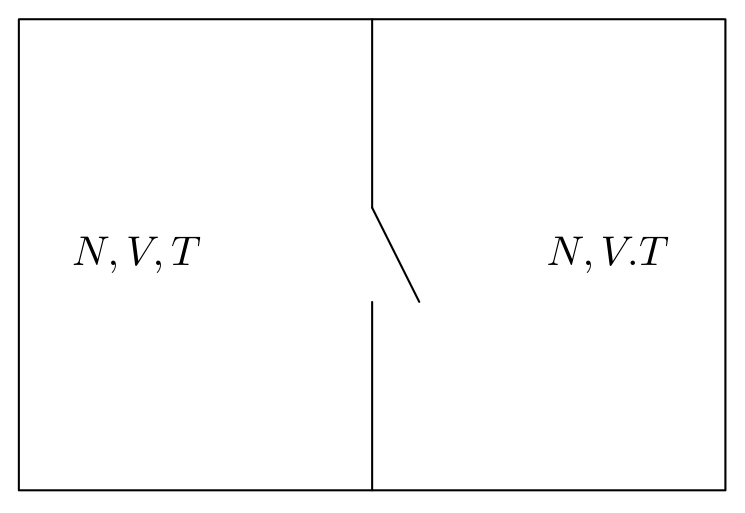
Under the assumptions made by part (b), Zed’s device violates the second law of thermodynamics. We’ll now investigate why this actually does not happen for a particular kind of door. This door, of mass , has a hinge that exerts a restoring torque when the door is open at an angle , where is not necessarily small (Figure 1).
c. (5 pts.) Explain in one or two sentences why this door behaves effectively like a hole in the wall with area , and hence the second law of thermodynamics is not violated.
d. (10 pts.) Estimate in terms of the variables given and fundamental constants. You may make appropriate simplifying assumptions.
Решение
a.
The internal energy of the system must remain the same as the system is isolated. This implies the temperature of each of the molecules remains as even when the hole is created. As entropy is a state function and the temperature remains the same, the change in entropy is caused by isothermal expansion/compression. There are two contributions to entropy change: the one experienced by the particles in the first chamber and those in the second chamber.
Since each container as a volume of , the total volume that each particle can occupy is now . The number density is thus . The particles in the first chamber increase in volume from to . This means that
Similarly, for particles in the second chamber, we have
The total entropy change is thus
Note: Max 2 points for the approach that assumes particles in are distinguishable from particles in . In this approach, the volume of each compartment doubles so the answer is .
b.
is a function of . Therefore, we can express as
Right when the door is opened, the system is essentially in equilibrium, so . Hence, as well.
Note: Even though initially , it is negative for , and the entropy of the system decreases.
c.
The door is almost always open due to thermal contact with the wall at temperature . How open the door is doesn’t significantly increase as a particle hits it from the left, since its energy is on the same order as the energy of the door . The effective size of the opening is thus the same for particles traveling in both directions, so particles pass through the opening in both directions at the same rate, hence keeping the entropy constant.
Note: This is just an intuitive explanation as to why we shouldn’t find it surprising that there’s an equal particle flow in the opposite direction. A rigorous argument (that is not cyclic) would be much more involved.
Marking scheme:
- Door is generally open due to thermal motion of molecules in wall — 3 pts
- Door doesn’t get much more open when a particle hits it from the left — 2 pts
Explanations that get partial credit:
- When a particle hits the door from the left, the door opens and a particle from the right passes through: max. 3pts (only explains the existence of particle flow in the opposite direction)
- Due to the equipartition theorem, , so the door is effectively open: max. 3pts (same reason as above)
d.
The equipartition theorem gives , so the typical . When , the size of the opening is about ; when , the size of the opening is better approximated by the size of the hole, .
Note: In reality, there’s a smooth transition from the regime to the regime. A precise model would likely involve modeling the joint distribution of the door’s angle and its rate of change, and the particle density and velocity distribution of gas particles at each point in space.
Organizer clarification document — other notes
Separately quoted from the organizer clarification document:
Other Notes
- You are allowed to refer to Wikipedia (but not any other sources). You should typically rederive proofs instead of citing them.
- Uploading images: View this link to find how to upload images on overleaf.
- You are allowed to mix LaTeX and handwritten PDFs for your answer sheet. Note that you need to write your solution to the problem alongside your final answers. If you desire a LaTeX template, we have made one for you here. Make a copy of the project to edit the document.
- You can use basic formulae related to topics on the IPhO syllabus without derivation but all other formulae which go beyond that must be derived.
- If you find that space is running out on your LaTeX file, try to use and see if that fixes it.
Оригинал в Архива: theory.pdf · официални решения: theory_sol.pdf · допълнителни данни: Clarifications.pdf