OPhO 2023, Теория — Задача 1. T1: Booster
2023 Online Physics Olympiad: Invitational Contest — Theoretical Examination · 5 август 2023 г.
Sponsors
This competition could not be possible without the help of our sponsors, who are all doing great things in physics, math, and education.
Instructions for Theoretical Exam
The theoretical examination consists of 3 long answer questions and 160 points over 2 full days from August 5, 0:01 am GMT.
- The team leader should submit their final solution document in this google form.
- If you wish to request a clarification, please use this form. To see all clarifications, view this document.
- Participants are given a google form where they are allowed to submit up-to 100 megabytes of data for their solutions. It is recommended that participants write their solutions in LaTeX. However, handwritten solutions (or a combination of both) are accepted too. If participants have more than one photo of a handwritten solution (
jpg, png, etc), it is required to organize them in the correct order in apdfbefore submitting. If you wish a premade LaTeX template, we have made one for you here. - Since each question is a long answer response, participants will be judged on the quality of your work. To receive full points, participants need to show their work, including deriving equations. As a general rule of thumb, any common equations (such as the ones in the IPhO formula sheet) can be cited without proof.
- Remember to state any approximations made and which system of equations were solved after every step. Explicitly showing every step of algebra is not necessary. Participants may leave all final answers in symbolic form (in terms of variables) unless otherwise specified. Be sure to state all assumptions.
Problems
- T1: Booster
- T2: The Complex Potential
- T3: General Relativity
List of Constants
| Proton mass | |
|---|---|
| Neutron mass | |
| Electron mass | |
| Avogadro’s constant | |
| Universal gas constant | |
| Boltzmann’s constant | |
| Electron charge magnitude | |
| 1 electron volt | |
| Speed of light | |
| Universal Gravitational constant | |
| Acceleration due to gravity | |
| 1 unified atomic mass unit | |
| Planck’s constant | |
| Permittivity of free space | |
| Coulomb’s law constant | |
| Permeability of free space | |
| Stefan-Boltzmann constant |
Условие
In this problem, we explore a simplified model of Solid Rocket Boosters (SRBs). SRBs are supplements to liquid rockets and provide enormous thrust at liftoff at the expense of lower specific impulse. They have a pretty simple design – a tube containing solid propellant with a central cavity that acts as a combustion chamber. As the solid fuel burns (deflagrates), gasses are forced out of the combustion chamber through a nozzle, producing thrust. It is desirable to choose a combustion chamber design which produces constant thrust (to reduce structural load on the spacecraft) and also have constant internal pressure and temperature (to reduce stress on the SRB). Below a diagram, along with a typical shape of the combustion chamber.
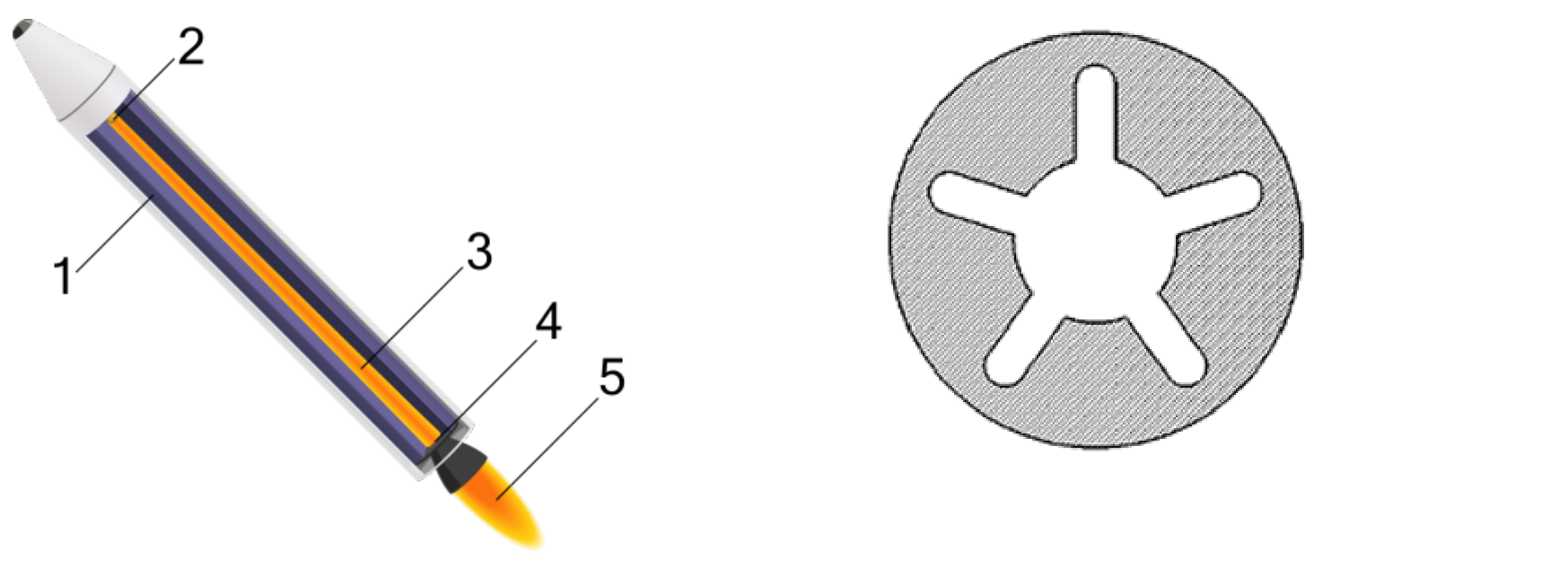
Data:
Rate of vaporization of surface of fuel:
Length of combustion chamber:
Radius of combustion chamber:
Density of propellant:
Molar mass of exhaust gas:
Temperature inside chamber:
Ideal gas constant:
(a) Find the burn rate of fuel (in terms of ) as a function of time for the following designs for the combustion chamber. Assume that the combustion chamber never reaches the walls of the SRB.
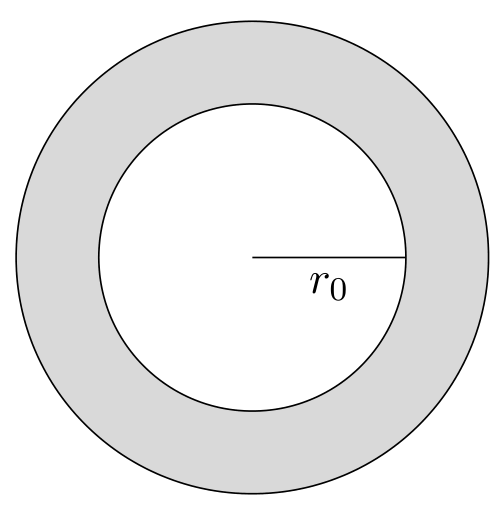
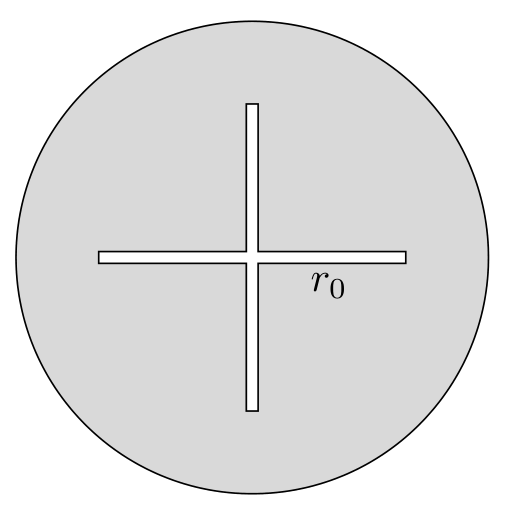
Answer the following for design i.
(b) Compute the thrust as a function of time. Assume the temperature and pressure of the chamber stay constant, and the density of the gas is .
(c) Is the assumption of constant internal conditions for this design valid?
(d) Now assume that the temperature is constant, but the pressure changes. Estimate to within a factor of 2 the pressure inside the chamber as a function of time.
Отговори
(a)
Boxed results of the official solution; for design (ii) with t > r0/v the solution gives a longer expression.
(b)
Time-independent.
(c) The assumption is false.
(d)
Решение
Solution 1:
All point values should be multiplied by 3 (for a total of 30 points)
(a) (i) The shape of the chamber after time is a circle with radius . Thus the volume burned is , and
(ii) The volume of fuel that is burned after some time () looks like this:
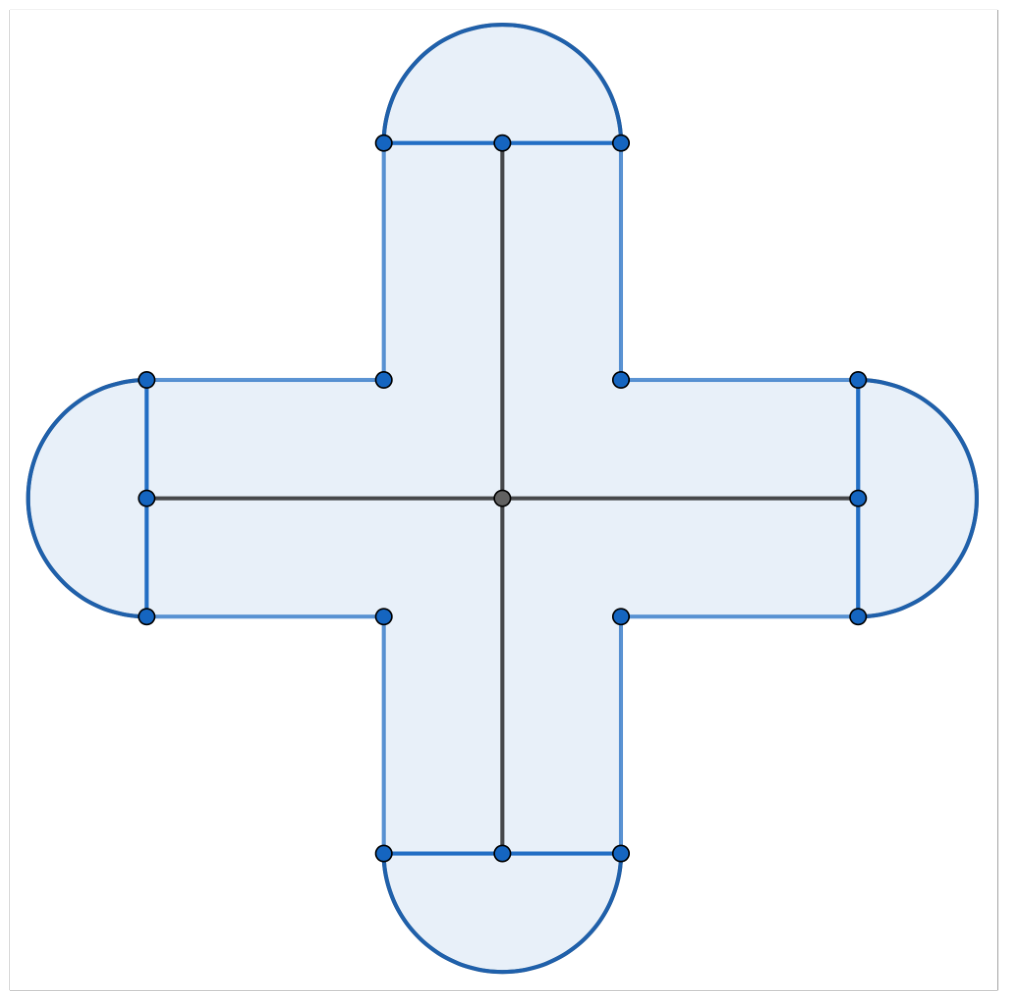
The total area of the semicircular endcaps is , and the area of the remaining cross-like figure is . So the total area is . The mass flow rate is .
The intent of the problem was for , but that wasn’t clearly specified. For fairness to everyone who spent time on it, we solve the case-https://www.overleaf.com/project/64cc0b0dcfb587f85f42416c below.
This case looks like the following:
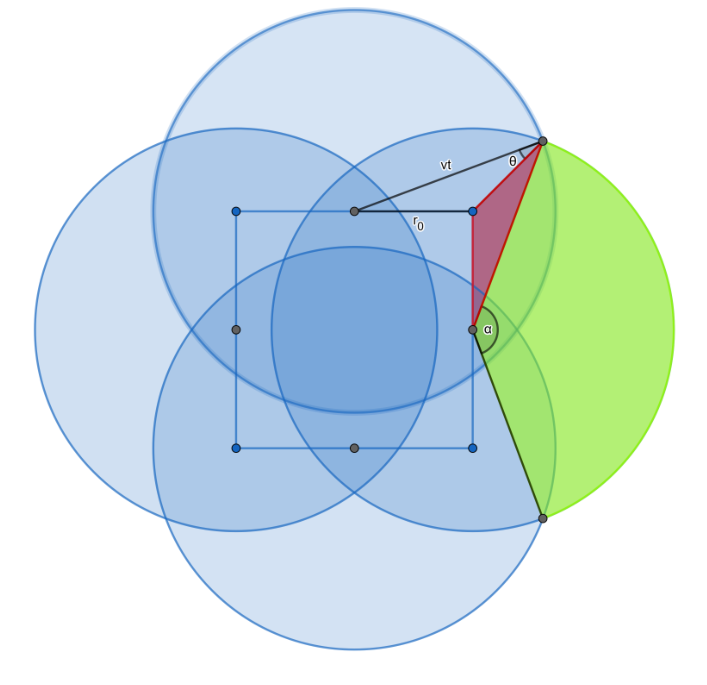
In the figure, by Law of Sines, . Then .
The total area of the circular sectors (colored green) is . The total area of the triangles (colored red) is . The area inside the square is constant, so differentiation will get rid of it.
We want:
Grading Scheme
- 1 pts for correct answer for (i)
- 2 pts for correct answer for for (ii). 1 pt should be given if only a small mistake (e.g. neglecting the endcaps) was made in the figure.
- 1 pt for something resembling the correct answer for for (ii)
(b) The gas is produced at a (volumetric) rate of , and the area of the opening is , so the velocity is
Multiplying by the mass flow rate gives
Which is time-independent.
Grading Scheme
- 2 pts for correct final answer.
(c) The assumption is false. If the pressure and temperature stay constant, then by conservation of energy, the velocity of the exhaust gasses will be constant. Thus the thrust will be proportional to area and not constant in time, which contradicts part (b).
Grading Scheme
- 1 pts for stating the assumption is false and a valid explanation.
(d) The speed of sound is as only 3 of the degrees of freedom are translational (the constant doesn’t actually matter that much). We can use this as an estimate for the speed of the exhaust. Thus the gas is expelled at a volumetric rate of . The density of the gas is , so the rate of mass expulsion is .
This should equal the result from (a) i, yielding
Grading Scheme
- 1 pt for any dimensionally correct final answer.
- +2 pts for a final answer of the correct form (not considering the constant factor).
Оригинал в Архива: theory.pdf · официални решения: theory_sol.pdf