OPhO 2025, Финален кръг · част I — Задача 1. Theory Question 1
2025 Online Physics Olympiad: Invitational Contest — Part I · 23 август 2025 г. · 10 т.
Sponsors
This competition could not be possible without the help of our sponsors, who are all doing great things in physics, math, and education.
Sponsors
This competition could not be possible without the help of our sponsors, who are all doing great things in physics, math, and education.
Указания
Part 1 of the Invitational Round consists of three theoretical free response questions over 2 full days from August 23, 12:00 AM UTC to August 24, 11:59 PM UTC. Part 2 consists of a fourth theoretical question and one experimental problem, to be completed during the second day, from August 24, 12:00 AM UTC to August 24, 11:59 PM UTC.
- The team leader should submit their final solution document in this google form. We don't anticipate a tie, but in the rare circumstance that there is one, the time you submit will be used to break it. You are allowed to submit up 10 MB of data for each problem solution. It is recommended that participants write their solutions in LaTeX. However, handwritten solutions (or a combination of both) are accepted too. If participants have more than one photo of a handwritten solution (
jpg, png, etc), it is required to organize them in the correct order in apdfbefore submitting. If you wish a premade LaTeX template, we have made one for you here. - If you wish to request a clarification, please use this form. To see all clarifications, view this document.
- Since each question is a long answer response, participants will be judged on the quality of their work. To receive full points, participants need to show their work, including deriving equations. As a general rule of thumb, any common equations (such as the ones in the IPhO formula sheet) can be cited without proof.
- Remember to state any approximations made and which system of equations were solved after every step. Explicitly showing every step of algebra is not necessary. Participants may leave all final answers in symbolic form (in terms of variables) unless otherwise specified. Be sure to state all assumptions.
- Participants are required to keep all their rough working for both parts of this round and to submit it to this form by 30 minutes after the end of the competition, i.e. the deadline is August 25, 12:30 AM UTC. Note that we will not explicitly request working from any team: all teams are required to submit their rough working.
List of Constants
- Proton mass, kg
- Neutron mass, kg
- Electron mass, kg
- Avogadro's constant,
- Universal gas constant,
- Boltzmann's constant, J/K
- Electron charge magnitude, C
- 1 electron volt, J
- Speed of light, m/s
- Universal Gravitational constant,
- Solar Mass kg
- Acceleration due to gravity,
- 1 unified atomic mass unit,
- Planck's constant,
- Permittivity of free space,
- Coulomb's law constant,
- Permeability of free space,
- Magnetic constant,
- 1 atmospheric pressure,
- Wien's displacement constant,
- Stefan-Boltzmann constant,
Условие
This problem consists of two independent parts.
A. Magnetosphere [5 marks]
Iron is a soft ferromagnetic material, meaning that it has relative permeability and zero intrinsic magnetisation.
(A.1) Show that the magnetic field at the surface of an iron body is approximately perpendicular to the surface. [0,5 т.]
An iron hemisphere of radius sits face down on a very large iron plane. Assume that there is a small air gap between the plane and the bottom of the hemisphere (with relative permeability 1). A thin conducting loop of radius is centered a distance above the hemisphere and has current flowing through it.
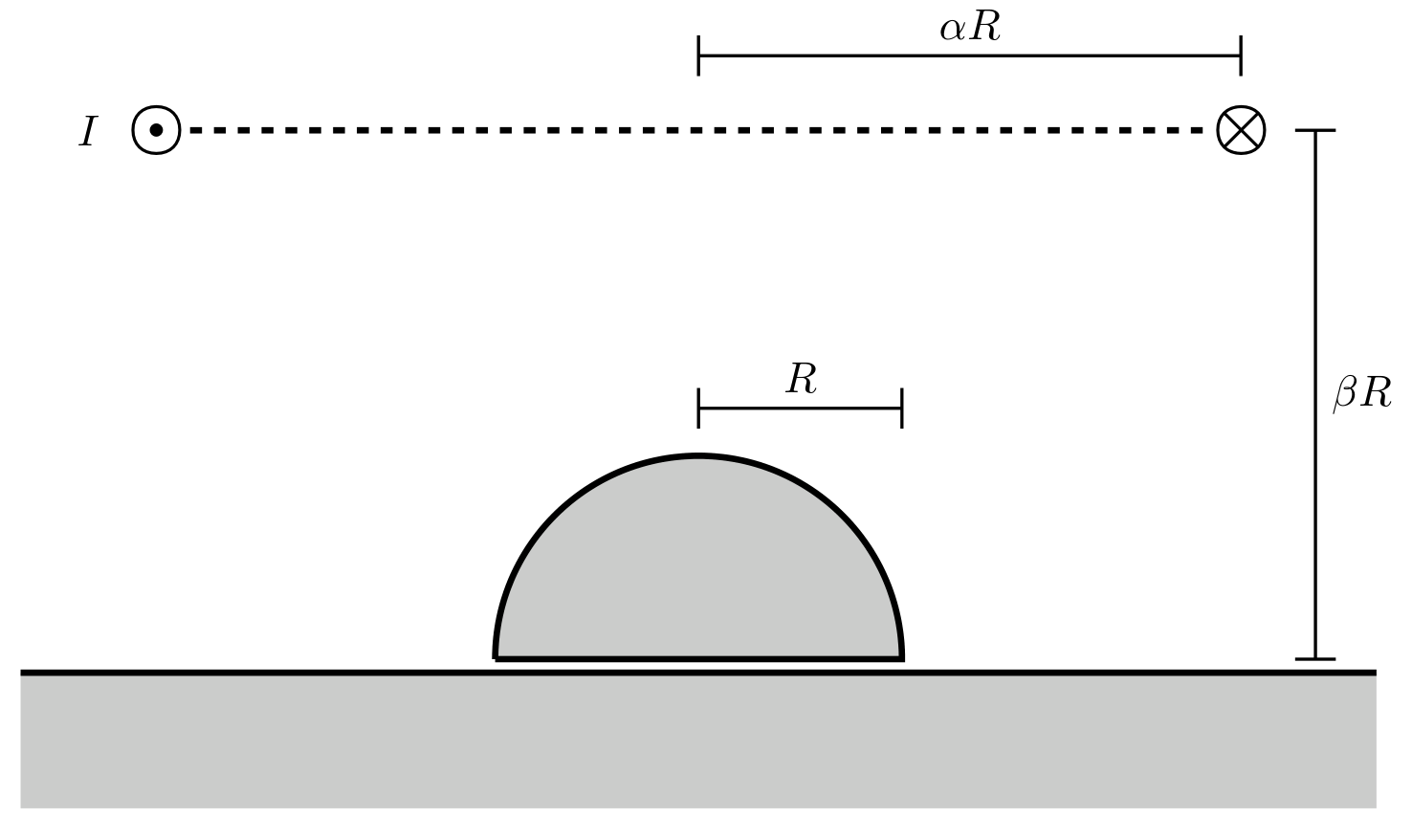
(A.2) Find the net magnetic force on the hemisphere. Give your answer in terms of the integral
[3 т.]
(A.3) Find numerically the maximum value of such that the hemisphere can be lifted, assuming that and can be chosen freely. [0,5 т.]
(A.4) Find an equation for the maximum value of such that the hemisphere can be lifted, assuming that and can be chosen freely. [1 т.]
B. World Eater [5 marks]
According to general relativity, a particle's distance from a black hole of mass obeys:
Here, is the particle's proper time and is its conserved angular momentum per unit mass around the black hole.
A black hole of mass travels at speed through a medium with density , accreting mass as it moves. Near the black hole, the gravitational field is so strong that you may treat the medium as a fluid of noninteracting particles. Assume that .
(B.1) Find the rate of increase of the black hole's mass. [1,5 т.]
(B.2) Find the drag force on the black hole, neglecting the medium's gravitational interaction with itself. Qualitatively explain your result. [2 т.]
(B.3) Including the medium's gravitational interaction with itself, give an asymptotic estimate for the drag force. [1,5 т.]
Отговори
(A.1) Boundary conditions give , so as .
(A.2)
Answer of the "original solution"; the official Erratum states that the image-loop construction for (b)-(d) is in error and that full points for (b)-(d) were given for the key idea of the sphere-plane image setup.
(A.3) 1.097
At ; from the original (erratum-affected) solution.
(A.4)
From the original (erratum-affected) solution.
(B.1)
(B.2) The drag force diverges (logarithmically): ; the assumption that particles arbitrarily far away are affected only by the black hole is not valid.
(B.3)
Решение
Magnetosphere - Solution
(a) Consider the fields and outside and inside the iron respectively. Gauss's Law, , shows that while Ampere's Law, , shows that . These are the boundary conditions for magnetic materials. Using , we have . Thus, if and are the angles to the normal, we have:
Assuming that cannot become arbitrarily large, this implies that as .
Marking Scheme: 0.25 for applying and boundary conditions. 0.25 for obtaining ”refraction” law relating and .
Original solution for (b)-(d) (b) By uniqueness, it suffices to find a field that is perpendicular to the interfaces and has the correct circulation around the wire, so we may use the method of images. Note that the image of the current loop in the plane is a congruent current loop with the same orientation.
To show that the image of the current loop in the sphere is another current loop, consider the equivalent configuration of a spherical cap with radius and magnetic dipole moment per unit area perpendicular to the cap. This lets us apply well-known results from electrostatics. The image of this cap is another cap with radius , where . Furthermore, the image of an area has area and dipole moment , giving (with the same orientation).
Thus, we can consider the following set of three image loops. Because the loops can be divided into image pairs either in the sphere or in the plane, the resulting field is perpendicular to both of these surfaces and thus satisfies the boundary conditions.
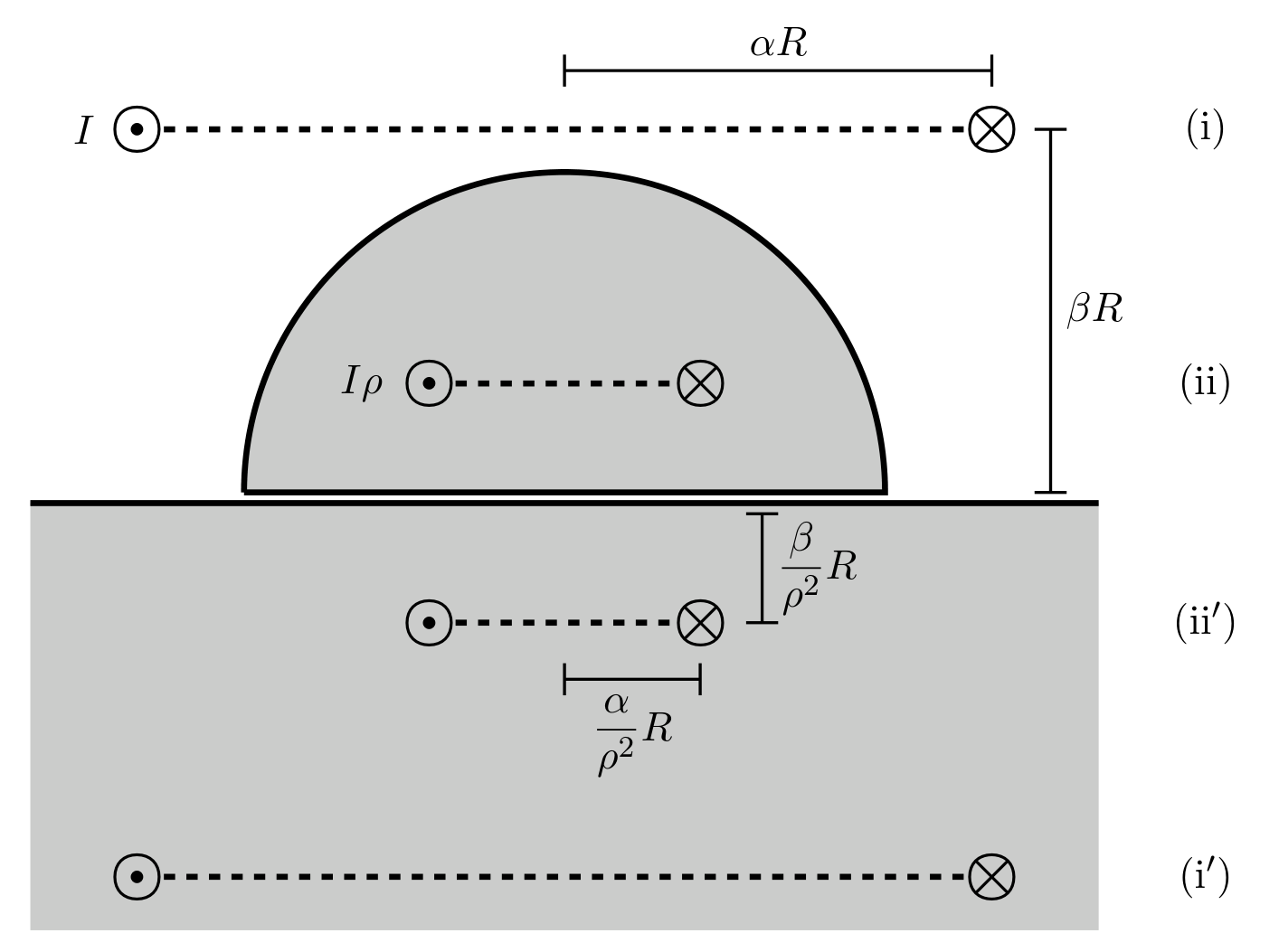
Next, we note that the force on the hemisphere is equal to the force on loop (ii) from the other three. This is because we could replace the hemisphere with loop (ii) without changing the external field, so the forces on loop (i) and on the plane would not change. Here, it is necessary to have an air gap between the hemisphere and the plane.
Thus, we need to find the force between coaxial current loops. Consider the general case of two loops with radii and currents whose centers are at . First, we'll find the magnetic vector potential of the first loop, working in cylindrical coordinates:
Here, the component integrates to 0. Thus, the force on the second loop is:
Note that this is independent of . Finally, we can write the total force on loop (ii) as:
(c) Plotting the region where in the plane:
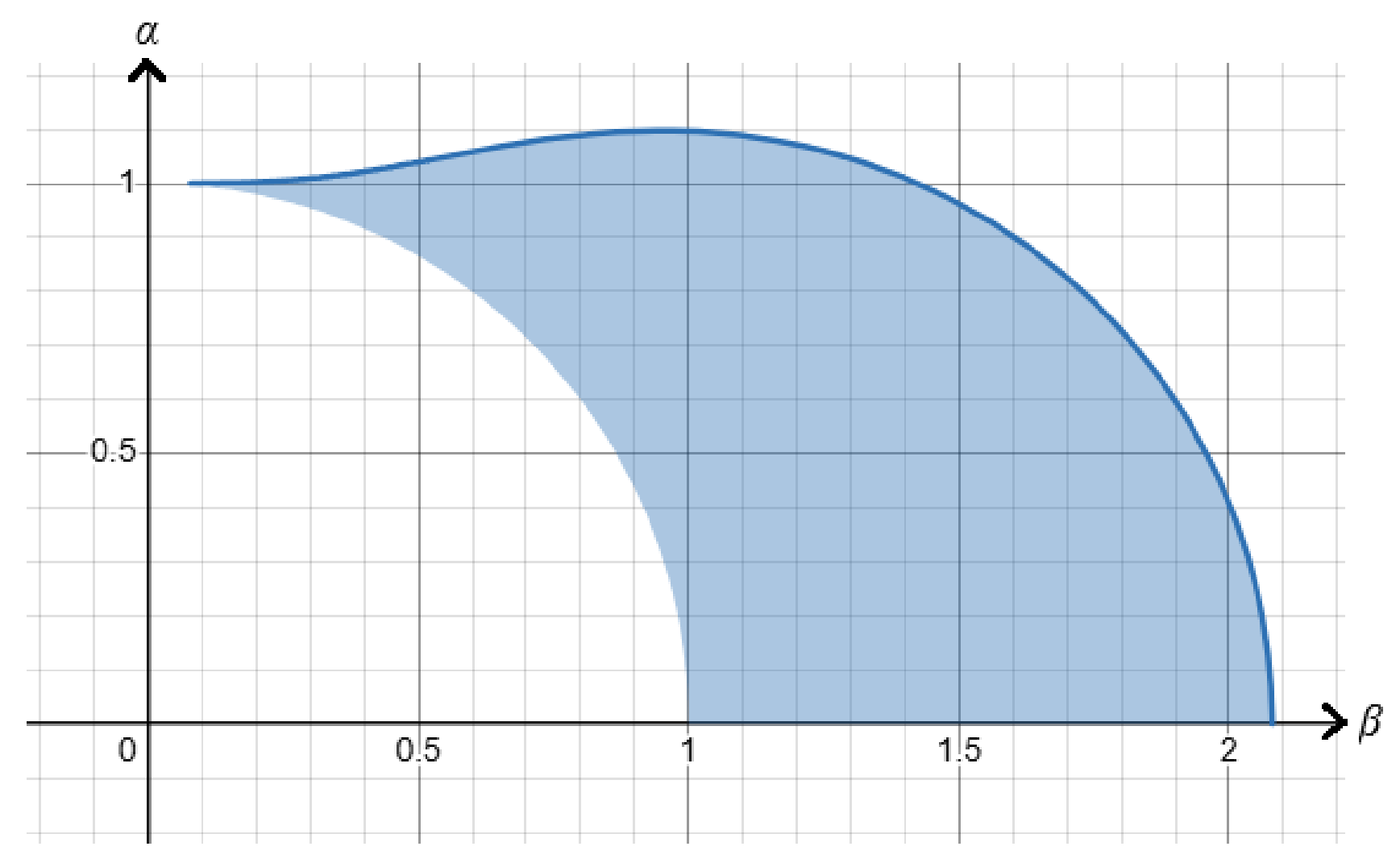
We see that the maximum value of is ; here, .
(d) According to the plot, the maximum value of has , so we can treat the current rings as point dipoles. The field of a dipole along its axis is , so the force on a dipole located at is . Letting ring (i) have moment , ring (i) has moment while rings (ii) and (ii) have moments . Thus, at the threshold we have:
This agrees with the plot.
Erratum Unfortunately, the image charges for part (b) are in error. The image of a dipole in a sphere is not another dipole; instead, it is a dipole and a net charge. If we think of the dipole as two opposite charges, the image charges are no longer of equal magnitude, and the difference is non-negligible for any choice of charges. This is a subtle issue which is detailed further in Kevin Zhou's E2 handout.
For the case of a ferromagnetic sphere, the net flux out of the sphere must be 0 by Gauss' law, so we add another charge at the center of the sphere to enforce neutrality. Then, the image of a current ring can be thought of as another current ring and a conical sheet of current from the image ring to the center of the sphere. This situation is much less tractable than intended, so we have decided to give full points for (b)-(d) to teams which realized the key idea of the sphere-plane image charge setup.
World Eater – Solution
(a) Defining , we have the following:
Thus, evolves under the “effective potential” . For , we have , so a faraway particle can overcome the angular momentum barrier and fall into the black hole if its “effective energy” satisfies .
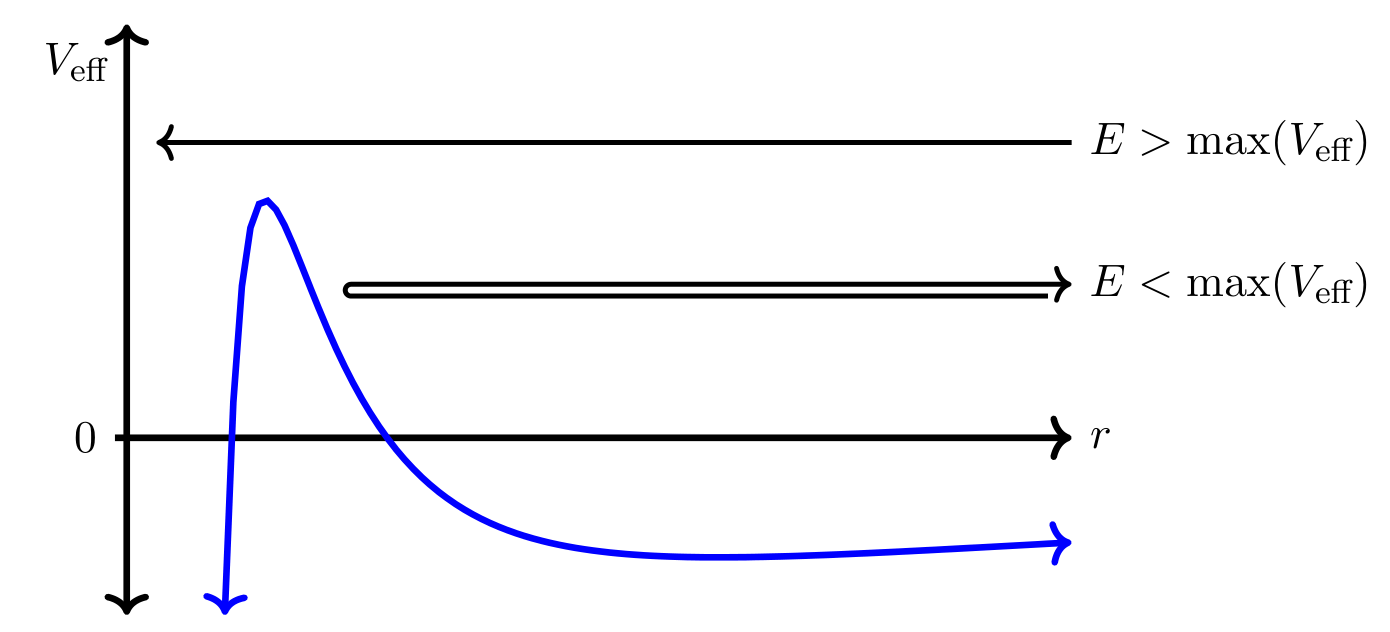
Consider a particle with impact parameter (original distance to the axis of motion) . Then, we have and . Let be the maximum impact parameter which falls into the black hole. We claim that where gives . To see this, let be the corresponding values of . Then, we can linearly approximate , so gives .
Note that when , the equation will have a double root. We have:
This has a double root when , so . Finally, the rate of mass increase is equal to the rate of mass swept out by the circle of infalling impact parameters, which is .
Marking Scheme: 0.25 for rewriting in terms of effective potential. 0.5 for considering particles with a given impact parameter and realizing that they will enter the black hole iff they can overcome the effective potential. 0.5 for finding the maximum impact parameter in the approximation. 0.25 for finding the rate of mass increase using the swept out circle of impact parameters.
(b) Treat the black hole's potential as Newtonian. Relativistic behavior is important for , so we may neglect it because the Newtonian scale is and .
Note that all particles leave with speed in the black hole's frame, so we need to find the deflection angle . Using the properties of a hyperbola, we find where is the semimajor axis. We have , so . Then, the change in the particle's axial momentum is:
Integrating over all particles:
Letting :
This ! Clearly, the assumption that particles arbitrarily far away are affected only by the black hole is not valid.
Marking Scheme: 0.25 for stating that relativistic trajectories can be neglected. 0.75 for finding the axial impulse from a particle starting at a given impact parameter in the Newtonian approximation. Small deflections end up being the dominant contribution, so it is valid to approximate particles' trajectories as straight lines. 0.5 for integrating over all impact parameters. 0.25 for obtaining a logarithmic divergence and 0.25 for the correct prefactor.
(c) We must apply a cutoff scale to the integral. This is the distance where the gravitational influence of the black hole no longer overwhelms that of the medium; dimensionally, we have . Then, ; because , we have . This gives:
Note that a multiplicative uncertainty in turns into an additive uncertainty in the logarithm, allowing us to obtain an asymptotic estimate.
Marking Scheme: 1.0 for realizing that a cutoff scale is needed due to assumptions about the noninteracting medium becoming invalid. Different cutoff scales (i.e. the dimensional scale presented here, or a different scale based on the Jeans' length of the black hole) may lead to different numeric prefactors; we accepted any which give the correct logarithmic term for 0.5 points.
Оригинал в Архива: theory.pdf · официални решения: theory_sol.pdf