OPhO 2026, Единствен кръг — Задача 17. Not Quite Now
2026 Online Physics Olympiad · 21 август 2026 г.
Last updated
Last updated: 22nd August 03:35 UTC
Sponsors
This competition would not be possible without the help of our sponsors.
Corrections (all times are in UTC)
- Q8: Cleared up wording (21/08 04:40 and 04:52)
- Q3: improved wording (21/08 08:49)
- Q19: Improved wording (21/08 09:42)
- Q16: Attempts reset (21/08 22:00), Error bound increased (22/8 02:30)
- Q1: Improved wording (22/08 03:35)
Указания
Format. The OPhO is a team-based competition (3 members at most per team). Unlike previous years, the 2026 OPhO consists of a single round held from August 21, 12 am (UTC), to August 23, 11:59 pm (UTC). The contest is made up of three parts, all running concurrently over the full contest window:
- Short Answer — problems requiring numerical answers, submitted on the OPhO portal;
- Long Answer — problems requiring full written solutions, submitted on the OPhO portal;
- Simulation — computational problems requiring teams to run a provided executable locally, with solutions submitted on the OPhO portal.
All teams have access to all three parts for the entire duration of the contest. Submissions are made on the OPhO portal https://opho.physoly.org/ using the team login, and may be made at any time within the contest window.
Short Answer. Teams submit numerical answers on the portal, with up to three attempts per problem. Every answer submission must be accompanied by a file upload, on the portal, of the working used to obtain that answer. This working will not be graded, but submissions without it will not be accepted. The base score for each problem depends on the number of teams that successfully answer it, each incorrect attempt multiplies the base score by a factor of 0.8, and there is no time factor. The score for an individual problem follows:
where represents whether a team got it on the first, second, or third try, represents the number of teams that answer the problem correctly, and is the sum of across all teams that have solved the problem. The base score is independent of problem number, but expect questions to be ordered roughly by difficulty. A team’s raw Short Answer total is the sum of these values, and all raw totals are then scaled linearly such that the top team receives 55 points.
Long Answer. Teams submit full solutions on the portal. Rubrics are predetermined, and solutions will be reviewed to determine the proper number of points to give. The points breakdown is given per problem, for a total of 35 points. It is recommended that participants write their solutions in LaTeX. Handwritten solutions (or a combination of both) are accepted too; if participants have more than one photo of a handwritten solution (jpg, png, etc.), it is required that they be organized in the correct order in a pdf before submitting.
Simulation. Teams will need to be able to run a provided executable locally. Solutions are submitted on the portal and will be graded against predetermined rubrics. The points breakdown is given per problem, for a total of 10 points.
Scoring. A team’s cumulative score is the sum of its scaled Short Answer score (out of 55 points), Long Answer score (out of 35 points), and Simulation score (out of 10 points), for a maximum score of 100 points.
Permitted Resources. Use of the internet is allowed, including textbooks, published papers, calculators, and computer algebra systems. However, the use of AI tools of any kind is strictly prohibited. This includes, but is not limited to, large language models (e.g. ChatGPT, Claude, Gemini), AI coding assistants, AI-generated search summaries, and any other AI-powered assistance.
Dishonest Behavior. Please refrain from cheating in any form. This includes, but is not limited to, creating alternate accounts to gain additional attempts, sharing answers with other teams, posting problems online, utilizing AI tools as described above, or employing any other method to gain an unfair advantage.
We have previously caught numerous teams engaging in such practices, and pursuing dishonest tactics provides no genuine sense of security. Any teams found to be acting maliciously will be notified via email, along with the opportunity to appeal. Failing to provide a valid appeal will result in a ban from participating in any future Physoly competitions. Our utmost priority is to ensure an enjoyable contest experience for all participants, and we remain committed to preventing any disruption to the fun for others.
Awards and Results. The top competitors will be recognized on the website. No cash prizes will be awarded this year.
List of Constants
- Proton mass,
- Neutron mass,
- Electron mass,
- Avogadro’s constant,
- Universal gas constant,
- Boltzmann’s constant,
- Electron charge magnitude,
- 1 electron volt,
- Speed of light,
- Universal Gravitational constant,
- Solar Mass
- Acceleration due to gravity,
- 1 unified atomic mass unit,
- Planck’s constant,
- Permittivity of free space,
- Coulomb’s law constant,
- Permeability of free space,
- Magnetic constant,
- 1 atmospheric pressure,
- Wien’s displacement constant,
- Stefan-Boltzmann constant,
Условие
A plane electromagnetic wave propagates in vacuum along the -direction. In the lab frame, its intensity profile at the initial time can be approximated as:
for over scales , and the profile thereafter propagates rigidly at speed . An object which is a sphere of radius in its own rest frame is constrained by an external force to move along with constant relativistic speed ; its surface has absorptivity and reflectivity , with reflection taken to be specular. Note that and are constant across the surface, independent of wave polarization or the angle of incidence.
At every instant in the sphere’s rest frame, only a fraction of the absorbed energy is retained by the sphere, the remainder being re-emitted isotropically in that frame.
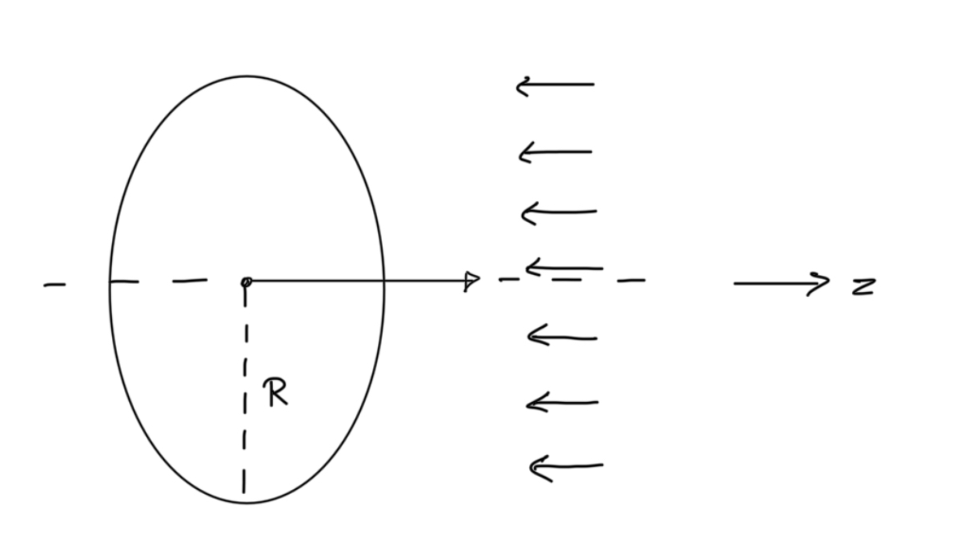
Assuming the sphere’s size is NOT negligible compared to the length scale , find the force applied by the radiation on the sphere as felt in the lab frame, if the sphere’s center starts from the origin at the initial time .
Numerical data: Take , , , , , (so ), and evaluate at . Evaluate in Newtons, and use a negative sign if force is along and vice versa.
Отговори
- -0.00000145 N
Решение
Let
Since the beam propagates along at speed , its lab-frame profile is
For a plane wave traveling opposite to the boost direction, the intensity in the sphere rest frame is Doppler-enhanced by a factor , and its argument is squeezed by the same factor. Hence
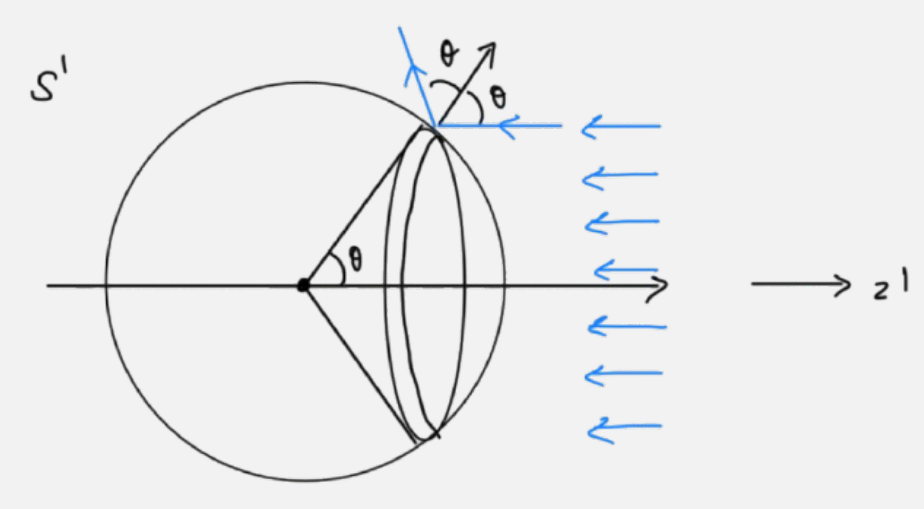
Now consider the ring on the sphere at polar angle (measured from the -axis). The illuminated hemisphere is , and the ring area is
To compute the lab-frame force at a fixed lab time , one must evaluate each ring at the corresponding time in the sphere frame. Using the Lorentz transformation and the fact that points on the same ring have the same , one finds
This is the key kinematic ingredient: a common lab-time slice does not correspond to a common over the whole sphere.
Substituting and gives a useful simplification,
so that the ring sees the intensity
The incident power on the ring in the sphere frame is
Absorption transfers momentum along the beam direction, while specular reflection adds the usual extra normal impulse. Therefore the ring contributes, in the sphere frame,
Only the retained fraction of the absorbed energy contributes to the sphere’s internal-energy increase. Thus
The longitudinal momentum rate in the lab frame is obtained by Lorentz-transforming the infinitesimal energy–momentum transfer. Since the ring is followed along its own worldline, , and one gets
The extra term is precisely why one cannot use naive longitudinal-force invariance here: the sphere is gaining internal energy in its own rest frame, so the time component of the transferred 4-momentum is nonzero and mixes into the spatial component under a boost.
Substituting the two rates above yields
Hence the total radiation force on the sphere is
Using
one finds
This force points along .
Checks. In the limit , the beam is uniform and the result reduces to the usual projected-area radiation-pressure expression, dressed by the relativistic Doppler factor. In the limit , no energy is retained in the rest frame, and the additional mixing term from disappears.
Numerical evaluation: with , , , , , the result is
.
Оригинал в Архива: problems.pdf · официални решения: solutions.pdf