OWAO 2023, Практически тур — Задача 1. Kholshevnikov Metric
ΩWAO 2023 ◇ Practical Round ◇ Problems
Условие
Consider two points in 3-dimensional space, defined by their radius vectors and . According to the Pythagorean theorem, the distance between these points . The concept of “distance” can be generalized to arbitrary spaces.
In order to determine which meteor shower a meteoroid belongs to, it is required to determine the “distance” between the orbits — the so-called metric in the space of orbital parameters. One example of metric is Kholshevnikov metric, described in detail below.
Let , , , , be the semi-major axis, eccentricity, inclination, argument of the pericentre and the longitude of the ascending node of the meteoroid’s orbit, respectively (Keplerian elements).
We introduce two vectors and :
Let us define a distance — Kholshevnikov metric — between two orbits in the space of Keplerian elements by the formula
Let , , , , be the Keplerian elements of the mean orbit of the meteor shower. If the distance between this orbit and the orbit of a given meteoroid is smaller than a limiting value, we may suppose the meteoroid to belong to this meteor shower.
The file catalog2018.csv contains the observation times and equatorial coordinates of meteoroids, as well as the Keplerian elements of the orbit of each meteoroid. The data was taken from the archives of the project SonotaCo Network.
| Year | Month | Day | , | , | , au | , | , | , | |
|---|---|---|---|---|---|---|---|---|---|
| 2018 | 1 | 1.42418 | 83.56900 | 1.11400 | 1.967 | 0.57950 | 8.81110 | 55.40330 | 100.69660 |
| 2018 | 1 | 1.48810 | 107.81900 | 24.12900 | 1.973 | 0.75290 | 1.44970 | 280.02610 | 280.76860 |
| … | … | … | … | … | … | … | … | … | … |
We are looking for meteoroids related to the Geminids meteor shower. The mean orbit of the shower corresponds to au, , , , . For this problem, let us set the limiting value .
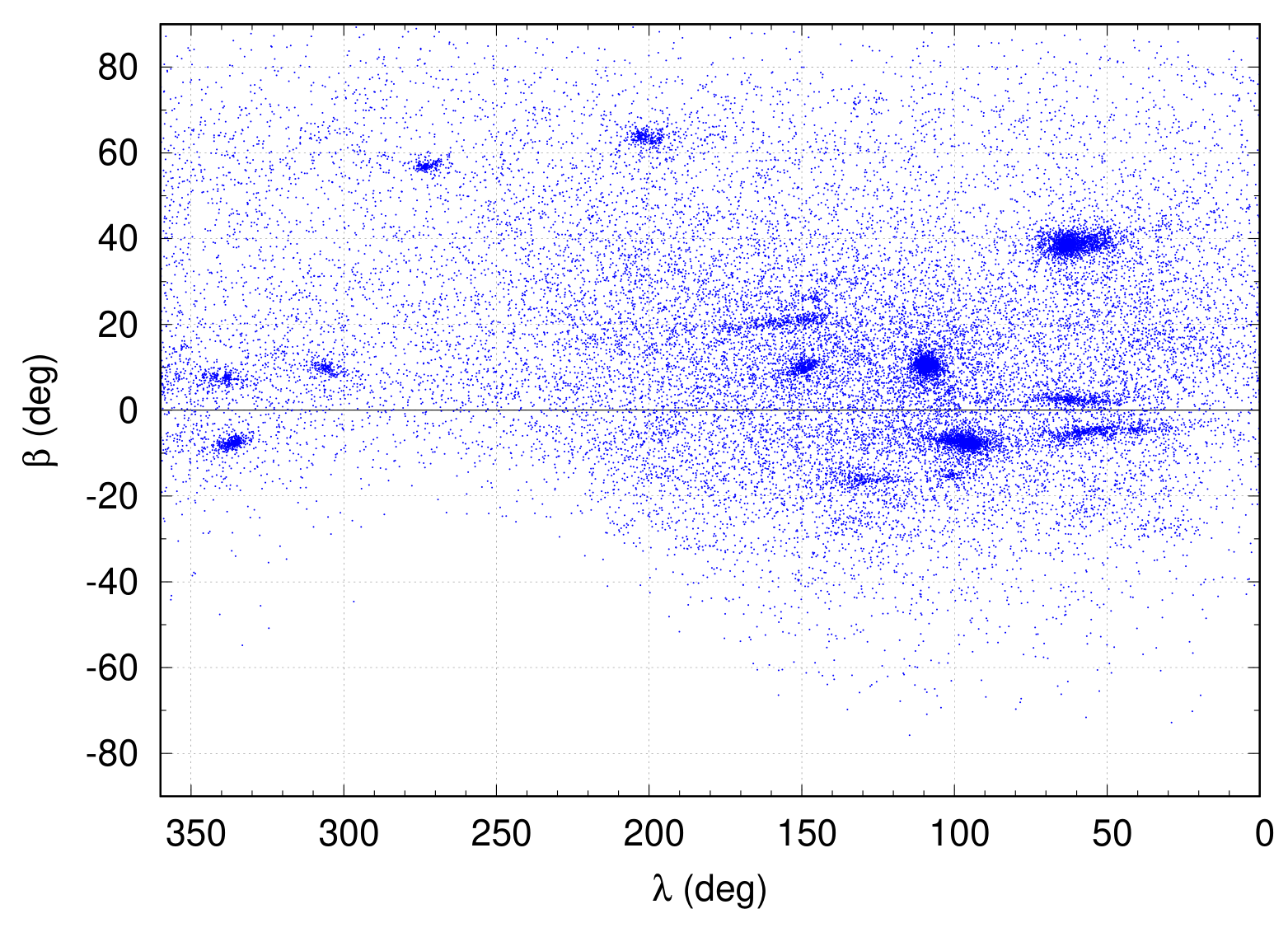
a) Plot all meteoroids on the graph in the coordinates where and are the ecliptic longitude and latitude of the meteoroid, respectively.
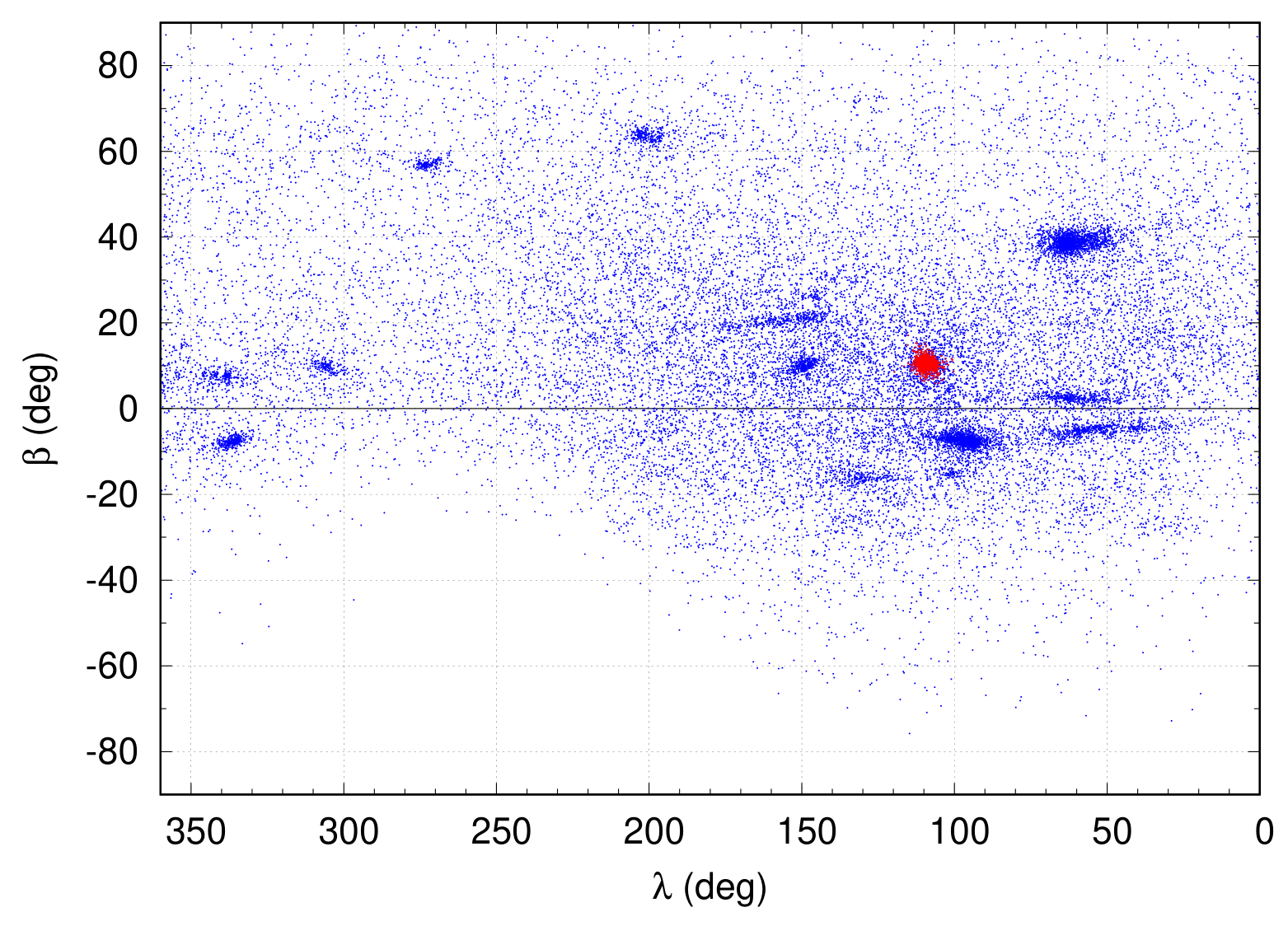
b) How many meteoroids belong to the Geminids meteor shower? Use the limiting value of the specified above and consider only meteoroids with elliptic orbits. Mark these meteoroids on the graph in the coordinates .
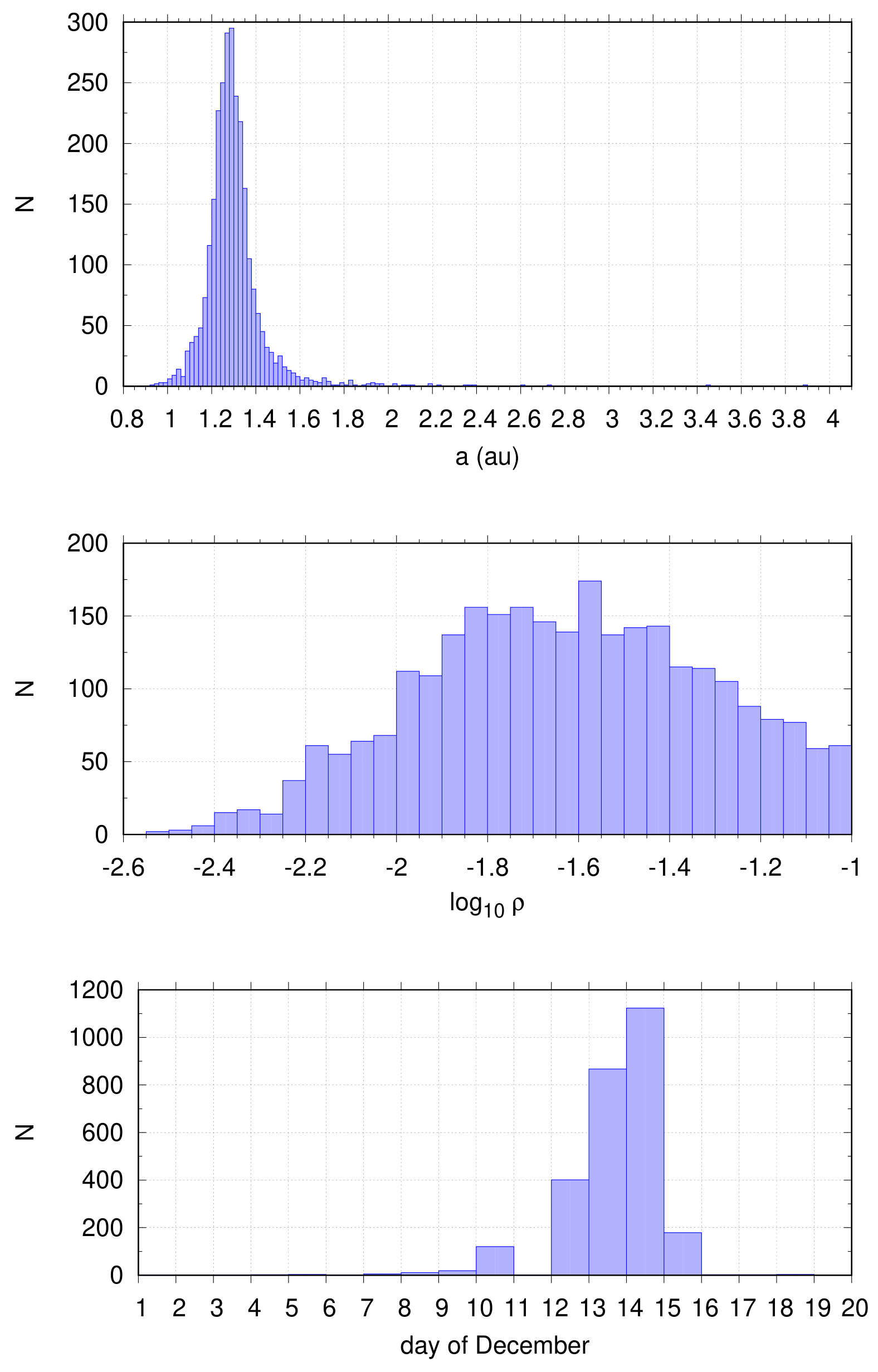
c) Plot histograms for semi-major axes and values for meteoroids belonging to the Geminids meteor shower and the histogram for days of observing these meteoroids. On what date was the largest number of meteoroids from the Geminids meteor shower observed?
d) Determine the median ecliptic and equatorial coordinates of the meteoroids belonging to the Geminids meteor shower.
Отговори
b) 2742
Official solution: only 2742 objects have .
c) December 14
d) Me δ = 32.37°, Me α = 113.29°; Me β = 10.76°, Me λ = 109.94°
Решение
In memory of Konstantin Vladislavovich Kholshevnikov (1939–2021), head of the Department of Celestial Mechanics at St. Petersburg State University, honored scientist of the Russian Federation, whose name was given to the minor planet (3504) Kholshevnikov.
Solution:
a) First, we convert the equatorial coordinates into ecliptic coordinates by writing spherical trigonometry formulae for a triangle with vertices at the north celestial pole, the north ecliptic pole and a meteoroid:
where is the inclination of the celestial equator to the ecliptic.
Numerous clumps are visible in the Fig. 1. These are what meteor showers look like if projected on the celestial sphere.
b) We denote the vectors and for the mean orbit of the meteor shower as , .
The problem condition states that we should consider only meteoroids in elliptical orbits, so objects with an orbital eccentricity greater than or equal to 1 are immediately excluded from consideration. For each meteoroid remaining in the catalog, we calculate the vectors and and determine the value of . Next, we leave only objects with . There are only 2742 such objects.
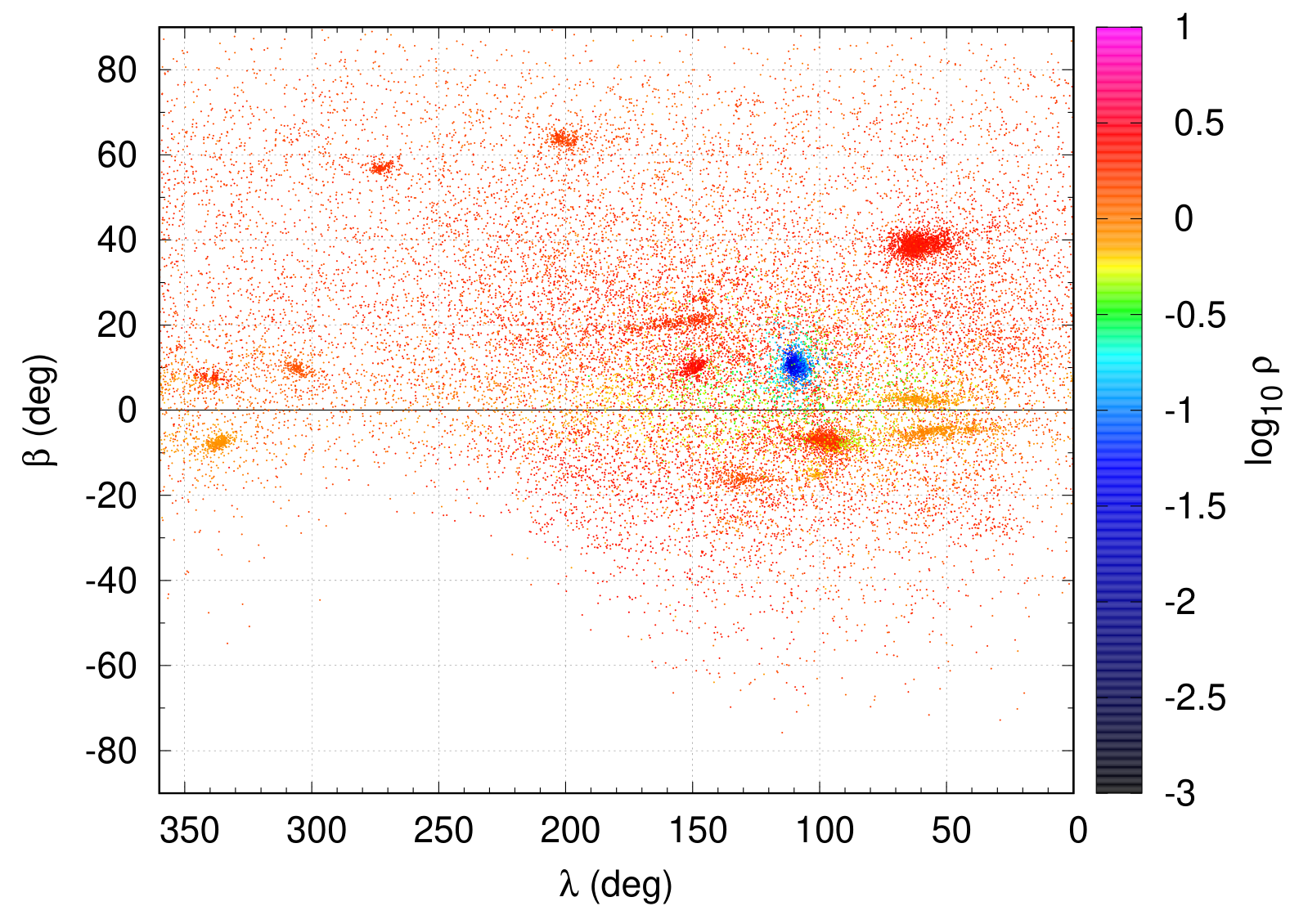
When calculating the metric, we substitute the value of semi-major axis in au since this unit of measurement is natural for the problem in consideration. values for all meteoroids from the catalog are shown in Fig. 2. The blue area corresponds to the meteoroids from the Geminids meteor shower. Meteoroids from the Geminids meteor shower are marked in red on the distribution of all meteoroids in Fig. 3.
c) The distribution of the semi-major axes of the orbit turns out to be quite wide. Objects with a semi-major axis up to 4 au are observed. Thus, the criterion for selecting objects by metric only is not absolutely accurate. However, most objects outline a narrow distribution peak.
All meteoroids that fit the criterion were observed in December, therefore, along the vertical axis on the corresponding histogram, we mark the days of December. The largest number of meteoroids was observed on December 14. In reality, the meteor shower is active from December 4 to December 17 and the maximum activity really falls on December 14.
d) In order to find the median values of the coordinates, we must separately sort each coordinate in ascending order and take the central value (or half-sum of the central values) of the resulting ordered array:
Note that the median equatorial coordinates are in good agreement with the accepted coordinates of the radiant, , (Jenniskens et al., 2016, Icarus, V. 266, p. 331).
Marking Scheme:
- — 3 pt.
- Distribution of the meteoroids on the celestial sphere — 2 pt.
- calculation — 3 pt.
- Geminids highlighted — 2 pt.
- Distribution of parameters (histograms) — 2 pt. 3
- Estimation of median coordinates — 1 pt. 2 2
Константи
| Universal | |
|---|---|
| Speed of light | |
| Planck constant | |
| Hubble constant | |
| Astronomical unit | |
| Parsec |
| Earth | |
|---|---|
| Radius | |
| Obliquity | |
| Surface gravity | |
| Orbital period | |
| Orbital eccentricity |
| Moon | |
|---|---|
| Radius | |
| Orbital period | |
| Orbital inclination |
| Sun | |
|---|---|
| Radius | |
| Absolute magnitude | (bol.) |
| Effective temperature | |
| Luminosity |
| Emission constants | |
|---|---|
| Stefan–Boltzmann | |
| Wien’s displacement |
| UBV system | Mean wavelengths |
|---|---|
| U band | |
| B band | |
| V band |
| Hydrogen spectrum | |
|---|---|
| Lyman L | Å |
| Balmer H | Å |
Оригинал в Архива: OWAO_2023_Practical_Round_Problems.pdf · официални решения: OWAO_2023_Practical_Round_Solutions.pdf