OWAO 2024, Теория — Задача 1. Crossroad of Worlds
ΩWAO 2024 ◇ Theoretical Round ◇ Problems · 20 т.
Указания
- The theoretical round is 5 hours long and accounts for 40 % of the total grade.
- The maximum score for each problem is 20 points. The round total is 180 points.
- There are Answer Sheets to write down detailed solutions.
On each Answer Sheet, please fill in
- Student code
- Problem number
- Page number and total number of pages in the submitted work
- Start each problem on a separate Answer Sheet.
- Please write only on the printed side of the sheet. Do not write on the reverse side.
- Your work will be scanned. Please use a pen so that the writing is clearly visible on the scan. Duplicate pencil lines with a pen.
- Please remember that the jury may not understand your language. It is expected that solutions are written in plain English. Use mathematical expressions, numbers and drawings.
- If you wrote something that you do not want to be marked, just cross it out like this.
- Draft papers will not be graded.
- Some problems are quite difficult. Remember that partial solutions are also scored.
- A list of constants is given on page 4.
Good luck!
Условие
The table below shows the current equatorial coordinates , parallax , proper motion components , and radial velocity for two stars for the observer on the Earth. Consider the motion of the stars relative to the Sun to be linear. Determine when the angular distance between the stars will reduce by 50 % as observed from the Earth.
| Star | (mas) | (mas/yr) | (mas/yr) | (km/s) | |
|---|---|---|---|---|---|
| 80 | 0 | ||||
| 60 | 0 |
Отговори
59000 yr
The official solution gives two moments: after about 59 thousand years and after about 148 thousand years (Method 2: 0.055 and 0.141 million years); either one earns full marks, acceptable range ±5 % each.
Решение
The stars are in the plane of the celestial equator. Since there are no components of proper motion in declination, the movement of stars also occurs in the plane of the celestial equator, .
Let us determine the distances to each of the stars and their tangential velocities:
We also calculate the overall velocity of each star relative to the Sun:
Currently, the angular distance between the stars is
We need to determine when this distance will decrease to .
Since the radial velocities of the stars are negative, the stars are currently moving towards the Sun. The signs of the components of their proper motion in right ascension differ, so the stars really will come “closer” in the Earth’s sky.
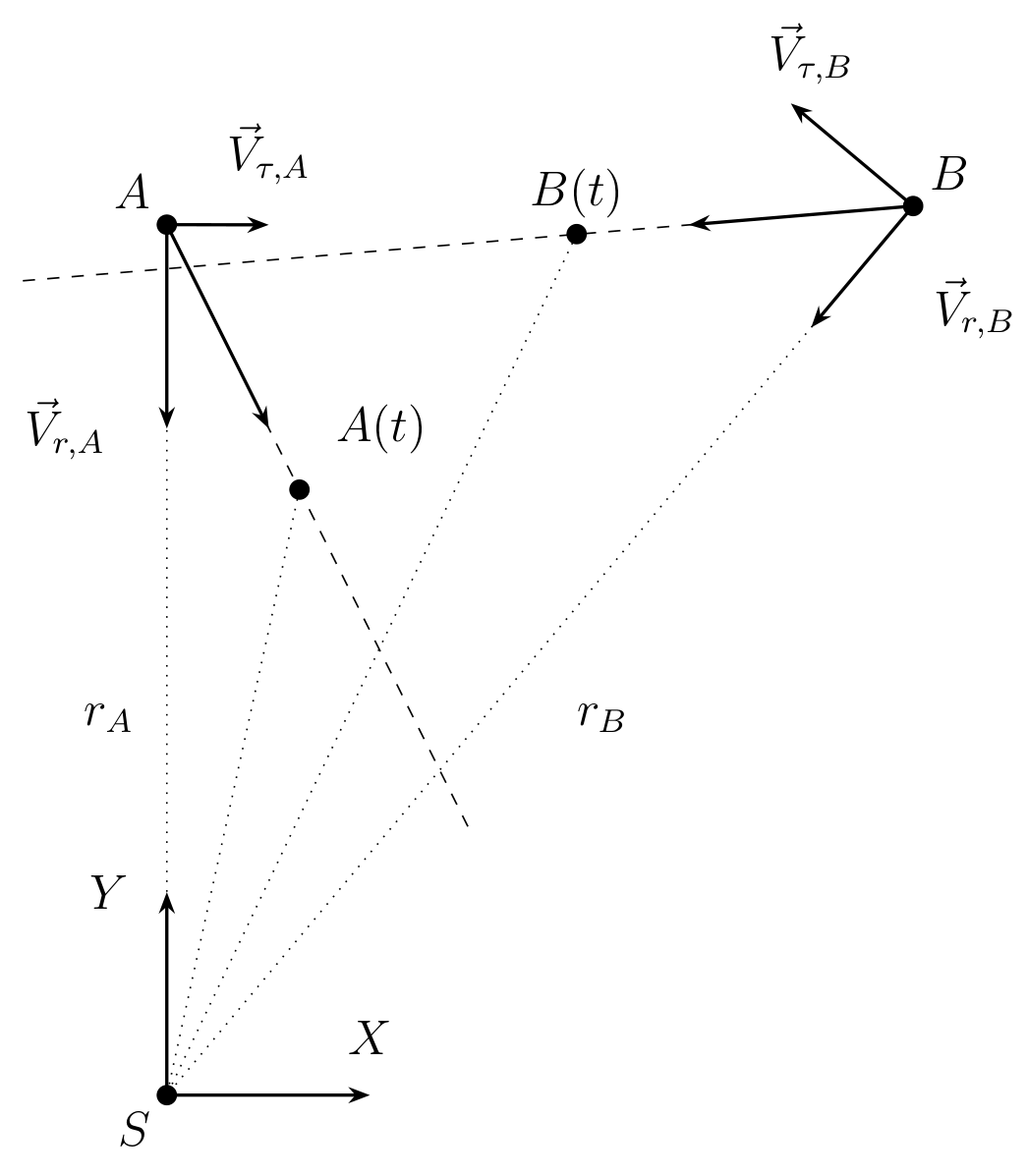
Method 1. Let us introduce a coordinate system centered on the Sun as shown in Figure 1. After a time from the current moment, the coordinates of the star will be
The angle between the full velocity vector of the star and its tangential velocity is , therefore the angle of the velocity vector of the star to the -axis is
After a time from the current moment, the coordinates of the star will be
The angle between the directions to the stars is calculated as the angle between the vectors and :
We will measure distances in parsecs, time in thousands of years and velocities in parsec per thousand years. Next, we substitute the numerical data into the expressions for the coordinates:
So our goal is to find the roots of the function
The equation is similar to the 4th degree equation. We will solve it numerically.
For geometric reasons, the equation must have exactly 2 roots. At some point, the stars will be on the same line of sight for the observer. Therefore, an angular distance of 6 degrees will occur both before and after such a moment.
First, let us define the ranges of the argument at which the function changes its sign. To do this, we calculate the values of the function on some grid:
| [kyr] | 0 | 20 | 40 | 60 | 80 | 100 | 120 | 140 | 160 |
|---|---|---|---|---|---|---|---|---|---|
| 16.4 | 10.0 | 4.4 | 4.4 | ||||||
We can find roots on the intervals and using the bisection method:
| [kyr] | 40 | 60 | 50 | 55 | 58 | 59 |
|---|---|---|---|---|---|---|
| 4.4 | 1.9 | 0.77 | 0.13 | |||
| [kyr] | 140 | 160 | 150 | 145 | 147 | 148 |
| 4.4 | 0.75 | 0.14 |
As a result, the angular distance of is reached after 59 thousand years and 148 thousand years from the current moment. Due to emerging rounding errors, the answers may differ from those indicated above by several thousand years.
Method 2. The geometrical framework here is the same as used in Method 1, but the calculations are much simpler.
Firstly, we adopt the local coordinate system for each star at the current moment. We denote the first coordinate being along the line of sight at the initial moment of time . Second coordinate in the equatorial plane is measured along the perpendicular to the direction and is positive in the direction counterclockwise from polar axis.
Then the initial coordinates for each star are:
Velocities measured along those axes are the radial and the tangential one respectively.
After a time passes the coordinates should be
Calculating all the velocities and distances we get the coordinates (in parsec) expressed as function of time (in million years):
Coordinate frame of star is rotated relatively the coordinate frame of star through the angle counterclockwise. To transform the coordinates into the same coordinate system we perform the rotation of coordinates :
After that we should express the angle between and as a function of time. Using the given cartesian coordinates we can write a dot product of the position vectors:
The answers can be found using bisection method. Note that we have 2 answers, any of them will give participant a full score, since the angle of between star can occur before and after the alignment of such stars on the sky.
Such answers are , in millions of years.
The results are slightly different because the calculations in this problem are sensitive to rounding.
Method 3. Using the same systems of coordinates as were in Method 2, one can say that the angle star travelled on the sky up to time from initial moment corresponding to parameters given in the table is
From the signs of proper motions and radial velocities it is obvious that the stars are moving towards each other. Then the equation to solve for the first moment of time is
For the second moment of time
Marking Scheme:
- Proper geometric model, including positions and velocities of the stars — 4 pt.
- Determining the tangential velocity of each star — 2 pt. + 2 pt.
- Formulation of the equation(s) for the geometric model — 4 pt. Points may be awarded even if the model is incorrect.
- Solution of the equation(s) — 6 pt. The numerical method used is not described — pt.
0 points if the model is incomplete (it is impossible to obtain a meaningful answer). - Numerical answers — 1 pt. + 1 pt. The acceptable range is % each.
Note. A participant could also say that radial velocities are too small to make a difference in answers and simply transform the last equation for the first moment of time to . The answer in this approximation is years. It is out of the 5% boundary specified in the marking scheme. If the participant proves that the radial velocities are small, then points are awarded for the understanding of limitations of the model. Otherwise, no more than 6 points are awarded for simply using the proper motions.
Константи
| Universal | |
|---|---|
| Speed of light | |
| Planck constant | |
| Boltzmann constant | |
| Gas constant | |
| Proton mass | |
| Astronomical | |
| Astronomical unit | |
| Parsec | |
| Hubble constant | |
| Earth | |
| Radius | |
| Mass | |
| Obliquity of ecliptic | |
| Surface gravity | |
| Orbital period | |
| Orbital eccentricity | |
| Hydrogen spectrum | |
| Lyman L | Å |
| Balmer H | Å |
| Jupiter | |
| Radius | |
| Mass | |
| Orbital radius | |
| Orbital period | |
| Sun | |
| Radius | |
| Mass | |
| Absolute magnitude | (bol.) |
| Effective temperature | |
| Luminosity | |
| Emission constants | |
| Stefan–Boltzmann | |
| Wien’s displacement | |
| UBV system | Mean wavelengths |
| U band | |
| B band | |
| V band |
Number of Siriuses in the Solar system
Оригинал в Архива: OWAO-2024-prob-T.pdf · официални решения: OWAO-2024-sol-T.pdf