OWAO 2024, Теория — Задача 5. Almost Circumpolar
ΩWAO 2024 ◇ Theoretical Round ◇ Problems · 20 т.
Указания
- The theoretical round is 5 hours long and accounts for 40 % of the total grade.
- The maximum score for each problem is 20 points. The round total is 180 points.
- There are Answer Sheets to write down detailed solutions.
On each Answer Sheet, please fill in
- Student code
- Problem number
- Page number and total number of pages in the submitted work
- Start each problem on a separate Answer Sheet.
- Please write only on the printed side of the sheet. Do not write on the reverse side.
- Your work will be scanned. Please use a pen so that the writing is clearly visible on the scan. Duplicate pencil lines with a pen.
- Please remember that the jury may not understand your language. It is expected that solutions are written in plain English. Use mathematical expressions, numbers and drawings.
- If you wrote something that you do not want to be marked, just cross it out like this.
- Draft papers will not be graded.
- Some problems are quite difficult. Remember that partial solutions are also scored.
- A list of constants is given on page 4.
Good luck!
Условие
Let’s consider stars for which it is true at the same time: (i) in their diurnal motion they cross the horizon, and (ii) their upper culmination occurs to the north of the zenith.
a) Express the fraction of such stars as a function of latitude . Assume that stars are distributed uniformly over the celestial sphere.
b) Determine what is the maximum possible fraction of such stars and at what latitude this maximum is achieved.
Отговори
a)
b) 0.71
Maximum 1/√2 ≈ 0.71, reached at latitude φ = −45°.
Решение
a) Let us determine the location of suitable stars on the diagram . The upper culmination of the star occurs to the north of the zenith if .
A star does not cross the horizon in two cases: either it is circumpolar or it is non-rising. A star is circumpolar if its lower culmination is above the horizon: . A star is non-rising if its upper culmination is below the horizon: . Considering , we find 4 different cases:
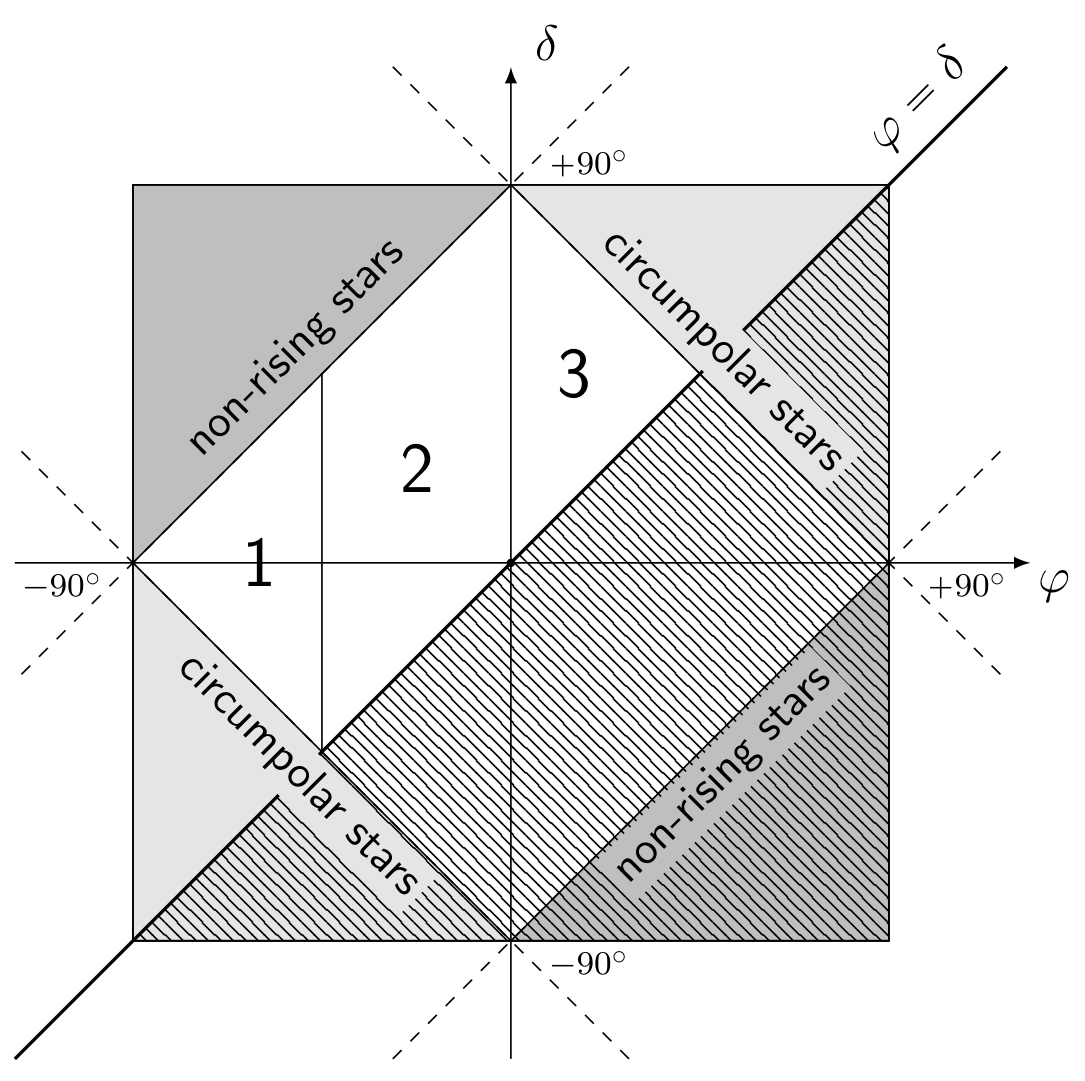
The fraction of the area of a sphere enclosed between small circles with declinations from to can be calculated using the spherical segment area formula :
Next, we obtain the fractions for the each case stated above:
Finally,
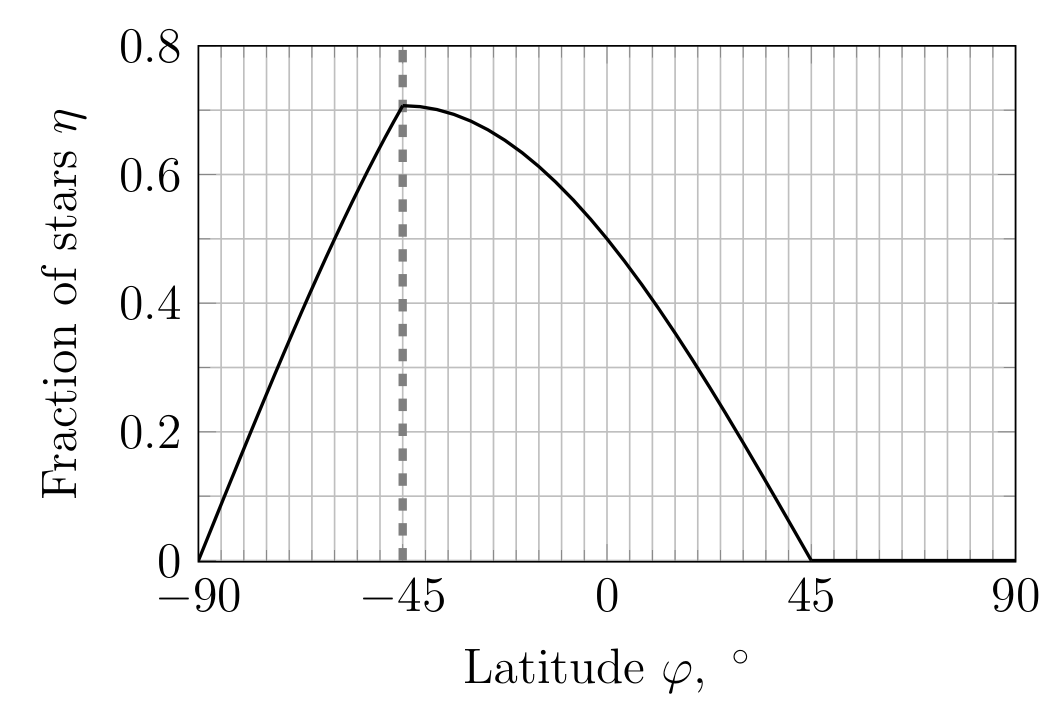
b) Obviously, the maximum of is achieved at and equals
Marking Scheme:
- Question (a)
- The presence of a graph or formulas for culminations — 3 pt.
- Indication of 4 possible cases — 4 × 1 pt. = 4 pt.
- Relationship of latitude and declination for each case — 4 × 1 pt. = 4 pt.
- Calculation of the spherical area — 2 pt.
- Providing answers for three possible cases — 3 × 1 pt. = 3 pt.
- Question (b) 6. Discussion of the maximum value — 2 pt. () + 1 pt. () 7. Correct final answer — 1 pt.
Константи
| Universal | |
|---|---|
| Speed of light | |
| Planck constant | |
| Boltzmann constant | |
| Gas constant | |
| Proton mass | |
| Astronomical | |
| Astronomical unit | |
| Parsec | |
| Hubble constant | |
| Earth | |
| Radius | |
| Mass | |
| Obliquity of ecliptic | |
| Surface gravity | |
| Orbital period | |
| Orbital eccentricity | |
| Hydrogen spectrum | |
| Lyman L | Å |
| Balmer H | Å |
| Jupiter | |
| Radius | |
| Mass | |
| Orbital radius | |
| Orbital period | |
| Sun | |
| Radius | |
| Mass | |
| Absolute magnitude | (bol.) |
| Effective temperature | |
| Luminosity | |
| Emission constants | |
| Stefan–Boltzmann | |
| Wien’s displacement | |
| UBV system | Mean wavelengths |
| U band | |
| B band | |
| V band |
Number of Siriuses in the Solar system
Оригинал в Архива: OWAO-2024-prob-T.pdf · официални решения: OWAO-2024-sol-T.pdf