OWAO 2024, Теория — Задача 6. Jupiter in Sirius
ΩWAO 2024 ◇ Theoretical Round ◇ Problems · 20 т.
Указания
- The theoretical round is 5 hours long and accounts for 40 % of the total grade.
- The maximum score for each problem is 20 points. The round total is 180 points.
- There are Answer Sheets to write down detailed solutions.
On each Answer Sheet, please fill in
- Student code
- Problem number
- Page number and total number of pages in the submitted work
- Start each problem on a separate Answer Sheet.
- Please write only on the printed side of the sheet. Do not write on the reverse side.
- Your work will be scanned. Please use a pen so that the writing is clearly visible on the scan. Duplicate pencil lines with a pen.
- Please remember that the jury may not understand your language. It is expected that solutions are written in plain English. Use mathematical expressions, numbers and drawings.
- If you wrote something that you do not want to be marked, just cross it out like this.
- Draft papers will not be graded.
- Some problems are quite difficult. Remember that partial solutions are also scored.
- A list of constants is given on page 4.
Good luck!
Условие
Let’s observe Jupiter from a point near the Omega Sirius Hotel tonight!
a) In which constellation is Jupiter located?
b) At what civil time and at what altitude the upper culmination of Jupiter does occur? Neglect the equation of time.
c) Estimate the period of visibility of Jupiter during the current day.
d) What is the elongation of Jupiter?
e) What is the angular size of Jupiter?
f) Estimate the date of the nearest opposition of Jupiter in the future.
| Date | 16 September 2024 | |
|---|---|---|
| Jupiter | Right ascension | |
| Declination | ||
| Omega Sirius | Latitude | N |
| Longitude | E | |
| Time zone | Moscow (UT+3) |
Отговори
a) Taurus
b) At about 6.0ʰ civil time, at altitude +69°
c) From its rise at 22.5ʰ until sunrise at about 6ʰ: about 7.5ʰ in total
d) 96 °
About 96° west of the Sun; the spherical-law-of-cosines estimate in the official solution gives ≈ 94°.
e) 38 ″
f) About December 10, 2024 (the actual opposition is on December 7)
Решение
a) The analysis of the equatorial coordinates makes it clear that Jupiter is located on the ecliptic approximately at west of the summer solstice point (). Since the summer solstice point is located in the Taurus constellation, almost on the border with the Gemini constellation, Jupiter is also located in Taurus.
b) The altitude of Jupiter’s upper culmination is
On the day of the Northern hemisphere autumnal equinox, September 22, the solar and sidereal times are equal. On September 16, 6 days before the equinox, the sidereal time is behind solar time. Thus, the upper culmination of Jupiter occurs at local solar time. That is
or civil time.
c) Next, we determine the hour angle at the moment of Jupiter’s set:
Thus, Jupiter crosses the horizon at civil time. It rises at and sets at . Here the difference in the duration of the solar and sidereal days can be neglected due to the reasonable accuracy of calculations.
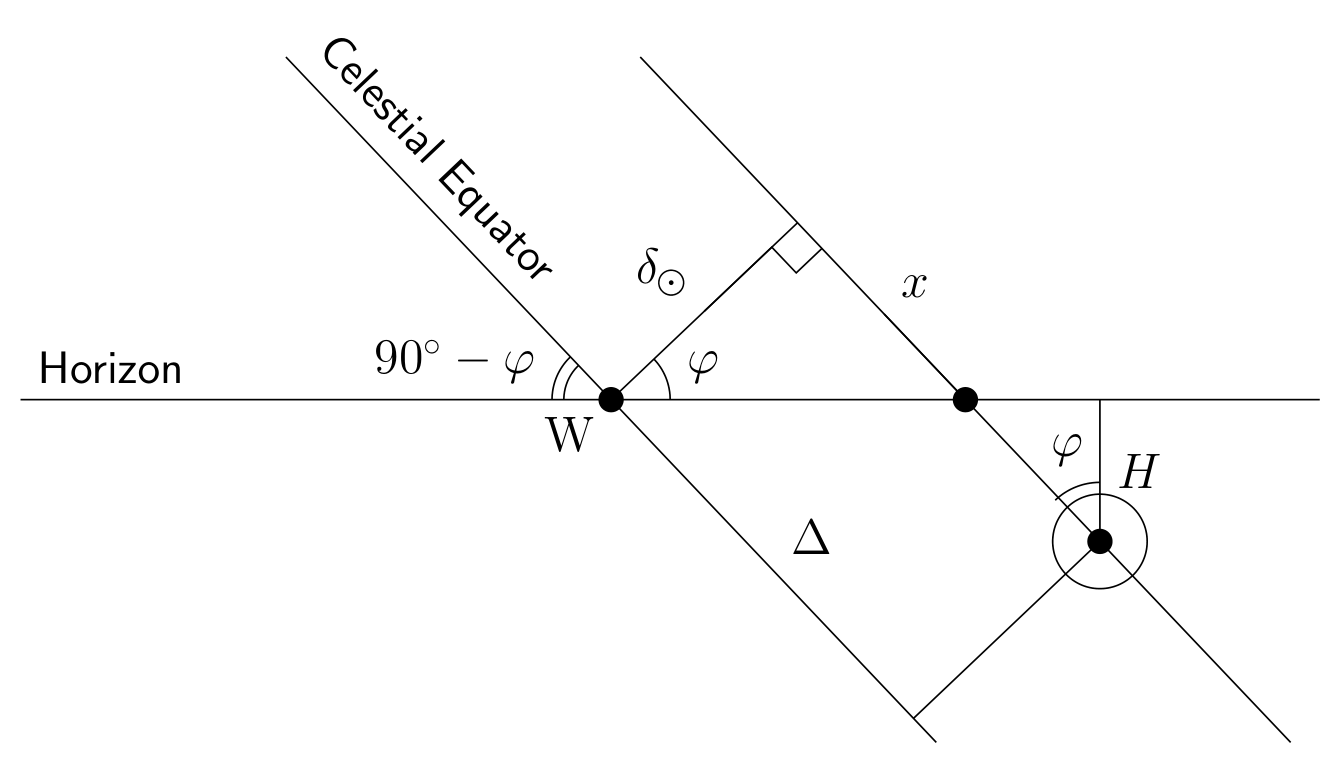
The Sun interferes with observations. Near the equinox, the declination of the Sun changes at a rate of about per day. On September 16, .
On this day, the center of the Sun crosses the horizon at after the local noon (see Figure 5), where
In addition, the atmospheric refraction () and the angular radius of the Sun () extend the daylength by
both at sunrise and sunset. In total, we have a correction .
The Sun rises at
and sets at
Thus, Jupiter can be observed approximately since its rise at until its upper culmination and the sunrise at approximately in the morning, in total.
d) The elongation of Jupiter is the angular distance between the Sun and Jupiter as observed from the Earth. It can be estimated as the difference of the ecliptic longitudes of the Sun (near the autumnal equinox) and Jupiter (near the summer solstice):
It is also possible to estimate the elongation of Jupiter as the angular distance between the Sun and Jupiter for an observer on the Earth. The equatorial coordinates of Jupiter are given in the table. The equatorial coordinates of the Sun we can estimate based on the date of observation. The declination of the Sun was calculated earlier (). The right ascension near the autumnal equinox can be estimated approximately using the formula
The elongation of Jupiter can be estimated using the spherical law of cosines
e) Jupiter is near the quadrature, so the distance to the planet can be estimated by the Pythagorean theorem: au. The angular size of Jupiter is
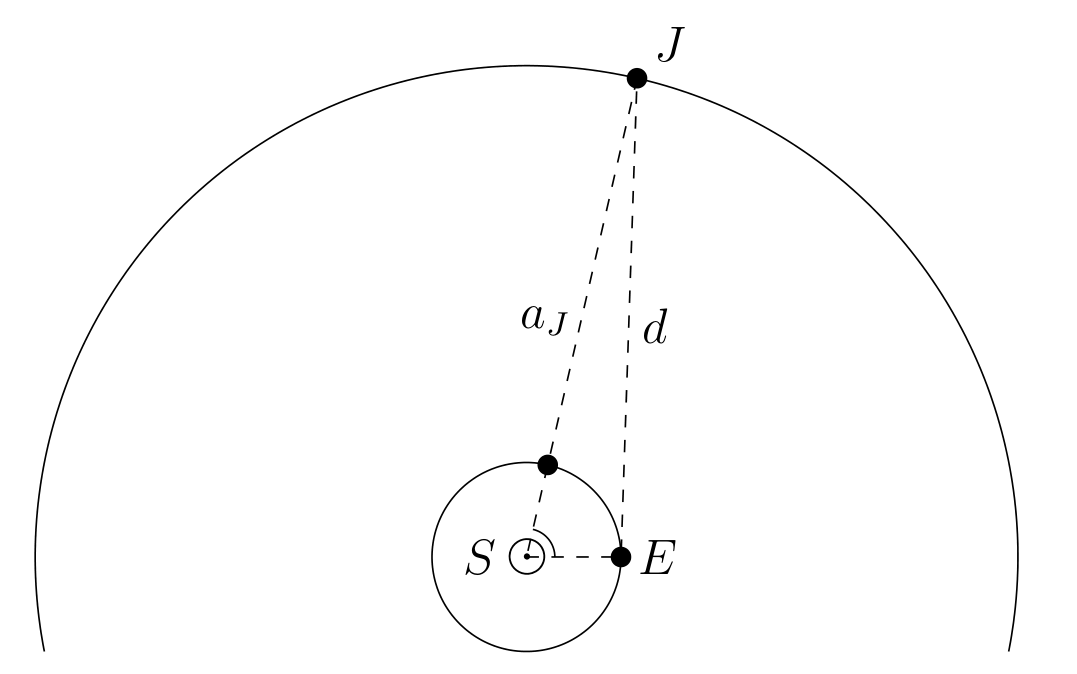
f) Since Jupiter is located to the west of the Sun, the Earth “catches up” with it in its orbital motion. For the opposition to occur, the Earth has to shift relatively to the Sun–Jupiter direction by
This shift is associated with the relative motion of the planets and with the synodic period of Jupiter relatively to the Earth.
The synodic period of Jupiter
so the opposition will come in
That is about December 10, 2024. The actual opposition of Jupiter will occur on December 7.
Marking Scheme:
- Question (a) — 2 pt.
- Question (b) 2. Altitude — 2 pt. 3. Civil time — 3 pt.
- Question (c) — 4 pt.
- Question (d) — 3 pt.
- Question (e) — 3 pt.
- Question (f) — 3 pt.
Константи
| Universal | |
|---|---|
| Speed of light | |
| Planck constant | |
| Boltzmann constant | |
| Gas constant | |
| Proton mass | |
| Astronomical | |
| Astronomical unit | |
| Parsec | |
| Hubble constant | |
| Earth | |
| Radius | |
| Mass | |
| Obliquity of ecliptic | |
| Surface gravity | |
| Orbital period | |
| Orbital eccentricity | |
| Hydrogen spectrum | |
| Lyman L | Å |
| Balmer H | Å |
| Jupiter | |
| Radius | |
| Mass | |
| Orbital radius | |
| Orbital period | |
| Sun | |
| Radius | |
| Mass | |
| Absolute magnitude | (bol.) |
| Effective temperature | |
| Luminosity | |
| Emission constants | |
| Stefan–Boltzmann | |
| Wien’s displacement | |
| UBV system | Mean wavelengths |
| U band | |
| B band | |
| V band |
Number of Siriuses in the Solar system
Оригинал в Архива: OWAO-2024-prob-T.pdf · официални решения: OWAO-2024-sol-T.pdf