OWAO 2024, Теория — Задача 8. Thirty Degrees of Freedom
ΩWAO 2024 ◇ Theoretical Round ◇ Problems · 20 т.
Указания
- The theoretical round is 5 hours long and accounts for 40 % of the total grade.
- The maximum score for each problem is 20 points. The round total is 180 points.
- There are Answer Sheets to write down detailed solutions.
On each Answer Sheet, please fill in
- Student code
- Problem number
- Page number and total number of pages in the submitted work
- Start each problem on a separate Answer Sheet.
- Please write only on the printed side of the sheet. Do not write on the reverse side.
- Your work will be scanned. Please use a pen so that the writing is clearly visible on the scan. Duplicate pencil lines with a pen.
- Please remember that the jury may not understand your language. It is expected that solutions are written in plain English. Use mathematical expressions, numbers and drawings.
- If you wrote something that you do not want to be marked, just cross it out like this.
- Draft papers will not be graded.
- Some problems are quite difficult. Remember that partial solutions are also scored.
- A list of constants is given on page 4.
Good luck!
Условие
A spherical molecular cloud has a radius of 5 pc and a mass of . The temperature of the gas is 30 K, the cloud is homogeneous.
a) Estimate the mean free path and the mean free time (between successive collisions) of the hydrogen molecules in the cloud. The cross section radius of is 2.7 Å.
b) Let a star pass behind the cloud along its apparent diameter with a tangential velocity of 70 km/s. For how long will the absorption be greater than ? Absorption in the V band is related to the atomic column density by formula in magnitudes, where is measured in .
Отговори
a) Mean free path ≈ 4·10¹⁰ m ≈ 0.3 au; mean free time ∼ 5·10⁷ s ∼ 1–2 yr
b) 140000 yr
τ ≈ 4.4·10¹² s ≈ 1.4·10⁵ yr.
Решение
a) The mean free path of the molecules is , where is the collisional cross section of a molecule, Å is the cross section radius. The coefficient arises from taking into account the motion of molecules relative to each other. Note, however, that taking the latter into account does not critically affect the estimations of the values needed for the solution.
The concentration of the molecules in the cloud
Here the mass of is estimated as .
The characteristic thermal velocity of the molecules is
We can also estimate the characteristic velocities associated with the gravitational field of the cloud. We may use the virial theorem assuming that the cloud is not collapsing nowadays (), or calculate the circular velocity at the cloud boundary
As a result, to estimate the mean free time we may take the value of velocity of km/s. The mean free time is
b) We estimate the absorption in the direction of the cloud center, that is, the maximum possible absorption in the cloud:
The minimal path of light through the cloud for the absorption to be at least is
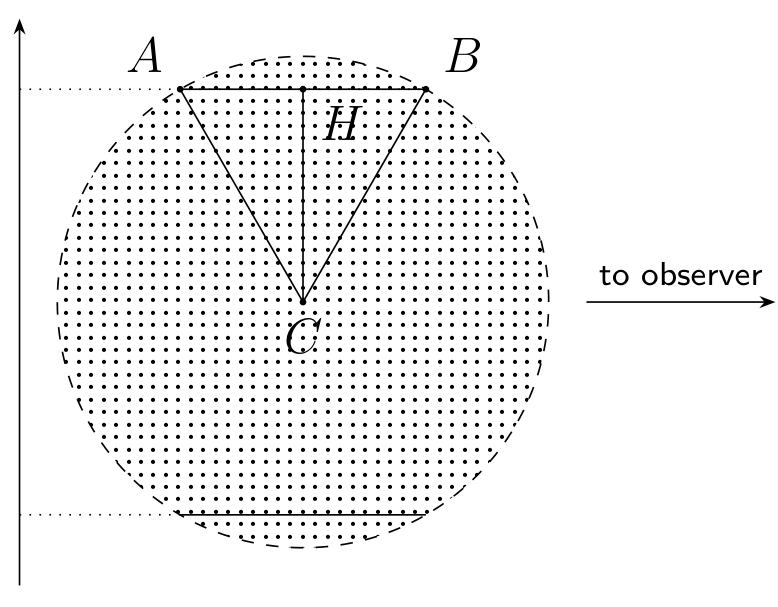
The star has to travel the distance
which is approximately the cloud’s diameter.
The time needed for that travel
Marking Scheme:
- Question (a)
- Concentration of the molecules — 2 pt. + 1 pt. (formula + estimation)
- Mean free path — 2 pt. + 1 pt.
- Characteristic velocity of molecules — 2 pt. + 1 pt.
- Two estimations of the velocity (thermal and gravitational), conclusion — 2 pt.
- Mean free time — 1 pt.
- Question (b) 6. Absorption in the direction of the cloud center — 2 pt. + 1 pt. 7. Light travel distance corresponding to an absorption of — 2 pt. 8. Length of the star’s path — 2 pt. 9. Star’s travel time — 1 pt.
Константи
| Universal | |
|---|---|
| Speed of light | |
| Planck constant | |
| Boltzmann constant | |
| Gas constant | |
| Proton mass | |
| Astronomical | |
| Astronomical unit | |
| Parsec | |
| Hubble constant | |
| Earth | |
| Radius | |
| Mass | |
| Obliquity of ecliptic | |
| Surface gravity | |
| Orbital period | |
| Orbital eccentricity | |
| Hydrogen spectrum | |
| Lyman L | Å |
| Balmer H | Å |
| Jupiter | |
| Radius | |
| Mass | |
| Orbital radius | |
| Orbital period | |
| Sun | |
| Radius | |
| Mass | |
| Absolute magnitude | (bol.) |
| Effective temperature | |
| Luminosity | |
| Emission constants | |
| Stefan–Boltzmann | |
| Wien’s displacement | |
| UBV system | Mean wavelengths |
| U band | |
| B band | |
| V band |
Number of Siriuses in the Solar system
Оригинал в Архива: OWAO-2024-prob-T.pdf · официални решения: OWAO-2024-sol-T.pdf