OWAO 2024, Теория — Задача 9. High Precision Guidance
ΩWAO 2024 ◇ Theoretical Round ◇ Problems · 20 т.
Указания
- The theoretical round is 5 hours long and accounts for 40 % of the total grade.
- The maximum score for each problem is 20 points. The round total is 180 points.
- There are Answer Sheets to write down detailed solutions.
On each Answer Sheet, please fill in
- Student code
- Problem number
- Page number and total number of pages in the submitted work
- Start each problem on a separate Answer Sheet.
- Please write only on the printed side of the sheet. Do not write on the reverse side.
- Your work will be scanned. Please use a pen so that the writing is clearly visible on the scan. Duplicate pencil lines with a pen.
- Please remember that the jury may not understand your language. It is expected that solutions are written in plain English. Use mathematical expressions, numbers and drawings.
- If you wrote something that you do not want to be marked, just cross it out like this.
- Draft papers will not be graded.
- Some problems are quite difficult. Remember that partial solutions are also scored.
- A list of constants is given on page 4.
Good luck!
Условие
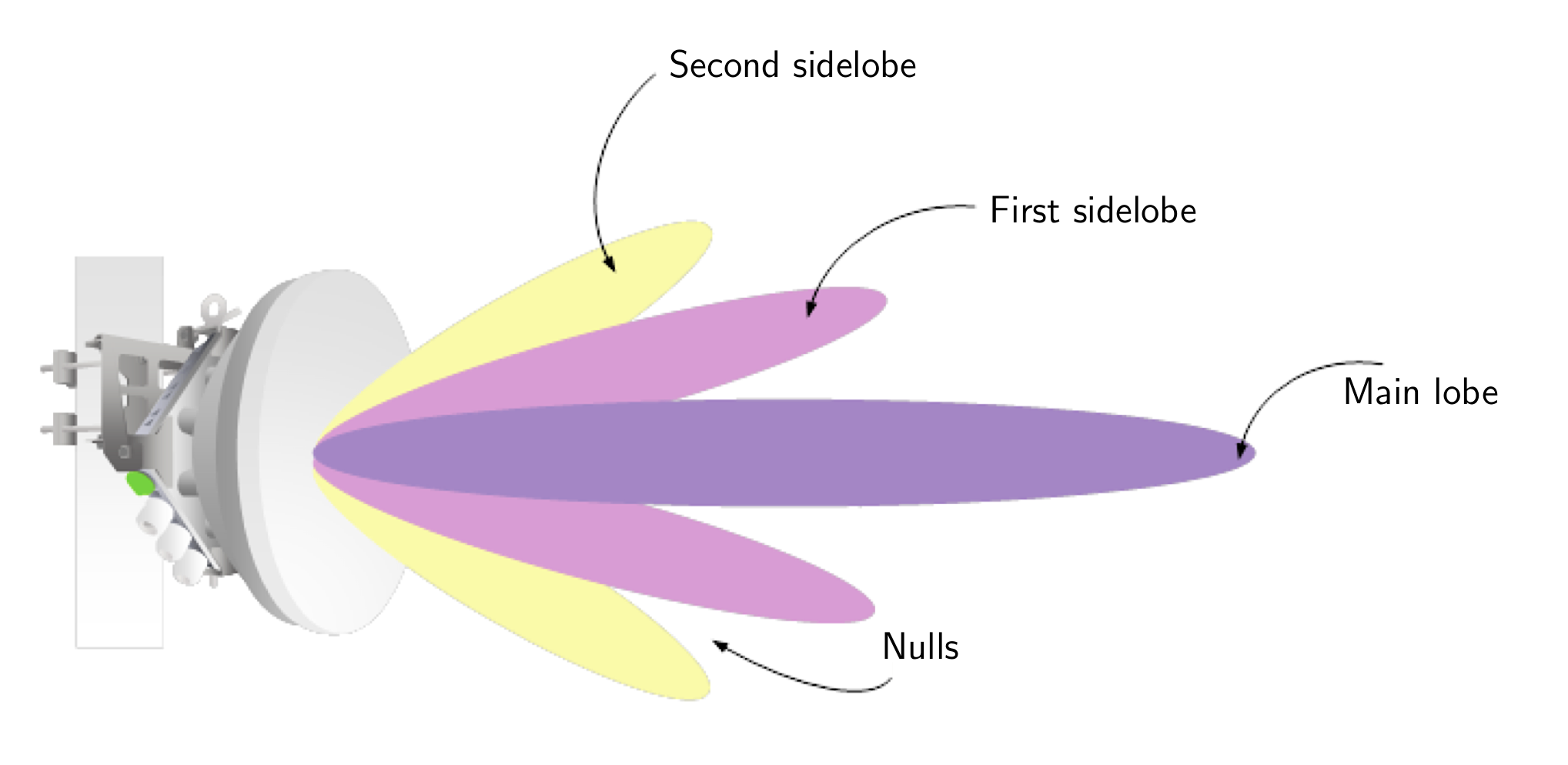
A radiotelescope RT-22 (CrAO) has a mirror dish with a diameter of 22 m and focal length m. They are going to observe the Sun in the first sidelobe of the radiation pattern of the telescope (see Figure 1 on page 1) at a frequency of 420 MHz. A receiver is located at the primary (main) focus of the mirror. Consider the mirror to be spherical. Determine the distance between the center of the mirror and the center of the receiver’s shadow on the dish.
Отговори
- 0.5 m
Решение
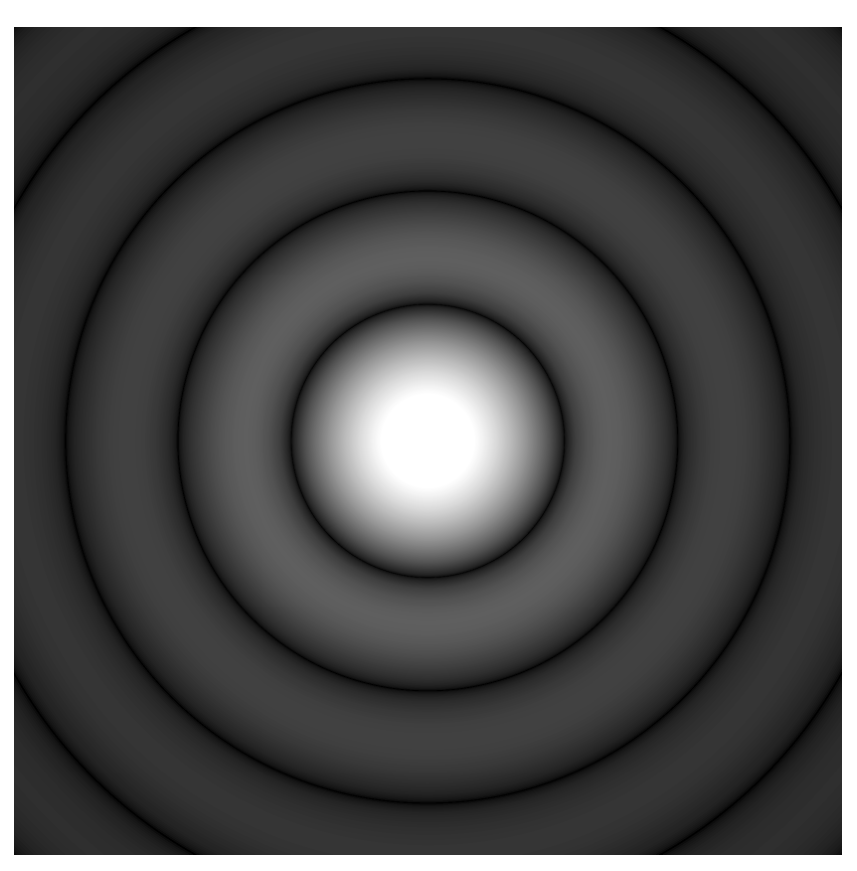
An image in the focal plane of the dish is determined by the diffraction pattern on a circular aperture (Figure 8). First, we estimate the angular distance of the peak of the first sidelobe relative to the axis of symmetry of the system. Note that to do this, we need to determine the position of the first maximum of the diffraction pattern outside the Airy disc. Recall that the angular radius of the Airy disc is , where is a diameter of the dish and is the wavelength of light. Further, the distances between the minima are about , so the angular distance between the peak of the main lobe (the center of the image) and the peak of the first sidelobe is about .
To estimate the angular distance, we calculate the wavelength at which the observations are carried out:
Thus,
Note that the angular diameter of the Sun () is much smaller than the resolution of the telescope (), so we may consider the Sun to be a point source.
Such an angular distance corresponds to a linear distance of
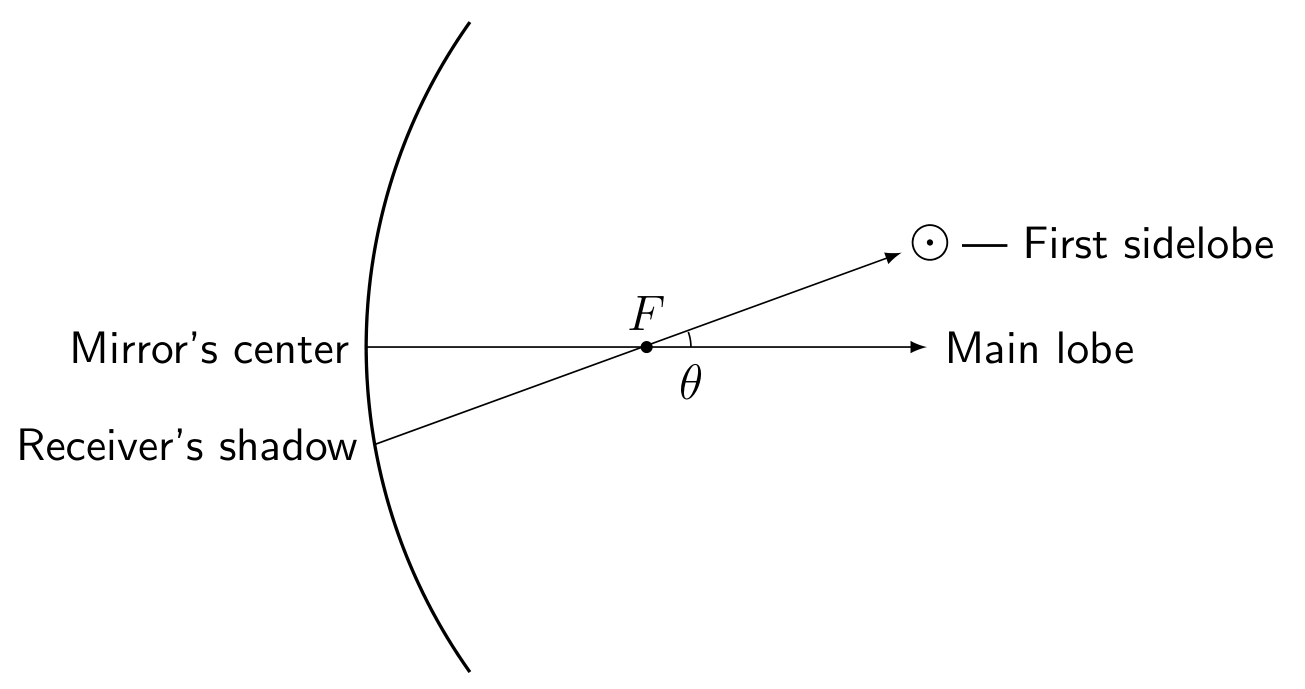
Note that the sphericity of the mirror can be ignored. Possible mirror aberrations are proportional to the third power of the angle between the beam and the main optical axis. Taking into account such effects will affect only the fourth digit in the answer. The accuracy of the data given in the problem does not allow one to discuss such effects. The difference in the distance along the surface of the mirror dish and along the chord can also be neglected due to the smallness of the angle obtained.
Marking Scheme:
Wavelength — 2 pt.
Resolution estimation using the formula — 3 pt.
Coefficient in the formula for the angular distance with justification — 6 pt.
Linear distance based on angular distance — 4 pt.
Rationale for not taking into account the sphericity of the mirror — 5 pt.
Bonus criterion. The final answer MUST NOT contain more than two significant digits. For each extra digit the penalty is points.
1 pt. is awarded in total for the problem in case of some sane attempt to solve it.
Константи
| Universal | |
|---|---|
| Speed of light | |
| Planck constant | |
| Boltzmann constant | |
| Gas constant | |
| Proton mass | |
| Astronomical | |
| Astronomical unit | |
| Parsec | |
| Hubble constant | |
| Earth | |
| Radius | |
| Mass | |
| Obliquity of ecliptic | |
| Surface gravity | |
| Orbital period | |
| Orbital eccentricity | |
| Hydrogen spectrum | |
| Lyman L | Å |
| Balmer H | Å |
| Jupiter | |
| Radius | |
| Mass | |
| Orbital radius | |
| Orbital period | |
| Sun | |
| Radius | |
| Mass | |
| Absolute magnitude | (bol.) |
| Effective temperature | |
| Luminosity | |
| Emission constants | |
| Stefan–Boltzmann | |
| Wien’s displacement | |
| UBV system | Mean wavelengths |
| U band | |
| B band | |
| V band |
Number of Siriuses in the Solar system
Оригинал в Архива: OWAO-2024-prob-T.pdf · официални решения: OWAO-2024-sol-T.pdf