OWAO 2025, Практически тур — Задача 1. Chandrasekhar Says No
ΩWAO 2025 ◇ Practical Round ◇ Problems · 20 т.
Условие
The file WD.txt contains a data table for ZZ Ceti white dwarfs (Cang et al., 2025) with the following columns:
Teff(K)— effective temperature in kelvin;logg— base-10 logarithm of the surface gravity in cm/s;G(mag)— apparent magnitude in the band;Parallax(mas)— parallax in milliarcseconds.
The file BC.txt provides bolometric corrections for the band (Carrasco et al., 2014):
Teff[K]— effective temperature in kelvin;logg[cm/s2]— base-10 logarithm of the surface gravity in cm/s;Mbol-MG— bolometric correction.
a) Plot the dependence of the white dwarf radius (in ) on its mass (in ). [16 т.]
b) How many objects outlie the main relation? For how many objects are the parameters non-realistic? Explain. [4 т.]
Отговори
- b) At least four objects have clearly unrealistic parameters (masses above the Chandrasekhar limit of about 1.4 solar masses or below ~0.1 solar masses); several more show moderate deviations from the main trend.
Решение
Solution
a) We start from the standard parallax–distance relation: .
Using this, we can express the absolute magnitude of each object in the band as
Since most objects are located at distances of only a few hundred parsecs, we can safely neglect the effect of interstellar extinction.
To proceed further, we need the bolometric magnitude. This requires applying a bolometric correction, for which the tabulated values are provided in the file BC.txt. These corrections are given only on a relatively coarse grid of parameters (). Hence, in order to obtain the appropriate value for each individual white dwarf, interpolation across this grid is necessary.
In particular, the SciPy library in Python provides convenient tools for that. The corresponding part of the code might look like this:
interp = LinearNDInterpolator(
    points=BC_cat[[‘Teff[K]’, ‘logg[cm/s2]’]].values,
    values=BC_cat[‘Mbol-MG’].values,
    fill_value=np.nan
)

cat[‘BC’] = interp(cat[[‘Teff(K)’, ‘logg’]].values)
Alternative way. One might also implement a “manual” bilinear interpolation. Suppose we wish to evaluate at a point given its values at the four surrounding grid nodes: , , , and .
First, perform linear interpolation along the -direction to obtain intermediate values at
Next, interpolate in the -direction between and :
Altogether this produces the standard bilinear interpolation formula. If lies outside the rectangle, the same expressions provide a simple linear extrapolation.
After the bolometric corrections are determined, the bolometric magnitude and luminosity of each object can be obtained by comparison with the Sun using Pogson’s relation:
Next, we apply the Stefan–Boltzmann law. Expressing the stellar radius relative to the Sun yields
Finally, the mass of each white dwarf follows from the surface gravity and the radius:
Remark. Care must be taken with units: the catalog quantity logg , so that the actual surface gravity in SI units is
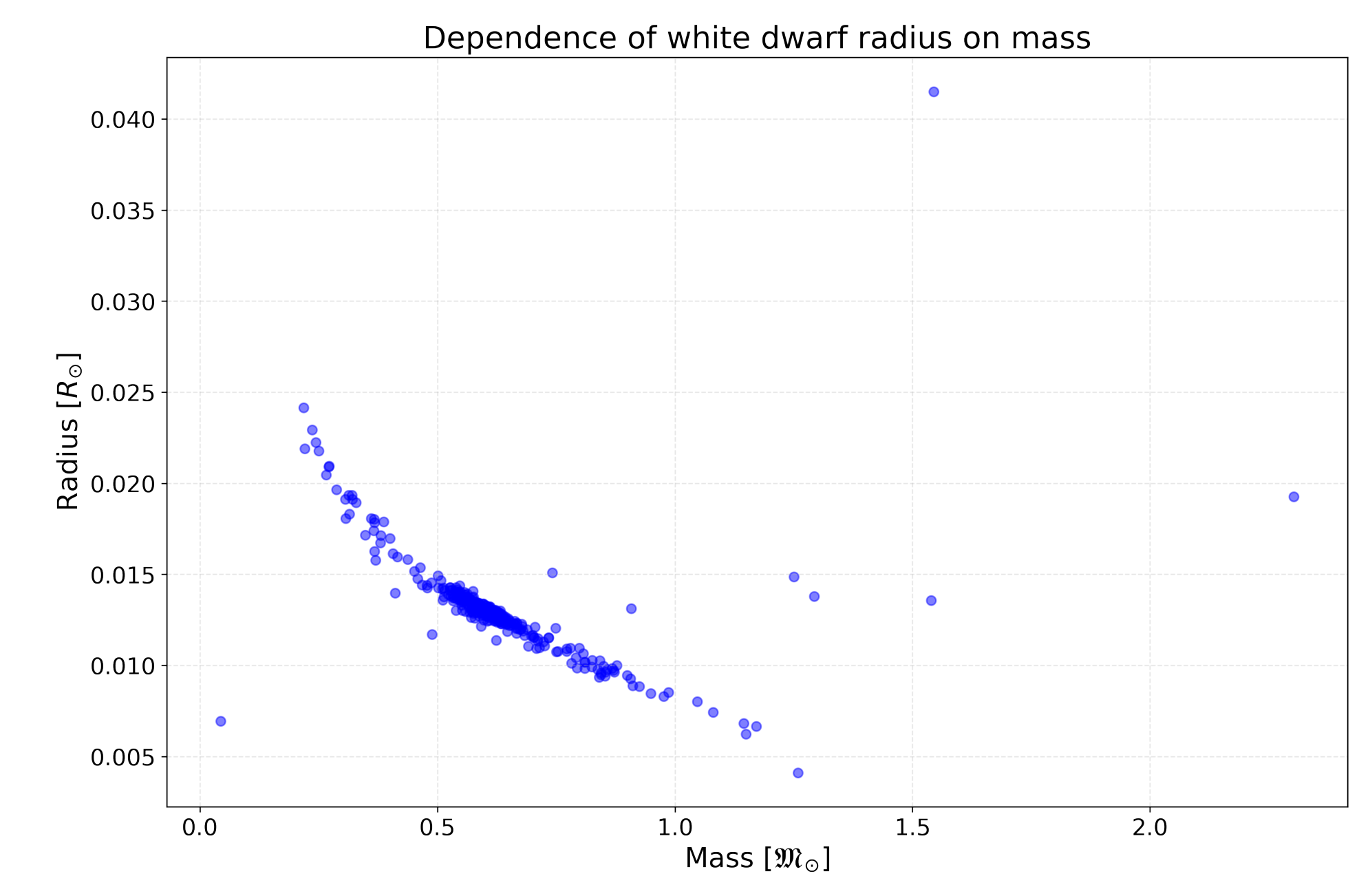
b) We identify at least four objects with clearly unrealistic parameters: white dwarf masses cannot exceed the Chandrasekhar limit of about , nor can they fall below . In addition, several stars exhibit moderate deviations from the main trend.
Such discrepancies may arise from unaccounted interstellar extinction, the absence of reported observational uncertainties, or hidden binarity of some objects. Nevertheless, the overall distribution agrees reasonably well with the theoretical white dwarf mass–radius relation.
Marking Scheme:
- Question (a) – relation
Interpolation of the bolometric correction — 5 pt.
Application of the bolometric correction to the band magnitude — 1 pt.
Calculation of absolute magnitudes — 2 pt.
Calculation of luminosities — 1 pt.
Calculation of radii — 1 pt.
Calculation of masses — 2 pt.
Plot Radius vs. Mass — 4 pt.
If Mass is plotted versus Radius, values are not in solar units, or the axes are unlabeled — pt. each.
- Question (b) Outliers
- Correct identification of the number of outliers — 2 pt.
- Interpretation of the identified outliers — 2 pt.
Константи
Universal
- Gravitational constant
- Speed of light
Astronomical
- Astronomical unit
- Parsec
- Hubble constant
Emission constants
- Stefan–Boltzmann
- Wien’s displacement
Earth
- Radius
- Obliquity of ecliptic
- Orbital period
Sun
- Radius
- Mass
- Absolute magnitude (bol.)
- Effective temperature
- Luminosity
Оригинал в Архива: OWAO_2025_Practical_Problems.pdf · решение от архива: OWAO_2025_Practical_Solutions.pdf