OWAO 2025, Теория — Задача 1. Celestial Pause
2025 ◇ Theoretical Round ◇ Problems
Внимание: Бележка към темата
All eight whole original tasks and 29 lettered parts, complete official worked solutions, alternatives and marking schemes are retained. Constants are native question page 5 and repeated key page 31, fully transcribed once as a shared reference. No paper/time/task/part total is printed, so no totals are inferred from marking criteria. Source mathematical/subscript/endpoint/equality discrepancies are preserved with attributed local notes. The separately printed cooler-star Criterion (x) remains inside original task 8; no extra problem is created.
Константи
Universal
| Gravitational constant | |
| Speed of light | |
| Planck constant | |
| Boltzmann constant | |
| Gas constant | |
| Proton mass |
Astronomical
| Astronomical unit | |
| Parsec | |
| Hubble constant |
Earth
| Radius | |
| Mass | |
| Obliquity of ecliptic | |
| Surface gravity | |
| Orbital period | |
| Orbital eccentricity |
Hydrogen spectrum
| Lyman | |
| Balmer |
Jupiter
| Radius | |
| Mass | |
| Orbital radius | |
| Orbital period |
Sun
| Radius | |
| Mass | |
| Absolute magnitude | |
| Effective temperature | |
| Luminosity | |
| Color index |
Emission constants
| Stefan-Boltzmann | |
| Wien’s displacement |
UBV… system — Mean wavelengths
| U band | |
| B band | |
| V band | |
| K band |
Условие
From opposition to the nearest stationary point, the apparent angular diameter of an asteroid decreases by 10%. A stationary point is the point at which the asteroid’s apparent motion reverses. The observer is located on the surface of the Earth. Assume the asteroid’s orbit is circular and lies in the ecliptic plane.
a) Determine the radius of the asteroid’s orbit.
b) How much time passes between these two moments?
Отговори
- a) .
- b) .
Решение
a) A stationary point is a configuration in which the relative velocity of the observer and the asteroid is directed along the line of sight, meaning there is no relative tangential component. The stationary points are symmetric with respect to opposition.
Let denote the difference in the heliocentric longitudes of the Earth and the asteroid. The distance between them is
Express the tangential components of velocity:
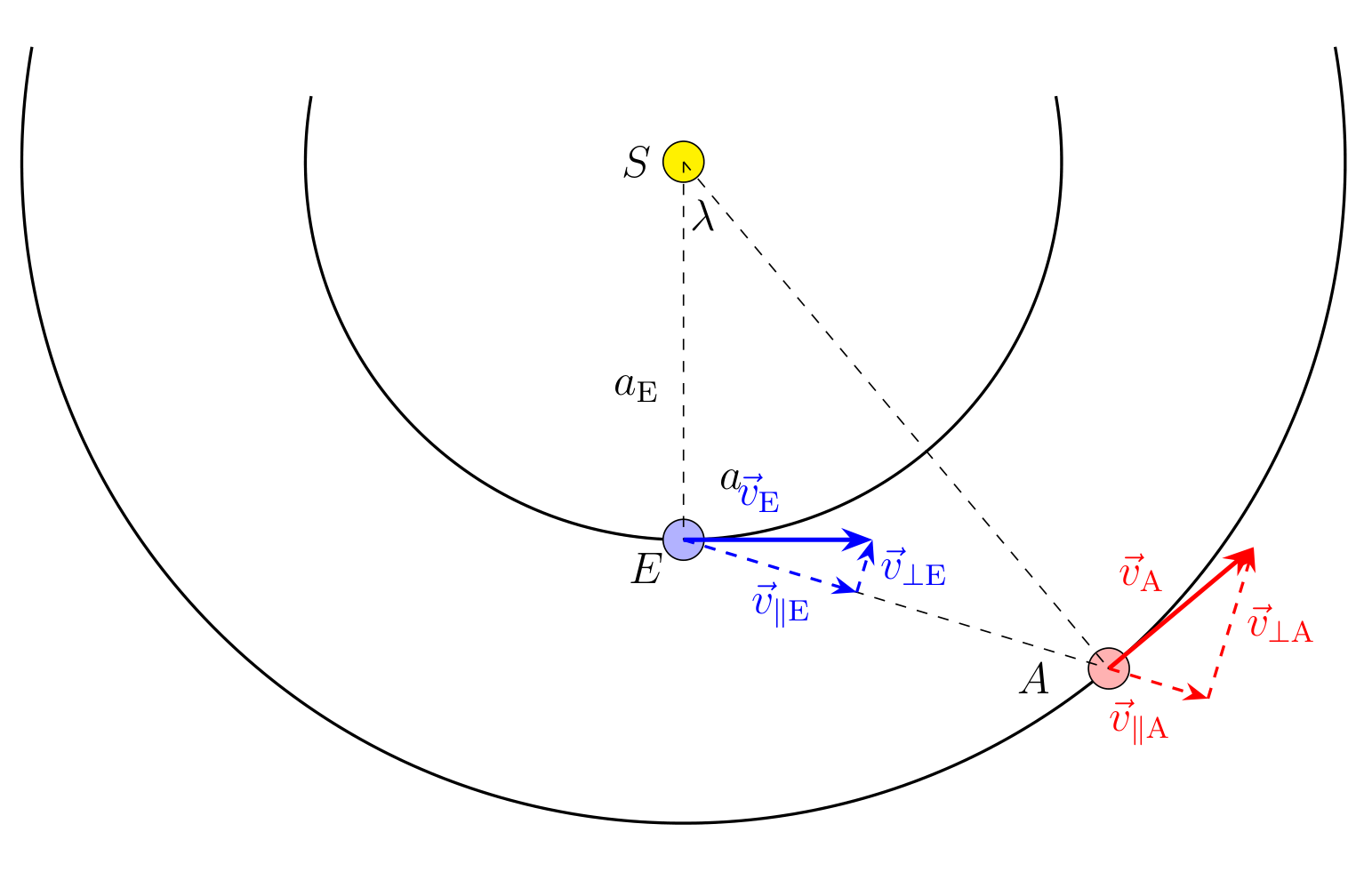
Apply the law of cosines to :
Assuming circular orbits, we equate the tangential components of the orbital velocities:
The distance to the asteroid at opposition is . The distance at the stationary point is derived using the geometrical relation involving . The ratio of the asteroid’s angular sizes at these two points leads to the following equation:
Let us measure distances in au, so . The equation simplifies to:
b) Next, determine the time interval between opposition and the stationary point. The difference in heliocentric longitudes at the stationary point is
The change in the difference of heliocentric longitudes is related to the synodic period . Then, the time interval is proportional to the difference in heliocentric longitudes:
Marking Scheme:
- Question (a) Orbital radius
- Geometric and kinematic relations for the stationary point — 5 pt.
- Valid technique to solve the equation for the orbital radius — 5 pt.
- Correct numerical result — 3 pt.
- Question (b) Time interval
- Synodic period, difference in heliocentric longitudes at the stationary point — 5 pt.
- Correct numerical result — 2 pt.
Теми и трудност
Оценена трудност: 3/5.
Небесна механика · Орбитално движение · Синодични периоди
Предпоставки: Гимназиална подготовка, Разширена олимпиадна подготовка
Оригинал в Архива: OWAO_2025_Theoretical_Problems.pdf · официални решения: OWAO_2025_Theoretical_Solutions.pdf