OWAO 2025, Теория — Задача 4. Tides on a Rod
2025 ◇ Theoretical Round ◇ Problems
Внимание: Бележка към темата
All eight whole original tasks and 29 lettered parts, complete official worked solutions, alternatives and marking schemes are retained. Constants are native question page 5 and repeated key page 31, fully transcribed once as a shared reference. No paper/time/task/part total is printed, so no totals are inferred from marking criteria. Source mathematical/subscript/endpoint/equality discrepancies are preserved with attributed local notes. The separately printed cooler-star Criterion (x) remains inside original task 8; no extra problem is created.
Константи
Universal
| Gravitational constant | |
| Speed of light | |
| Planck constant | |
| Boltzmann constant | |
| Gas constant | |
| Proton mass |
Astronomical
| Astronomical unit | |
| Parsec | |
| Hubble constant |
Earth
| Radius | |
| Mass | |
| Obliquity of ecliptic | |
| Surface gravity | |
| Orbital period | |
| Orbital eccentricity |
Hydrogen spectrum
| Lyman | |
| Balmer |
Jupiter
| Radius | |
| Mass | |
| Orbital radius | |
| Orbital period |
Sun
| Radius | |
| Mass | |
| Absolute magnitude | |
| Effective temperature | |
| Luminosity | |
| Color index |
Emission constants
| Stefan-Boltzmann | |
| Wien’s displacement |
UBV… system — Mean wavelengths
| U band | |
| B band | |
| V band | |
| K band |
Условие
An experimental gradiometer satellite consists of a thin, rigid, massless rod of length with small masses at its ends. Its center moves in a circular orbit at an altitude above the Earth’s surface. In equilibrium, the rod is oriented radially toward the Earth’s center.
Assume that the Earth’s gravitational field is the same as that of a point mass:
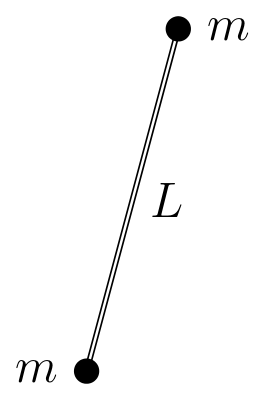
a) Determine the orbital period of the satellite, neglecting the rod’s length.
b) Find a small correction to the satellite’s circular orbital speed that comes from the fact that it isn’t a point, but has a finite length :
c) Find the period of small oscillations of the satellite about the equilibrium in the orbital plane, assuming that the satellite’s center continues to move in a circular orbit.
Отговори
- a) .
- b) ; .
- c) .
Решение
a) The radius of satellite’s orbit is . For a circular orbit, the centripetal acceleration is provided by gravity:
b) Let be the half-length of the rod. The positions of its endpoints are , where . By definition, their average gives the center of mass (COM):
Since internal forces cancel, Newton’s second law for the system gives
We now compute the gravitational acceleration at the endpoints using the binomial expansion, noting that :
“Averaging” the two values cancels the odd term:
Alternative way. Let us denote . We start by simplifying the expression:
This result simplifies the calculation of the center-of-mass acceleration:
For a circular COM orbit,
Thus, , and the relative correction to the velocity is
c) When the rod is tilted by a small angle , each end feels a force that is
- slightly stronger/weaker because of being nearer/farther, and
- points in a direction turned by a small angle because the end is shifted sideways.
The combination of these effects produces a net torque about the center of mass, which acts as a restoring torque:
where
We begin by expanding the gravitational acceleration at each end of the rod , noting that :
For small angles , we use the approximations , . The restoring torque about the center of mass, calculated to first order, is
The moment of inertia of the two end masses about the COM in the orbital plane is
Using the torque above, we obtain the equation of motion for a harmonic oscillator
Therefore, the angular frequency and period of small librations are:
Elegant shortcut. In the reference frame co-rotating with the rod’s center of mass, the effective potential combines Earth’s gravity and the centrifugal potential:
The center of mass is in mechanical equilibrium at the orbital radius , satisfying:
which is the standard expression for the orbital angular velocity.
The tidal acceleration near is given by the second derivative of the potential. To first order:
For small angular deflections, the system can be modeled as two simple pendulums of length , oscillating in the effective tidal field, each in a uniform field with acceleration
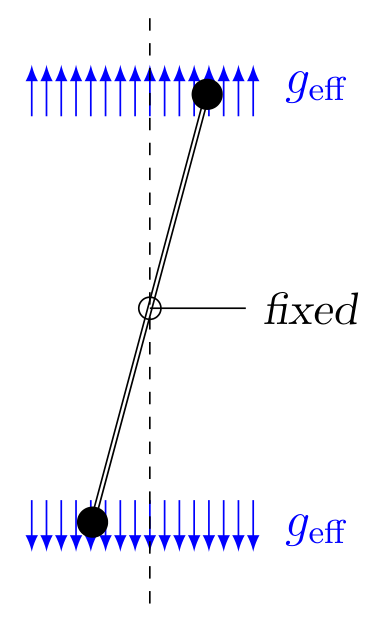
The corresponding oscillation period is
Marking Scheme:
- Question (a) Orbital period
- Correct expression for the period — 2 pt.
- Calculations and correct answer — 2 pt.
- Question (b) Correction to circular speed
- Correct Newton’s 2nd law — 2 pt.
- Correct series expansion — 4 pt.
- Correct numerical result — 2 pt.
- Question (c) Period of small oscillations
- Correct physical laws and relations that can be used to derive the differential equation for harmonic oscillations — 4 pt.
- Correct harmonic motion equation — 2 pt.
- Correct numerical result — 2 pt.
Теми и трудност
Оценена трудност: 4/5.
Небесна механика · Механика · Гравитационни системи · Механични трептения · Въртене на твърдо тяло
Предпоставки: Гимназиална подготовка, Разширена олимпиадна подготовка
Оригинал в Архива: OWAO_2025_Theoretical_Problems.pdf · официални решения: OWAO_2025_Theoretical_Solutions.pdf