OWAO 2025, Теория — Задача 5. Above the Photosphere
2025 ◇ Theoretical Round ◇ Problems
Внимание: Бележка към темата
All eight whole original tasks and 29 lettered parts, complete official worked solutions, alternatives and marking schemes are retained. Constants are native question page 5 and repeated key page 31, fully transcribed once as a shared reference. No paper/time/task/part total is printed, so no totals are inferred from marking criteria. Source mathematical/subscript/endpoint/equality discrepancies are preserved with attributed local notes. The separately printed cooler-star Criterion (x) remains inside original task 8; no extra problem is created.
Константи
Universal
| Gravitational constant | |
| Speed of light | |
| Planck constant | |
| Boltzmann constant | |
| Gas constant | |
| Proton mass |
Astronomical
| Astronomical unit | |
| Parsec | |
| Hubble constant |
Earth
| Radius | |
| Mass | |
| Obliquity of ecliptic | |
| Surface gravity | |
| Orbital period | |
| Orbital eccentricity |
Hydrogen spectrum
| Lyman | |
| Balmer |
Jupiter
| Radius | |
| Mass | |
| Orbital radius | |
| Orbital period |
Sun
| Radius | |
| Mass | |
| Absolute magnitude | |
| Effective temperature | |
| Luminosity | |
| Color index |
Emission constants
| Stefan-Boltzmann | |
| Wien’s displacement |
UBV… system — Mean wavelengths
| U band | |
| B band | |
| V band | |
| K band |
Условие
For a main-sequence star, the difference in free-fall acceleration in the photosphere and at the upper boundary of the chromosphere (10000 km above the photosphere), measured above the star’s pole, is . It is also known that from the upper boundary of the chromosphere, only 0.7% of the entire photosphere is visible.
a) Estimate the mass, radius, and temperature of the star.
b) Which spectral and luminosity class does this star belong to?
c) Estimate the minimum possible rotational period of the star.
Отговори
- a) , , .
- b) Early G-type or late F-type, luminosity class V.
- c) .
Решение
a) An observer (point ) at a height above the photosphere of a star of radius sees a spherical cap defined by the angle . The solid angle subtended by this cap is
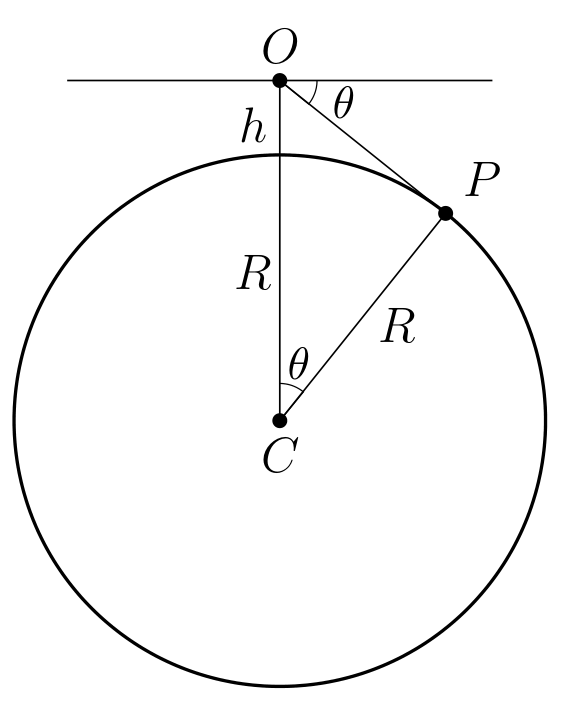
The fraction of the total steradians is therefore:
Solving for the radius :
The free-fall acceleration at a distance from the center:
The difference in the gravitational acceleration between two locations is
Given , we simplify the expression in parentheses:
Thus,
Solving for the mass:
Using the mass-luminosity relation for main-sequence stars, we find the luminosity relative to the Sun:
The Stefan-Boltzmann law in relative terms is
b) Such temperature is typical for early G-type or late F-type stars. They are quite similar to the Sun (G2V, 5778 K). The star is on the main sequence (luminosity class V).
c) The minimum rotational period occurs when the star’s equatorial velocity reaches the first cosmic (circular) velocity. At this limit, the centrifugal force balances gravity at the equator. Hence, the corresponding minimum period is the orbital period:
It is important to note that this is a simplified estimate. In reality, as rotational velocity increases, the star deforms into an oblate spheroid. A more accurate treatment would require modeling the surface as an equipotential, where the effective gravity incorporates the centrifugal potential. However, for the purpose of a rough estimation, the spherical model is adequate.
Marking Scheme:
- Question (a) Mass, radius, and temperature
- Estimate for the radius — 1+1 pt.
- Estimate for the mass — 2+2 pt.
- Estimate for the luminosity — 2+2 pt.
- Estimate for the temperature — 2+2 pt.
- Question (b) Spectral type — 2 pt.
- Question (c) Minimum rotational period
- Maximum possible velocity on the equator or equivalent — 2 pt.
- Minimum rotational period — 2 pt.
Теми и трудност
Оценена трудност: 3/5.
Звезди · Светлина и астрономически измервания · Небесна механика · Свойства на звездите · Абсолютно черно тяло · Гравитационни системи
Предпоставки: Гимназиална подготовка, Разширена олимпиадна подготовка
Оригинал в Архива: OWAO_2025_Theoretical_Problems.pdf · официални решения: OWAO_2025_Theoretical_Solutions.pdf