RMPh 2012, Експеримент — Задача 1. PROBLEM No. 1
Romanian Master of Physics 2012 · 10 т.
Условие
The aim of this experimental task is to make numeric estimations for the Maxwell-Boltzmann distribution. Specifically, we want to determine de fraction of the helium atoms () at room temperature () having speeds within a range of at most ±11% of their most probable speed.
For this, you need to make use of a coin.
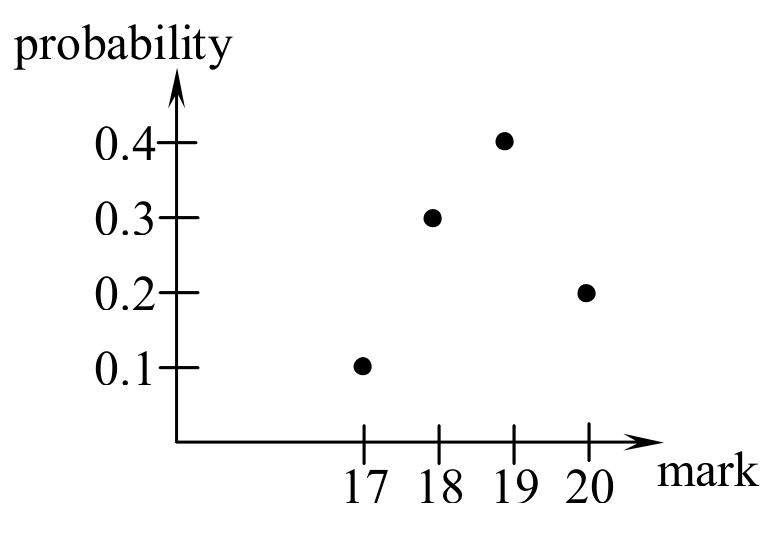
A distribution function is a probability density in the space of certain expected events. If the outcomes of the expected events making up the space are discreet, then you don't have to use a distribution function, just the probabilities associated to those events (it is absolutely equivalent to having various values of point-like masses in a physical space). For instance, we would be most happy if your final marks for this test will look somehow like in the diagram alongside.
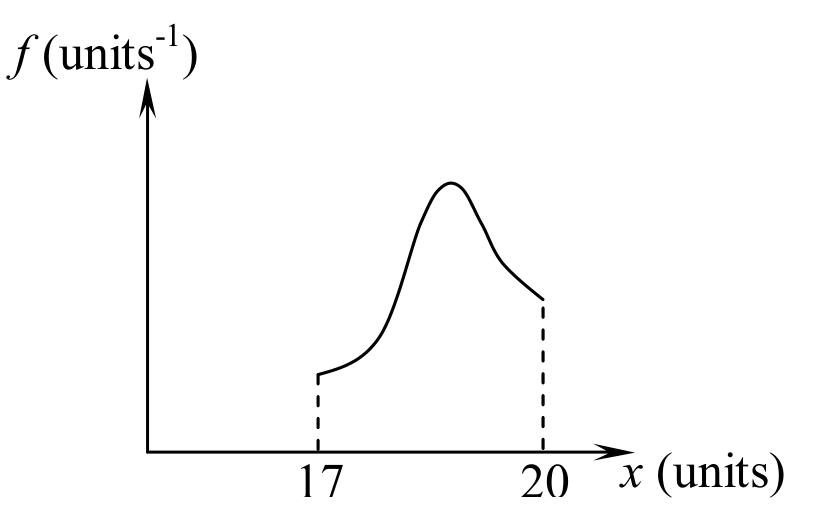
Instead, if the outcomes of the expected events make up a continuous space, then you need to define a probability density of getting the outcome around a certain expected value. For instance, assuming that your marks for this test could take continuous values in the range [0 , 20], then it would be most fortunate if the distribution function will look somehow like in the diagram alongside.
Please note that the probabilities and the distribution function do not depend on the number of participants; they are calculated in the hypothesis of an infinite number of contestants.
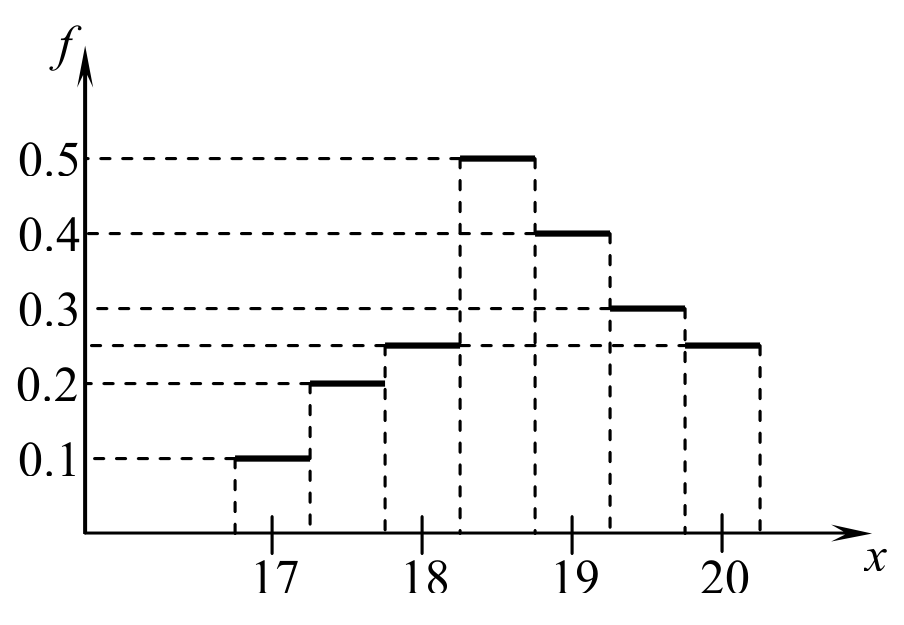
In what follows, we will try to reconcile probabilities and distribution function, by resorting to the approximation of a step function (staircase function). For instance, by taking a 0.5 step, the distribution function for the above example will look like in the diagram alongside. Please note two things. The first one is that, being an approximation, you can get nonzero probabilities even around not expected values of the outcome, like, say, 20.12. The second one is that, by adding the probabilities for the domain around a certain mark and for half the upper and lower neighboring values, you get the exact result from the first diagram.
A. We will first consider the distribution function for the component of the velocities of the helium atoms along the -axis, (of course, the argument goes the same way also for and ). For various pertinent physical reasons, we shall use the well-known Gauss normal distribution, or bell curve. It is proportional to .
a. Specify the SI units of the proportionality constant. [0,5 т.]
b. It is quite reasonable to assume that when the value of the function drops below 1% of its maximum value, then we practically reached the maximum possible value for . Evaluate the magnitude of . (For the sake of simplicity of the result, please take and .) [0,5 т.]
Now we want to introduce a very simple physical model which generates the Gauss distribution. Consider a multitude of collisions between the helium atoms, the net result of these along the -axis being small variations of the corresponding component of the momentum of the atoms. Obviously, it is more likely that two such consecutive variations be in opposite directions, so that the velocity doesn't change too much. Nonetheless, it is not totally impossible that a certain number of such consecutive variations be in the same direction, so that such a mechanism would consistently account for the existence of a normal distribution.
One can mimic such a mechanism by a series of throwings of a coin. For this, consider the integers between -5 and 5, on an -axis. As you will immediately see, starting from 0 and reaching 5 is a very good approximation for starting from 0 and reaching .
In order to reach any of the 11 outcomes, one must perform 10 throwings, divided into 5 consecutive pairs. If a pair consists of two heads, then you must progress by +1. If a pair consists of two tails, then you must recoil by -1. And finally, if a pair consists of one head and one tail, then you are to stay put. In order to get a minimum of accuracy, one should perform not less than 100 series of throwings.
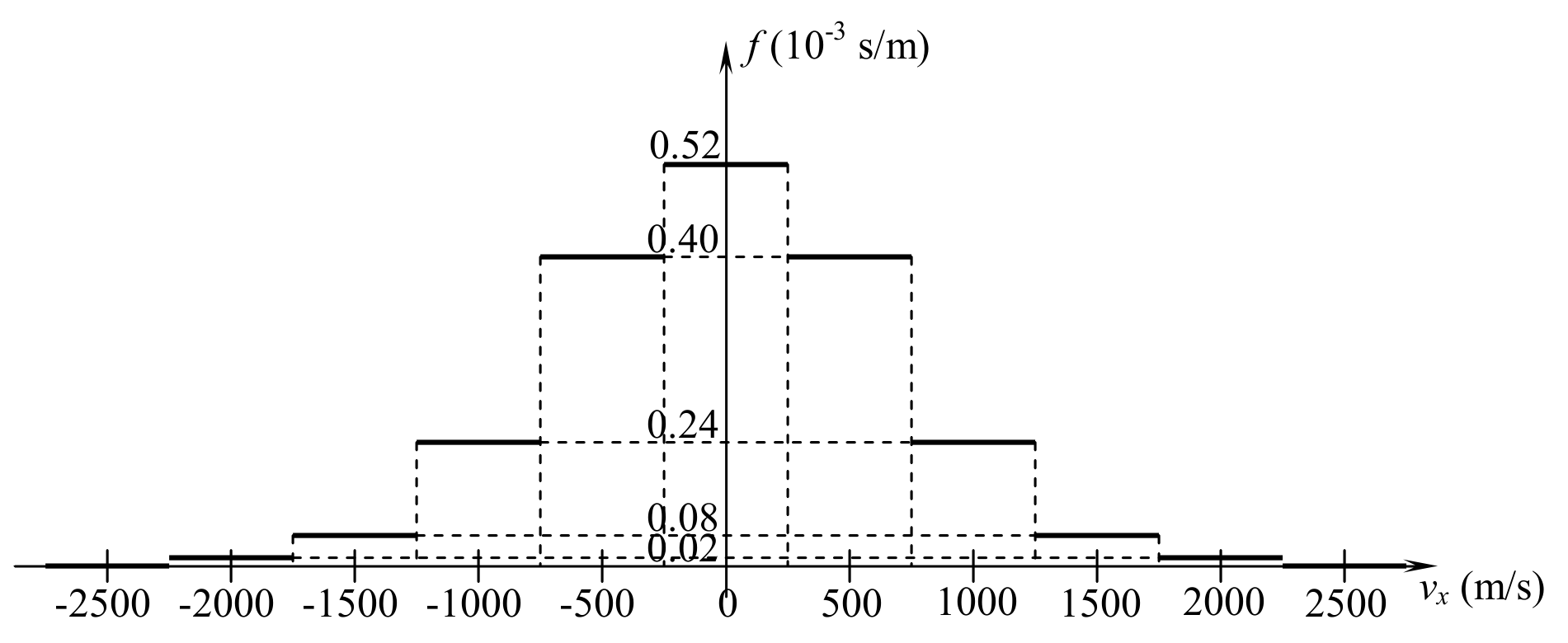
c. Plot a diagram showing the probabilities that you got for the 11 events. [2 т.]
d. As you can see, if your results are accurate, the probability of getting from 0 to 5 is very much like the one of getting from 0 to . Draw the diagram for the corresponding 11 steps distribution function. [2 т.]
e. What fraction η of the helium atoms have the magnitude of the component of their velocity along a given direction equal to at most 5% of the maximum possible value of that component? [0,5 т.]
f. What fraction η of the helium atoms have the magnitudes of all three velocity components along each axis equal to at most 5% of the maximum possible value? [0,5 т.]
B. Now we will move to the Maxwell-Boltzmann distribution function, which describes the density probability for the speeds of the atoms. It is proportional to .
g. What is the most probable value of the speed of the helium atoms? (Please take the square root of 5 as being equal to 2.25.) What is the speed interval for the atoms with speeds within a range of at most ±11% of their most probable speed? [0,5 т.]
As you can see, the width of the found interval is practically equal to half the step of the step function approximating the Gauss distribution in section A. In other words, if we imagine a space of the velocities, having , and as its axes, then we want to find out the fraction of helium atoms having velocities in a spherical shell with mean radius equal to their most probable speed, and with thickness equal to half the step of the staircase function approximating the bell curve.
Consequently, for any of the three velocity components of the atoms, we will use the step function determined in section A, starting from half a step around the 0 value, and jumping left and right in half-steps. To begin with, we will restrict ourselves only to the first octant of this spherical shell, corresponding to positive values of the velocity components. We are interested in finding the possible combinations of values of , and for which the quantity lies inside the shell. We will call such a combination a triplet.
h. What is the probability of the triplet (0,0,0)? [0,5 т.]
In order to find the desired triplets, you should draw a two-dimensional table. The rows of the table will correspond to the values of , starting from 0 and jumping in half-steps of the staircase function in section A. The columns of the table will correspond to the same values, but of . At the intersection of each row and column you must write down all the values of that satisfy the condition mentioned above.
i. Write down a list of all the different triplets you found. By "different" we mean that, when calculating the probability of a triplet, it doesn't matter the order of the velocity components , and , i.e. you don't have to take into account the permutations of these values (and not even the signs of these values). [2 т.]
Now, all you are left to do is to find out how many times does a certain triplet occur, not only in the first octant of the spherical shell, but everywhere in the space of the velocity components. When counting the occurrences of a triplet, please be careful that there are some triplets which lie exactly on one of the axes , or , while there are others which lie exactly in the plane determined by two of these axes. So in the list you made you should add two more columns in which you should write the total numbers of occurrences and the probability for each triplet. (When calculating the probabilities for each triplet, stick to the first five decimal places.)
j. What fraction η of the helium atoms () at room temperature () have speeds within a range of at most ±11% of their most probable speed? [1 т.]
Отговори
a. m⁻¹ s
Printed in the official solution as [f]SI = m-1s.
b. 2500 m/s
e. 0.13
f. 0.0022
g. 1125 m/s
The official solution gives m/s and the interval m/s.
h. 0.0022
j. 0.17868
Решение
a. 0.5p
b. 0.5p
c. 2p
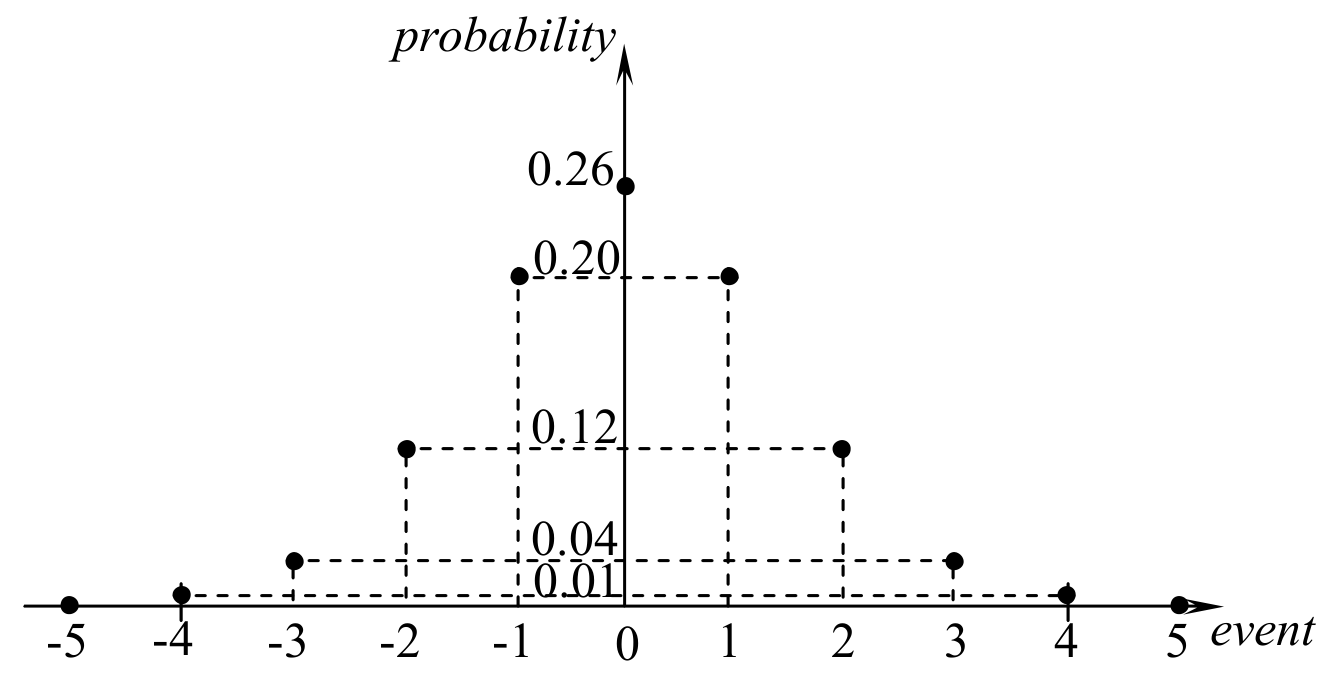
d. 2p
e. 0.5p
η = 0.13
f. 0.5p
η = 0.0022
g. 0.5p
h. 0.5p
i. 2p
| magnitude of the velocity component (m/s) | magnitude of the velocity component (m/s) | magnitude of the velocity component (m/s) | number of occurrences | |
|---|---|---|---|---|
| 0 | 0 | 1000 | 6 | 0.00100 |
| 0 | 0 | 1250 | 6 | 0.00068 |
| 0 | 250 | 1000 | 24 | 0.00090 |
| 0 | 500 | 1000 | 24 | 0.00078 |
| 0 | 750 | 750 | 12 | 0.00083 |
| 0 | 750 | 1000 | 24 | 0.00062 |
| 250 | 250 | 1000 | 24 | 0.00079 |
| 250 | 500 | 1000 | 48 | 0.00069 |
| 250 | 750 | 750 | 24 | 0.00074 |
| 500 | 500 | 750 | 24 | 0.00080 |
| 500 | 500 | 1000 | 24 | 0.00060 |
j. 1p
η = 0.17868
Answer sheet for Problem No. 1
Contestant code
ANSWER SHEET FOR PROBLEM No. 1
a.
b.
c. Plot here the probabilities diagram for the events -5 through +5 (it is not imperative to make a scale drawing).
d. Draw here an 11 steps staircase function which approximates the Gauss normal distribution (it is not imperative to make a scale drawing).
e. η =
f. η =
g.
h.
i. List all possible combinations of , and (without permutations and negative signs) that result in a value of the speed within our range of interest. Then add the number of occurrences and the probability for each triplet.
j. η =
Оригинал в Архива: exp_1.pdf · официални решения: RMPh_2012_EXP_SOL.pdf