RMPh 2014, Експеримент — Задача 1. Determination of length, mass and density using a chronometer
Experimental Problems — chronometer and electrical black box · 10 т.
Внимание: Бележка към темата
Two independent ten-point experiments with six connected tasks and 26 printed Parts; catalogue 29differs from native source. All 26 primary question/form pages,13 matching Romanian key pages and 26additional English question/form pages were obtained and read. The two English originals repeat the same complete tasks and all 21blank form pages; PDF/font encoding and image bytes differ. Both original citations are retained without a duplicate entry. The supplied official key is preserved in Romanian; no English key was obtained. No time limit is printed. Physical apparatus and marked paper described by the question are not invented as digital companions. Printed scientific/notation/reference errors are retained and disclosed below.
Source editions and literal discrepancies
Romanian Master of Physics 2014. The primary English question/form original and the additional English question/form original contain the same two complete ten-point experiments. Both sources remain cited. The matching supplied “Barem de evaluare şi de notare” is Romanian and accepts any other correct method; it is transcribed in its original language.
Printed source discrepancies retained. Question 1.c explicitly prints . In experiment 2 the question's 1.d refers to 1.a, and 1.f refers to itself for the slope; the answer forms instead refer to 1.c and 1.e. Key 1.g for experiment 1 prints after its earlier torque equation. Its radius calculation prints followed by ; the product and printed result disagree. The regression graph's ordinate prints , while the adjacent formula and table use . The sample table's last row contains 6.97s among times near 5.9s and a printed mean 6.13s; none of these values is recalculated. Experiment 2 key 1.a prints “070p” in its total column. The original answer-sheet page 14 lacks its right outer vertical border, but the complete plotting grid is retained. The ideal-water inertia assumption in the theoretical key and the nonideal-water error explanation in 3.e are both preserved.
Условие
This experimental problem I propose that - using a chronometer and a piece of paper calibrated in arbitrary units a.u. - to determine the geometric dimensions of a can and express the results in meters. Also, the problem propose that - using experimental measurements you've done on the can - to determine its mass in kilograms, and its density in SI units. For this you will be provided with an experimental set, consisting of:
A. A cylindrical tin closed at one end (a can).
B. A sheet of paper marked with equidistant lines; distance between the lines is NOT known.
C. A chronometer.
D. A very strong thread, inextensible, perfectly deformable and of negligible mass.
E. A plastic template contour of Romanian borders allowing a proper suspension of can.
F. A tank vessel containing chemically pure water (water is assumed ideal fluid without viscosity).
G. A plastic syringe with unknown internal volume; on the syringe are marked equidistant divisions. The volume of liquid removed from the syringe when the piston travel a division is the fifth part of the volume of the syringe. Water will be added in the can in "portions" corresponding to the volume of a division - considered as "elementary volume".
H. Double-sided scotch tape for mounting the template on table.
I. Absorbent paper towels.
J. A toothpick (of negligible mass) serving to yield the initial rotation of the can and to observe its oscillations.
Study small rotating oscillations of empty can and of the can that have added one or more elementary volumes of water. Considers that the gravitational acceleration is and that the density of water is . Write all data known or measured and all the results you get in different workloads using two significant figures.
Fill in the appropriate boxes in the answer sheet with your results.
In solving the problem uses the following notations:
| Notation | Meaning |
|---|---|
| For the length of each of the two suspension wires | |
| For the radius of the cover of can | |
| For the height of the can | |
| For sheet thickness of which the can was made | |
| For „elementary” volume corresponding to a division marked on the syringe. In expression is five time the number of syringe of water necessary to completely fill the can. | |
| For unknown density of can material. | |
| For unknown mass of empty can. | |
| For the unknown mass of elementary volume of water . |
Keep in mind that .
Consider the coordinate system shown in the figure below. When the can is in balance, the center of the circular upper face of the box is the origin of the system; the system axis passing through the two mounting holes of the suspension wires. Axis is perpendicular to the axis. The axis of the coordinate system is the axis of symmetry of the box.
Task no. 1 - Deduction of the expressions useful for solving experimental problem (4 т.)
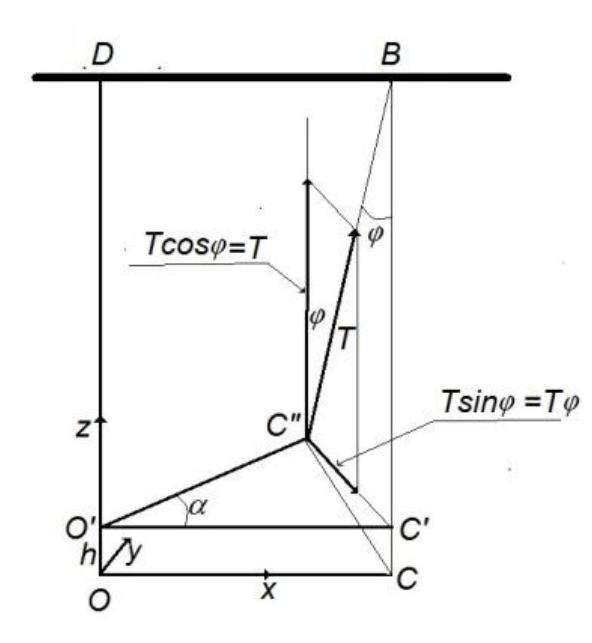
Assume that the can rotates so that the centers of its circular faces remain on axis. In the new situation, the direction of each wires forms angle with the vertical original direction. During rotation, the wires are always stretched; a diameter of circular face of can rotates with the angle , and the can rises with . Consider that one of the suspension wires is trapped in . In Figure 1 is represented the evolution of the radius of the top face of the can.
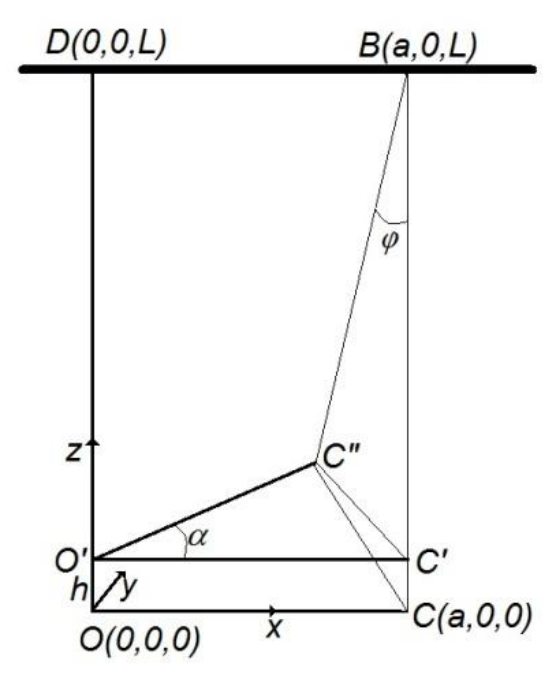
In the figure 1, is the radius of the top face of the can in the equilibrium position and is the radius of the top face of the can when the box is rotated by the angle around the axis of symmetry. is a segment of length equal to the radius, parallel to and at a distance of .
1.a Write the expression for the coordinates of - the place where a suspension wire is caught - in the situation where the box is rotated by the angle around the vertical axis of symmetry. Express your answer in terms of, and . [0,2 т.]
1.b Deduce the expression of angle as function on the angle , length and radius of can cover. [0,6 т.]
1.c Deduce the expression of angle and elevation , when the angle is small enough to admit that . Express the results as functions of, and . [0,4 т.]
1.d Deduce the expression of the interior volume , as well as the expressions for the mass and moment of inertia of the empty can. Express results as appropriate functions of and . [0,6 т.]
1.e Determine the expression of the mass and of moment of inertia of the can filed with “elementary volumes “of water. Express the results as appropriate functions of and . [0,4 т.]
1.f Deduce the expression of the momentum of the forces acting on the can when it is rotated by a small angle . Express your answer in terms of and . [0,8 т.]
1.g Neglecting damping, determine the equation of motion describing the rotation of the can with a small angle and show that it performs simple harmonic motion. . [0,6 т.]
1.h Period of oscillatory motion of the can has the expression where
Find the unknown coefficient in the above expression. [0,4 т.]
Task no. 2 – Measurements (3 т.)
2.a Using paper marked in arbitrary unit (a.u.) determines the volume of metallic material of the can in arbitrary units. Arbitrary unit is the distance between two lines on paper sheet provided. On the chair there is a stack - compact packaging - of 10 metal sheets identical to that used for the can. You can use it if you need. [0,8 т.]
2.b Using marked paper determines the volume of can in . [0,2 т.]
2.c Determine the size of „elementary volume ” in . [0,2 т.]
2.d Measure the period of the rotating oscillation for the empty can and for the can having added one or more elementary volumes of water. Put the measured data in a table for each amount of water (measured time, number of oscillations and period) [1,8 т.]
Task no. 3 – Interpretation of experimental data (3 т.)
3.a In the appropriate box in Answer sheet builds a linear plot of experimental data that allow you to determine the geometric dimensions of the box, its mass and density of its material. Express all these characteristics in SI units. [1,8 т.]
3.b Use the graphical representation obtained in the task 3.a. to determine the geometric dimensions of the can in meters. [0,5 т.]
3.c Using the graphical representation obtained in the task 3.a. determine the mass of the can in kilograms. [0,2 т.]
3.d Calculate the density of the metallic material of the can and the elementary volume of water and express the results in SI. [0,2 т.]
3.e Write the errors when measuring length in arbitrary units and for measuring time using chronometer. Decide whether the errors are larger when the amount of water increases. Justify your answer. [0,3 т.]
Answer Sheet
The complete original unfilled Answer Sheet occupies pages 4–16. Its native response boxes and graph sheet are preserved below, including every blank working area. Page 8 prints only Task nr.2/2.a followed by blank space; its response box begins on page 9. Page 9 also starts 2.b, whose box continues on page 10. Page 13 starts 3.a and “further calculations”; page 14 is the full plotting grid with its originally absent right outer vertical border. The printed form points are 1.a 0.20/1.b 0.60/1.c 0.40/1.d 0.60/1.e 0.40/1.f 0.80/1.g 0.60/1.h 0.40;2.a 0.80/2.b 0.20/2.c 0.20/2.d 1.80;3.a 1.80/3.b 0.50/3.c 0.20/3.d 0.20/3.e 0.30. The forms are also printed on the same physical pages of the additional English original; its PDF/font encoding differs, but the native requests, marks and blank areas correspond.
Решение
Barem de evaluare şi de notare
Se punctează oricare altă modalitate de rezolvare corectă a problemei.
Problema experimentală nr. 1 – Determinarea lungimii, a masei şi a densităţii cu ajutorul cronometrului
1.a
Sarcina de lucru nr. 1 – Deducerea expresiilor utile pentru rezolvarea problemei experimentale
Pentru expresia coordonatelor punctului al locului în care este prins firul de suspensie:
0,20p; punctaj item: 0,20p.
1.b
Pentru deducerea expresiei unghiului :
0,60p. Observaţie: pentru rezolvarea parţială a acestei sarcini de lucru se acordă numai 0,2p. Punctaj item: 0,60p.
1.c
Pentru determinarea expresiei unghiului , în cazul în care unghiul este suficient de mic: —0,20p.
Pentru determinarea expresiei pentru înălţimea , în cazul în care unghiul este suficient de mic:
0,20p. Punctaj item: 0,40p.
1.d
Pentru deducerea expresiei volumului interior al cutiei goale —0,20p.
Pentru deducerea expresiei masei cutiei goale —0,20p.
Pentru deducerea expresiei momentul de inerţie al cutiei goale:
0,20p. Punctaj item: 0,60p.
1.e
Pentru determinarea expresiei masei cutiei în care s-au turnat volume elementare de apă:
0,20p.
Pentru determinarea expresiei pentru momentul de inerţie al cutiei care conţine un număr întreg de volume elementare de apă: pentru oricare —0,20p.
Observaţie: Apa este considerată lichid ideal cu viscozitate nulă; ea nu se roteşte atunci când vasul care o conţine este în mişcare de rotaţie. Momentul de inerţie al cutiei rămâne , oricare ar fi cantitatea de apă din interiorul său. Punctaj item: 0,40p.
1.f
0,20p.
Expresia modulului componentei din planul orizontal pentru fiecare dintre tensiuni:
0,20p.
Expresia momentului fiecărei componente a tensiunii din fire conţinută în planul orizontal:
0,20p.
Expresia momentului total determinat de componentele orizontale ale tensiunilor din fire :
0,20p. Punctaj item: 0,80p.
1.g
Pentru ecuaţia mişcării de rotaţie a cutiei:
0,20p.
Precizarea că ecuaţia descrie o oscilaţie armonică a mărimii unghiului , cu pulsaţia
0,40p. Punctaj item: 0,60p.
1.h
Pentru determinarea puterii la care apare în expresia perioadei, :
0,40p; punctaj item: 0,40p.
2.a
Sarcina de lucru nr. 2 – Măsurări
Pentru — exemplu de răspuns:
0,30p. Observaţie: Dacă rezultatele indicate de concurent nu sunt determinate din cel puţin trei măsurări se acordă doar 0,10p.
0,30p.
Mărimea volumului materialului metalic al cutiei în unităţi arbitrare. Exemplu de răspuns:
0,20p. Observaţie: Dacă rezultatul nu se încadrează în intervalul , atunci se acordă zero puncte. Punctaj item: 0,80p.
2.b
Pentru mărimea volumului cutiei în unităţi arbitrare. Exemplu de răspuns:
0,20p. Observaţie: Dacă rezultatul nu se încadrează în intervalul , atunci se acordă zero puncte. Punctaj item: 0,20p.
2.c
Pentru mărimea volumului elementar în unităţi arbitrare. Exemplu de răspuns:
0,20p. Observaţie: Dacă rezultatul nu se încadrează în intervalul , atunci se acordă zero puncte. Punctaj item: 0,20p.
2.d
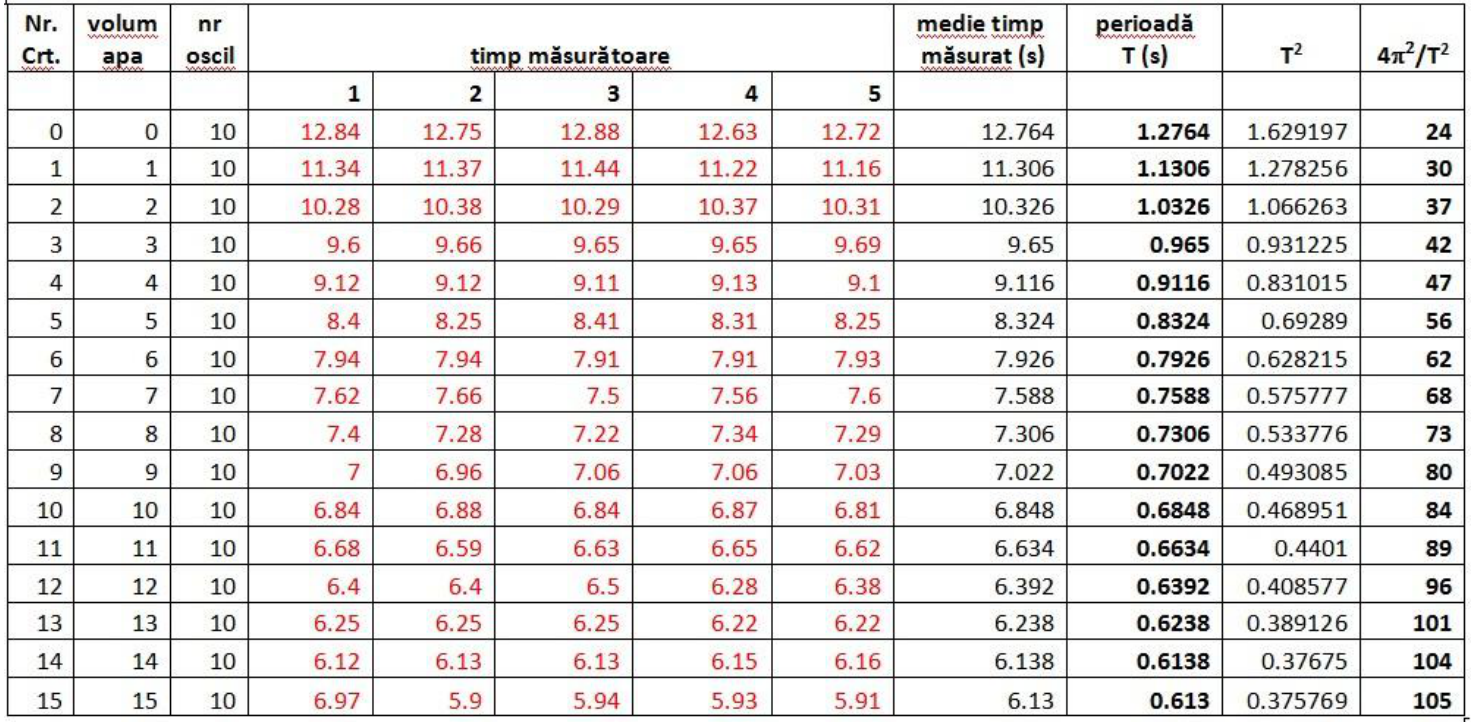
Pentru perioadele de oscilaţie de rotaţie pentru cutia goală şi pentru cutia în care s-au adăugat una sau mai multe volume elementare de apă:
| Nr. Crt. | volum apă | nr oscil | timp1 | timp2 | timp3 | timp4 | timp5 | medie timp măsurat(s) | perioadă T(s) | T² | 4π²/T² |
|---|---|---|---|---|---|---|---|---|---|---|---|
| 0 | 0 | 10 | 12.84 | 12.75 | 12.88 | 12.63 | 12.72 | 12.764 | 1.2764 | 1.629197 | 24 |
| 1 | 1 | 10 | 11.34 | 11.37 | 11.44 | 11.22 | 11.16 | 11.306 | 1.1306 | 1.278256 | 30 |
| 2 | 2 | 10 | 10.28 | 10.38 | 10.29 | 10.37 | 10.31 | 10.326 | 1.0326 | 1.066263 | 37 |
| 3 | 3 | 10 | 9.6 | 9.66 | 9.65 | 9.65 | 9.69 | 9.65 | 0.965 | 0.931225 | 42 |
| 4 | 4 | 10 | 9.12 | 9.12 | 9.11 | 9.13 | 9.1 | 9.116 | 0.9116 | 0.831015 | 47 |
| 5 | 5 | 10 | 8.4 | 8.25 | 8.41 | 8.31 | 8.25 | 8.324 | 0.8324 | 0.69289 | 56 |
| 6 | 6 | 10 | 7.94 | 7.94 | 7.91 | 7.91 | 7.93 | 7.926 | 0.7926 | 0.628215 | 62 |
| 7 | 7 | 10 | 7.62 | 7.66 | 7.5 | 7.56 | 7.6 | 7.588 | 0.7588 | 0.575777 | 68 |
| 8 | 8 | 10 | 7.4 | 7.28 | 7.22 | 7.34 | 7.29 | 7.306 | 0.7306 | 0.533776 | 73 |
| 9 | 9 | 10 | 7 | 6.96 | 7.06 | 7.06 | 7.03 | 7.022 | 0.7022 | 0.493085 | 80 |
| 10 | 10 | 10 | 6.84 | 6.88 | 6.84 | 6.87 | 6.81 | 6.848 | 0.6848 | 0.468951 | 84 |
| 11 | 11 | 10 | 6.68 | 6.59 | 6.63 | 6.65 | 6.62 | 6.634 | 0.6634 | 0.4401 | 89 |
| 12 | 12 | 10 | 6.4 | 6.4 | 6.5 | 6.28 | 6.38 | 6.392 | 0.6392 | 0.408577 | 96 |
| 13 | 13 | 10 | 6.25 | 6.25 | 6.25 | 6.22 | 6.22 | 6.238 | 0.6238 | 0.389126 | 101 |
| 14 | 14 | 10 | 6.12 | 6.13 | 6.13 | 6.15 | 6.16 | 6.138 | 0.6138 | 0.37675 | 104 |
| 15 | 15 | 10 | 6.97 | 5.9 | 5.94 | 5.93 | 5.91 | 6.13 | 0.613 | 0.375769 | 105 |
1,80p.
Observaţii:
- se acordă doar 0,90p dacă sunt mai puţin de 10 seturi de date experimentale;
- se acordă 0,00p dacă sunt mai puţin de 5 seturi de date experimentale;
- se acordă tot punctajul pentru un set de date, dacă sunt cel trei măsurări pentru fiecare situaţie şi se acordă doar jumătate din punctaj, dacă sunt mai puţin de trei măsurări pentru fiecare situaţie.
Punctaj item: 1,80p.
3.a
Sarcina de lucru nr. 3 – Prelucrarea datelor experimentale
Pentru:
0,50p.
0,20p.
| 0 | 24 |
| 1 | 30 |
| 2 | 37 |
| 3 | 42 |
| 4 | 47 |
| 5 | 56 |
| 6 | 62 |
| 7 | 68 |
| 8 | 73 |
| 9 | 80 |
| 10 | 84 |
| 11 | 89 |
| 12 | 96 |
| 13 | 101 |
| 14 | 104 |
| 15 | 105 |
Reprezentare grafică :
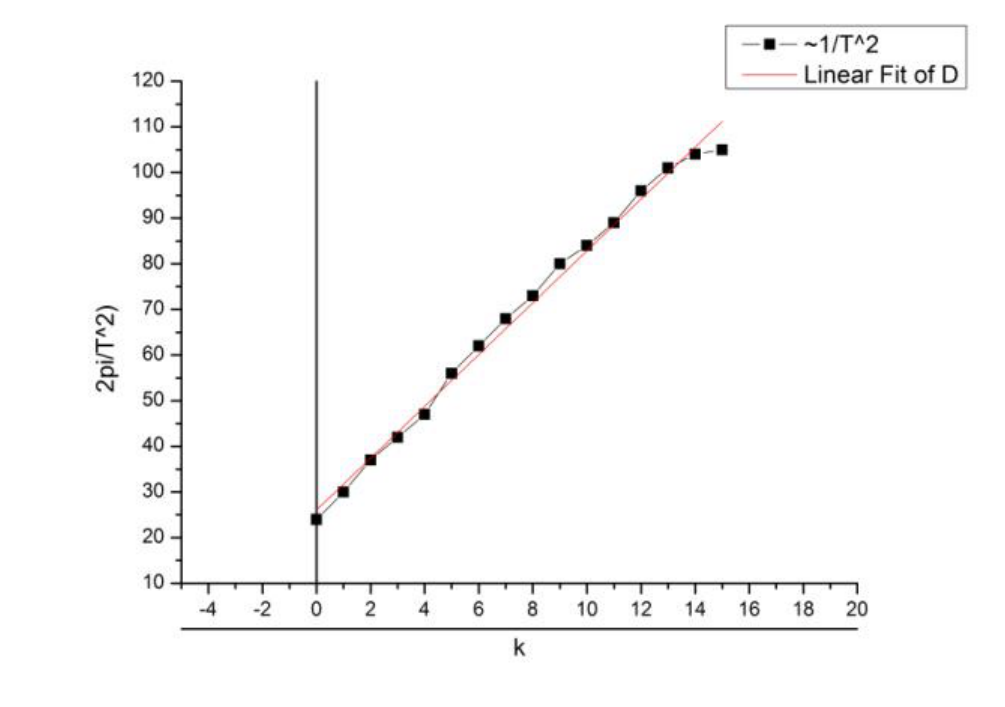
, .
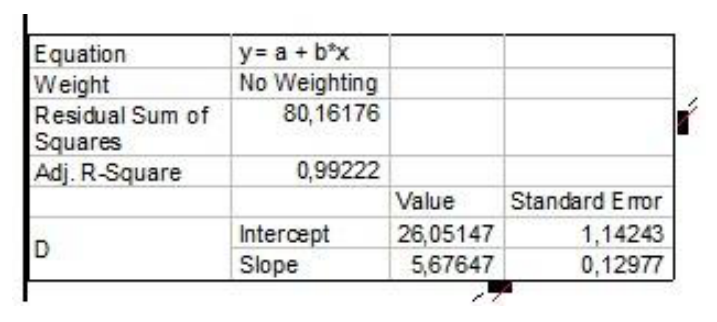
Reprezentare grafică:1,10p. Punctaj item: 1,80p.
| Equation | y=a+b*x |
|---|---|
| Weight | No Weighting |
| Residual Sum of Squares | 80.16176 |
| Adj. R-Square | 0.99222 |
| D | Value | Standard Error |
|---|---|---|
| Intercept | 26.05147 | 1.14243 |
| Slope | 5.67647 | 0.12977 |
3.b
Pentru valoarea în metrii a lungimii a firului de suspensie:
0,20p. Factorul de scală:
0,30p. Punctaj item: 0,50p.
3.c
Pentru:
0,10p.
Masa materialului cutiei :
0,10p. Punctaj item: 0,20p.
3.d
Pentru densitatea materialului cutiei :
0,10p.
Volumul elementar al seringii :
0,10p. Punctaj item: 0,20p.
3.e
Pentru scrierea erorilor pentru măsurarea lungimii în unităţi arbitrare şi a timpului cu cronometrul.
Observaţii: În scrierea erorilor pentru măsurarea lungimii în unităţi arbitrare se acceptă răspunsuri de tipul 0,2u.a.÷0,5u.a. Eroarea la măsurarea timpului depinde de tipul de cronometru folosit. Se vor admite abateri ale datelor cu 10%.
0,20p.
Justificarea pe scurt a răspunsului. Exemplu de răspuns: Eroarea creşte cu creşterea cantităţii de apă, mai ales datorită creşterii momentului de inerţie, deoarece apa nu este lichid ideal.
0,10p. Punctaj item: 0,30p.
Оригинал в Архива: exp_problems.pdf · официални решения: rmph_experiment_sol.pdf · допълнителни данни: rmph_experiment_sub.pdf