RMPh 2016, Теория — Задача 1. Q1. Compressible fluids
Romanian Master of Physics 2016 — theory · 10 т.
Внимание: Бележка към темата
The original contains three whole theory problems, seven blank answer sheets, complete worked keys for Q1 and Q2, and a four-page detailed grading scheme for Q3. Printed labels, formulas, values and unit discrepancies are preserved and explained in separate reader notes. The retained key PDF also contains twelve experimental pages without matching questions in this question booklet; those pages remain in the original PDF outside this theory edition.
Условие
The study of gases flow uncovers many interesting phenomena which have a myriad of applications, starting from boilers to airplanes and rockets. To simplify the calculations, in this problem the following assumptions will be adopted:
- The gas is ideal;
- The gas flow is steady and non-turbulent;
- The processes taking place in the flowing gas are adiabatic;
- The gas flow speed is much less than the speed of light;
- The gas flow is uniform and one-dimensional (axisymmetric);
- The effect of gravity is negligible.
The constants useful in this problem are:
- the molar mass of air, ;
- the ideal gas constant, .
A. Bernoulli’s equation
Bernoulli’s equation is the mathematical form of the law of conservation and transformation of energy for a flowing ideal gas. It bears the name of the Swiss physicist Daniel Bernoulli (1700–1782), who derived it in 1738. The easiest way to obtain this equation is to follow a fluid particle (a volume element of the fluid) in its way on a streamline.
A Perform the energy balance between two points in the flowing gas, knowing the parameters and , and derive the equation that connects these variables. The adiabatic exponent of the gas is also known. The parameter is the gas pressure, its density, and its speed. [1,5 т.]
B1. Speed of the perturbation
B. Propagation of a perturbation in a flowing gas
If the pressure in a layer of a macroscopically motionless gas system suddenly increases (by heating or rapid compression), the layer will begin to expand, compressing the adjacent layers. This pressure disturbance will be thus transmitted by contiguity as an elastic wave through the gas.
The speed of this wave is the speed of its wavefront (the most advanced surface, the points of which oscillate in phase and the thermodynamic parameters of which have the same value). If in the reference frame of the unperturbed gas the process of the wave propagation is nonsteady (the gas parameters in any point vary with time), in the reference frame of the wavefront the process will be steady, so the simple equations for a steady state can be applied.
B1 Derive the mathematical expression for the speed of the wavefront, taking into account that the thermodynamic parameters of the unperturbed gas are , while those “behind” the wavefront are . [1,5 т.]
B.2 Sound waves
Sound waves are waves of weak disturbances ( and ) that travel fast enough, their speed being of the order of hundreds of meters per second. Due to this, the gas compressions and rarefactions can be considered as adiabatic, the adiabatic exponent being .
B2 Using the result from B1, obtain the mathematical expression for the sound speed in the gas and, using Bernoulli’s eq., derive the relation between the flow speed at a given point in the gas and the local sound speed. [0,5 т.]
B.3 Mach’s number
For classifying the speed performances of bodies in a fluid (e.g. aircrafts), as well as the flow regimes of fluids, the Swiss aeronautical engineer Jakob Ackeret (1898–1981) — one of the leading authorities in the 20th century aeronautics — proposed in 1929 that the ratio of the body or of the fluid’s speed and the local sound speed in that fluid to be called Mach’s number
after the name of the great Czech (then in the Austrian empire) physicist and philosopher Ernst Mach (1838–1916). Primarily, the value of this non-dimensional quantity delimitates the incompressible from the compressible behavior of a flowing fluid, in aeronautics this limit being settled to .
B3.1 Find the relative variation of the gas density as a function of Mach’s number, when its motion is slowed down to a stop, its initial velocity being , and calculate its maximum value for a flow to be considered incompressible. [0,5 т.]
B3.2 The pressure at the nose of an aircraft in flight was found to be and the speed of air relative to the aircraft was zero at this point. The pressure and temperature of the undisturbed air were and respectively. The adiabatic exponent for this temperature is . Find the speed and the Mach number of the aircraft. [0,5 т.]
B3.3 When a gas is flowing through a pipe, it exerts a friction force on the fluid, which is not always negligible. If at the entrance of such a pipe the static pressure in the flowing fluid is and the Mach number is , while at the exit , find the expression and the numerical value of the force with which the fluid is acting on the pipe. The adiabatic exponent is , the constant cross section of the pipe is , and the relative increase of the gas temperature through the pipe is . [1 т.]
C.1 The shock adiabat
C. Shock waves
There are two types of acoustic waves in a gas: sound waves and shock waves. The latter appear when a body moves in a gas with a supersonic speed (i.e. the relative speed of the body with respect to that of the gas is greater than the sound speed). At supersonic speeds, in front of the body appears a very thin layer of gas with a higher pressure, called compression shock. This kind of special acoustic waves were studied by Mach, so the envelope of such a wave is known as Mach’s cone, having the body in its apex. Passing through the compression shock, the thermodynamic parameters of the gas change abruptly. The Mach’s cone is an example of an oblique shock, but we are interested here mainly in normal shocks, for which the shock wavefront is perpendicular on the body or fluid velocity.
For shock waves the pressure/density differences between the two sides of the wavefront can reach very high values. Passing through the wavefront, the thermodynamic parameters vary abruptly, with a sudden jump. This is another reason for which a shock wavefront is called a pressure or a compression shock.
The gas compressed by the shock wave undergoes an irreversible adiabatic process which cannot be described by Poisson’s equation. However, an equation for the shock adiabat was deduced towards the end of the XIXth century by the Scottish physicist William Rankine (1820–1872) and, independently by him, by the French engineer Pierre Henri Hugoniot (1851–1887), using the mass and energy conservation, as well as the momentum equation. The Rankine–Hugoniot equation, or the shock adiabat, relates the pressure and the density of the gas compressed by a shock wave.
C1 Denoting with and the gas pressure and density in front of the compression shock (which are known), and with and the same parameters behind the shock (which are unknown), show that the pressure ratio is related with the density ratio by a relation of the form
Find the explicit form of the coefficients , , and .
The adiabatic exponent of the gas is known.
Note: For simplicity, use a stream tube with a constant cross section, crossing perpendicularly the wavefront of the normal shock. [1,5 т.]
C.2 A shockwave created by an explosion
An explosion creates a spherically shockwave propagating radially into still air at and . A recording instrument registers a maximum pressure of as the shock wavefront passes by. The adiabatic coefficient of air for this compression shock is , the molar mass of air is and the ideal gas constant is .
C2.1 Determine the air temperature increase under the action of the compression shock. [0,5 т.]
C2.2 Determine the Mach’s number corresponding to the speed of the shockwave. [0,5 т.]
C2.3 Determine the wind’s speed following the shock wavefront, with respect to a fixed observer. [0,5 т.]
C2.4 During the compression shock the gas temperature and pressure sharply increase, much more than in a quasistatic adiabatic compression. After the shock, the gas expands adiabatically, but because the slope of the adiabatic process is smaller than that of the adiabatic shock, when the gas density reaches again the initial value, its pressure is still higher than that of the unperturbed gas, .
Derive the ratios and at the end of the expansion process and calculate the numerical values of and . [0,5 т.]
C2.5 From this point the gas is cooling until it reaches the initial state. Assuming that for the entire cyclic process the adiabatic exponent has the same value, derive an expression for the entropy variation of the mass unit of air during the compression shock and calculate its numerical value.
© Assoc. Prof. Sebastian POPESCU, PhD; Faculty of Physics, Alexandru Ioan Cuza University of Iași, ROMANIA. [1 т.]
Answer sheet — three native pages
The three original answer-sheet pages retain every printed field and blank response space. Their native recurring footer says “Theoretical Problem No. 3”.
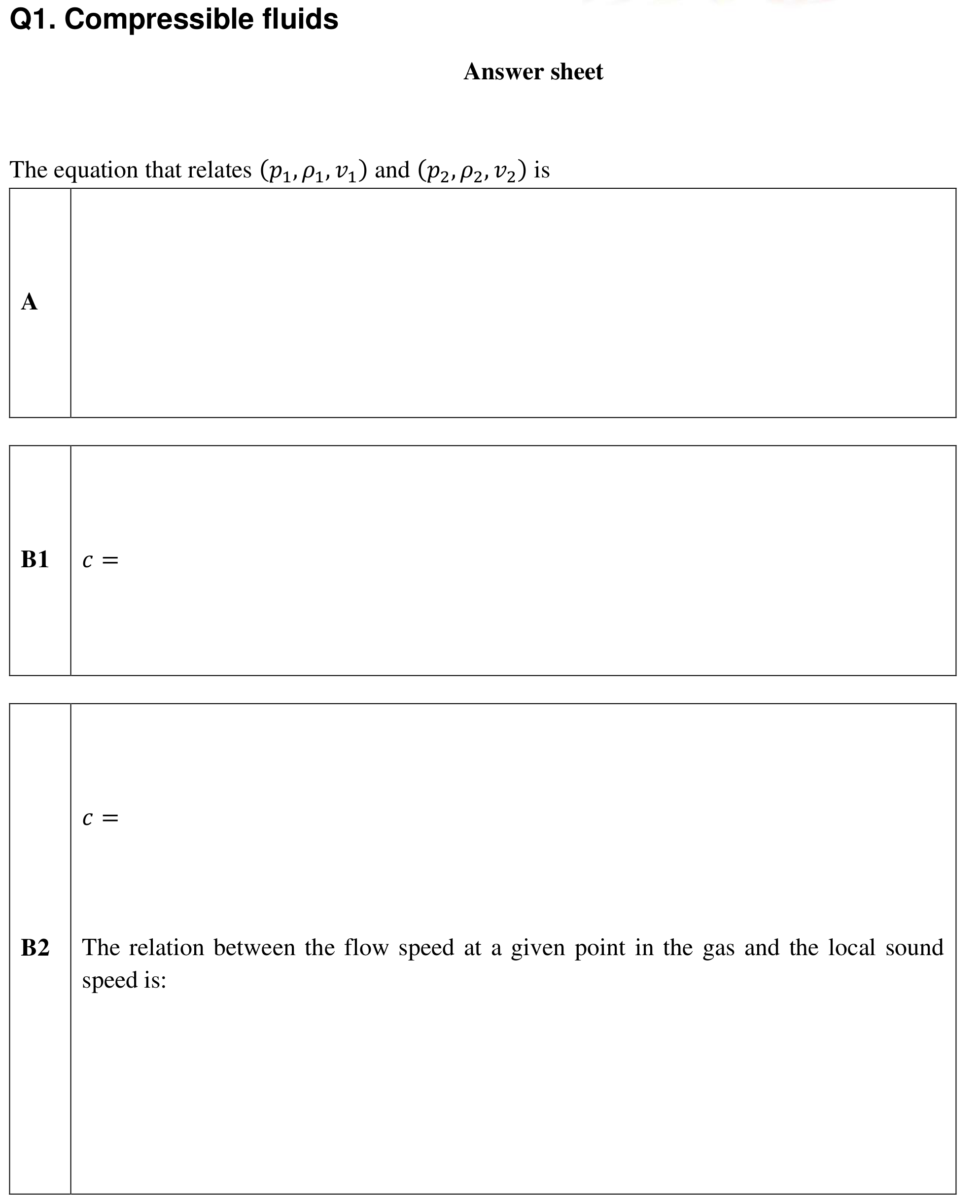
Q1. Compressible fluids — Answer sheet (native page5)
- A — 1.5 p: The equation that relates and is [blank].
- B1 — 1.5 p: [blank].
- B2 — 0.5 p: [blank]. The relation between the flow speed at a given point in the gas and the local sound speed is: [blank].
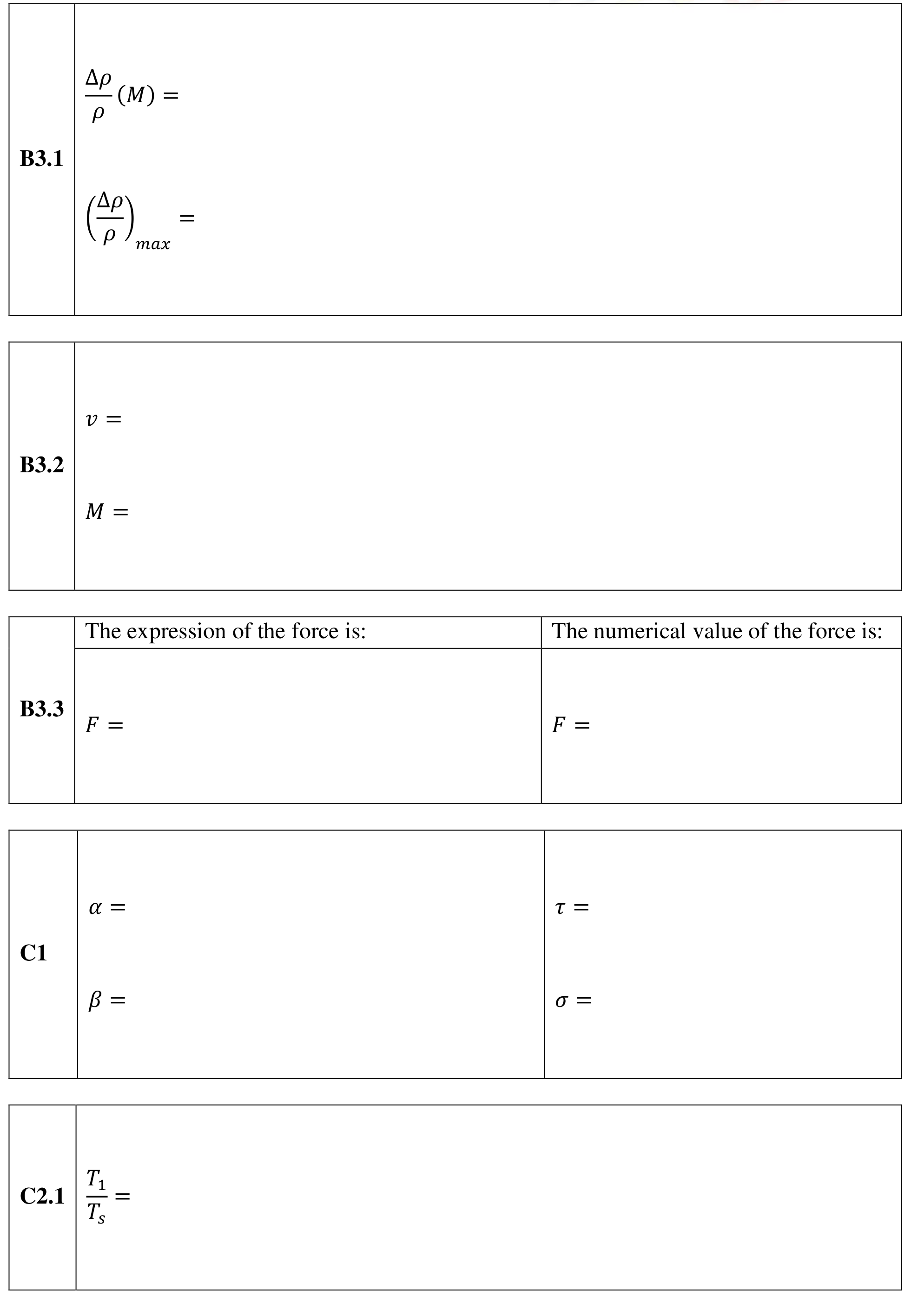
Continuation (native page6)
- B3.1 — 0.5 p: [blank]; [blank].
- B3.2 — 0.5 p: [blank]; [blank].
- B3.3 — 1.0 p: The expression of the force is: [blank]; The numerical value of the force is: [blank].
- C1 — 1.5 p: [blank]; [blank]; [blank]; [blank].
- C2.1 — 0.5 p: [blank].
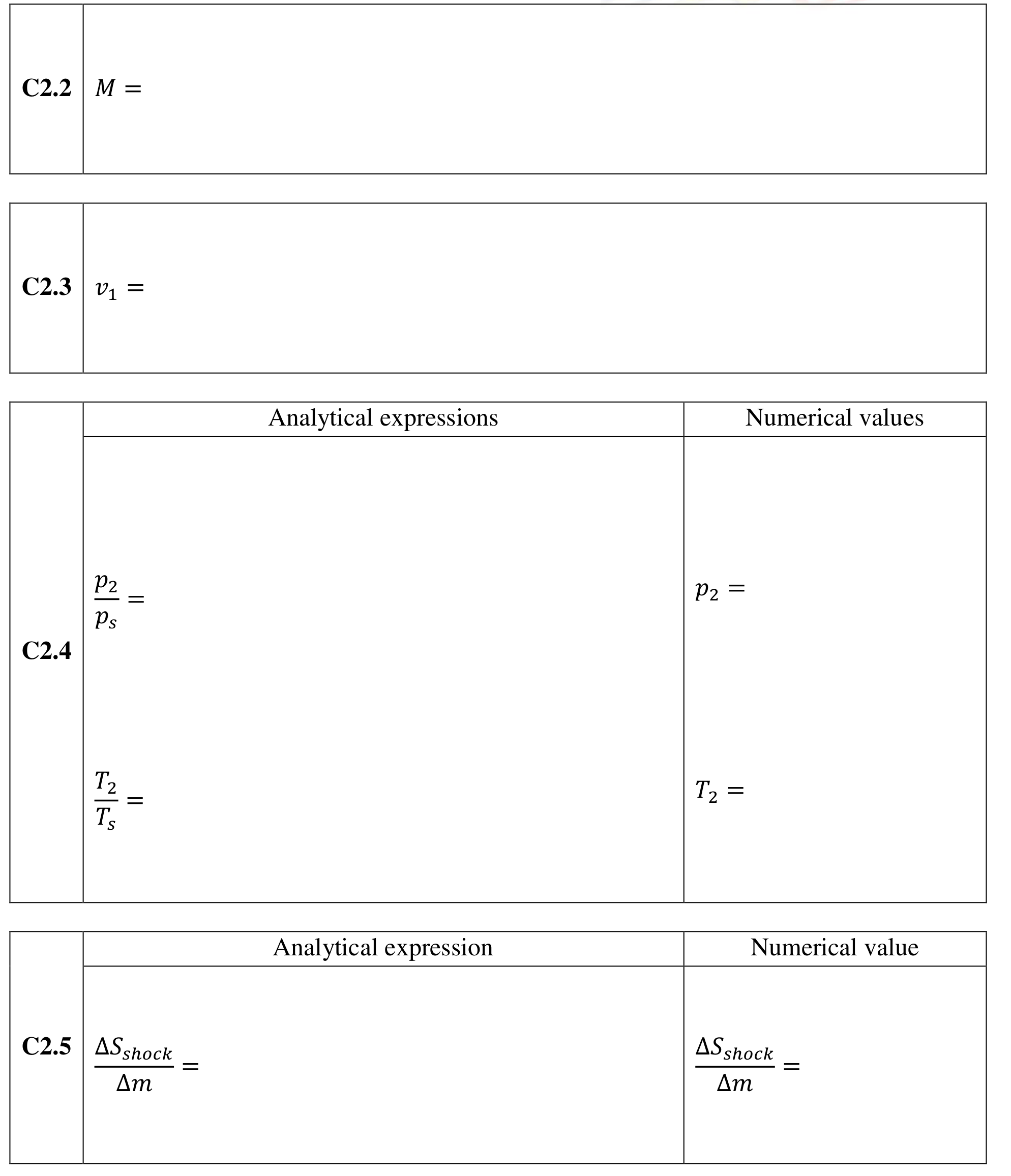
Continuation (native page7)
- C2.2 — 0.5 p: [blank].
- C2.3 — 0.5 p: [blank].
- C2.4 — 0.5 p: Analytical expressions: [blank]; [blank]. Numerical values: [blank]; [blank].
- C2.5 — 1.0 p: Analytical expression: [blank]. Numerical value: [blank].
Решение
A. Bernoulli’s equation — 1.5 p
Solution. The law of conservation and transformation of energy is the first law of thermodynamics. Since the processes taking place inside the gas are adiabatic, this law has the form
where the work done by the gas is
and the variation of the total energy of the gas is
so that
Making use of the Robert Mayer eq., , and of , we find . With the Clapeyron–Mendeleev eq., , the energy conservation eq. becomes
B. Propagation of a perturbation in a flowing gas — 4 p
B1. Speed of the perturbation — 1.5 p
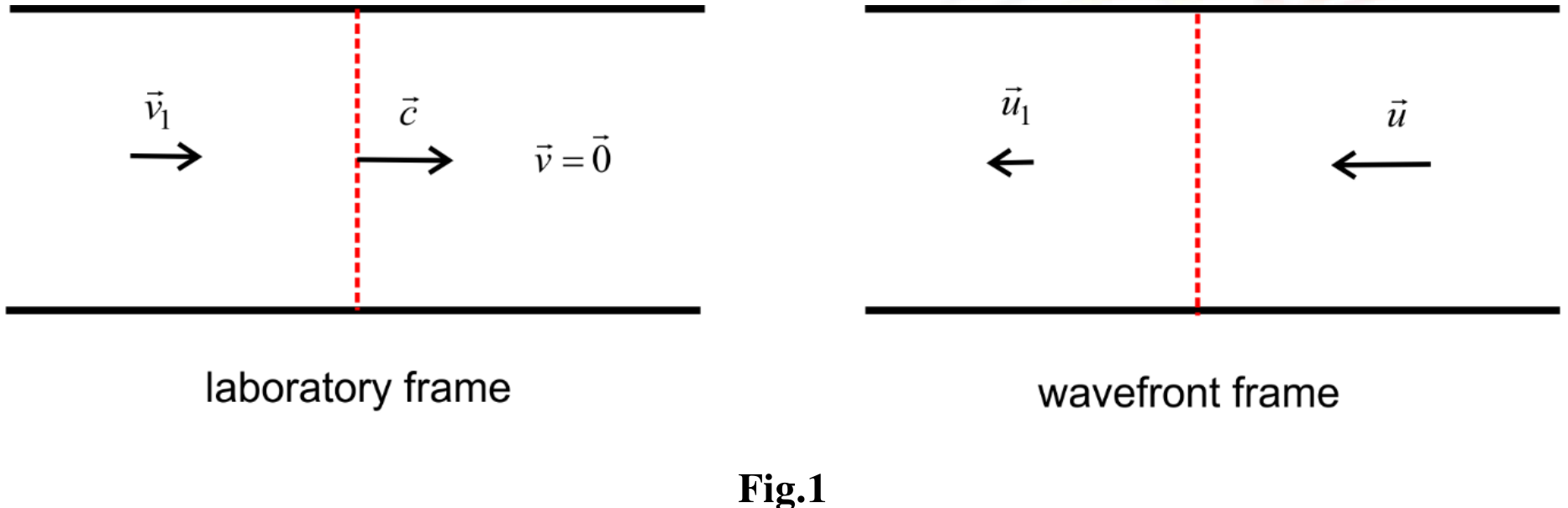
Solution. In the reference frame of the undisturbed gas (laboratory frame, see Fig.1), the speed of the gas in front of the wavefront (to the right) is and the speed of the gas behind the wavefront (to the left) is .
In the reference frame moving together with the wavefront, the speed of the undisturbed gas laying in front of the wavefront is (the undisturbed gas runs against the wavefront) and the gas behind (to the left) the wavefront (or in the wakefield, or even upstream), which is still compressed, moves to the left with the speed .
The continuity eq. (mass flow rate) is
so for a stream tube of constant cross section
The momentum eq. (Newton’s second law) is
or
Hence . Using these eqs. (eliminating ), we find
B2. Sound waves — 0.5 p
Solution.
Since for an adiabatic process , we find
Under these circumstances, Bernoulli’s eq. can be rewritten as
B3.1 — 0.5 p
Solution. In this case Bernoulli’s eq. becomes
Taking into account that , we find
For a flow to be considered incompressible, the relative variation of density should not exceed
B3.2 — 0.5 p
Solution. Applying Bernoulli’s eq. we find the stagnation pressure of air at the nose of the aircraft is
so
The sound speed in air is
the Mach’s number being .
B3.3 — 1.0 p
Solution. From the momentum eq. the force exerted by the gas on the pipe is
From the Clapeyron–Mendeleev eq. , while from continuity , or
Using the above eqs. it follows that
Hence
with a numerical value of .
C. Shock waves — 4.5 p
C1. The shock adiabat — 1.5 p
Solution. The repeated key stem denotes the known undisturbed quantities by . In the reference frame moving with the shock the processes are steady. If, in the laboratory frame, is the velocity of the body passing through the stationary gas, which is also the speed of the compression shock, and that of the gas behind the compression shock, then in the shock reference frame the speed of the undisturbed gas will be , while that of the gas behind the shock will be .
Since there are three unknown variables, and , we need three equations to solve the problem:
- The mass conservation eq. (the mass flow rate eq.), for a stream tube with a constant cross section passing perpendicularly through the normal shock: .
- The momentum equation: .
- The energy conservation equation (Bernoulli eq.):
Using these eqs. (eliminating ), we find
Hence
This is the shock adiabat equation. Consequently, the requested coefficients are and .
C2.1 — 0.5 p
Solution. From the shock adiabat it follows that , where and . Hence .
Since , the still air density is given by the Clapeyron–Mendeleev eq.,
Under these circumstances, the air density behind the shock wavefront is , so the temperature behind the shock is
the temperature ratio being (the last denominator is printed without the subscript in this key line).
C2.2 — 0.5 p
Solution. From the above eqs. it follows that
or .
C2.3 — 0.5 p
Solution.
C2.4 — 0.5 p
Solution. At the end of the adiabatic expansion the requested ratios are
and
Since
then
and
So and ().
C2.5 — 1.0 p
Solution.
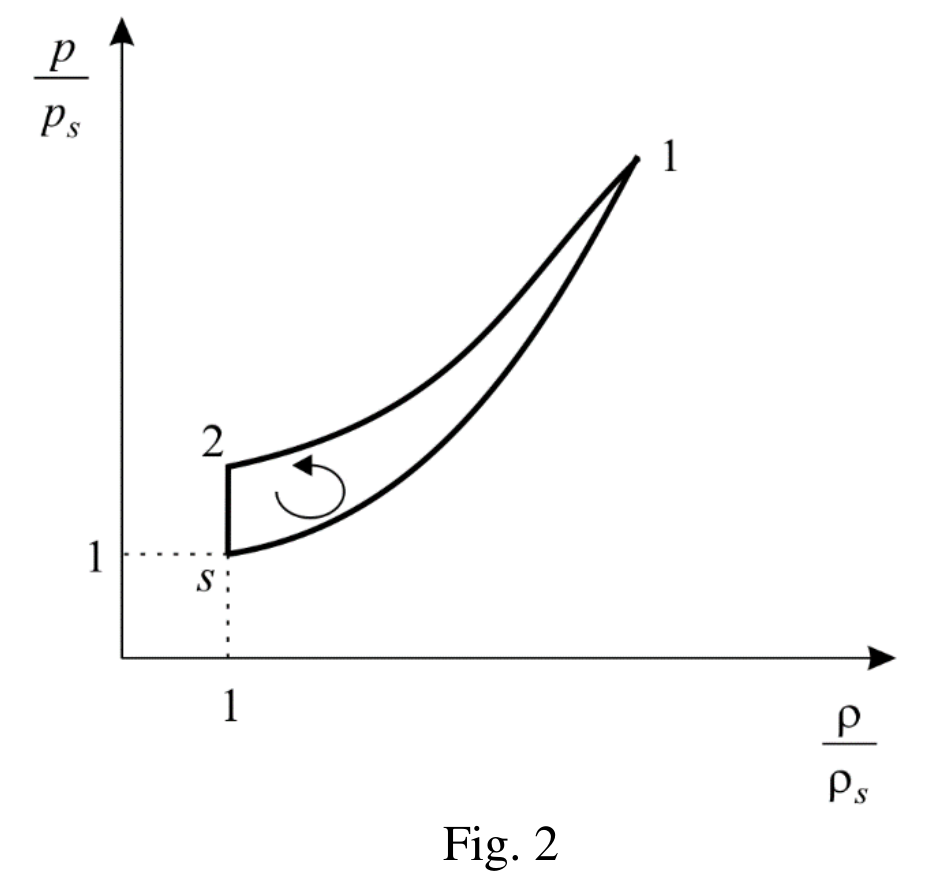
Admitting that the cycle is enclosed by an isochoric process, since the entropy variation during the entire cycle, as well as for the adiabatic expansion are zero, then
The printed key’s numerical and algebraic forms above are retained literally; source discrepancies are described separately in the reader notes.
Reader note: native whole tasks and printed footer labels
The original question booklet contains Q1, Compressible fluids (12 requests); Q2, Sources, atoms, and spectra (6 requests); and Theoretical Problem No. 3, “Squeezing” electrical charge carriers using magnetic fields (11 requests). These are three whole problems with 29 connected requests. Q1 and Q2 pages print “Theoretical Problem No. 3” in their recurring footer. The body titles and connected parts establish the problem grouping; the printed footer labels remain in the original PDF.
Reader note: retained key authority and original mathematical expressions
The retained solutions_2016.pdf carries Romanian Master of Physics 2016 branding, matching Q1 and Q2 worked keys, and a detailed Q3 grading scheme credited to the named problem authors. It is a key retained by the archive; an organizer publication URL has not been independently verified. The solutions are attributed to the archive. Q1 key equations are small embedded raster images; their printed mathematical content is retained.
Reader note: literal flow and shock-key calculations
The B3.1 repeated key stem omits the original question’s condition ; the condition remains in the question. B3.2 prints , and . Those printed expressions and values are retained. The shock derivation denotes the undisturbed gas by , while the question uses ; each source notation remains in its original context.
Reader note: literal shock equation and numerical discrepancy
C2.2 prints its final shock-speed factor as . C2.3 then prints after C2.2 reports Mach 3.58. Those algebraic and numerical forms do not consistently follow the preceding relations. C2.1 prints its final ratio without a denominator subscript. These literal source expressions are preserved.
Reader note: answer-sheet title correspondence
Question page 9 labels the Sources, atoms, and spectra answer sheet Q3, while the matching question and key label it Q2. The six A/B/C requests, marks and content establish its correspondence to Q2. Both printed labels remain in the transcription and the original answer-sheet crop.
Reader note: literal absorption-ratio ordering
The key’s displayed wavelength ratio uses its energy-difference numerator and denominator in the reciprocal order from the preceding inverse wavelength expression. It then prints and . The printed ratio, search table and both estimates of are retained literally.
Reader note: printed permeability unit and source language
The question prints the magnetic permeability of vacuum as . The unit is dimensionally anomalous for permeability; the printed F is retained. Task 3.iii contains the Romanian word “și” between and , also retained.
Reader note: complete Q3 rubric and literal source expressions
The matching Q3 key is the complete four-page “Detailed grading scheme”. Every intermediate formula, partial mark, both diagrams and the instruction to credit other correct approaches are retained. The rubric prints , a plus sign between the two component terms of , its potential-energy signs, and the displayed pressure-force differential signs. These expressions and the printed conclusions are preserved. No additional prose derivation is present in this source.
Reader note: matching theory boundary and retained experimental tail
The question booklet contains fourteen pages covering the three theory problems and seven blank answer sheets. In the thirty-page key PDF, pages 1–10 correspond to Q1, pages 11–14 to Q2, and pages 15–18 to Q3. Pages 19–25 contain “Experimental Problem No. 1. Secrets of toys”, a filled answer and marking key for a hollow globe and an optical black box. Pages 26–30 contain the detailed grading scheme for “Experimental Problem Nr. 2. The study of Moiré pattern”. These experimental pages are retained in the original PDF, but are outside the matching theory scope. The exact retained event folder lists only problems_2016.pdf and solutions_2016.pdf; no matching experimental question booklet or further companion was obtainable there.
Оригинал в Архива: problems_2016.pdf · решение от архива: solutions_2016.pdf