RMPh 2016, Теория — Задача 2. Q2. Sources, atoms, and spectra
Romanian Master of Physics 2016 — theory · 10 т.
Внимание: Бележка към темата
The original contains three whole theory problems, seven blank answer sheets, complete worked keys for Q1 and Q2, and a four-page detailed grading scheme for Q3. Printed labels, formulas, values and unit discrepancies are preserved and explained in separate reader notes. The retained key PDF also contains twelve experimental pages without matching questions in this question booklet; those pages remain in the original PDF outside this theory edition.
Условие
Q2. Sources, atoms, and spectra
A. Light source
In its proper reference frame, a point source emits light in the form of a divergent conical beam, with the angular width of (from to with respect to the cone axis). In a reference frame which moves towards the source with an unknown speed , the angular width of the beam is of only (from to with respect to the same cone axis). The light speed in vacuum is .
A Determine the speed of the source. [2,5 т.]
B. Balmer emission spectrum
The spectral resolving power of a spectrometer is . The spectrometer is used to observe the Balmer series in the emission spectrum of the hydrogen atom (the visible domain).
Note: The possible mechanisms of broadening of the spectral lines (Lorentzian, Gaussian, etc.) will not be considered.
B.1 Express the mathematical definition of the spectral resolving power of the instrument. [0,25 т.]
B.2 Determine the highest value for the principal quantum number of the energy level for which the spectral line emitted by an atom for the transition to the level can still be distinctly resolved by the instrument, with respect with its neighbours. [2,25 т.]
C. Absorption spectra
The energy levels of an atom are given by , where is an integer and is a positive constant. Among the adjacent spectral lines which, at room temperature, the atom can absorb, two have the wavelengths and , respectively. The elementary electric charge is , the speed of light in vacuum is , and Planck’s constant is .
C.1 Find the values of the quantum numbers of the energy levels implied in the transitions. [3 т.]
C.2 Determine the value of the constant in joule and in electron-volt. [1,5 т.]
C.3 Identify the nature of the atom and justify the choice made.
© prof. Florea ULIU, PhD, University of Craiova. [0,5 т.]
Answer sheet — original title Q3
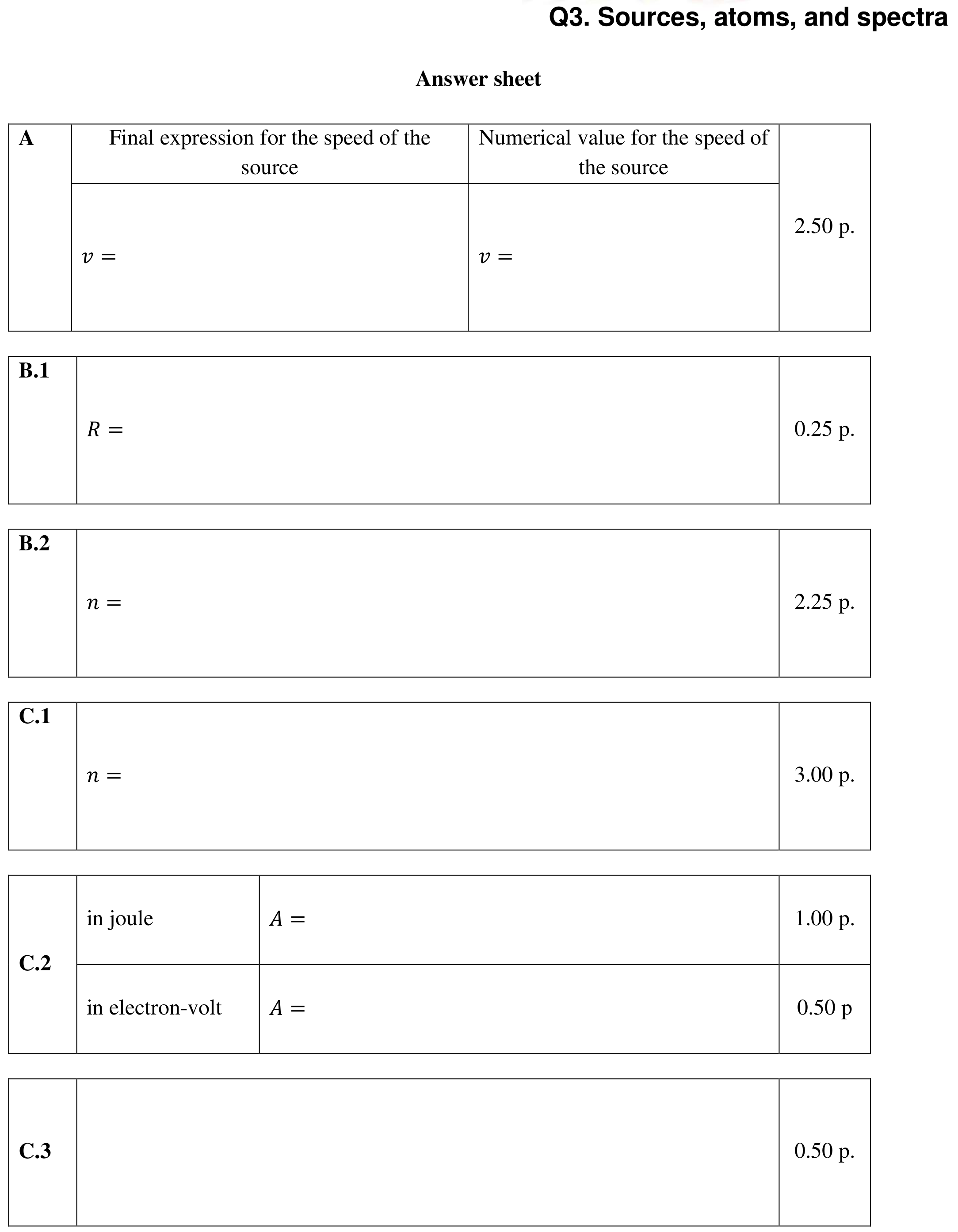
Q3. Sources, atoms, and spectra — Answer sheet (the original page9 literally says Q3; its content and requests correspond to the Q2 stem).
| Native field | Required response | Points |
|---|---|---|
| A | Final expression for the speed of the source: [blank]; Numerical value for the speed of the source: [blank] | 2.50 |
| B.1 | [blank] | 0.25 |
| B.2 | [blank] | 2.25 |
| C.1 | [blank] | 3.00 |
| C.2 | in joule: [blank] | 1.00 |
| C.2 | in electron-volt: [blank] | 0.50 |
| C.3 | [blank response space] | 0.50 |
Решение
Q2. Sources, atoms, and spectra — proposed by prof. Florea ULIU, PhD, University of Craiova.
A. Light source — 2.50 p
1st Solution
Starting from the Lorentz transformations it is easy to obtain the so-called formula for the aberration of light
so that
With and , it follows immediately that , or .
2nd Solution
This solution is based on the transformation relations for velocities. Let and be the axes of the cone in the proper reference frame, and the other one, . The velocity of with respect to is . Consider a photon moving on the external surface of the cone with the apex angle of and with as a symmetry axis. Then . The other component has the same value . The speed in reference frame is given by the transformation law
Applying the other transformation law (for the , respectively components of the velocities), we will get
Note: This expression for could be obtained from , with given by eq.(). Here it was taken into account that the photon moves with the same speed, , both in , as well as in .*
From , using eqs.(*) and (**), it follows that
or .
3rd Solution
This method uses directly the Lorentz transformations, written in differential form. So,
Consider a photon moving on the external surface of the cone, in the reference frame . If this photon correlates two events having a spatial separation on the axis, their spatial separation on the axis is (because the moving direction of the photon makes with the axis ). The time interval separating the events is , with . Thus . [It could be reasoned considering that the photon moves with the speed on a distance .]
Now, eq.(***) takes the form
respectively. Knowing that and using the usual notation , the resulting eq. is
the physical solution of which is . So , obtaining the same result as above.
B. Balmer emission spectrum
B.1 — 0.25 p
Solution. The spectral resolving power of an optical instrument is , where is the minimum value of the difference between the wavelengths of two adjacent spectral lines, and , which can be distinctly observed with the instrument. According to the Rayleigh criterion, this spectral (chromatic) interval corresponds to the following situation: the first zero minimum beside the principal maximum of the radiation coincides with the principal maximum of the same order of the radiation .
B.2 — 2.25 p
Solution. The wavelengths of Balmer Series (the only series in visible) are given by
where is a positive constant (the value of which is not important now) and the quantum number can take the values . The variation of the wavelength must be found when the quantum number varies with one unit (i.e. ). The approximation (as if would vary continuously) can be used. The derivative of Balmer eq. gives
Using this result, we can tell that the ratio when is given by
The minus sign was abandoned because we will consider only positive variations of .
According to the definition, the spectral resolving power of an instrument is given by . In this case
Asking this value to be smaller than the value of given in the text, it follows that . Knowing that , we can conclude that the highest value of is pretty big. Consequently, ignoring the second term in the left hand side of the above inequality, we get . The physical solution is .
C. Absorption spectra
C.1 — 3.00 p
An absorption line corresponds to an excited state of the atom, or to a down (quantum number )–up (quantum number ) transition. For such a transition to happen it is necessary to transmit the atom an energy
If it is a photoexcitation, the wavelength of the absorbed radiation has the value
The adjacent absorption lines must correspond to the transitions and . The last transition needs more energy, so it will correspond to a smaller wavelength. The constant being unknown, we will derive the ratio of those two wavelengths:
To solve this eq. we will write it first in the form
and will try, progressively, the possible values . For , the obtained results will be:
| 2 | 0.59528 |
| 3 | |
| 4 | 1.44463 |
| 5 | 1.93769 |
| 6 | 2.46743 |
and so on. Analyzing these values, the conclusion is that the absorption has as a consequence the transition from level to the level (the other values found for being far from integer values).
C.2 — 1.50 p
On one hand, with , we get
From the formula containing , the result will be
which is practically the same result. Transforming the result in electron-volt, the result reads
C.3 — 0.50 p
Since the ionization energy for the hydrogen atom from its fundamental state is , the conclusion is that the atom is hydrogen.
Reader note: native whole tasks and printed footer labels
The original question booklet contains Q1, Compressible fluids (12 requests); Q2, Sources, atoms, and spectra (6 requests); and Theoretical Problem No. 3, “Squeezing” electrical charge carriers using magnetic fields (11 requests). These are three whole problems with 29 connected requests. Q1 and Q2 pages print “Theoretical Problem No. 3” in their recurring footer. The body titles and connected parts establish the problem grouping; the printed footer labels remain in the original PDF.
Reader note: retained key authority and original mathematical expressions
The retained solutions_2016.pdf carries Romanian Master of Physics 2016 branding, matching Q1 and Q2 worked keys, and a detailed Q3 grading scheme credited to the named problem authors. It is a key retained by the archive; an organizer publication URL has not been independently verified. The solutions are attributed to the archive. Q1 key equations are small embedded raster images; their printed mathematical content is retained.
Reader note: literal flow and shock-key calculations
The B3.1 repeated key stem omits the original question’s condition ; the condition remains in the question. B3.2 prints , and . Those printed expressions and values are retained. The shock derivation denotes the undisturbed gas by , while the question uses ; each source notation remains in its original context.
Reader note: literal shock equation and numerical discrepancy
C2.2 prints its final shock-speed factor as . C2.3 then prints after C2.2 reports Mach 3.58. Those algebraic and numerical forms do not consistently follow the preceding relations. C2.1 prints its final ratio without a denominator subscript. These literal source expressions are preserved.
Reader note: answer-sheet title correspondence
Question page 9 labels the Sources, atoms, and spectra answer sheet Q3, while the matching question and key label it Q2. The six A/B/C requests, marks and content establish its correspondence to Q2. Both printed labels remain in the transcription and the original answer-sheet crop.
Reader note: literal absorption-ratio ordering
The key’s displayed wavelength ratio uses its energy-difference numerator and denominator in the reciprocal order from the preceding inverse wavelength expression. It then prints and . The printed ratio, search table and both estimates of are retained literally.
Reader note: printed permeability unit and source language
The question prints the magnetic permeability of vacuum as . The unit is dimensionally anomalous for permeability; the printed F is retained. Task 3.iii contains the Romanian word “și” between and , also retained.
Reader note: complete Q3 rubric and literal source expressions
The matching Q3 key is the complete four-page “Detailed grading scheme”. Every intermediate formula, partial mark, both diagrams and the instruction to credit other correct approaches are retained. The rubric prints , a plus sign between the two component terms of , its potential-energy signs, and the displayed pressure-force differential signs. These expressions and the printed conclusions are preserved. No additional prose derivation is present in this source.
Reader note: matching theory boundary and retained experimental tail
The question booklet contains fourteen pages covering the three theory problems and seven blank answer sheets. In the thirty-page key PDF, pages 1–10 correspond to Q1, pages 11–14 to Q2, and pages 15–18 to Q3. Pages 19–25 contain “Experimental Problem No. 1. Secrets of toys”, a filled answer and marking key for a hollow globe and an optical black box. Pages 26–30 contain the detailed grading scheme for “Experimental Problem Nr. 2. The study of Moiré pattern”. These experimental pages are retained in the original PDF, but are outside the matching theory scope. The exact retained event folder lists only problems_2016.pdf and solutions_2016.pdf; no matching experimental question booklet or further companion was obtainable there.
Оригинал в Архива: problems_2016.pdf · решение от архива: solutions_2016.pdf