RMPh 2016, Теория — Задача 3. Theoretical Problem No.3. “Squeezing” electrical charge carriers using magnetic fields
Romanian Master of Physics 2016 — theory · 10 т.
Внимание: Бележка към темата
The original contains three whole theory problems, seven blank answer sheets, complete worked keys for Q1 and Q2, and a four-page detailed grading scheme for Q3. Printed labels, formulas, values and unit discrepancies are preserved and explained in separate reader notes. The retained key PDF also contains twelve experimental pages without matching questions in this question booklet; those pages remain in the original PDF outside this theory edition.
Условие
Plasma physics has to solve the problem of achieving devices capable of producing energy on a large scale through fusion. There are no issues related to the feasibility of the scientific method — the process can be observed as it happens in stars. But there are many technological feasibility problems primarily related to heating the plasma, and controlling it, at temperatures like the ones in the Sun. Physical conditions of the nuclear fusion cannot be achieved in containers. Maintaining plasma localized in limited volume can be accomplished using magnetic fields.
The first two tasks of the problem require analyzing several situations in which the movement of charged particles is limited by external magnetic fields. The third task asks you to study the confinement of electrical charge carriers through their own magnetic field. When solving the problem you may rely on the following numerical values: elementary electric charge , mass of the electron , the magnetic permeability of vacuum .
The permeability unit above is retained as printed in the question; see the separate reader note.
Task No.1
A very long metallic cylinder (a perfect electric conductor), having the length and the radius , rotates at constant angular speed around its axis of symmetry.
The cylinder is located in a homogeneous magnetic field whose induction is parallel to the axis of symmetry of the cylinder. The mass of electron is and his electric charge is . Let the dielectric permittivity of the material from which the cylinder is made be .
1.i For a stationary situation determine the expression of the bulk density of electric charge into the cylinder at a distance from its axis of symmetry . Express the result as function of and . [1 т.]
1.ii Determine the expression of angular velocity so that the bulk charge density is zero at any point of the cylinder. Express the result as function of and . [0,2 т.]
1.iii Evaluate the possibility of the practical realization of a zero bulk charge density in any point of the metallic cylinder, when an experiment of the type described in question is carried out in the Earth’s magnetic field in a place where the magnetic field induction is . Briefly argue the answer. [0,3 т.]
Task No.2
In a vacuum chamber there is a long, straight wire of negligible thickness made from a material with high electrical conductivity. An electrical current with the intensity of passes through the wire.
Electrons are sent on a direction perpendicular on the wire, towards the wire. Their motion starts at the distance from the wire, with an initial speed much smaller than speed of light. The electrons cannot approach the wire at a distance less than . Consider two reference frames — one being the laboratory system S.L. and the other being a mobile system S.M. that runs parallel to the wire with a constant speed in the direction in which the current flows through the wire.
Neglect the magnetic field of Earth.
2.i Deduce the expressions of induction of the magnetic field produced by the current flowing through the wire in each of the two reference frames , . [1 т.]
2.ii Determine the expression of the difference between Lorentz forces in the two reference systems, , forces acting on the electron sent to the wire. Express the result in terms of and . [1,5 т.]
2.iii State the values of the electron velocity’s components in both reference frames. [1 т.]
2.iv Determine the expression of the speed as function of . Calculate the numerical value of . [1,5 т.]
2.v Deduce the expression of the maximum distance from the wire at which one can find the electron, as function of , when the electron moves away from wire on a direction perpendicular on it. [0,5 т.]
Task No.3
A cylindrical column of plasma having the radius and the length is generated in a vacuum chamber. The plasma appears as result of ionization of a gas, such that the concentrations of electrons and ions are equal at every point ; the common value depends only on the distance between the point and the axis of symmetry of the plasma cylinder. It is assumed that the plasma is in a stationary state, and therefore all its macroscopic characteristics are independent on time. It may be admitted that the temperature of plasma is the same at every point of the column and that at these temperature the parameters describing plasma abide the perfect gas law. The electric charge of electron is and the ions are monovalent, carrying an electric charge . Consider as known the magnetic permeability of plasma and Boltzmann’s constant . Between the electrodes at the ends of the plasma column passes through the plasma an electrical current characterized by a constant density .
Consider an elementary portion of the hollow cylinder having the radiuses and as in joined figure. Elementary portion has a height equal to the unit. In the annulus (circular crown) representing the cross section of the plasma column the elementary portion covers the angle .
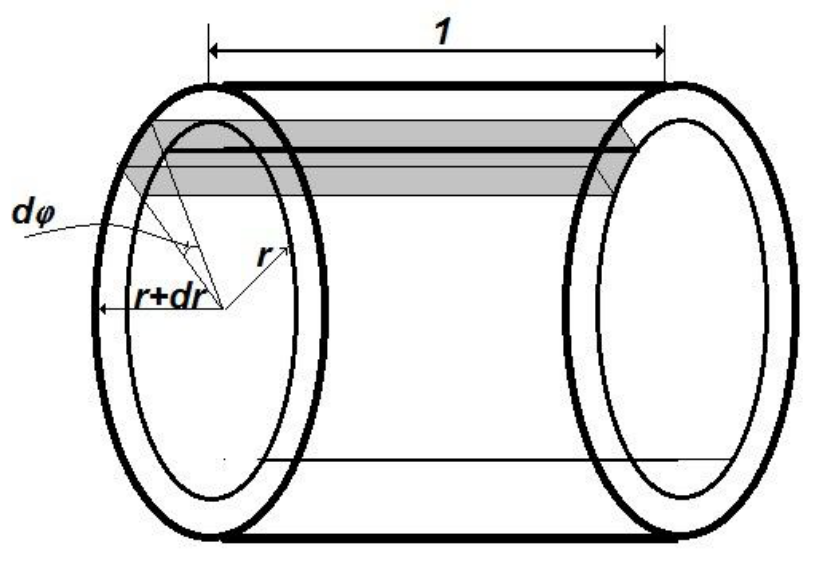
3.i Write the expressions of the forces acting on this elementary volume of plasma ( due to pressure in the column of plasma, due to the interaction with electrical charges carriers that there are in plasma, due to the interaction with magnetic field of electrical current flowing through plasma). Write the equation describing the equilibrium of the considered elementary portion of plasma. [1,2 т.]
3.ii Deduce the expression of pressure in a point of the column of plasma. Express the answer as function of and magnetic permeability . [1 т.]
3.iii Determine the expression of the number of particles carrying electrical charge in the column of plasma as function of și .
© Topic proposed by: Dr. Delia DAVIDESCU; Dr. Adrian DAFINEI. [0,8 т.]
ANSWER SHEET — three native pages
ANSWER SHEET — Theoretical Problem No.3 (10 points), “Squeezing” electrical charge carriers using magnetic fields
Native page12
| Task | Native field | Points |
|---|---|---|
| 1.i | The expression of the bulk density of electric charge into the cylinder at a distance from its axis of symmetry [blank] | 1.00 |
| 1.ii | The expression of angular velocity so that the bulk charge density is zero at any point of the cylinder [blank] | 0.20 |
| 1.iii | Evaluate the possibility of the practical realization of a zero bulk charge density in any point of the metallic cylinder. Briefly argue the answer [blank] | 0.30 |
| 2.i | The expressions of induction of the magnetic field produced by the current flowing through the wire in each of the two reference frames and [blank] | 1.00 |
| 2.ii | The expression of the difference between Lorentz forces in the two reference systems, [blank] | 1.50 |
Native page13
| Task | Native field | Points |
|---|---|---|
| 2.iii | State the values of the electron velocity’s components in both reference frames [blank] | 1.00 |
| 2.iv | The expression of the speed as function of and the numerical value of [blank] | 1.50 |
| 2.v | The expression of the maximum distance from the wire at which one can find the electron, as function of , when the electron moves away from wire on a direction perpendicular on it [blank] | 0.50 |
| 3.i | The expressions of the forces acting on this elementary volume of plasma [blank] | 0.80 |
| 3.i | The equation describing the equilibrium of the considered elementary portion of plasma [blank] | 0.40 |
| 3.ii | The expression of pressure in a point of the column of plasma [blank] | 1.00 |
Native page14
3.iii. The expression of the number of particles carrying electrical charge in the column of plasma [blank] — 0.80 p.

Решение
Detailed grading scheme for Theoretical Problem3
Give appropriate grades for other way to solve the problem correctly.
Theoretical Problem No.3 (10 points), “Squeezing” electrical charge carriers using magnetic fields.
Task nr.1
1.i — 1.00 p. For:
| Required expression or step | Points |
|---|---|
| expression of centrifugal force | 0.10 |
| expression of electrical force | 0.10 |
| expression of Lorentz force | 0.10 |
| 0.20 | |
| expression of intensity of electric field | 0.10 |
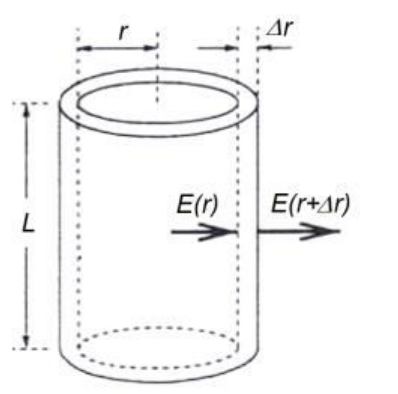
| Required expression or step | Points |
|---|---|
| Gauss theorem | 0.30 |
| 0.10 |
1.ii — 0.20 p. For: — 0.20 p.
1.iii — 0.30 p. For: . The situation can not be done in Earth’s magnetic field — 0.30 p.
Task nr.2
2.i — 1.00 p. For:
| Required expression or step | Points |
|---|---|
| ; | 0.10 |
| ; | 0.20 |
| 0.10 | |
| 0.10 | |
| 0.10 | |
| 0.20 | |
| 0.20 |
2.ii — 1.50 p. For:
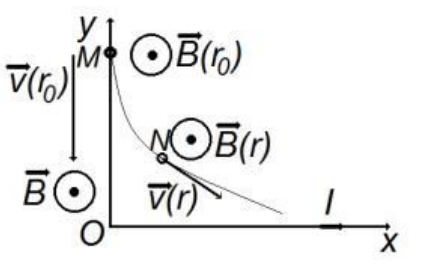
| Required expression or step | Points |
|---|---|
| expression of Lorentz force at : | 0.10 |
| Lorentz force at the moment : | 0.30 |
| Work done by Lorentz force on the electron: | 0.50 |
Note: the electron kinetic energy remains constant; therefore its speed module is conserved. Velocity of electron can only change direction.
| Required expression or step | Points |
|---|---|
| expression of initial velocity | 0.10 |
| expression of the velocity of electron found at the distance to wire | 0.10 |
| expression of Lorentz force in SM | 0.20 |
| 0.20 |
2.iii — 1.00 p. For:
- In the laboratory system S.L. magnetic field produces only a change of direction of speed without any variation of its module. (The trajectory is not circular because the magnetic field induction varies with the distance from electron to wire). When the electron is in the point closest to wire, its speed on direction (toward the wire) is null. At the speed of electron is parallel to wire and has the value — 0.50 p.
- In the mobile system S.M. the value of the initial speed of electron is . In this frame of reference, electron simply stops when it reaches the minimum distance. (the speed on the direction must change the sign — that means must pass through the value zero; the speed on direction vanishes because the speed in L.S. .) — 0.50 p.
2.iv — 1.50 p. For:
| Required expression or step | Points |
|---|---|
| 0.20 | |
| 0.30 | |
| expression of total initial energy of the electron: | 0.20 |
| expression of energy of the electron when it was at the minimum distance from wire: | 0.20 |
| energy conservation law | 0.20 |
| 0.20 | |
| 0.20 |
2.v — 0.50 p. For:
| Required expression or step | Points |
|---|---|
| energy conservation law | 0.30 |
| 0.20 |
Task nr.3
3.i — 1.20 p. For:
| Required expression or step | Points |
|---|---|
| Expression of the force due to pressure ; ; | 0.20 |
| electrical force | 0.10 |
| Ampère law ; | 0.10 |
| Total Lorentz force acting on “elementary element” of the plasma column | 0.20 |
| current density | 0.10 |
| 0.10 | |
| Condition for achieving balance of “elementary element” from the plasma column | 0.20 |
| 0.20 |
3.ii — 1.00 p. For:
| Required expression or step | Points |
|---|---|
| 0.20 | |
| 0.20 | |
| plasma column located in vacuum | 0.20 |
| The pressure at the axis of the plasma column | 0.20 |
| 0.20 |
3.iii — 0.80 p. For:
| Required expression or step | Points |
|---|---|
| concentration of particles in considered volume | 0.20 |
| 0.20 | |
| 0.40 |
TOTAL — 10 p.
© Grading scheme proposed by: Prof. dr. Delia DAVIDESCU; Conf. univ. dr. Adrian DAFINEI.
This is the complete native four-page detailed grading scheme. Its printed expressions, signs, numeric value and units are retained; no additional worked solution has been invented.
Reader note: native whole tasks and printed footer labels
The original question booklet contains Q1, Compressible fluids (12 requests); Q2, Sources, atoms, and spectra (6 requests); and Theoretical Problem No. 3, “Squeezing” electrical charge carriers using magnetic fields (11 requests). These are three whole problems with 29 connected requests. Q1 and Q2 pages print “Theoretical Problem No. 3” in their recurring footer. The body titles and connected parts establish the problem grouping; the printed footer labels remain in the original PDF.
Reader note: retained key authority and original mathematical expressions
The retained solutions_2016.pdf carries Romanian Master of Physics 2016 branding, matching Q1 and Q2 worked keys, and a detailed Q3 grading scheme credited to the named problem authors. It is a key retained by the archive; an organizer publication URL has not been independently verified. The solutions are attributed to the archive. Q1 key equations are small embedded raster images; their printed mathematical content is retained.
Reader note: literal flow and shock-key calculations
The B3.1 repeated key stem omits the original question’s condition ; the condition remains in the question. B3.2 prints , and . Those printed expressions and values are retained. The shock derivation denotes the undisturbed gas by , while the question uses ; each source notation remains in its original context.
Reader note: literal shock equation and numerical discrepancy
C2.2 prints its final shock-speed factor as . C2.3 then prints after C2.2 reports Mach 3.58. Those algebraic and numerical forms do not consistently follow the preceding relations. C2.1 prints its final ratio without a denominator subscript. These literal source expressions are preserved.
Reader note: answer-sheet title correspondence
Question page 9 labels the Sources, atoms, and spectra answer sheet Q3, while the matching question and key label it Q2. The six A/B/C requests, marks and content establish its correspondence to Q2. Both printed labels remain in the transcription and the original answer-sheet crop.
Reader note: literal absorption-ratio ordering
The key’s displayed wavelength ratio uses its energy-difference numerator and denominator in the reciprocal order from the preceding inverse wavelength expression. It then prints and . The printed ratio, search table and both estimates of are retained literally.
Reader note: printed permeability unit and source language
The question prints the magnetic permeability of vacuum as . The unit is dimensionally anomalous for permeability; the printed F is retained. Task 3.iii contains the Romanian word “și” between and , also retained.
Reader note: complete Q3 rubric and literal source expressions
The matching Q3 key is the complete four-page “Detailed grading scheme”. Every intermediate formula, partial mark, both diagrams and the instruction to credit other correct approaches are retained. The rubric prints , a plus sign between the two component terms of , its potential-energy signs, and the displayed pressure-force differential signs. These expressions and the printed conclusions are preserved. No additional prose derivation is present in this source.
Reader note: matching theory boundary and retained experimental tail
The question booklet contains fourteen pages covering the three theory problems and seven blank answer sheets. In the thirty-page key PDF, pages 1–10 correspond to Q1, pages 11–14 to Q2, and pages 15–18 to Q3. Pages 19–25 contain “Experimental Problem No. 1. Secrets of toys”, a filled answer and marking key for a hollow globe and an optical black box. Pages 26–30 contain the detailed grading scheme for “Experimental Problem Nr. 2. The study of Moiré pattern”. These experimental pages are retained in the original PDF, but are outside the matching theory scope. The exact retained event folder lists only problems_2016.pdf and solutions_2016.pdf; no matching experimental question booklet or further companion was obtainable there.
Оригинал в Архива: problems_2016.pdf · решение от архива: solutions_2016.pdf