SAO 2016, Теория и практика — Задача 1. Question 1
4th Singapore Astronomy Olympiad · 19 март 2016 г. · 14 т.
Внимание: Бележка към темата
Suggested answers preserve native scoring and scientific differences: Q5 question 25 marks/key 24 marks; Q7 question 5 marks/key 6 marks. Original units, intermediate formulas, assumptions and printed descriptions are retained. The complete source-supported discrepancy list is bound in the source-reader evidence.
Native cover, rules, constants and formulae
4th Singapore Astronomy Olympiad — 19 March 2016
Organized by Astronomy.SG. Sponsored by DSO National Laboratories.
I hereby consent to provide my details to the organizing and sponsoring organisations, Astronomy.SG and DSO National Laboratories:
Full Name: __________; School: __________; NRIC/FIN: __________; Email address: __________; Signature: __________.
For official use only (the cover prints two identical tables):
| Question | Score | Question | Score |
|---|---|---|---|
| 1 | /14 | 1 | /14 |
| 2 | /8 | 2 | /8 |
| 3 | /20 | 3 | /20 |
| 4 | /12 | 4 | /12 |
| 5 | /25 | 5 | /25 |
| 6 | /16 | 6 | /16 |
| 7 | /5 | 7 | /5 |
Rules
- Students may use pen or pencil to answer the paper.
- Any working or answers on the question papers will not be considered.
- Only the use of scientific calculators is allowed. Graphing/programmable calculators are not allowed.
- Students are to bring their own stationery.
- Students have 3 hours to complete the paper. If a student is late, no time extension is granted.
- Students should clearly state their assumptions in their working, if any.
- Students may leave any time upon submission of their solutions and question paper.
- Cheating or allowing others to cheat is grounds for immediate disqualification.
- No notes are allowed.
- Question papers must be returned together with their scripts. The cover page and Figure 2 are to be attached to the answer script.
Constants / Values
| Constant / value | Printed value |
|---|---|
| Gravitational constant, | |
| Speed of light in vacuum, | |
| Hubble constant, | |
| Radius of Earth, | |
| Mass of Earth, | |
| Solar mass | |
| Nominal solar luminosity | |
| Thomson-cross section for an electron, | |
| Mass of a proton, | |
| Current density parameter for matter (baryonic and dark), | |
| Current density parameter for radiation | |
| [Errata] Apparent magnitude of the Sun |
Formulae
Hawking Temperature of a black hole, .
Spatial curvature density, .
Условие
The Hubble Space Telescope (HST), launched in 1990, will someday be decommissioned. It will fire its retrorockets, fall back into Earth's atmosphere and crash harmlessly into the Pacific Ocean. Let us study the dynamics of this operation. Assume that the HST is currently in a circular orbit around the Earth and that the retrorockets will fire in precisely the opposite direction of its motion. The HST has an orbital period of 95.6 minutes.
a What is the radius of the HST's orbit? [2m] [2 т.]
b What is the orbital velocity of the HST? [2m] [2 т.]
c What is the minimum ΔV required to crash the HST into the Earth's surface? [4m] Briefly explain why such a trajectory would be unwise. [1m] [5 т.]
d NASA suggests that the HST should impact the ocean at an angle of at most 75° from the vertical. What would be the ΔV required to accomplish this? Neglect air resistance. [5m] [5 т.]
Решение
4th Singapore Astronomy Olympiad — Suggested Answers
Last updated 27/11/2016. Provided by 4th SAO Committee.
All rights reserved. Whilst every effort has been made to ensure the accuracy of information contained in this document, the 4th SAO Committee will not entertain any requests regarding questions, solutions and marking. By perusing this document, you agree to the above disclaimer.
Table of Contents
| Q1 | Celestial Mechanics | 2 |
| Q2 | Data response: observational astronomy | 6 |
| Q3 | Practical astronomy | 9 |
| Q4 | Physics of stars and planets | 15 |
| Q5 | Galactic and extragalactic astrophysics | 18 |
| Q6 | Celestial coordinate systems and geometric astronomy | 27 |
| Q7 | Optics and detectors | 35 |
Celestial Mechanics (14m)
a)
(First principles)
The gravitational force provides the centripetal force for the HST’s circular orbit, thus
(Solution)
Rearranging, Kepler’s Third Law: . [A1]
Hence, rearranging to find ,
[B1]
Note the full equation is in fact, where is the reduced mass; however since then .
Common Mistakes:
There is no need to use the vis-viva equation for circular orbits – remembering it incorrectly is self-penalisation
is incorrect here! This form of Kepler’s Third Law is only applicable to satellites of the Sun, i.e. planets, comets, where T and a are in units of yr and AU respectively.
b)
For a circular orbit,
[M1, A1]
c)
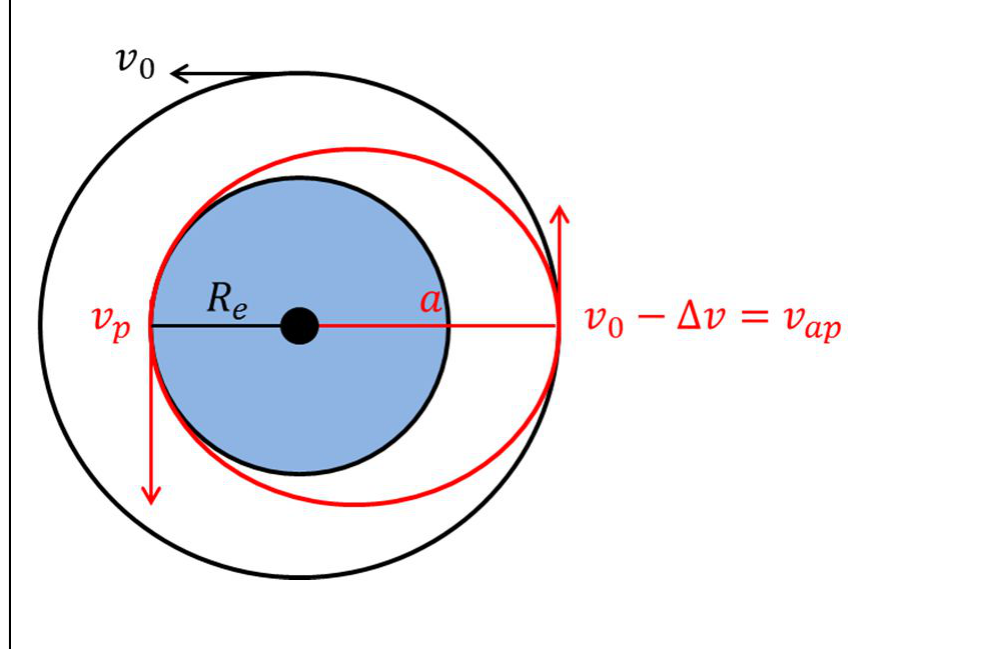
The problem can in fact be visualised as a Hohmann Transfer Orbit, with corresponding diagram (not to scale),
Conserving orbital energy ,
[A1]
Solving for ,
[M1]
[A1]
[B1]
Such a trajectory would skim the Earth’s surface. As such it would be hard to control where the HST impacts the surface. [A1]
There is no need to consider orbital angular momentum here as there is only one unknown, also gives no useful information.
Common Mistakes:
- is a scalar – it has no direction!
- Quoting Kepler’s first law in polar form or vis-viva equation without a supporting diagram or working
- Question does not involve escape velocity!
- Illogical conclusion unrelated to the question (e.g. damaging buildings)
d)
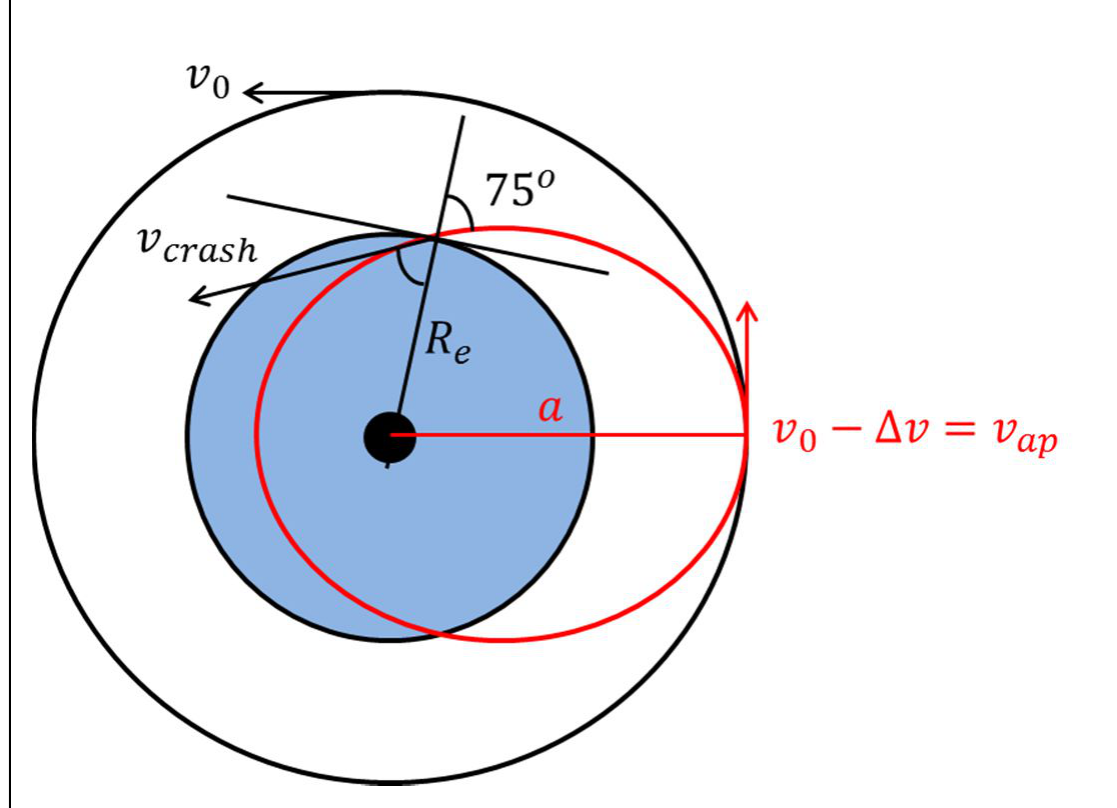
The diagram for this scenario is shown below.
Conserving orbital energy ,
[A1]
Conserving orbital angular momentum ,
[A1]
Rearranging and substituting,
[M1]
[A1]
[B1]
Recall , hence , where is the angle between the vectors and .
Recall .
Also observe that as the impact angle from the vertical decreases from , the periapsis of the new orbit moves closer to the focus (Earth’s centre).
Common Mistakes:
- Note the actual angle between the and vectors is 105°, not 75°
- Some candidates misinterpreted the question, calculating for the scenario where the HST impacts at 15° to the vertical (i.e. 75° to the horizontal).
Оригинал в Архива: SAO4_q.pdf · официални решения: SAO4_sol.pdf