SAO 2016, Теория и практика — Задача 2. Question 2
4th Singapore Astronomy Olympiad · 19 март 2016 г. · 8 т.
Внимание: Бележка към темата
Suggested answers preserve native scoring and scientific differences: Q5 question 25 marks/key 24 marks; Q7 question 5 marks/key 6 marks. Original units, intermediate formulas, assumptions and printed descriptions are retained. The complete source-supported discrepancy list is bound in the source-reader evidence.
Native cover, rules, constants and formulae
4th Singapore Astronomy Olympiad — 19 March 2016
Organized by Astronomy.SG. Sponsored by DSO National Laboratories.
I hereby consent to provide my details to the organizing and sponsoring organisations, Astronomy.SG and DSO National Laboratories:
Full Name: __________; School: __________; NRIC/FIN: __________; Email address: __________; Signature: __________.
For official use only (the cover prints two identical tables):
| Question | Score | Question | Score |
|---|---|---|---|
| 1 | /14 | 1 | /14 |
| 2 | /8 | 2 | /8 |
| 3 | /20 | 3 | /20 |
| 4 | /12 | 4 | /12 |
| 5 | /25 | 5 | /25 |
| 6 | /16 | 6 | /16 |
| 7 | /5 | 7 | /5 |
Rules
- Students may use pen or pencil to answer the paper.
- Any working or answers on the question papers will not be considered.
- Only the use of scientific calculators is allowed. Graphing/programmable calculators are not allowed.
- Students are to bring their own stationery.
- Students have 3 hours to complete the paper. If a student is late, no time extension is granted.
- Students should clearly state their assumptions in their working, if any.
- Students may leave any time upon submission of their solutions and question paper.
- Cheating or allowing others to cheat is grounds for immediate disqualification.
- No notes are allowed.
- Question papers must be returned together with their scripts. The cover page and Figure 2 are to be attached to the answer script.
Constants / Values
| Constant / value | Printed value |
|---|---|
| Gravitational constant, | |
| Speed of light in vacuum, | |
| Hubble constant, | |
| Radius of Earth, | |
| Mass of Earth, | |
| Solar mass | |
| Nominal solar luminosity | |
| Thomson-cross section for an electron, | |
| Mass of a proton, | |
| Current density parameter for matter (baryonic and dark), | |
| Current density parameter for radiation | |
| [Errata] Apparent magnitude of the Sun |
Formulae
Hawking Temperature of a black hole, .
Spatial curvature density, .
Условие
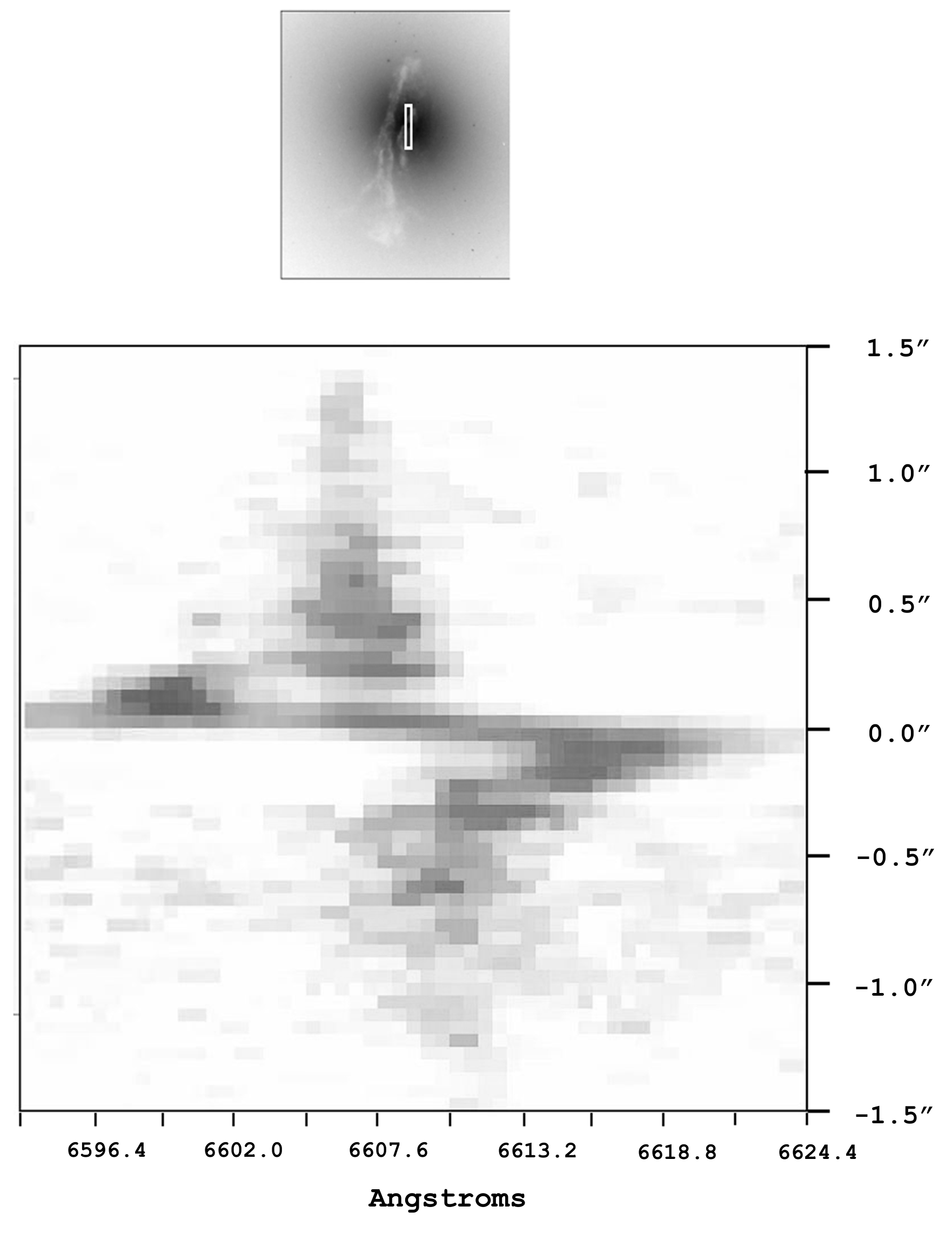
Long-slit spectroscopy was used to observe a gas disk in the central region of the galaxy M84. Refer to Fig. 1 for this problem. On the top there is a small image, which you will not need to analyse to solve this problem; you may just assume that the gas disk is thin, circular, and almost edge-on, and the slit is aligned through the centre of the disk, which coincides with the nucleus of M84. What you will instead need to analyse carefully is the spectrograph data below. It shows part of the data that includes the N II emission line (6583Å). The angular scale is centred to M84’s nucleus.
a Estimate the distance to M84, in Mpc. [2m] [2 т.]
b At this distance, what is the length of the arc subtended by an angle of 1 arcsecond from Earth? [2m] [2 т.]
c Estimate the total mass (in solar masses) within an 8pc radius of the central nucleus. [4m] [4 т.]
Решение
Data response: observational astronomy (8m)
a)
First, estimate the redshift of the nucleus of M84, by reading from the center,
[B1]
Accept all answers to the above error corresponding to maximum error of 2 pixels from the center.
Then, by Hubble’s law, for small ,
[B1]
Many participants did not know how to interpret the data, even though it’s technically the easiest question.
Common Mistakes:
Many used parallax to obtain the distance to the galaxy, even though parallax is impossible to use at such distances due to instrumental limitations (parallax is often used only out to a few kpc).
Parallax method also does not make use of the spectrograph data
Some left their answers to other units of distance
Lack of understanding that the recession velocity of the galaxy is causing the entire spectrum to be redshifted from the emitted wavelength.
Some participants brought in unnecessary special relativistic formula
b)
Convert the angle from degrees to radians,
[A1]
[B1]
Accept answers from 72 to 86pc.
Common Mistakes:
- Equations are not written out in full with variables – marks lost as markers have to guess your meaning
- Equation for arc length requires to be in radians.
c)
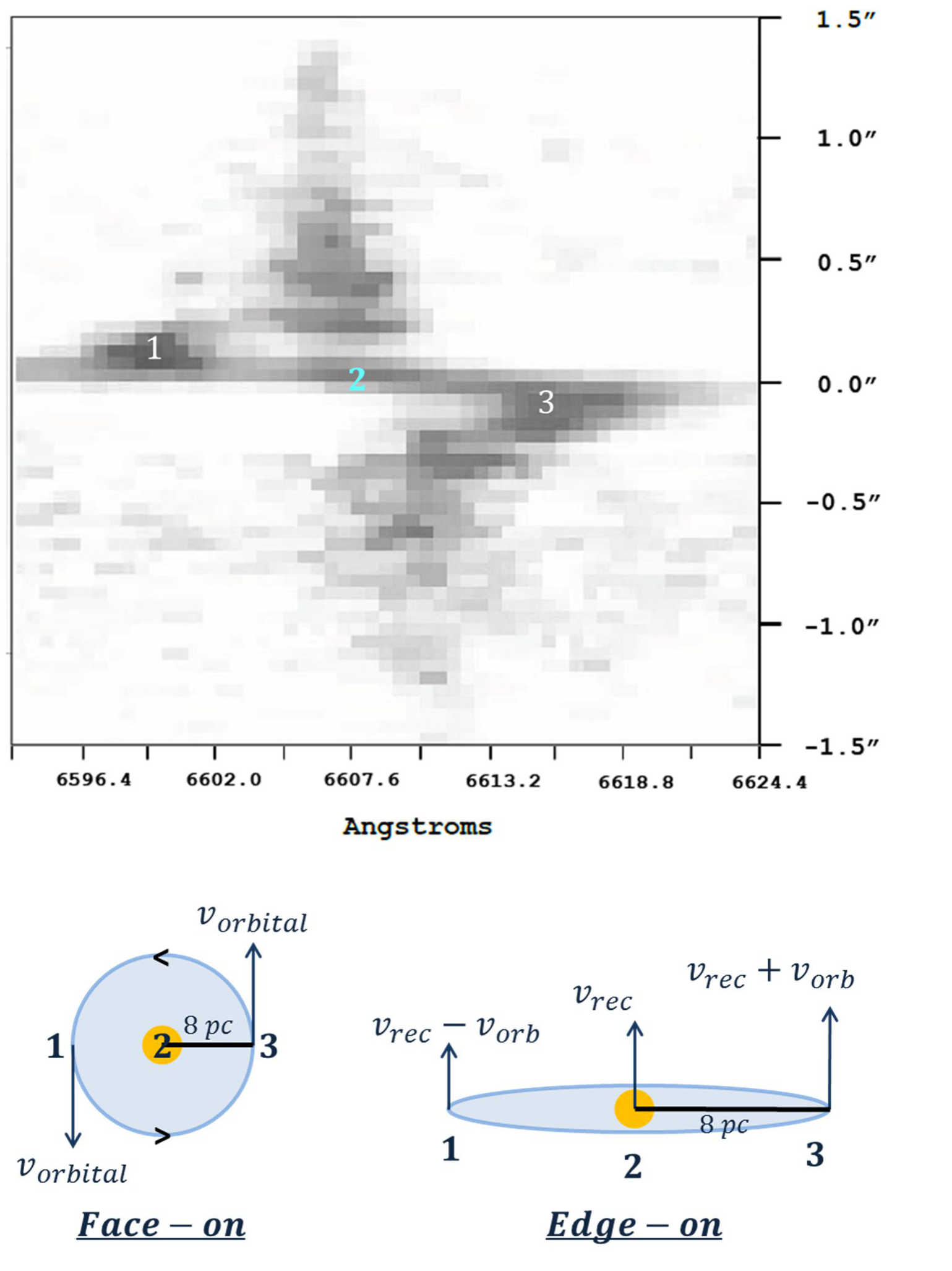
From part (b), 8pc corresponds to about 0.1”. Thus read the wavelengths of the spectrum at ±0.1” along the vertical axis, at the darkest parts of the spectrum (corresponding to localised concentrations of gas).
Reading from the spectrum,
[B1]
Award this 1m for either of the above wavelengths read off.
Approximating the orbital speed of the gas at this 8pc radius, using both ,
[M1, A1]
Award the M1 mark only for calculating the redshift due to orbital motion of the gas using both and .
Allow rounding off of to 1s.f. or 2s.f.
Thus, within an 8pc radius,
[B1]
Allow answers from to solar masses. Accept answers given to 1 s.f.
This subpart was badly done; almost no one scored full credit. The orbital speed of gas at 8pc radius out is due to the gravitational force exerted by the mass contained within.
Common Mistakes:
Assuming the galaxy is seen face-on despite being told otherwise in the question, leading to nonsensical working
Some candidates did not take the hint from part (b) about the angular distance Δθ along the vertical axis you should be reading the wavelength from; they incorrectly used parallax (again)
Candidates did not understand the significance of the two dark patches in the spectrum (local concentrations of gas at 8pc orbital distance)
The problem can be visualised as below.
Оригинал в Архива: SAO4_q.pdf · официални решения: SAO4_sol.pdf