SAO 2016, Теория и практика — Задача 3. Question 3
4th Singapore Astronomy Olympiad · 19 март 2016 г. · 20 т.
Внимание: Бележка към темата
Suggested answers preserve native scoring and scientific differences: Q5 question 25 marks/key 24 marks; Q7 question 5 marks/key 6 marks. Original units, intermediate formulas, assumptions and printed descriptions are retained. The complete source-supported discrepancy list is bound in the source-reader evidence.
Native cover, rules, constants and formulae
4th Singapore Astronomy Olympiad — 19 March 2016
Organized by Astronomy.SG. Sponsored by DSO National Laboratories.
I hereby consent to provide my details to the organizing and sponsoring organisations, Astronomy.SG and DSO National Laboratories:
Full Name: __________; School: __________; NRIC/FIN: __________; Email address: __________; Signature: __________.
For official use only (the cover prints two identical tables):
| Question | Score | Question | Score |
|---|---|---|---|
| 1 | /14 | 1 | /14 |
| 2 | /8 | 2 | /8 |
| 3 | /20 | 3 | /20 |
| 4 | /12 | 4 | /12 |
| 5 | /25 | 5 | /25 |
| 6 | /16 | 6 | /16 |
| 7 | /5 | 7 | /5 |
Rules
- Students may use pen or pencil to answer the paper.
- Any working or answers on the question papers will not be considered.
- Only the use of scientific calculators is allowed. Graphing/programmable calculators are not allowed.
- Students are to bring their own stationery.
- Students have 3 hours to complete the paper. If a student is late, no time extension is granted.
- Students should clearly state their assumptions in their working, if any.
- Students may leave any time upon submission of their solutions and question paper.
- Cheating or allowing others to cheat is grounds for immediate disqualification.
- No notes are allowed.
- Question papers must be returned together with their scripts. The cover page and Figure 2 are to be attached to the answer script.
Constants / Values
| Constant / value | Printed value |
|---|---|
| Gravitational constant, | |
| Speed of light in vacuum, | |
| Hubble constant, | |
| Radius of Earth, | |
| Mass of Earth, | |
| Solar mass | |
| Nominal solar luminosity | |
| Thomson-cross section for an electron, | |
| Mass of a proton, | |
| Current density parameter for matter (baryonic and dark), | |
| Current density parameter for radiation | |
| [Errata] Apparent magnitude of the Sun |
Formulae
Hawking Temperature of a black hole, .
Spatial curvature density, .
Условие
Preamble
A common way of creating a sky chart of the night sky is through a method called stereographic projection, where stars, being points on the celestial sphere, are projected onto a disk and then printed on paper. The edge of the disk represents the horizon, and the four cardinal points (N, S, E, W) are indicated on it.
A recent online news article read: “Five planets paraded across the dawn sky early Wednesday in a rare celestial spectacle set to repeat every morning until late next month” - The New York Times
Orienting yourself to the sky
The sky chart (Figure 2, printed on page 17), shows the sky at an unknown latitude at 0° Longitude; at 06:15 UTC on 28 Jan, 2016. Do all of the following on the sky chart, in any order: Note: You may be penalised if the final answers are indecipherable on the sky chart.
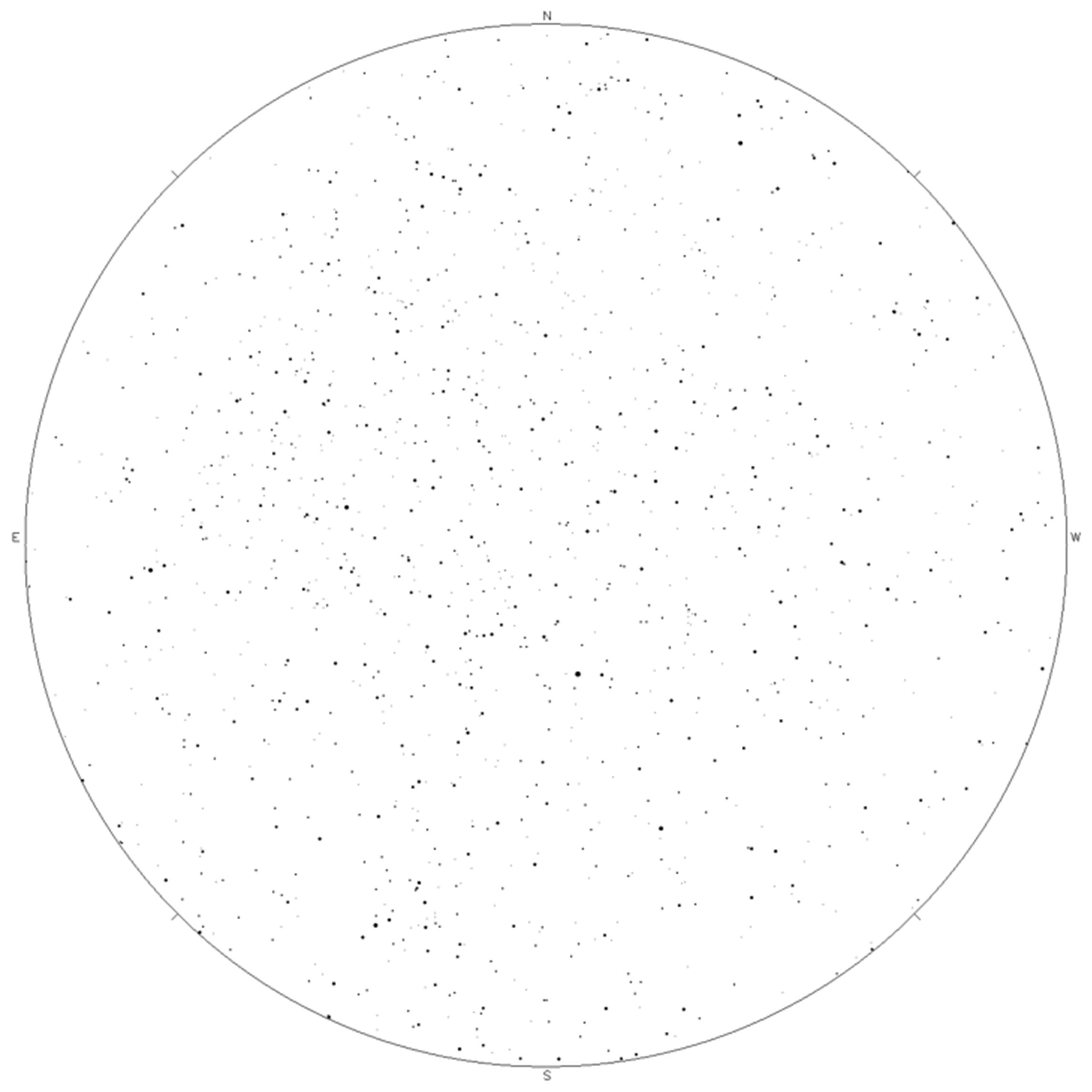
a Draw out the famous Summer Triangle on the sky chart with solid lines. [2m] [2 т.]
b Draw out the Little Dipper, mark out Polaris, and determine the latitude of the observer. [3m] Note: In a stereographic projection, constellations near the edge of the sky chart are stretched and appear larger than if they were at the centre of the chart. [3 т.]
c Mark out a small arrow that points to the star Denebola. [1m] The tip of the arrow should be just at where this star should be. Do the same for the Messier objects M101 [1m] and M13 [1m]. [3 т.]
d Draw the celestial equator (with the label: CE) on the chart with a solid line. [2m] [2 т.]
e Using any method, estimate the Local Sidereal Time (LST). Outline your reasoning as clearly as possible. [3m] [3 т.]
f Draw the ecliptic (with the label: Ecliptic) on the chart with a solid line. [2m] [2 т.]
g Mark the location of the planets on the chart. [1m each] Note that the planets are currently NOT marked on the chart. The following hints might be useful:
Mercury has just risen above the horizon
Venus is located slightly above (i.e. at a slightly higher altitude from) Kaus Borealis, which is a star in Sagittarius.
Mars is located slightly west of Alpha Librae (Common name: Zubenelgenubi)
Jupiter is located slightly west to the point of the Autumnal Equinox
Saturn is located at a Right Ascension of 16h50m38s, and a declination of −20° 48.8’ [5 т.]
Intentionally left blank
Решение
Practical astronomy (20m)
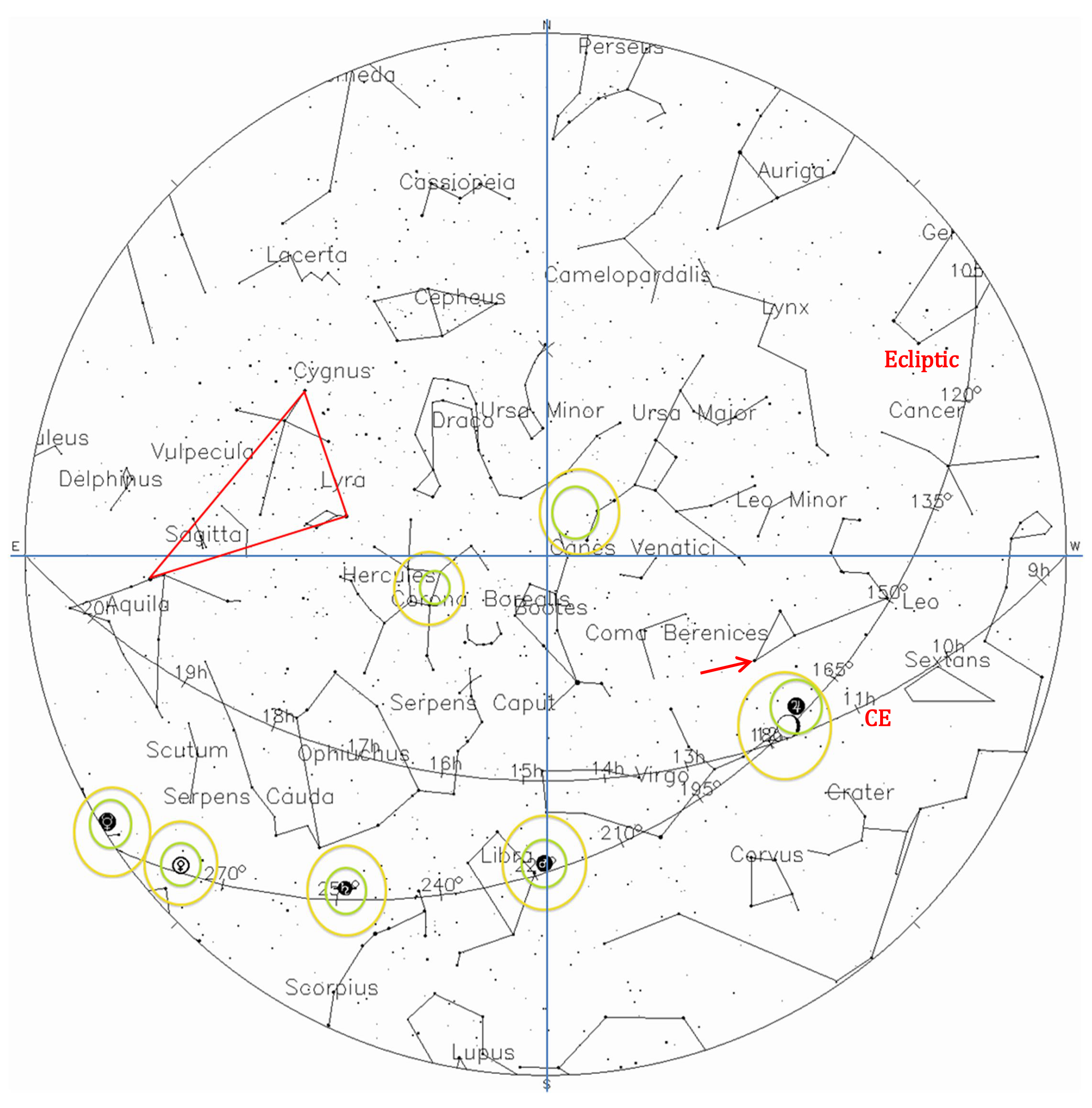
a)
Marking Scheme:
2 marks – All three stars (Vega in Lyra, Deneb in Cygnus, Altair in Aquila) in the Summer Triangle connected correctly
1 mark – Any two out of three stars in the Summer Triangle connected correctly
0 marks – One or none of the three stars identified correctly
Poorly attempted overall despite the Summer Triangle being a bright and easy visible asterism in Singapore and the Northern hemisphere.
In December at local midnight, the Winter constellations reach their culmination (Winter Solstice), and Spring constellations are rising from the East.
Since the planetary display event occurred at 5-7am in the morning, that means the Winter constellations would be setting in the West and Summer constellations will be rising in the East in December.
Since the planetary display event occurred in January-February, thus the Summer constellations would have risen 30–45° above the horizon.
From part (b), the observer is at a moderately northern latitude (~45°), thus all three constellations (Lyra, Aquilla and Cygnus), which are north of the celestial equator, will appear close to the great circle connecting the zenith, cardinal East and West (drawn as a straight horizontal line above). See diagram below.
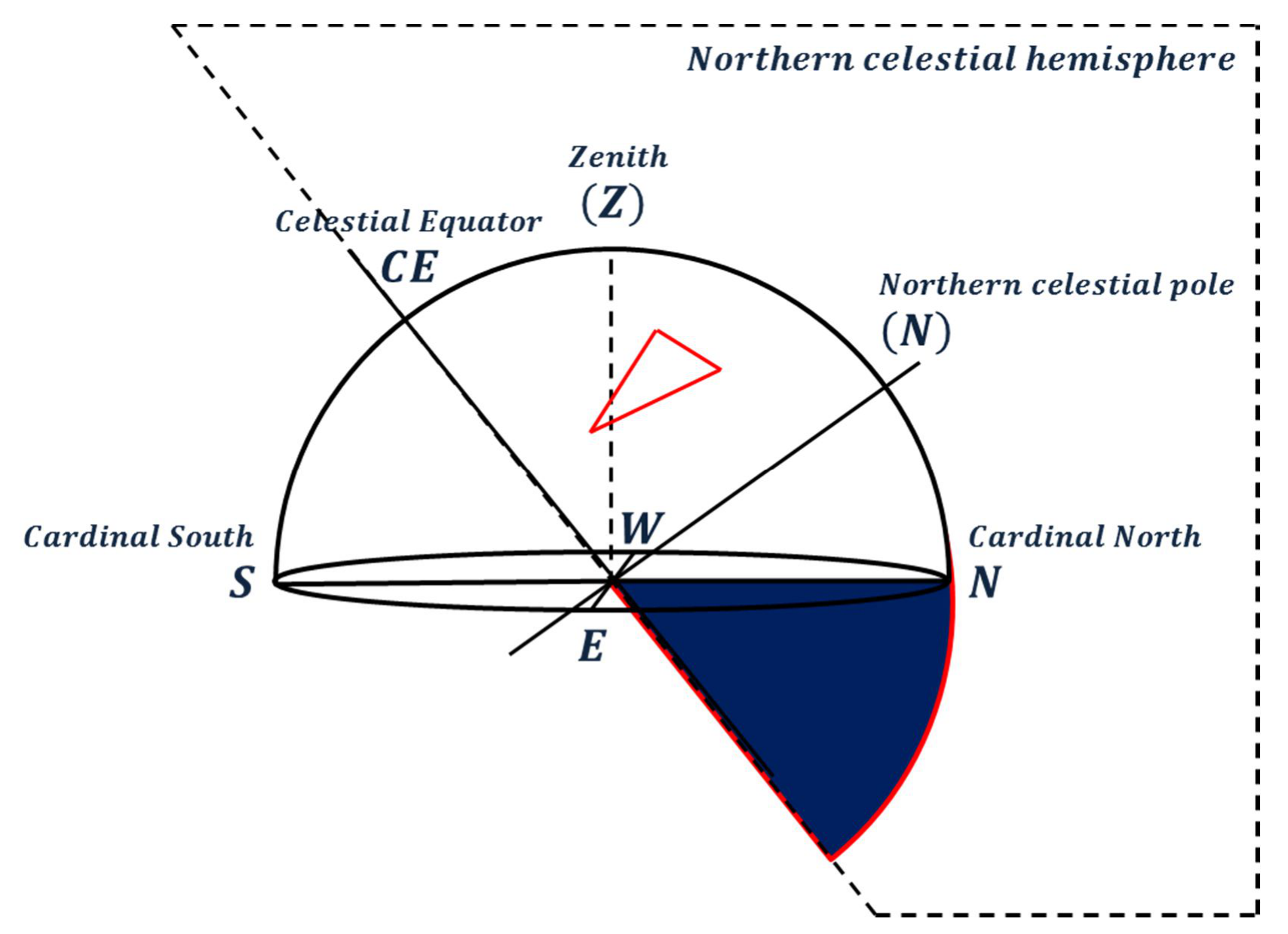
Thus, the Summer Triangle is expected to be located in the centre-left of the starchart.
Common Mistakes:
The angle at the vertex with Vega is not approximately a right angle.
Selecting other dimmer stars in the three constellations for the vertices
Summer Triangle drawn with stars in other constellations for vertices
Not using a ruler to connect the stars (no penalisation)
Deneb is Arabic for tail, hence the tail of the swan (Cygnus) is at the short end, i.e. the eagle and swan are flying in opposite directions
b)
Marking Scheme:
- Connecting all seven key stars of Ursa Minor [A1]
- Marking out Polaris, the axle of the Little Dipper, with a cross [A1]
- Reasonable approximation of the observer’s latitude (40°–50°) [A1]
Many participants left this part completely blank. Amongst those that didn’t, it was poorly attempted, showing poor understanding of the Celestial Sphere.
First, draw a vertical line connecting Cardinal North, South and the zenith on the starchart, representing the local meridian (a great circle in 3D). The Northern celestial pole (N), will always be found on the local meridian, and by extension, the pole star Polaris is too.
Scanning along the vertical line, we find Ursa Major and Polaris in the northern top-centre of the starchart, about 1/3 of the line down.
Note however that a stereographic projection distorts the shape and area of constellations, with the effect becoming more severe away from the zenith towards the horizon. Hence, whilst by linear proportion,
A correction should be made to account for this stereographic effect, by adding 5–10°, giving ~45° (which is the actual value).
Common Mistakes:
- Polaris is not found along the local meridian
- Ursa Major (Big Dipper) is traced out instead of Ursa Minor (Little Dipper)
- Tracing of the Little Dipper is not closed (no penalisation)
- Estimates of the latitude using linear proportion without correcting for error of stereographic projections (generally falling around 30–40°)
- Estimates of latitude widely outside reasonable bounds, e.g. or indicating zero understanding of the Celestial Sphere.
c)
Marking Scheme:
- Correctly identifying Denebola in Leo (tip of arrow has to point unambiguously at it) [A1]
Within green circle – full credit
Within yellow circle – half-credit
- Correctly identifying M101, the Pinwheel Galaxy in Ursa Major [A1]
- Correctly identifying M13, the Great Hercules Cluster in Hercules [A1]
Virtually no marks awarded, showing that almost all participants lack general knowledge of prominent stars and deep-sky objects in Singapore’s sky
Common Mistakes:
Selecting another star in Leo as Denebola, f.y.i. Denebola contains “Deneb”, which refers to the tail of the Lion
Randomly marking out stars in Hercules or Ursa Major hoping to luckily locate M13 or M101
d)
Marking Scheme:
- Celestial Equator passes through East and West, regardless of shape [M1]
- CE is a smooth arc with curvature such that it intersects the local meridian (vertical line) approximately the same distance from the zenith as the North Celestial pole (N), since the CE intersects the local meridian at 45° altitude as well. [A1]
Poorly attempted, demonstrating little understanding of the celestial coordinate system. Benefit of doubt was given to ambiguous tracings of the CE.
Common Mistakes:
- CE is not a smooth arc (e.g. horizontal line, vertical line, abstract curves) or is a closed trace.
- CE does not pass through cardinal East and West
- The ecliptic is traced but labelled as CE.
e)
Marking Scheme:
- Up to 2 marks for accuracy of final answer
- 2 marks – for answers between 14h and 15h inclusive
- 1 marks – for answers from 13h to 13h59m or 15h01m to 16h inclusive
- 0 marks – for answers outside the range of 13h to 16h
- Award 1 mark for correct logic and working
- For incorrect logic or unsupported answers, award 0 marks.
(Method 1: Using RA of known object and estimating LHA to obtain LST)
From the definitions of the following variables, the following equation relates LST, RA at meridian and local hour angle (LHA),
[M1]
Then, find an object with known RA, and estimate its LHA. For an object on the meridian, . For rising and setting objects, or respectively.
e.g. Arcturus has a RA of 14h15m; it is estimated to have crossed the meridian (LHA) about 30 mins ago, i.e. .
Hence, . [A2]
(Method 2: By first principles, definition of LST)
By definition, the , and .
In a tropical (calendar) year, there are 365.25 solar days, but 366.25 sidereal days.
By definition, at local noon on the day of Vernal Equinox (usually around March 20–21), the vernal equinox is at the local meridian everywhere, thus LST=0h.
Thus, the LST at local noon every day after that increases by a small amount equal to the time required for the Earth to rotate an extra small angle due to its orbital motion, i.e. for each complete solar day the Earth completes a small fraction of the extra sidereal day. This amount is,
Hence, in January 28, approximately 10 months and 7 days after Vernal Equinox (there is inaccuracy introduced here as each month is not of equal length),
If we do have a calendar, we can get a more accurate calculation, with 313 days between March 21 and January 28
[M1]
Since the starchart was taken at 06:15 UTC, i.e. 6.15am at the Greenwich Meridian (0° latitude, which coincidentally is the latitude of this observer),
[A2]
The actual answer according to a calculator is 14.65h. This is correct since Kochab, the brightest star in the bowl of the Little Dipper, has RA of 14.83h and has LHA=−0.2h (i.e. about 10 mins from crossing the local meridian).
Only one candidate got any credit for this question (he got full credit). Disappointing as it shows most other candidates are lacking understanding in geometric astronomy and time systems.
Common Mistakes:
Guessing the LST without any working
Calculating the LST based on an incorrectly remembered RA of a visible star in the starchart (no A2 marks)
f)
Marking Scheme:
- Ecliptic is inclined and intersects the CE at approximately 23.5° [A1]
- Ecliptic is a smooth arc of approximate curvature that intersects the CE around 11h30m to 12h30m RA, running through many of the zodiac constellations [A1]
Common Mistakes:
The CE is traced but labelled as the ecliptic.
The ecliptic is not a smooth arc (e.g. horizontal line, vertical line, abstract curves) or is a closed trace.
The ecliptic, when traced does not pass any of the through the zodiac constellations
The ecliptic ascends above the celestial equator at the intersections instead (the intersection at 12h RA is a descending node).
g)
Within green circle – full credit
Within yellow circle – half-credit
- Correctly locating Mercury near the eastern horizon and along the ecliptic [A1]
- Correctly locating Venus at a higher altitude above Kaus Borealis, the top star of the teapot in Sagittarius [A1]
- Correctly locating Mars to the west of Zubenelgenubi, Alpha Librae; Mars is also on the local meridian [A1]
- Correctly locating Jupiter to the west of the point of Autumnal Equinox, i.e. west of RA12h along the ecliptic, near the descending node [A1]
- Correctly locating Saturn at around17h RA, and around−20° declination, i.e. close to the point of Winter Solstice but1h earlier along the ecliptic [A1]
- Any planets not within ±5° of the ecliptic are awarded no marks.
Poorly attempted overall, only a handful of marks were awarded in total. This was exacerbated by the poor tracing of the ecliptic in part (f), which rendered the hints useless.
Common Mistakes:
Planets were identified too far above or below the ecliptic (the ecliptic is also the approximate orbital plane of most planets in the Solar System!)
Planets were marked out but not clearly named.
Оригинал в Архива: SAO4_q.pdf · официални решения: SAO4_sol.pdf