SAO 2016, Теория и практика — Задача 5. Question 5
4th Singapore Astronomy Olympiad · 19 март 2016 г. · 25 т.
Внимание: Бележка към темата
Suggested answers preserve native scoring and scientific differences: Q5 question 25 marks/key 24 marks; Q7 question 5 marks/key 6 marks. Original units, intermediate formulas, assumptions and printed descriptions are retained. The complete source-supported discrepancy list is bound in the source-reader evidence.
Native cover, rules, constants and formulae
4th Singapore Astronomy Olympiad — 19 March 2016
Organized by Astronomy.SG. Sponsored by DSO National Laboratories.
I hereby consent to provide my details to the organizing and sponsoring organisations, Astronomy.SG and DSO National Laboratories:
Full Name: __________; School: __________; NRIC/FIN: __________; Email address: __________; Signature: __________.
For official use only (the cover prints two identical tables):
| Question | Score | Question | Score |
|---|---|---|---|
| 1 | /14 | 1 | /14 |
| 2 | /8 | 2 | /8 |
| 3 | /20 | 3 | /20 |
| 4 | /12 | 4 | /12 |
| 5 | /25 | 5 | /25 |
| 6 | /16 | 6 | /16 |
| 7 | /5 | 7 | /5 |
Rules
- Students may use pen or pencil to answer the paper.
- Any working or answers on the question papers will not be considered.
- Only the use of scientific calculators is allowed. Graphing/programmable calculators are not allowed.
- Students are to bring their own stationery.
- Students have 3 hours to complete the paper. If a student is late, no time extension is granted.
- Students should clearly state their assumptions in their working, if any.
- Students may leave any time upon submission of their solutions and question paper.
- Cheating or allowing others to cheat is grounds for immediate disqualification.
- No notes are allowed.
- Question papers must be returned together with their scripts. The cover page and Figure 2 are to be attached to the answer script.
Constants / Values
| Constant / value | Printed value |
|---|---|
| Gravitational constant, | |
| Speed of light in vacuum, | |
| Hubble constant, | |
| Radius of Earth, | |
| Mass of Earth, | |
| Solar mass | |
| Nominal solar luminosity | |
| Thomson-cross section for an electron, | |
| Mass of a proton, | |
| Current density parameter for matter (baryonic and dark), | |
| Current density parameter for radiation | |
| [Errata] Apparent magnitude of the Sun |
Formulae
Hawking Temperature of a black hole, .
Spatial curvature density, .
Условие
In June 2011, scientists reported the discovery of the furthest known quasar yet with a redshift beyond 7. Located in Leo, ULAS J1120+0641 has a luminosity of solar luminosities. Fig. 3 shows its spectrum in infrared wavelengths.
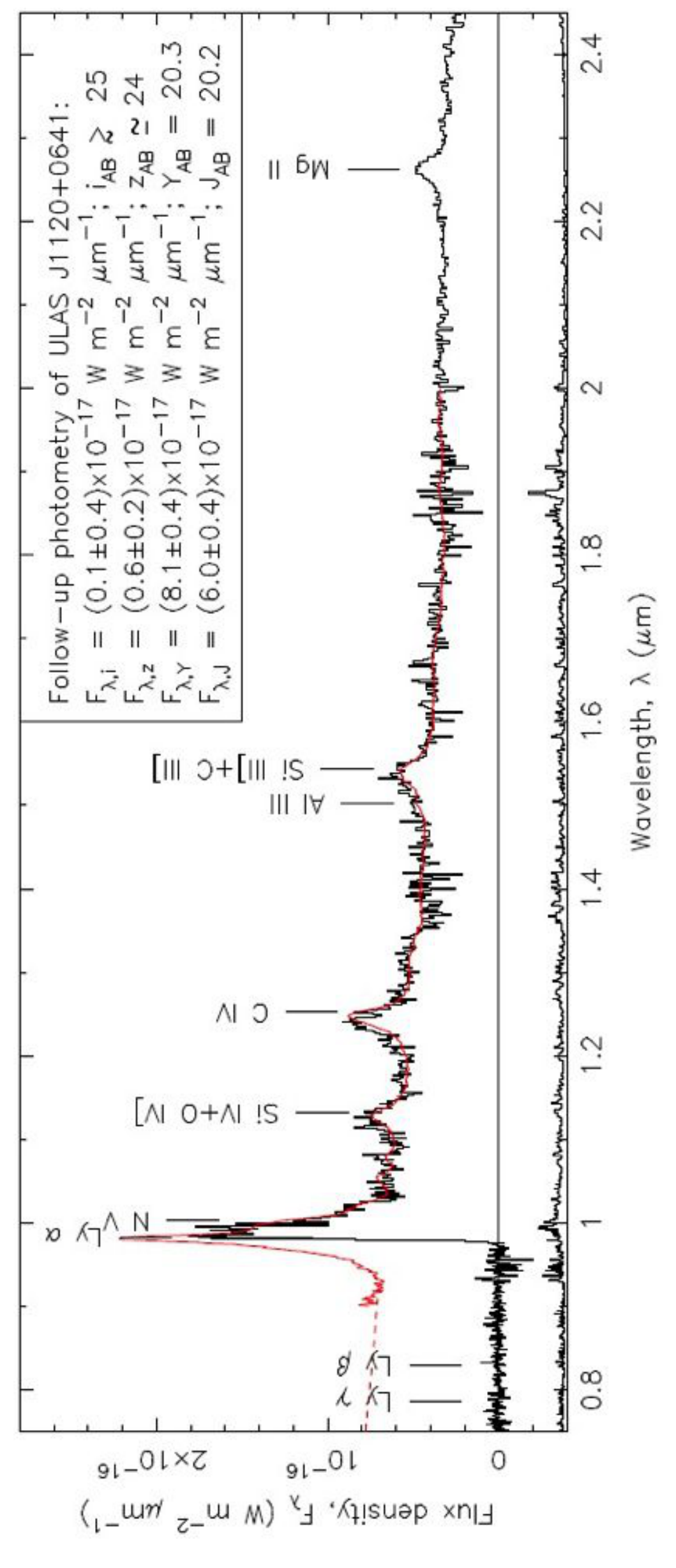
a In Fig. 3, the Lyman-α line is redshifted from a rest wavelength of . Calculate the redshift of this quasar. [2m] [2 т.]
b Calculate the apparent magnitude of this quasar as seen from Earth, assuming no intergalactic extinction. [3m] Hint: The comoving distance can be calculated from where is a dimensionless factor that is equal to 2.000 for this quasar, is the Hubble radius, the distance beyond which objects recede faster than the speed of light due to cosmological (Hubble) expansion. [3 т.]
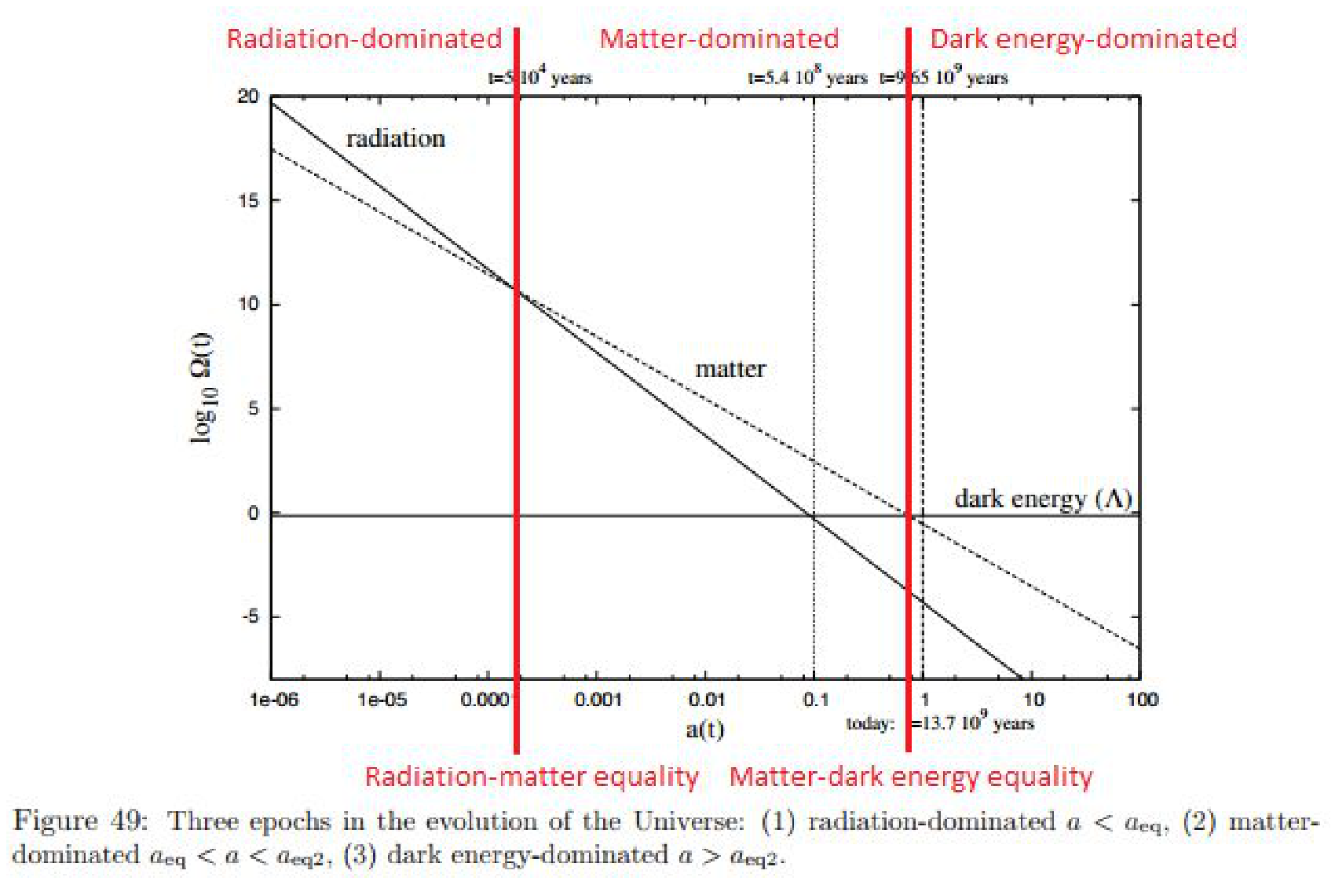
c Estimate the age of the Universe at the radiation-matter equality, given that the matter-dark energy equality occurred 4.05 billion years ago. [4m] Hint: In a radiation-, matter- and dark-energy-dominated Universe, , and respectively. [4 т.]
d From this form of the Friedmann equation,
where is the density of the Universe at time , is the current density of the Universe, and is the current critical density of the Universe, show that the equation can be manipulated to obtain
by considering the various components of our Universe and using the definition of the Hubble parameter , where is the rate of change of the scale factor. [5m] [5 т.]
e This equation can be differentiated to obtain
From this, estimate the scale factor when our Universe switched from decelerating to accelerating expansion. [3m] [3 т.]
Please note the following convention:
f The Eddington luminosity is the maximum luminosity a massive body can achieve when there is a balance between the radiation and gravitational forces acting on a particle in the vicinity of the body. Considering an ionised hydrogen cloud of mass and opacity at a distance from a radiating source of luminosity and mass , derive the Eddington luminosity for this body. For ionised hydrogen, we can assume that the opacity (cross-sectional area per unit mass) is provided by Thomson scattering such that . [5m] [5 т.]
g Assuming that the quasar ULAS J1120+0641 radiates at its Eddington luminosity, estimate its mass and Eddington-limited accretion rate for this quasar to maintain this luminosity. It is reasonable to assume that the accretion process is only 10% efficient. Compare this to its reported mass of solar masses. [3m] [3 т.]
Решение
Galactic and extragalactic astrophysics (24m)
a)
Given: , i.e. .
Since corresponds to then in Angstroms,
[A1]
The wavelength of the spectral lines is redshifted by a factor of , i.e.
[B1]
Common Mistakes:
- Incorrect conversion of Angstroms into meters
- Some participants gave answers where !
- The redshift is simply the ratio of the shift in wavelength to the emitted wavelength .
b)
Setting in Hubble’s law to find the Hubble radius/distance,
[B1]
Due to cosmological expansion, the wavelength of light received is increased and the photon flux is reduced, each which introduces a factor. Hence,
[M1, bonus]
Award this bonus1m only if participant has considered luminosity distance (using Etherington’s reprocity theorem) or factor.
Hence, comparing apparent magnitudes of the Sun and quasar (Pogson’s law),
Eliminating ,
[M1]
[B1]
Award this1m only if participant has carried through the calculation correctly and obtained the mark for the Hubble distance.
This sub-part has four marking points for three marks.
Common Mistakes:
- Bringing in special relativity when it was not needed – the velocity we observe is not the peculiar velocity of the quasar
- No contradiction between special relativity and general relativity – Hubble radius is not infinite
- Low wavelength approximation for redshift does not hold for large !
- Not reading the question thus not substituting as directed
- Apparent magnitude was poorly calculated: incorrect coefficient of term, incorrect conversion between parsecs and AU, comparing only ratio of distances
- Ignoring the dimensionless factor
- means is a function of redshift ; do not multiply with !
c)
The Hubble time, for a linear expansion model of the Universe, is
OR quote an estimate: billion years (5% error allowed). [B1]
Award this1m only if participant has provided has provided a reasonable estimate of the age of the Universe.
Hence, the age of the Universe at the end of the matter-dominated era ,
Since our Universe is flat, and is negligible at the current epoch,
At the matter-dark energy equality, ,
[B1]
Do not award this1m if .
At the end of the radiation-dominated era (start of the matter-dominated era), ,
[B1]
which corresponds to a redshift of around3400.
Between the radiation-matter equality and the matter-dark energy equality, the Universe is matter-dominated, hence use .
Rearranging to find ,
[B1]
Award this1m if participant has used the correct proportionality relation and has carried through the calculation.
Common Mistakes:
- Some candidates treated the proportionality relations as equations
- Little understanding of how the density of each component (radiation, matter, dark energy) change with evolution of the Universe
- Many treated the scale factor as a distance – it is a dimensionless constant relating one distance to another distance measured at a given reference time (convention: reference time is current epoch)
- Many did not understand the density parameter – it is the ratio of the mass density of a component to the critical density at current epoch (for radiation and dark energy, converted using Einstein’s mass-energy equivalence)
- Participants did not understand that the total density of the Universe today has been measured to be very close (virtually equal) to the critical density at current epoch
d)
Since by definition,
Then, substituting in the definition of the density parameter , we get
where a subscript0 indicates the value of the density parameter now.
Since the density of the Universe is equal to the sum of the density of its three components, thus
[M1]
Award this1m if at least one of the two equations above are stated.
Hence, we get
However, as the densities of the components change with time, so do the density parameters, i.e.
[B1]
Award this1m for expressing how the densities of the components change with and correct use of density parameters to obtain all , and .
Substituting in the spatial curvature equation from the formula list, since (corresponding to a flat critical Universe with zero curvature),
[M1]
Award this1m for substituting spatial curvature equation to obtain .
By definition, the Hubble parameter,
[B1]
Award this1m for correct definition of the Hubble parameter and its substitution into the Friedmann equation.
Multiplying across and taking square-root on both sides, we obtain the desired equation
[B1]
Award this final1m only if no severe mistakes were made in manipulation.
Common Mistakes:
- The Hubble constant, is in fact, the value of the Hubble parameter at the current epoch; its value changes with the evolution of the Universe
- Most candidates did not understand the Universe is made up of radiation (photos and neutrinos), matter (baryonic and dark) and dark energy
- Lack of understanding and misuse of density parameter and critical density
- Not simplifying the term
- Lack of understanding that the Universe is essentially critical and flat
- Poor mathematical manipulation
- Attempting to differentiate LHS does not spawn out an !
e)
When , the Universe switched from decelerating (where ) to accelerating expansion (where ), thus
[A1]
Since is negligible (order of ), this further reduces to
[M1]
For the standard model of the Universe (ΛCDM), and ,
[B1]
Award this final1m only if .
Participants are to understand that if represents the scale factor (ratio of a distance at time t relative to a reference), then is akin to velocity (as it shows how that distance changes with time) and thus to acceleration.
Participants are allowed to solve the quartic equation
by any means and will be awarded full credit provided , and follow the criteria above and the other unreal solutions are rejected. Note solving the quartic will also give .
Common Mistakes:
- Considering as the transition condition instead of .
f)
Non-calculus derivation
Considering the hydrogen cloud of mass , then the gravitational force is
The radiation flux at a distance is
Then, consider the radiation pressure at this distance, since ,
[B1]
Then the radiation force on the nuclei,
[M1]
Award this1m only if the opacity has been considered (correct dimensions).
Equating the two and substituting ,
[M1]
[B1]
*Note that this derivation assumes spherical symmetry, which realistically only applies to newly formed accretion clouds as they eventually collapse to a disk.
Calculus derivation
The radiation energy flux at a distance is
For a photon, , thus the momentum flux is
[B1]
Hence the momentum transfer rate to an electron with Thomson cross-section is
[B1]
This must be less than the gravitational force, hence
[M1]
Hence, rearranging,
[A1]
The derivation is considerably simplified by considering the gravitational and radiation force on just a single electron-proton pair.
Common Mistakes:
Dimensionally inconsistent equations and expressions – do not underestimate dimensional analysis
Incorrect expression relating the momentum and energy of a photon
Introduction of new variables not described in the question without proper definition
Many failed to substitute the opacity in the final expression as required
Some brought in attenuation relation and optical density/depth, introducing unnecessary dimensions that complicated matters
No need to consider Hawking radiation from the black hole in the quasar due to its negligible power output, in absolute terms
g)
By observation, the quasar must be radiating away a portion of the GPE of the accreted rest-mass energy, which can be expressed as a fraction of RME.
[B1]
Award this1m even if the Eddington luminosity was not derived in part(f). There is no need to express in solar masses per year.
[B1]
The estimated mass is in close agreement with the reported mass. [A1]
Award final1m for logical conclusion provided the previous1m was awarded.
Common Mistakes:
Many did not read the question thoroughly and left out the estimate of the Eddington-limited accretion rate
The mass estimated from the backhand estimate, whilst off by ~5%, is actually in close agreement (within experimental error).
Оригинал в Архива: SAO4_q.pdf · официални решения: SAO4_sol.pdf