SAO 2016, Теория и практика — Задача 6. Question 6
4th Singapore Astronomy Olympiad · 19 март 2016 г. · 16 т.
Внимание: Бележка към темата
Suggested answers preserve native scoring and scientific differences: Q5 question 25 marks/key 24 marks; Q7 question 5 marks/key 6 marks. Original units, intermediate formulas, assumptions and printed descriptions are retained. The complete source-supported discrepancy list is bound in the source-reader evidence.
Native cover, rules, constants and formulae
4th Singapore Astronomy Olympiad — 19 March 2016
Organized by Astronomy.SG. Sponsored by DSO National Laboratories.
I hereby consent to provide my details to the organizing and sponsoring organisations, Astronomy.SG and DSO National Laboratories:
Full Name: __________; School: __________; NRIC/FIN: __________; Email address: __________; Signature: __________.
For official use only (the cover prints two identical tables):
| Question | Score | Question | Score |
|---|---|---|---|
| 1 | /14 | 1 | /14 |
| 2 | /8 | 2 | /8 |
| 3 | /20 | 3 | /20 |
| 4 | /12 | 4 | /12 |
| 5 | /25 | 5 | /25 |
| 6 | /16 | 6 | /16 |
| 7 | /5 | 7 | /5 |
Rules
- Students may use pen or pencil to answer the paper.
- Any working or answers on the question papers will not be considered.
- Only the use of scientific calculators is allowed. Graphing/programmable calculators are not allowed.
- Students are to bring their own stationery.
- Students have 3 hours to complete the paper. If a student is late, no time extension is granted.
- Students should clearly state their assumptions in their working, if any.
- Students may leave any time upon submission of their solutions and question paper.
- Cheating or allowing others to cheat is grounds for immediate disqualification.
- No notes are allowed.
- Question papers must be returned together with their scripts. The cover page and Figure 2 are to be attached to the answer script.
Constants / Values
| Constant / value | Printed value |
|---|---|
| Gravitational constant, | |
| Speed of light in vacuum, | |
| Hubble constant, | |
| Radius of Earth, | |
| Mass of Earth, | |
| Solar mass | |
| Nominal solar luminosity | |
| Thomson-cross section for an electron, | |
| Mass of a proton, | |
| Current density parameter for matter (baryonic and dark), | |
| Current density parameter for radiation | |
| [Errata] Apparent magnitude of the Sun |
Formulae
Hawking Temperature of a black hole, .
Spatial curvature density, .
Условие
Linda is an alien who lives on planet Threa. She likes observing the planet Rams, which is also in her solar system. Sometime in the next 50 years, she would like to conduct an astronomy convention on a Thimssarc day, which is a religious festival significant to Threaean culture. It occurs annually exactly 280 days after Threa’s version of the Vernal Equinox. The highlight of the convention would be a Rams observation session, and Linda wants it to be the most epic Rams observation session in Threaean history by ensuring that Rams appears as large as possible in her telescopes. She thus asks the following question: What is the minimum distance from Threa that Rams would ever acquire on a Thimssarc day? [16m]
You can assume that Threa and Rams follow unchanging Keplerian orbits that do not precess. The following data about the two planets are provided:
Threa’s semi-major axis (): 1.00 AU
Threa’s eccentricity (): 0.00
Threa’s orbital period (): 365 days
Rams’ semi-major axis (): 1.52 AU
Rams’ eccentricity (): 0.300
Rams’ orbital inclination (): 15.3˚ to the ecliptic
Rams’ longitude of ascending node (): 49.6˚ (from the Vernal Equinox)
Rams’ argument of perihelion (): 286.5˚ (from the ascending node)
Threa and Rams orbit in the same direction, which is the same as the directions in which Rams’ argument of perihelion and longitude of ascending node are measured.
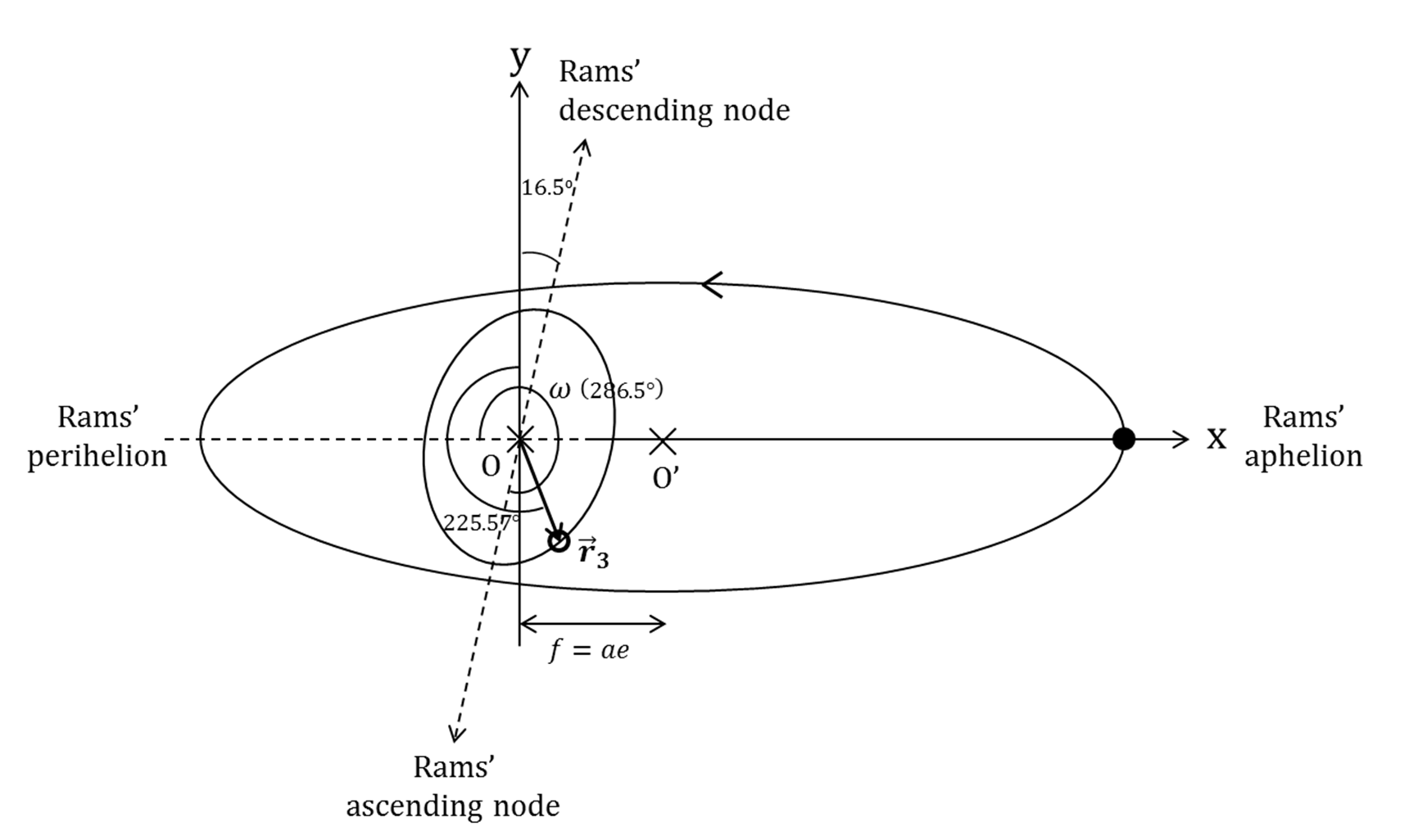
Hint: The definitions of the various orbital elements are as in the following diagram:
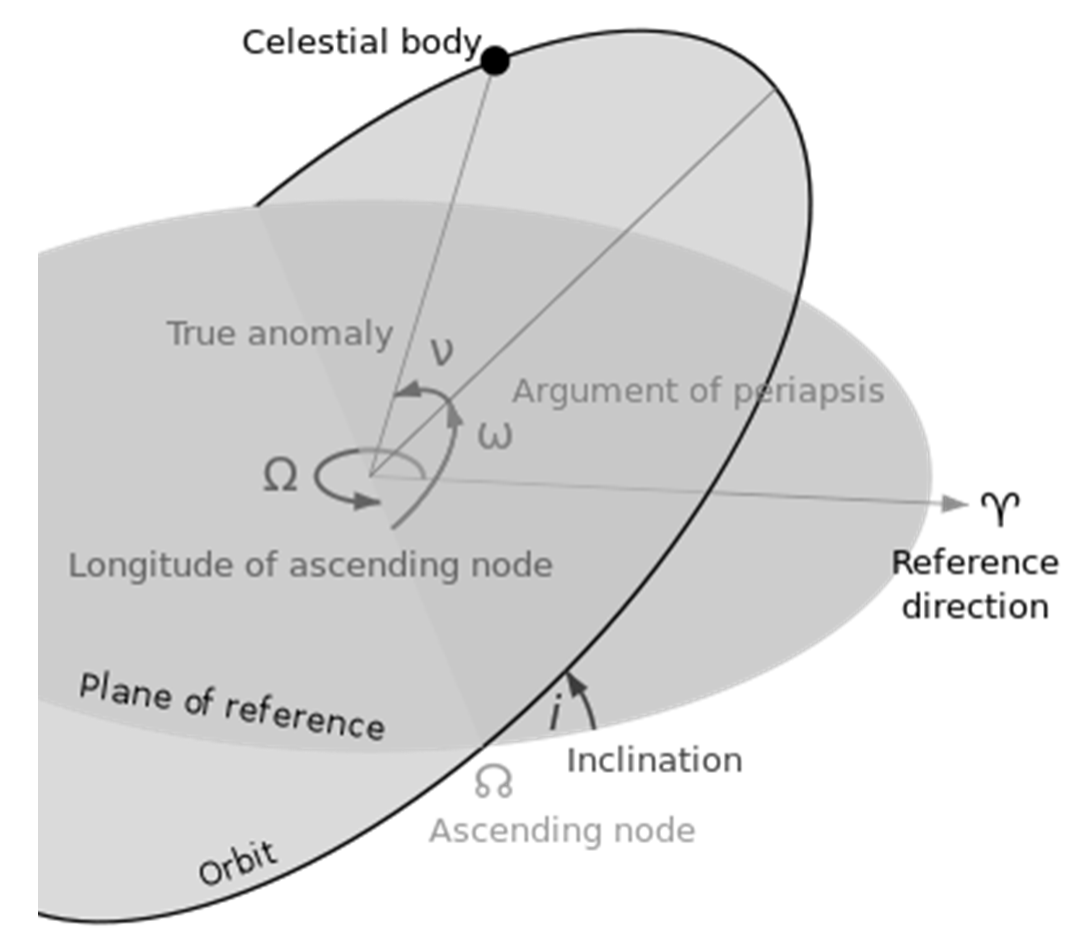
Specifically:
Rams’ orbital inclination is the angle between Rams’ orbital plane and Threa’s ecliptic;
Rams’ ascending node is the point at which it crosses from the south to the north of Threa’s ecliptic;
Rams’ longitude of ascending node is the angle between its ascending node and Threa’s Vernal Equinox;
Rams’ argument of perihelion is the angle between its perihelion and its ascending node.
Another hint: You may encounter the need to find the root of a quartic f(x) while solving this question. You do not need to provide any working to receive credit for solving the quartic. You may solve this using any analytical or numerical method of your choice. If you can’t think of any, you may find the following description of the Secant Method (one of the oldest numerical root- finding techniques) helpful:
Find any two numbers a and b such that f(a) < 0 and f(b) > 0. There will definitely be a root somewhere between a and b, so they act as an upper and lower bound for a search range. Since a quartic may have more than one real root, ensure that your desired root exists between a and b, and that that is the only root between a and b.
Find the equation of the line l connecting a and b.
Find the root c of the line l. This will definitely lie between a and b.
If f(c) < 0, then set a to c. If f(c) > 0, then set b to c. Now you have a smaller search range.
Repeat steps 1 to 4 until c stops changing, to the desired accuracy.
Yet another hint: If you’re stuck, you might find the following tips useful:
This problem can be reduced to a problem in coordinate geometry – finding the point on an ellipse closest to a given point.
The most convenient coordinate system to use for this problem is the right-handed Cartesian coordinate system defined with the origin in the centre of Rams’ orbit, the x-axis pointing towards Rams’ aphelion and the z-axis perpendicular to Rams’ orbit such that Rams orbits anti- clockwise when looking in the negative z direction.
The problem of finding the closest point on an ellipse can be reduced to the same problem in two dimensions – you just have to find out how.
The point P’ on an arbitrary curve C closest to a given point P is always such that the line connecting P and P’ is normal to C.
Finding the equation of the normal to a point on an ellipse may be difficult, but what about the equation of the tangent? Consider what happens when you compress or stretch the ellipse along the x-axis into a circle.
Решение
Celestial coordinate systems and geometric astronomy (16m)
1: Calculating Threa’s Coordinates
In this solution, the subscript for Rams’ orbital elements are omitted as they are used very often.
Additionally, the following parameters are used:
- Rams’ semi-minor axis,
- Linear eccentricity of Rams’ orbit (i.e. distance between centre and either foci),
Define a right-handed coordinate system such that
- The origin is in the centre of Rams’ orbit.
- The x-axis points in the direction of Rams’ aphelion.
- The z-axis points perpendicular to Rams’ orbit.
- When facing the negative z-direction, Rams orbits in the anti-clockwise direction.
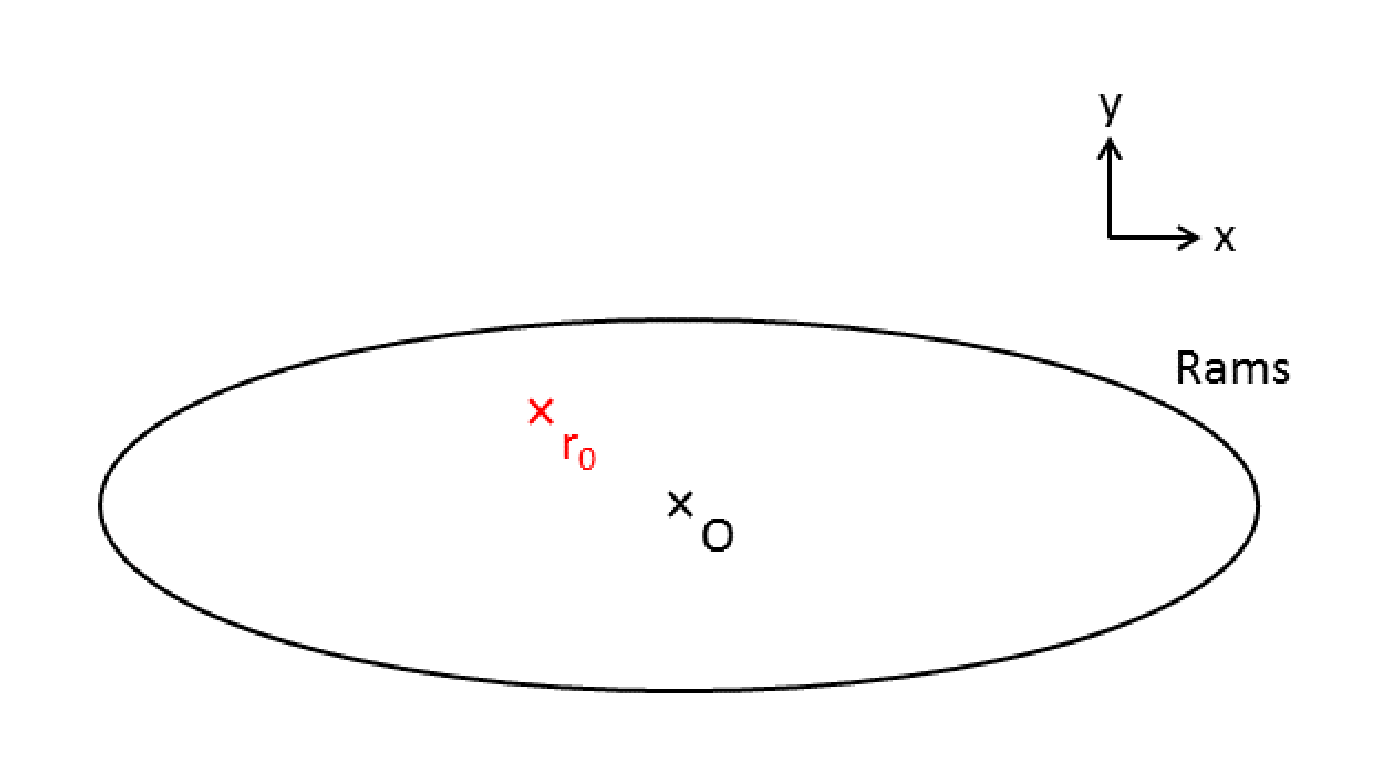
In this system, Threa will occupy the same coordinates on every Thimssarc day. This system will turn out to be the most useful system to work in later. We will obtain Threa’s coordinates in this system, through a series of coordinate transformations.
Then, define another right-handed coordinate system such that
- The origin is in the centre of Threa’s orbit.
- The y-axis points in the direction of Rams’ descending node.
- The z-axis is perpendicular to Threa’s orbit.
- When facing the negative z-direction, Threa orbits in the anti-clockwise direction.
At vernal equinox, Threa is at the point in its orbit diametrically opposite the Vernal Point Υ, such that at local noon the Vernal Point is directly overhead.
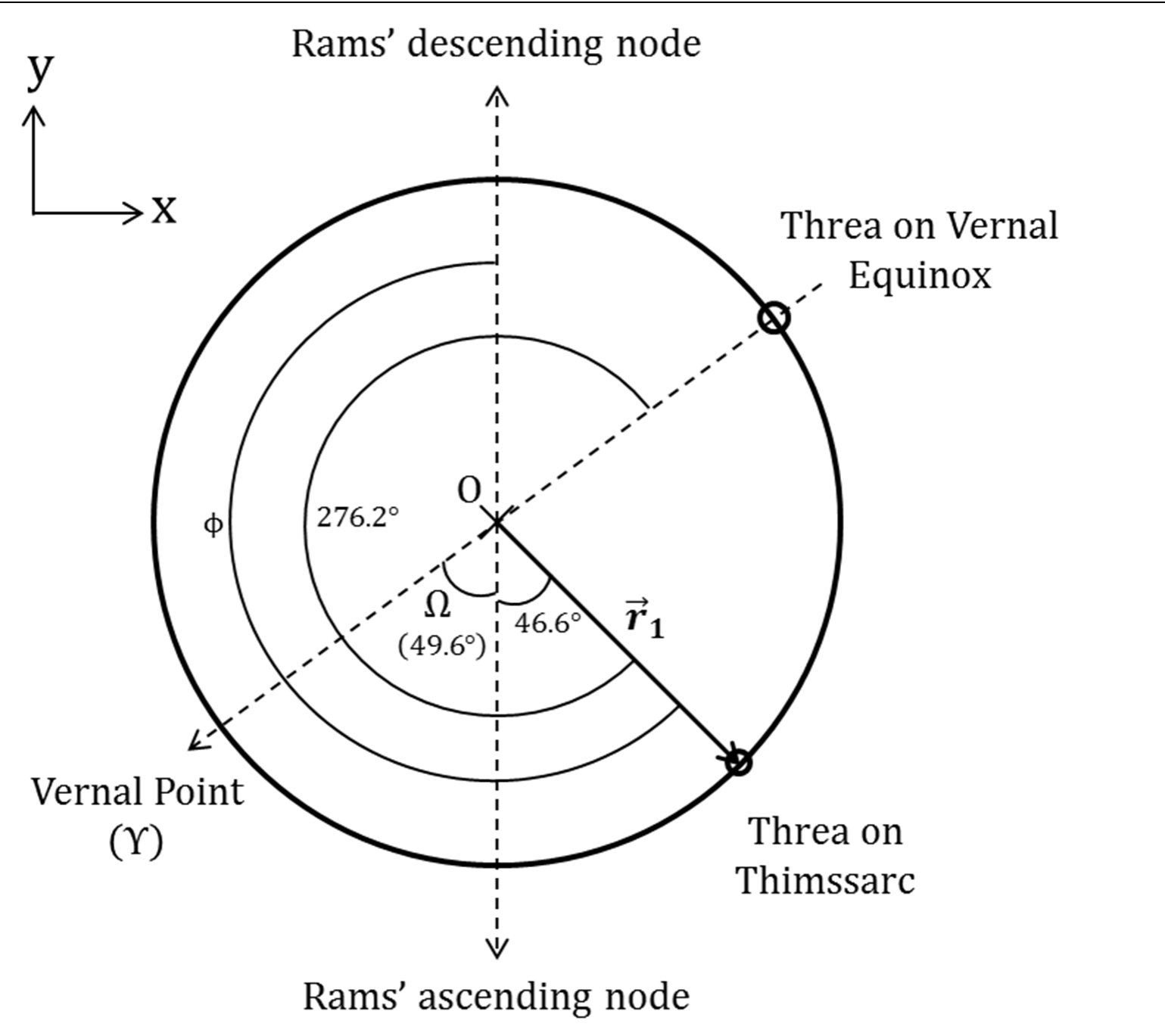
On Thimssarc day, Threa is
anticlockwise from the point in its orbit diametrically opposite the Vernal Point, and thus an angle
[B1]
anticlockwise from the positive y-axis.
Hence, Threa’s coordinates in are
Now, define the right-handed coordinate system such that
- The origin is in the centre of Threa’s orbit.
- The y-axis points in the direction of Rams’ descending node.
- The z-axis is perpendicular to Rams’ orbit.
- When facing the negative z-direction, Rams orbits in the anti-clockwise direction.
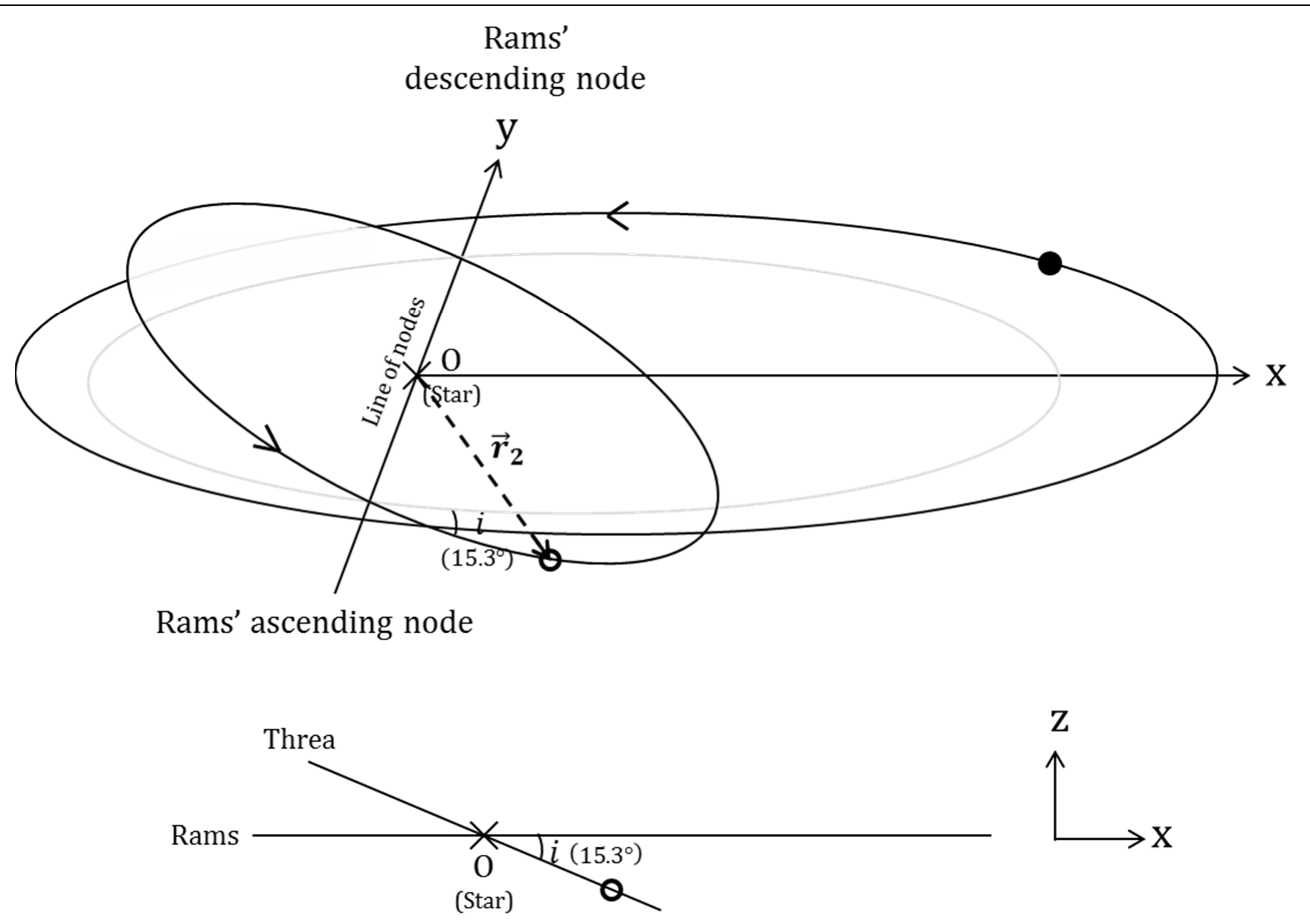
is rotated by about the y-axis, so the y-coordinate remains unchanged. Projecting to the xz-plane, the length of Threa’s position vector remains unchanged but is now an angle15.3° below the x-axis, so the new coordinates are
[B1]
Lastly, define the right-handed coordinate system such that
- The origin is in the centre of Threa’s orbit.
- The x-axis points in the direction of Rams’ aphelion.
- The z-axis is perpendicular to Rams’ orbit.
- When facing the negative z-direction, Rams orbits in the anti-clockwise direction.
is rotated by about the z-axis, so the z-coordinate remains unchanged. [B1] Let and be and projected to the xy-plane, and transform,
Angle of from y-axis . [B1]
Angle of from y-axis .
[B1]
is simply translated in the negative x-direction by , so we have
[B1]
Award0.5m if the linear eccentricity is calculated but is not.
2: Removing a Dimension
Hence, we want to find the point on Rams’ orbit that minimises its distance from . This is equivalent to minimising its square, which is given by
Since is constant, this is equivalent to minimising , that is, projecting onto the xy-plane and solving the two-dimensional problem of finding the point on Rams’ orbit that minimises its distance from .
3: Proof of the Lemma
Consider an ellipse and a point inside the ellipse. We want to find the point on that minimises its distance from . We have the following:
is normal to at .
Using this lemma, we can then find by finding the intersection of and .
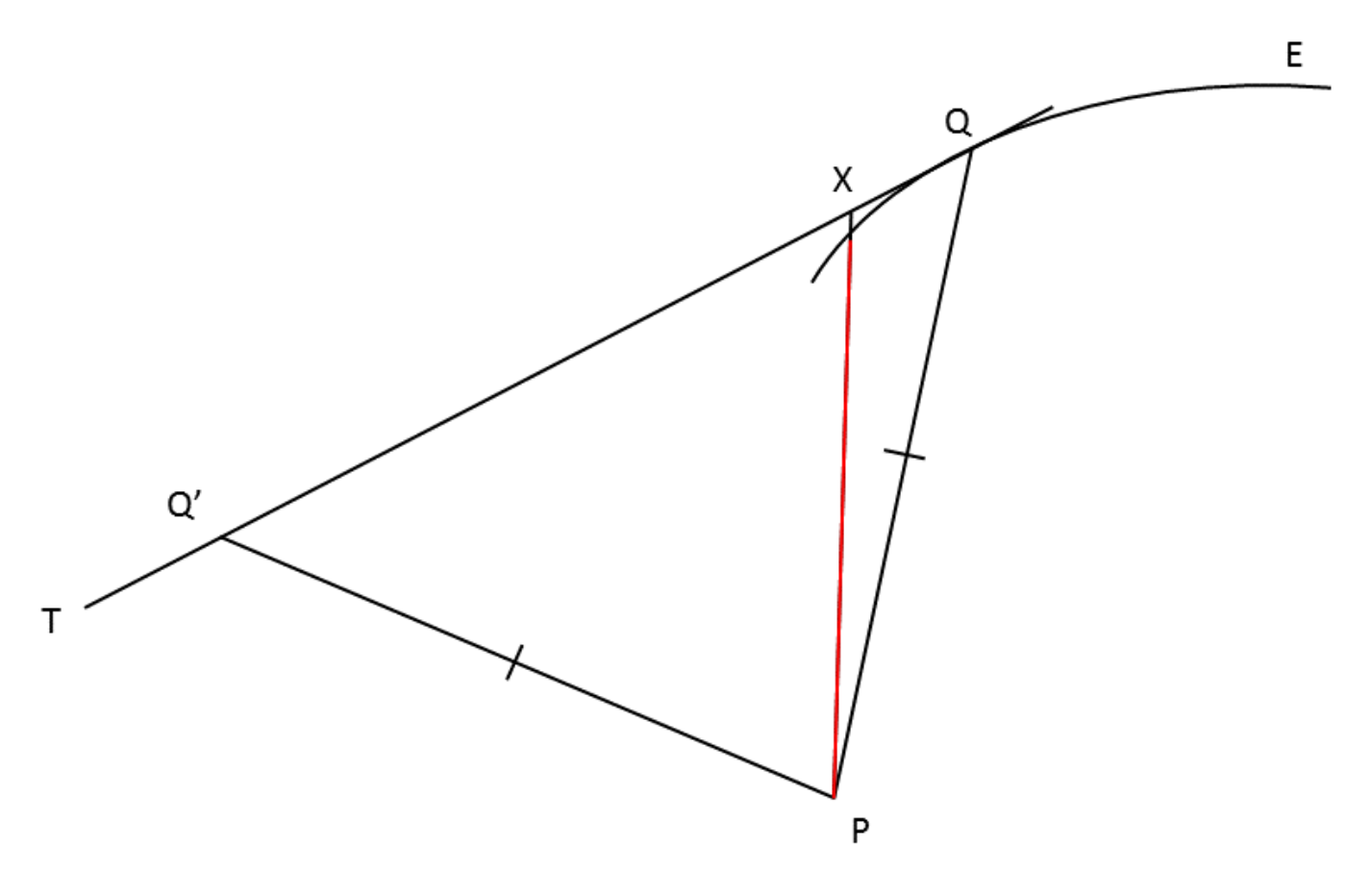
To prove this, draw the tangent to at . Assume, to prove a contradiction, that is not normal to . Then, it is possible to find another point on such that is isosceles. Choose any point between .
Since is inside and is convex, the line intersects at a point closer to than , hence the arc of the circle centred at , and hence , contradicting the fact that is the point on closest to . Hence proven by contradiction that is normal to .
4: Finding the Equation of the Normal
Now we need to find the equation of in terms of the parameters of and the coordinates of .
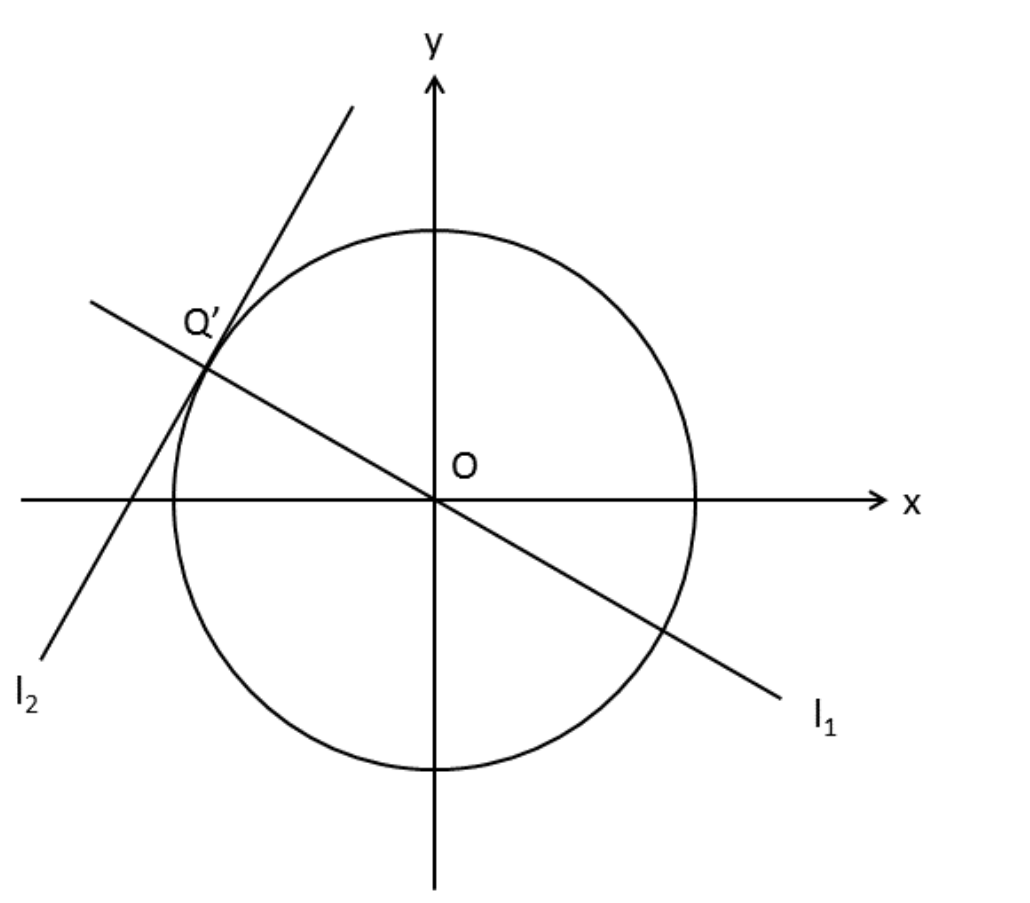
Consider the transformation that scales along the y-axis by a factor of and along the x-axis by a factor of . This transforms the ellipse into the unit circle and with coordinates into another point with coordinates
Let be the line and be the line normal to at . would thus be tangent to the circle. Then, for , we have
[B1]
For , we have,
[B1]
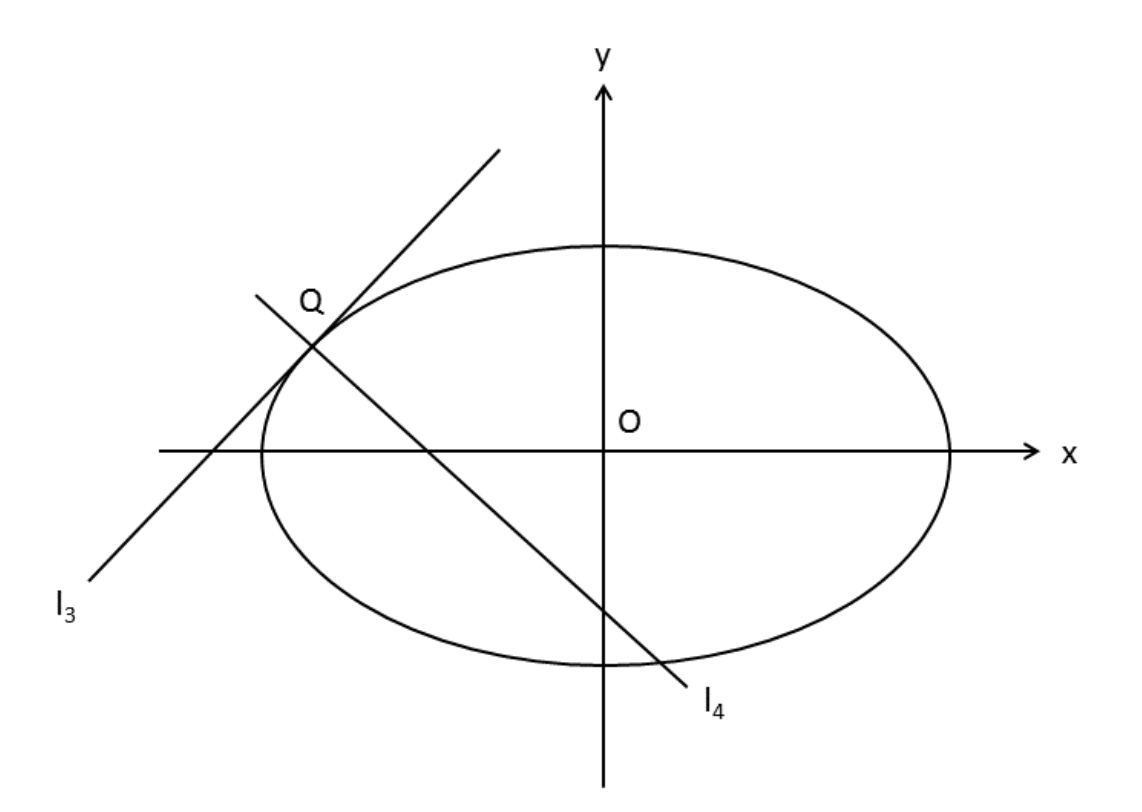
Now we transform back to find the equation of , which is tangent to at ,
[B1]
Then, we find the equation of by finding the equation of , the line normal to ,
[B1]
5: Forming the Quartic
We now change our notation to what we used in Section2 by replacing with and with . The equation of the line becomes
We want to find the intersection of this line and the ellipse (we take the bottom half since ),
Substituting the equation of the line into the equation of the ellipse ,
Using ,
[B1]
Award this1m for substituting the equation of the line into that of the ellipse without any mistakes.
Squaring both sides and expanding, we get a quartic,
[M1]
Award this1m for formulating the quartic symbolically (mark also awarded if all working is done numerically – provided no mistakes were made in manipulation).
with coefficients
[A1]
where we also use .
Award this1m for calculating the values of all five coefficients without mistakes (their quartic may differ but still correct).
6: Solving the Quartic
For convenience, make the first coefficient unity, then
We know, intuitively, that the solution should lie between and . We can thus use any of the following techniques to solve the quartic:
- Using a graphic calculator
- Using the secant method with initial bounds and
- Using Newton’s method with initial guess
- Using binary search with initial bounds and
- Depressing the quartic and factorising into a sum of two squares
- Writing the quartic as a product of two quadratics, expanding and comparing coefficients (not recommended)
Regardless of which method we use, we get . (The other real root is rejected.) [A1]
Award this1m for correct answer even if no working is shown and solution method is not stated.
7: Computing the Answer
Using the equation of the ellipse,
[B1]
Award this1m for finding (or if quartic was in ).
Finally,
[A1]
Accept answers given to accuracy of either2s.f. or3s.f.
Intended to be the most challenging question. Generally few participants made an attempt to answer the question; most attempts were generally short and led to no fruitful progress to solving the question.
Оригинал в Архива: SAO4_q.pdf · официални решения: SAO4_sol.pdf