SAO 2016, Теория и практика — Задача 7. Question 7
4th Singapore Astronomy Olympiad · 19 март 2016 г. · 5 т.
Внимание: Бележка към темата
Suggested answers preserve native scoring and scientific differences: Q5 question 25 marks/key 24 marks; Q7 question 5 marks/key 6 marks. Original units, intermediate formulas, assumptions and printed descriptions are retained. The complete source-supported discrepancy list is bound in the source-reader evidence.
Native cover, rules, constants and formulae
4th Singapore Astronomy Olympiad — 19 March 2016
Organized by Astronomy.SG. Sponsored by DSO National Laboratories.
I hereby consent to provide my details to the organizing and sponsoring organisations, Astronomy.SG and DSO National Laboratories:
Full Name: __________; School: __________; NRIC/FIN: __________; Email address: __________; Signature: __________.
For official use only (the cover prints two identical tables):
| Question | Score | Question | Score |
|---|---|---|---|
| 1 | /14 | 1 | /14 |
| 2 | /8 | 2 | /8 |
| 3 | /20 | 3 | /20 |
| 4 | /12 | 4 | /12 |
| 5 | /25 | 5 | /25 |
| 6 | /16 | 6 | /16 |
| 7 | /5 | 7 | /5 |
Rules
- Students may use pen or pencil to answer the paper.
- Any working or answers on the question papers will not be considered.
- Only the use of scientific calculators is allowed. Graphing/programmable calculators are not allowed.
- Students are to bring their own stationery.
- Students have 3 hours to complete the paper. If a student is late, no time extension is granted.
- Students should clearly state their assumptions in their working, if any.
- Students may leave any time upon submission of their solutions and question paper.
- Cheating or allowing others to cheat is grounds for immediate disqualification.
- No notes are allowed.
- Question papers must be returned together with their scripts. The cover page and Figure 2 are to be attached to the answer script.
Constants / Values
| Constant / value | Printed value |
|---|---|
| Gravitational constant, | |
| Speed of light in vacuum, | |
| Hubble constant, | |
| Radius of Earth, | |
| Mass of Earth, | |
| Solar mass | |
| Nominal solar luminosity | |
| Thomson-cross section for an electron, | |
| Mass of a proton, | |
| Current density parameter for matter (baryonic and dark), | |
| Current density parameter for radiation | |
| [Errata] Apparent magnitude of the Sun |
Formulae
Hawking Temperature of a black hole, .
Spatial curvature density, .
Условие
The SAR21 is the Singapore Armed Forces’ weapon of choice. A variant of it features a 3x optical scope (called the sharpshooter scope) with a diameter of 25mm, and a length of 120mm. It is also the weapon of choice for an unfortunate astronomer stuck on an island Northeast of Singapore, as he reckons the scope has a greater light gathering power.
a Find the f-number of the sharpshooter scope. [1m] [1 т.]
b The limiting magnitude of stars on the island is 3.2. What is the new limiting magnitude when the sharpshooter scope is used? [2m] The diameter of the pupil of the human eye is 8mm (night adapted). [2 т.]
c The astronomer points the scope to the Moon. Given the Earth-Moon distance is 384400km, would he be able to resolve these two craters on the moon? [2m]
a. Ross Crater (D = 24km). Fun fact: This crater is in Mare Tranquillitatis
b. Rosse Crater (D = 12km). Fun fact: This crater is in Mare Nectaris [2 т.]
Решение
Optics and detectors (6m)
a)
From the given context, the scope is a Galilean refractor, as the image and source object are both upright in order for it to facilitate aiming in the battlefield, i.e.
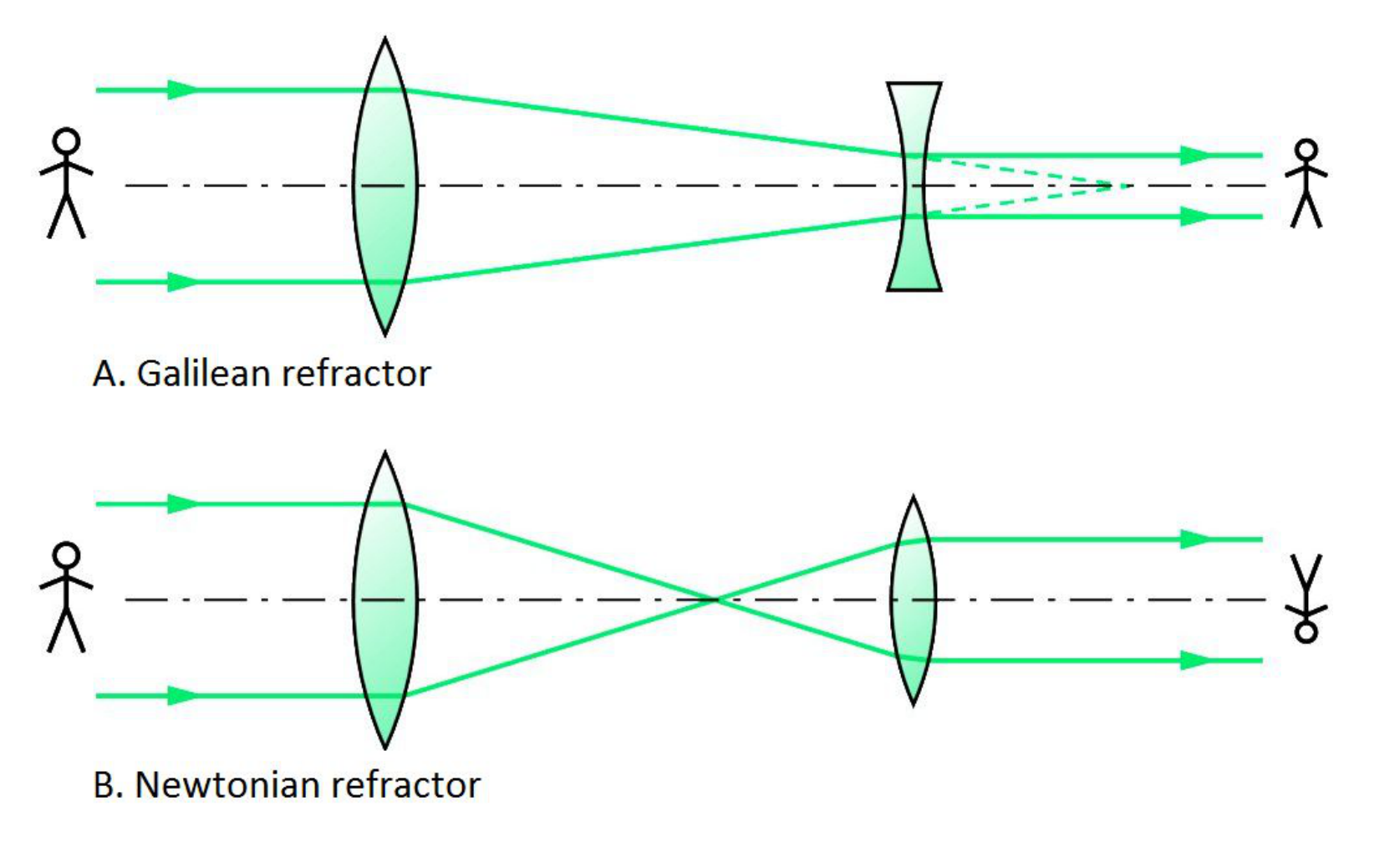
Hence, the focal point of the objective lens is behind the eyepiece lens. [M1]
From the given magnification (3x), the ratio of the focal lengths of the objective to eyepiece focal lengths is3, i.e.
[B1]
Award this1m only if the participant has shown consideration of the above.
From a ray diagram, since the distance between the two lenses is the difference between their focal lengths, the objective focal length is
Thus, the f-number is
Common Mistakes:
- Expression for f-number was inverted, giving extremely fast but unrealistic optics
- Misuse of terms focal length and aperture, by those with little understanding of optics
b)
For point sources (i.e. stars),
[B1]
Hence, the new limiting magnitude is
[B1]
Common Mistakes:
- Light Gathering Power/light grasp was often incalculated incorrectly where employed
- Incorrectly converting the extra factor in LGP to a decrease in limiting magnitude instead of an increase (ability to detect fainter objects)
- Magnification does not affect the limiting magnitude obtained this way for point objects
c)
The angular resolution of the scope using the Rayleigh criterion is
Hence assuming the wavelength of visible light , the linear resolution of the scope for small is
[M1]
Hence, since and , the scope can resolve both craters. [B1]
Only award full2m if the wavelength of visible light is reasonably estimated.
Other conclusions based on reasonable estimates of the wavelength of visible light between300nm and700nm are also accepted.
Correct conclusions on the basis of incorrect physics are awarded no marks.
Common Mistakes:
- Guessing an answer without quantitative proof nets zero marks.
- Some used the incorrect units for angular resolution
- Missing assumption for the wavelength of light in the visible spectrum/wavelength used is not part of visible spectrum
Оригинал в Архива: SAO4_q.pdf · официални решения: SAO4_sol.pdf