SAO 2021, Писмен тур — Задача 14. Section C: Long Question
Singapore Astronomy Olympiad 2021 · 39 т.
Указания
- The entire Olympiad lasts for 3.5 hours and is worth a total of 200 marks.
- Fill in these details on the cover page (after the Contents page), the Summary Answer Sheet and each side of an SAO answer sheet:
- Year of competition
- Your participant code
- The page number – which should be continuous from 1 to N
- The part of the paper, and the question number
- Cross out all workings or answers you do not wish to be evaluated.
- You are allowed to leave the venue early upon submission of your answer script (see Instructions on Cover Page), but only after one hour after the start of the paper and not within 30 minutes to completion of the paper.
- Please raise your hand to seek assistance from the invigilators (e.g. to visit the restroom, request for more answer sheets, enquire about an ambiguity, etc.)
Competition Rules and Regulation
- Only the use of scientific calculators is permitted. No graphing or programmable calculators are allowed.
- Disruptive behaviour, cheating, collusion to cheat or any integrity-related offences are grounds for immediate disqualification.
- You may opt to retain the question paper and constants sheet for personal use. Return all unused answer sheets to the Organising Team.
References for Data Analysis Question
- MS Star Details are derived from: Zombeck, Martin V. (1990). Handbook of Space Astronomy and Astrophysics (2nd ed.). Cambridge University Press
- Additional MS Star Details are derived from: Vardavas, Ilias M.; et al. (2011), "Chapter 5. Incoming Solar Radiation" Radiation and Climate: Atmospheric Energy Budget from Satellite Remote Sensing.
Astronomy.SG would like to thank the organizing committee and the question setters. This document is typeset in LaTeX.
Cover Page
- Fill in all required details below, before time is up.
- Ensure that all materials (answer sheets, graphing paper, practical question paper) you intend to submit for grading have been attached. Amendments to any answer script after it has been collected will not be entertained.
- Details on each side of answer sheet:
- Your participant code.
- Question number.
- Page number – continuous from 1 to N throughout your answer script.
- DO NOT WRITE YOUR NAME ON YOUR ANSWER SCRIPT.
- Order of answer script:
- Stack 1: i. This cover page.
ii. Summary Answer Sheet iii. Answer sheets from Part 1 to 3, in continuous order from page 1 to M. - Stack 2: i. Answer sheets for Part 4, in continuous order from M to N.
ii. Graph(s) from Part 4. - Stack 3: i. Practical cover page.
ii. Practical Component from Part 5.
1 Section A [12]
Write all your responses in the summary answer sheet provided.
Section B(1): Short Questions [36]
This section contains a total of 5 short-length questions worth 9 marks each.
You are to choose 4 to do.
Section B(2): Medium Questions [18]
This section contains a total of 2 medium-length questions worth 18 marks each.
You are to choose 1 to do.
Practical Cover Page
INSTRUCTIONS TO PARTICIPANTS:
- Fill in all required details below, before time is up.
- You are to detach this page and all subsequent pages as part of your response.
- All detached pages are to be re-stapled and be part of your 3rd stack of your answer script.
- All responses to this section of the paper are to be written on the question paper itself, in the spaces provided.
- There will be a star chart provided as part of the question. Responses to the corresponding questions in that section are to be answered on the star chart itself.
- All final responses shall be written legibly and unambiguously.
- Details on each page:
- Your participant code.
- DO NOT WRITE YOUR NAME ON YOUR ANSWER SCRIPT.
Section A
Each question is worth 2 marks.
Summary of answers:
| Q1 | Q2 | Q3 | Q4 | Q5 | Q6 |
|---|---|---|---|---|---|
| D | C | A | C | B | B |
Условие
Write all responses on the answer sheets provided. The marks are stated in the brackets [] at the end of each sub-part.
Eclipses
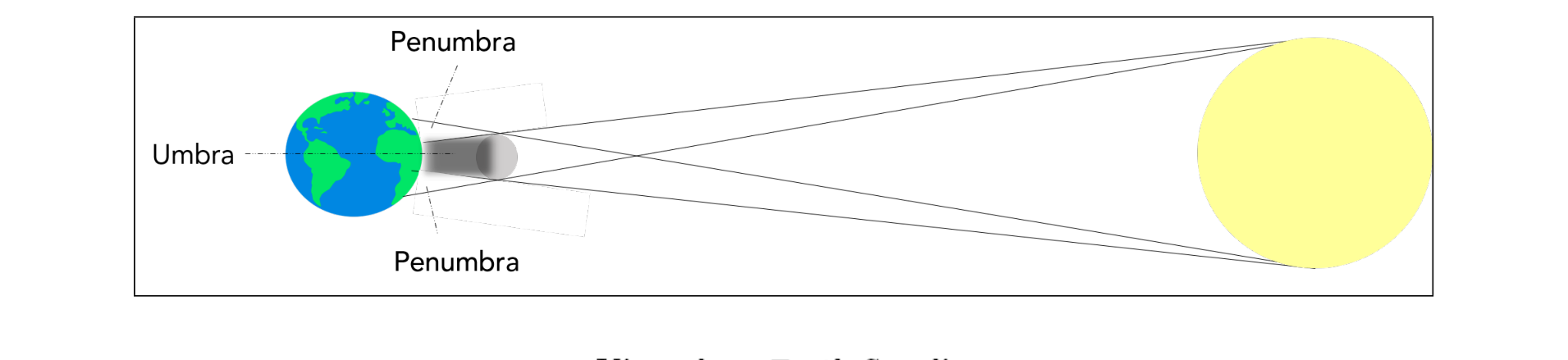
On 26 December 2019, we observed an annular eclipse in Singapore. In this question, we concern ourselves with the dynamics of a solar eclipse occurring on the vernal equinox. The Earth-Sun distance on this day is and the Earth-Moon distance is .
Part 1: Eclipse Geometry (10 т.)
(a) Determine the angular diameter of the moon and sun on the day of the eclipse. What type of solar eclipse is it? [4 т.]
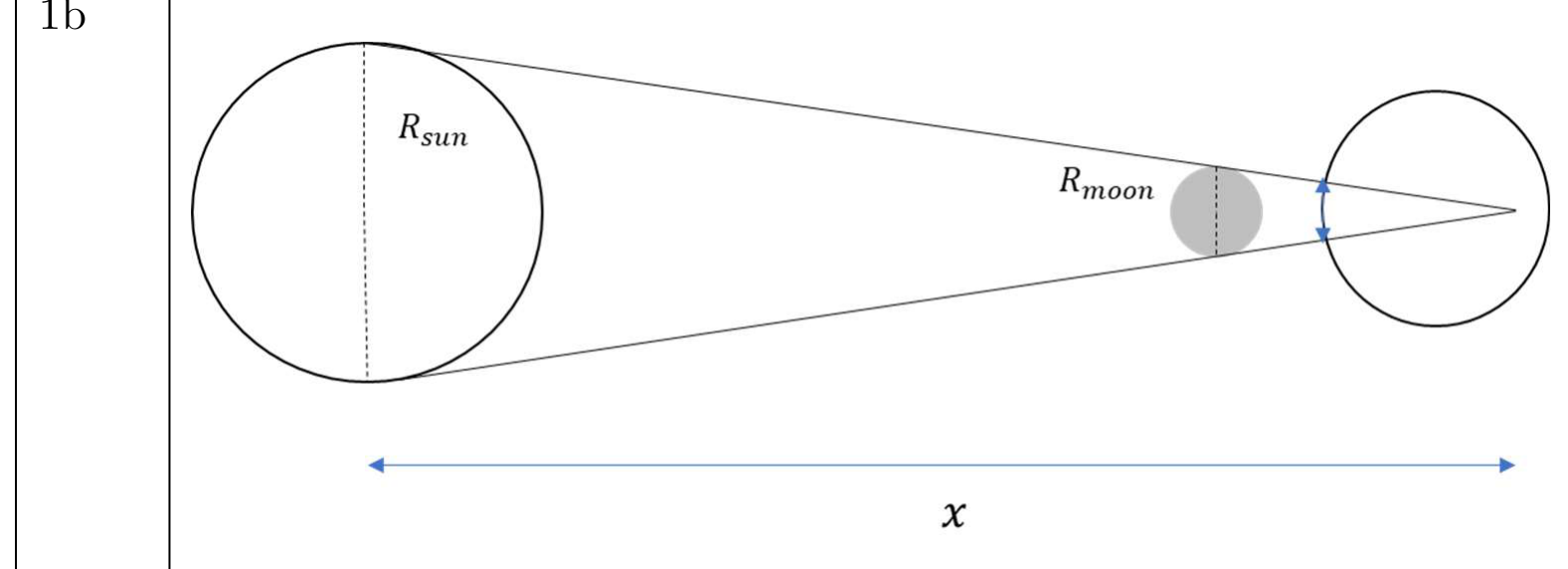
(b) Calculate the radius of the umbra to 3 significant figures, considering a geometry like above. State any assumptions made. [6 т.]
Part 2: Eclipse Dynamics (15 т.)
(c) Determine the angular velocity of the moon and Sun during the eclipse, as viewed from the Earth. [6 т.]
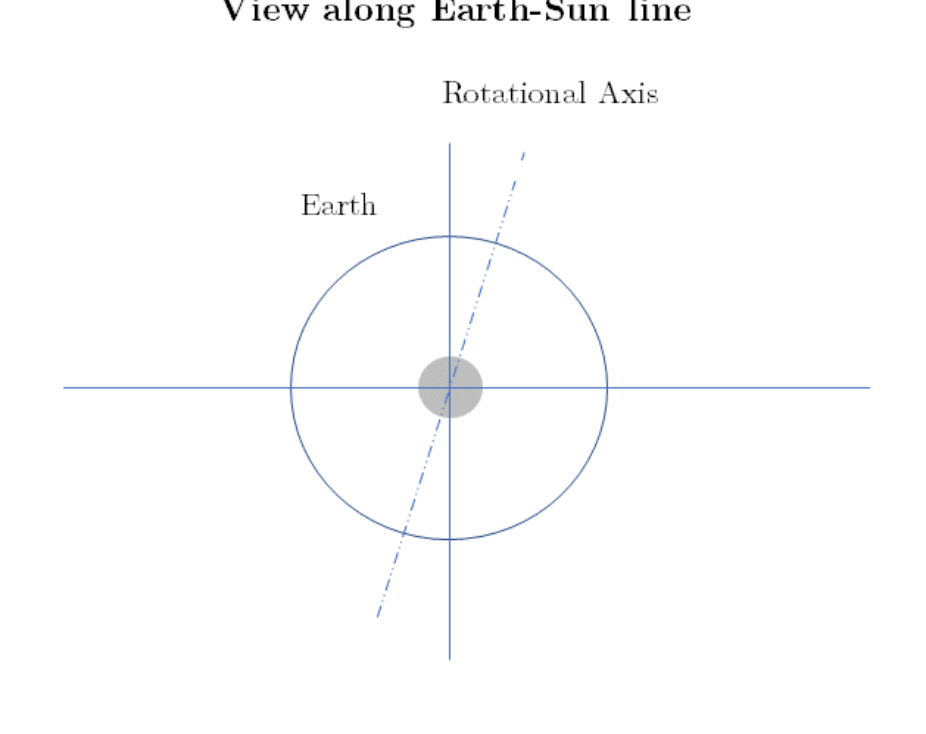
(d) Calculate the longest duration of totality for an observer on the equator, given an eclipse geometry (at peak eclipse) as shown above. For simplicity, suppose that the moon moves along the ecliptic plane. [9 т.]
Part 3: Eclipse Year (4 т.)
(e) The eclipse year describes the approximate periodicity of conditions giving rise to an eclipse, taking into account the precession of the lunar nodes and the orbit of the moon. The draconic month (27.2122 days) is the period of time between two consecutive passages of the moon through the same orbital node, and the synodic month is 29.5306 days. Evaluate the length of the eclipse year, to 4 significant digits. You may neglect the eccentricity of the moon’s orbit. [4 т.]
Part 4: The Terminator (10 т.)
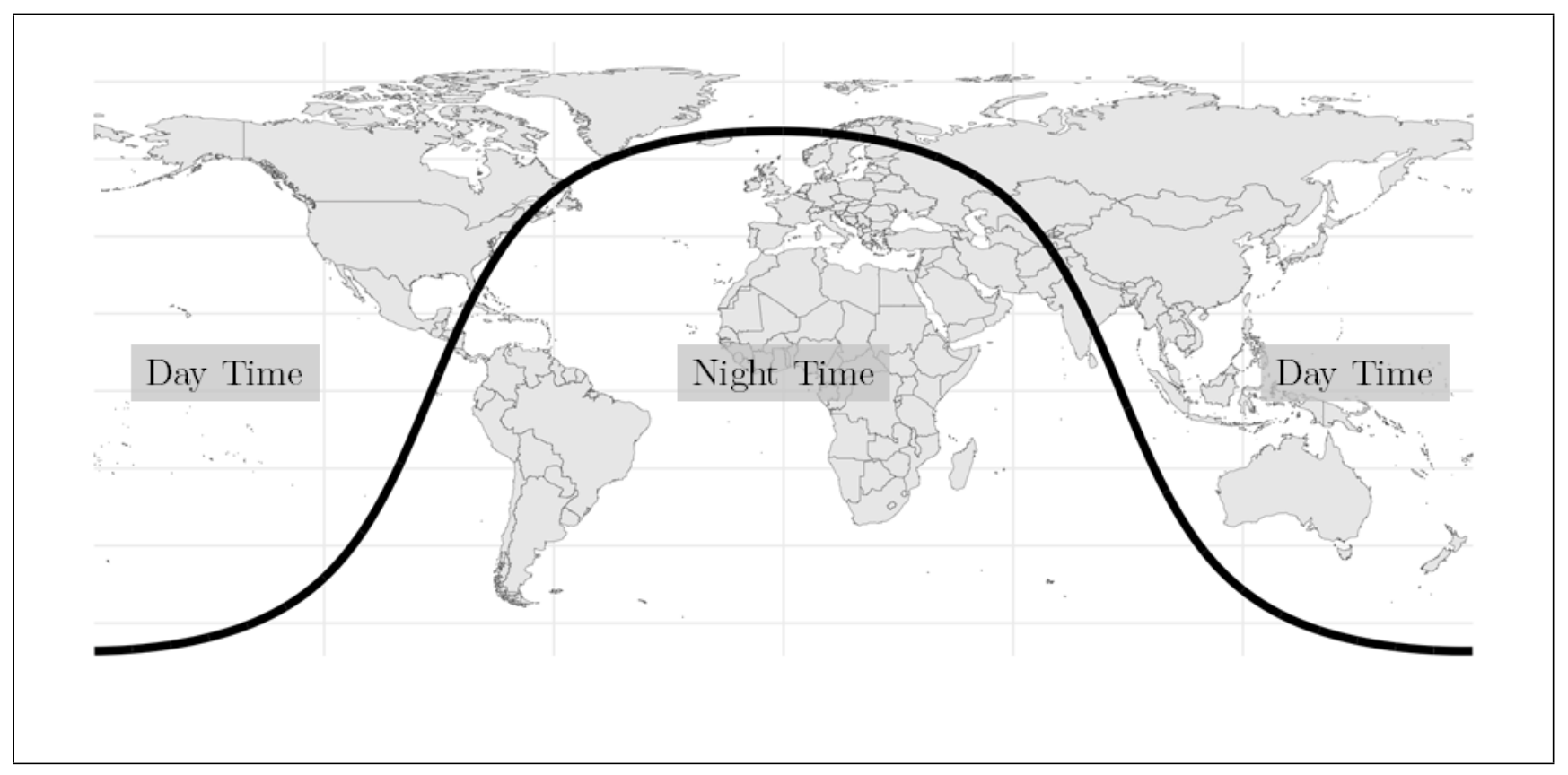
(f) On a Cartesian grid, with the Equator set as the x-axis and the Prime Meridian set as the y-axis, find the equation of the terminator line on 21 December 2021, when it is local noon in Singapore. Singapore has a longitude of 103.82°E. In this question, you can treat the Sun as a point source. [10 т.]
The terminator is a line that divides the daylit side and the dark night side of a planetary body.
Отговори
Part 1: Eclipse Geometry, (a) θM = 0.556°, θS = 0.536° (accepted range 0.535° − 0.536°)
Part 1: Eclipse Geometry, (b) 95.4 km
Part 2: Eclipse Dynamics, (c) (dθ/dt)moon = 3.065 × 10⁻⁶ rad/s; (dθ/dt)Sun = 2.008 × 10⁻⁷ rad/s
Part 2: Eclipse Dynamics, (d) 303 s
Приет интервал 301 − 305s според официалното решение.
Part 3: Eclipse Year, (e) 346.6 days
Part 4: The Terminator, (f)
Решение
Part 1: Eclipse Geometry
1a
Small angle approximation will also be accepted () M1 Expression for
A1
(accepted range )
A1
1b
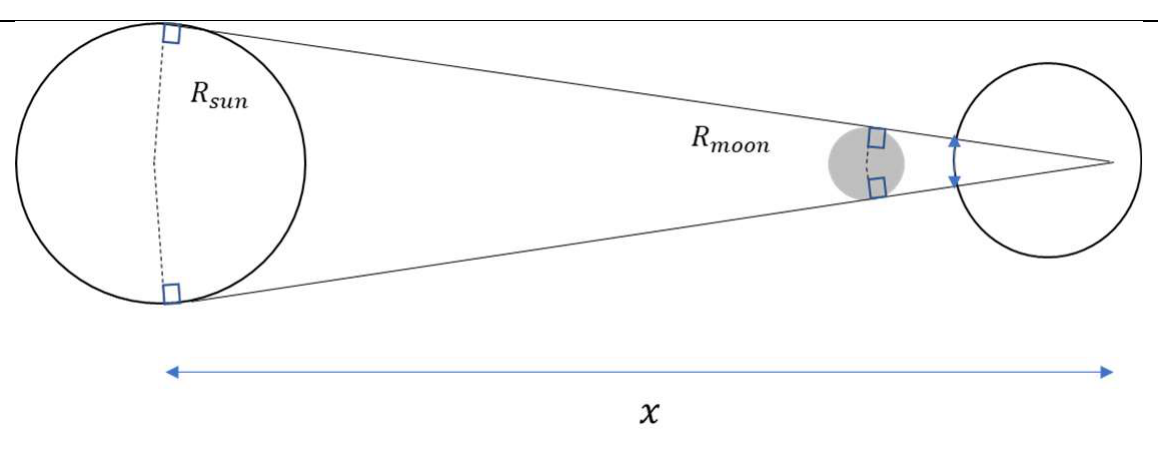
M2 (correct geometry) M1 (similar triangles)
M2 (correct manipulation)
M1 A1
A more correct diagram would in fact be the following, but we note that the similar triangles approach yields the same answer either way; as such, both diagrams (or results of) would be accepted and given full credit
Part 2: Eclipse Dynamics
1c
We may invoke a form of kepler’s second law:
M3
M1
A1
A1
1d
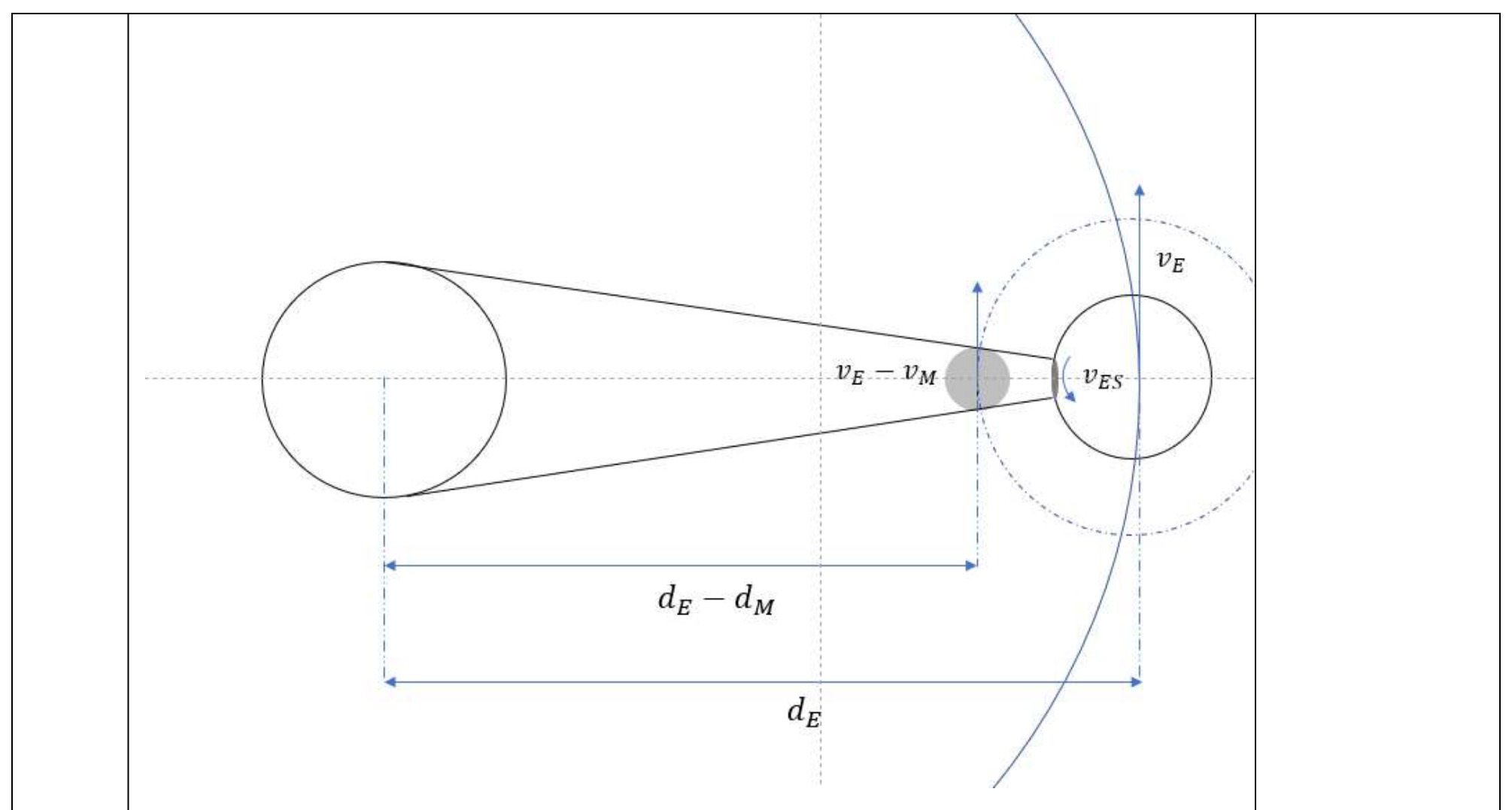
Essentially, what is important here is to calculate the velocity of the moon’s shadow on the surface of the Earth. The previous parts of the question were meant to guide the readers to the following formulation:
M1
M1
M3
Another solution that students may provide could be the following, which is a valid approximation – however, it is important to be careful when considering the direction of the shadow’s velocity.
M3
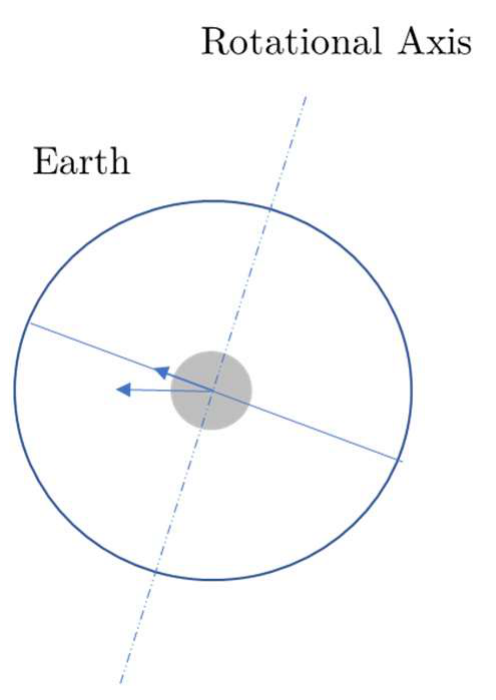
It is also important to take into the account the Earth’s rotational velocity at the surface
Note that this velocity is at angle of to the velocity of the shadow (the ecliptic makes that angle with the equator), and their relative velocities summed through use of the cosine rule M1
(accepted range: s)
M1 M1 A1
Part 3: Eclipse Year
1e
The eclipse year is in fact the beat period/synodic period of the draconic month and the synodic month – the conditions repeat when the moon is at the same position with respect to the nodes again and along the lunar cycle M2
M1 (Sign) A1
Part 4: The Terminator
1f
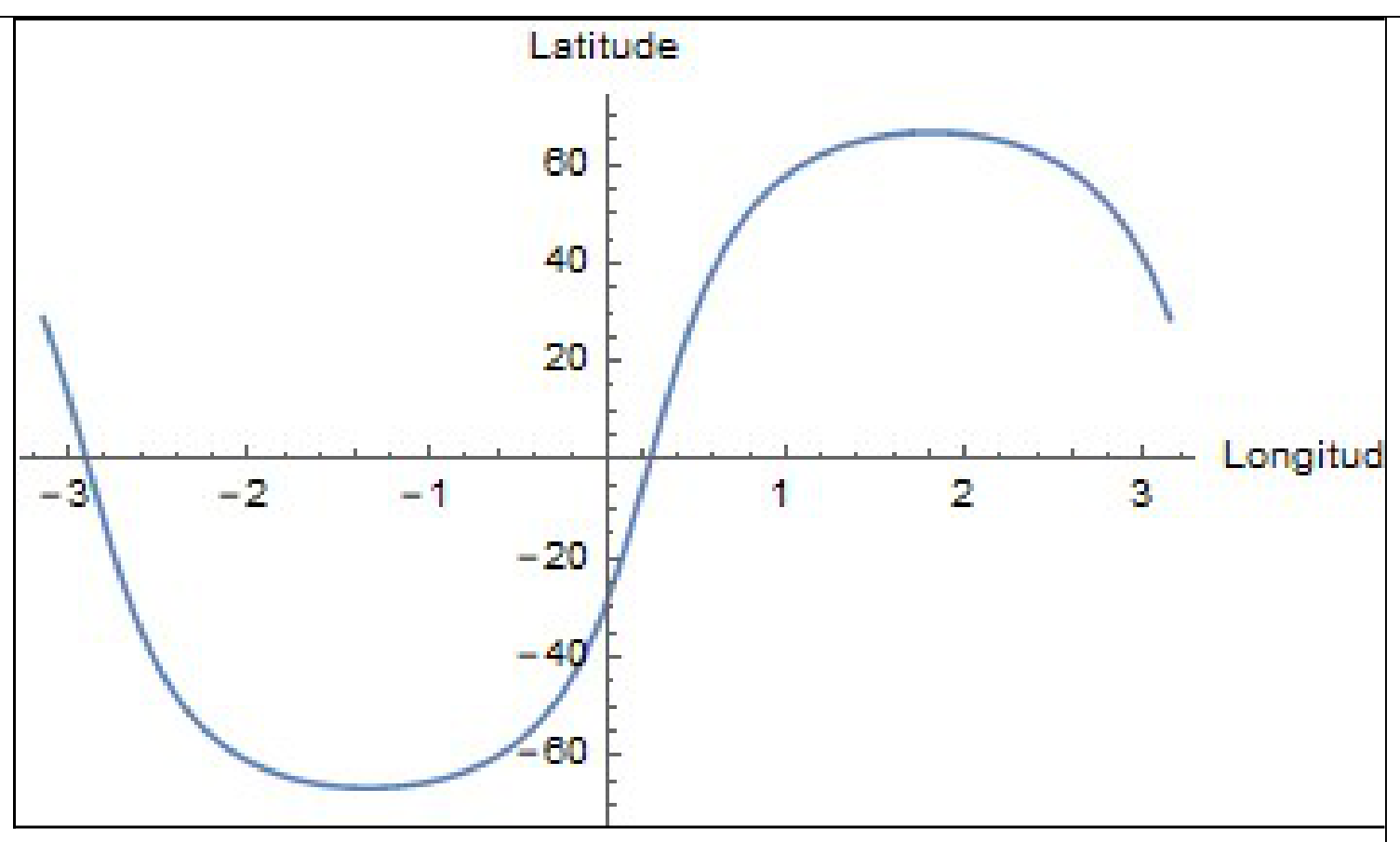
Given the set-up in the question, we are hinted to plot a latitude vs longitude graph, where the line in the graph symbolises the points on Earth that experience Sunset/Sunrise. Hence, we should turn our attention to finding an expression that gives us every pair of latitude and longitude points that experience sunset/sunrise.
To do that, we need to employ more celestial geometry. We will want to find out how many hours after noon will sunset/sunrise occur, given a specific latitude. M1
(Figure) M1
From the figure, we can find a relation between the Hour Angle (HA), latitude and the declination of the sun . Remember that is negative, and is negative for the southern hemisphere. M1
We can conjure up a spherical cosine law to get the relation.
M1
We can simplify it to:
Hence, we get:
M1
Looking at this, we may get stuck, but we need to remind ourselves the importance of the hour angle expression we have gotten. The in question represents the number of hours that will have pass before sunset occurs. M1 Putting a spin to that by bringing in the idea of time zones, it tells us which place that is an number of hours ahead of Greenwich will be experiencing sunset. M1
So, for example at the Equator, which translates to 6 hours, and so a place that is 6 hours ahead of Greenwich at the Equator will be experiencing Sunset! This is basically how time zones work.
Using time zones, we can then realise that the we calculated is just the longitude coordinate we are looking for. Coincidentally, we have found the expression, we just need to put in terms of .
M1
Finally, we need to translate the graph to the right, since the expression above is for local noon at Greenwich, but we require it when it is local noon in Singapore. Luckily, this tweak is a simple one. M1
Where , the longitude of Singapore. A1
When plotted, we see that the graph looks neat:
Оригинал в Архива: SAO 2021 Question Paper.pdf · официални решения: SAO 2021 Compiled Solutions.pdf