SAO 2021, Писмен тур — Задача 15. Section D: Data Analysis
Singapore Astronomy Olympiad 2021 · 45 т.
Указания
- The entire Olympiad lasts for 3.5 hours and is worth a total of 200 marks.
- Fill in these details on the cover page (after the Contents page), the Summary Answer Sheet and each side of an SAO answer sheet:
- Year of competition
- Your participant code
- The page number – which should be continuous from 1 to N
- The part of the paper, and the question number
- Cross out all workings or answers you do not wish to be evaluated.
- You are allowed to leave the venue early upon submission of your answer script (see Instructions on Cover Page), but only after one hour after the start of the paper and not within 30 minutes to completion of the paper.
- Please raise your hand to seek assistance from the invigilators (e.g. to visit the restroom, request for more answer sheets, enquire about an ambiguity, etc.)
Competition Rules and Regulation
- Only the use of scientific calculators is permitted. No graphing or programmable calculators are allowed.
- Disruptive behaviour, cheating, collusion to cheat or any integrity-related offences are grounds for immediate disqualification.
- You may opt to retain the question paper and constants sheet for personal use. Return all unused answer sheets to the Organising Team.
References for Data Analysis Question
- MS Star Details are derived from: Zombeck, Martin V. (1990). Handbook of Space Astronomy and Astrophysics (2nd ed.). Cambridge University Press
- Additional MS Star Details are derived from: Vardavas, Ilias M.; et al. (2011), "Chapter 5. Incoming Solar Radiation" Radiation and Climate: Atmospheric Energy Budget from Satellite Remote Sensing.
Astronomy.SG would like to thank the organizing committee and the question setters. This document is typeset in LaTeX.
Cover Page
- Fill in all required details below, before time is up.
- Ensure that all materials (answer sheets, graphing paper, practical question paper) you intend to submit for grading have been attached. Amendments to any answer script after it has been collected will not be entertained.
- Details on each side of answer sheet:
- Your participant code.
- Question number.
- Page number – continuous from 1 to N throughout your answer script.
- DO NOT WRITE YOUR NAME ON YOUR ANSWER SCRIPT.
- Order of answer script:
- Stack 1: i. This cover page.
ii. Summary Answer Sheet iii. Answer sheets from Part 1 to 3, in continuous order from page 1 to M. - Stack 2: i. Answer sheets for Part 4, in continuous order from M to N.
ii. Graph(s) from Part 4. - Stack 3: i. Practical cover page.
ii. Practical Component from Part 5.
1 Section A [12]
Write all your responses in the summary answer sheet provided.
Section B(1): Short Questions [36]
This section contains a total of 5 short-length questions worth 9 marks each.
You are to choose 4 to do.
Section B(2): Medium Questions [18]
This section contains a total of 2 medium-length questions worth 18 marks each.
You are to choose 1 to do.
Practical Cover Page
INSTRUCTIONS TO PARTICIPANTS:
- Fill in all required details below, before time is up.
- You are to detach this page and all subsequent pages as part of your response.
- All detached pages are to be re-stapled and be part of your 3rd stack of your answer script.
- All responses to this section of the paper are to be written on the question paper itself, in the spaces provided.
- There will be a star chart provided as part of the question. Responses to the corresponding questions in that section are to be answered on the star chart itself.
- All final responses shall be written legibly and unambiguously.
- Details on each page:
- Your participant code.
- DO NOT WRITE YOUR NAME ON YOUR ANSWER SCRIPT.
Section A
Each question is worth 2 marks.
Summary of answers:
| Q1 | Q2 | Q3 | Q4 | Q5 | Q6 |
|---|---|---|---|---|---|
| D | C | A | C | B | B |
Условие
In this question, you will be taking on the role as an astronomer looking for extra-terrestrial lifeform.
Part 1: Eureka! (12 т.)
In the distant future, scientists notice a burst of radio waves lasting for roughly 9 minutes. Given the long nature of the message, astronomers were able to pinpoint its origin.
Astronomers managed to find the most likely star candidate within a globular cluster, SAO-2021, from which the signal originated. The stellar detail is given below.
| Spectral Type | G6 V |
|---|---|
| App Magnitude | 18.61 |
| Peak Emission Wavelength |
(a) Given the data, find out the surface temperature of the star, SAO-2021. Do also find the corresponding error in your value. [4 т.]
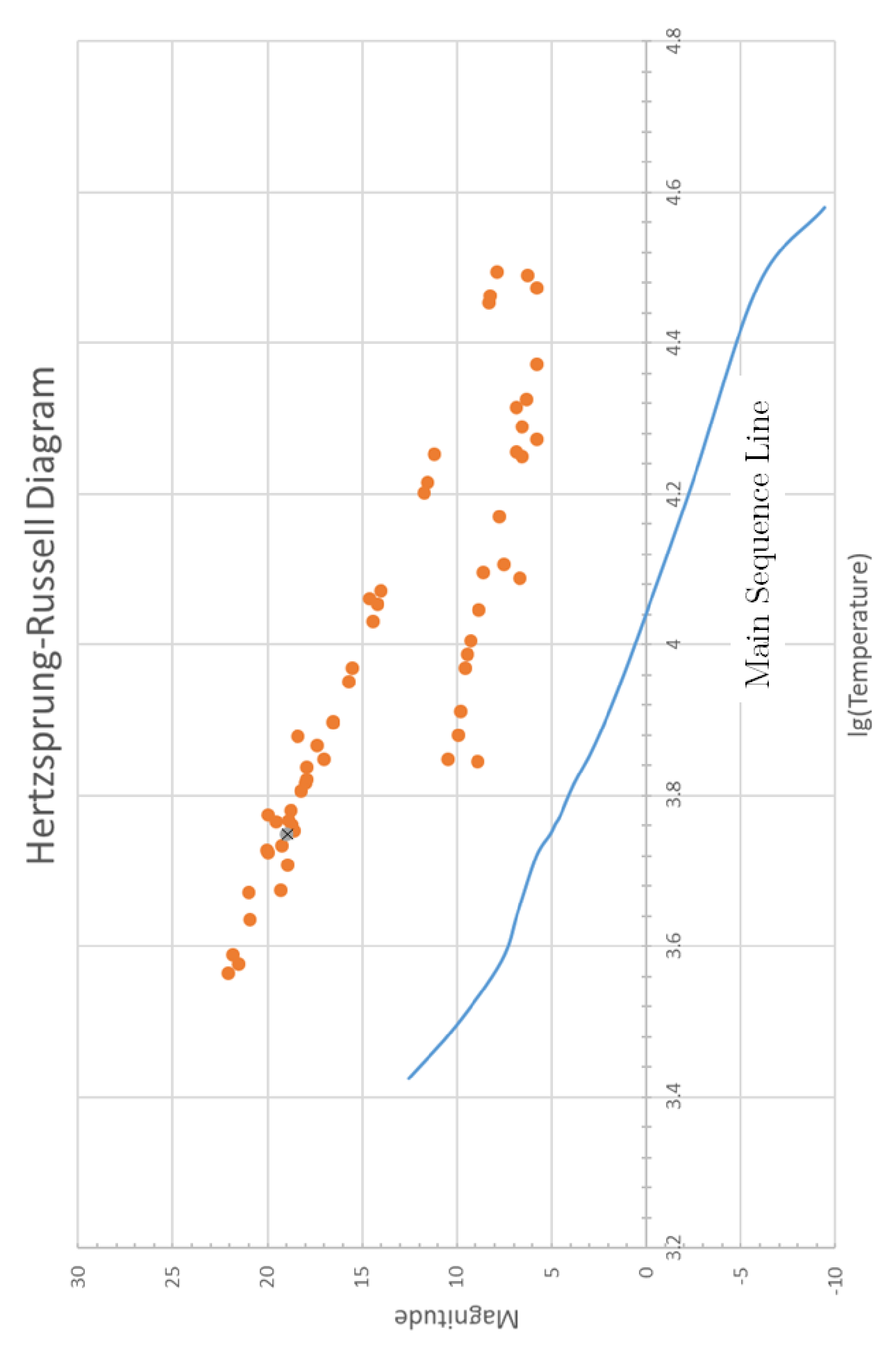
On a separate piece of paper, you are given an HR diagram. The line represents the Main Sequence (MS) line, as plotted according to the corresponding absolute magnitude stars on the MS line is supposed to have.
The stars in the cluster are also plotted as points according to their apparent magnitude, with SAO-2021 marked with a . Specifically, there are two types of stars that have been plotted in the diagram, Main Sequence and Giant Stars.
The "distance factor", , is measured as the difference in magnitude between the MS line and the MS stars of the cluster that have the same temperature, .
(b) Measure the average distance factor of the cluster. [5 т.]
(c) Hence, calculate the distance to this cluster. [3 т.]
Part 2: Digging Deeper (11 т.)
Our extra-terrestrial friends have sent us a message giving us extra data about their home world, SAO-2021c, but it is incomplete. Local astronomers have managed to get the light curves and isolated it for SAO-2021c.
On a separate piece of paper, Figure 2 shows the transit curve by SAO-2021c.
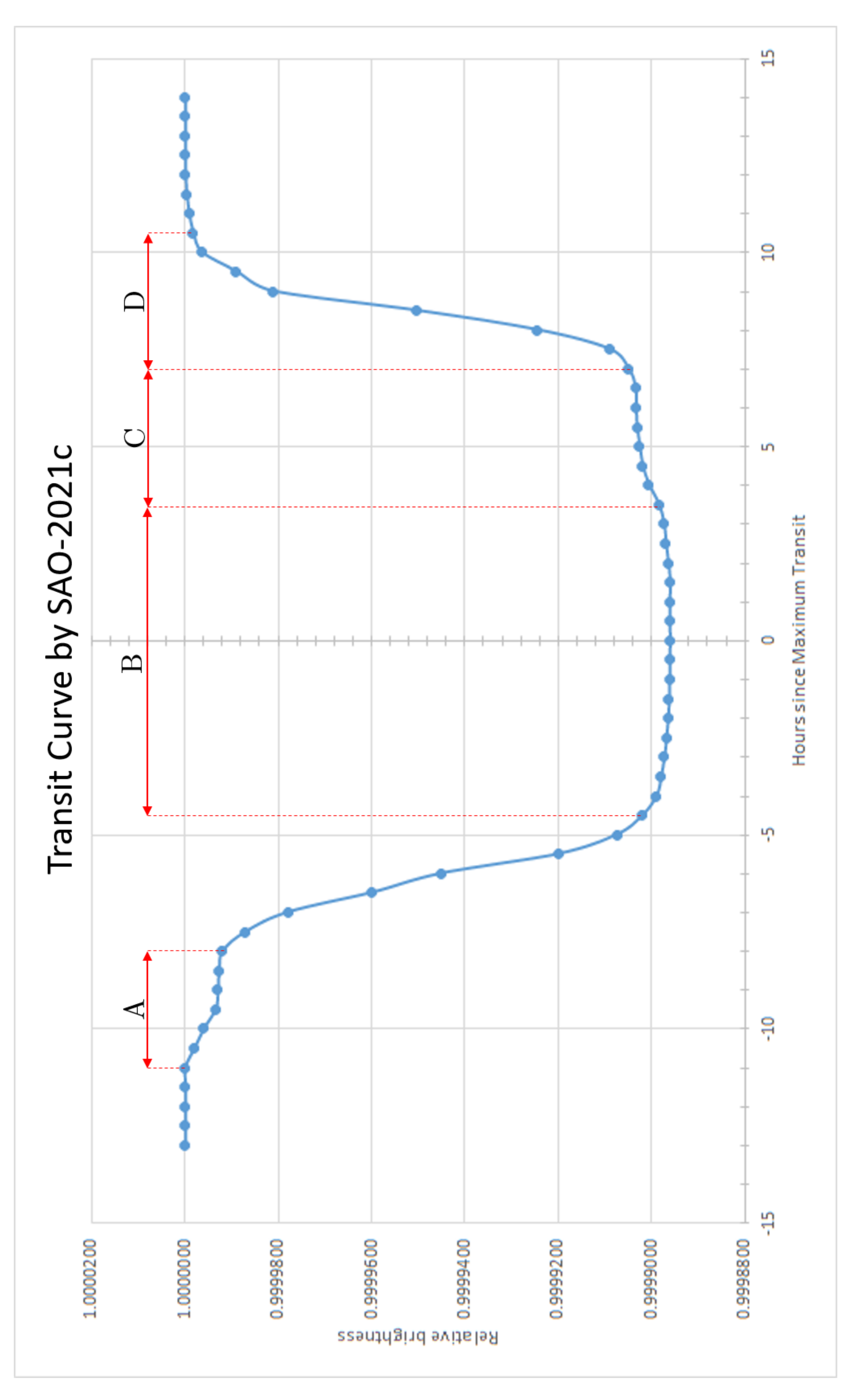
(d) Using the light curve, estimate the value of , the ratio of the radius of SAO-2021c to the radius of SAO-2021. [3 т.]
The light curve in Figure 2 has been labelled with the different events taking place during one transit, from events (A) to event (D).
(e) Explain the causes of events (A) and (C). [3 т.]
(f) During event (B), the brightness is not constant, but rather dips slightly before rising slightly back to levels at the start. Give a plausible explanation for this. [3 т.]
Please proceed on to the next page for the remaining portion of the Data Analysis question.
The overall stellar metallicity is usually conveniently defined as the ratio of the total iron content of the star to its hydrogen content. We define the ratio of Iron to Hydrogen as such, making a convenient comparison to the Sun’s:
Where and are the number of iron and hydrogen atoms per unit volume respectively.
(g) Researchers have noted that the value of SAO-2021 is . Using this additional data, draw some conclusions about when SAO-2021 formed, relative to the Sun. [2 т.]
Part 3: Earth-like? (22 т.)
Now it is time to combine all our data together and try to reason out as to what kind of planetary system SAO-2021 hosts as compared to ours. Below is a table listing 15 different stars with their masses and luminosity.
| Star | Spectral Type | Mass/ | Luminosity/ |
|---|---|---|---|
| Sirius | A1 V | 2.06 | 25.4 |
| Altair | A7 V | 1.76 | 10.6 |
| Alberio B | B8 V | 3.70 | 2500 |
| Achernar | B6 V | 6.70 | 3150 |
| 11 Com | K0 III | 1.66 | 110 |
| Cyg | A0 IV | 2.93 | 155 |
| Girtab | B1.5 III | 17.0 | 6910 |
| Spica | B1 V | 11.4 | 20500 |
| Procyon | F5 IV | 1.50 | 6.93 |
| 75 Cet | K1 III | 1.85 | 56.1 |
| Alkaid | B3 V | 6.10 | 594 |
| Alphecca | A0 V | 2.58 | 74 |
| Ser | G8 III | 1.20 | 69 |
| Oct | F0 III | 1.59 | 38 |
| Segin | B3 V | 9.20 | 2500 |
(h) Hence, by taking into consideration the data given in the table and plotting a suitable graph, calculate the mass of SAO-2021. You do not need to find the error for .
Hint: There is a rather peculiar relation between the mass and the luminosity of Main Sequence stars with , where:
Where . [19 т.]
(i) Find the values of and . [3 т.]
Отговори
Part 1: Eureka!, (a) T = (5570 ± 214) K
Part 1: Eureka!, (b) 14.05
μ̄ = 14.05; по официалното решение пълен брой точки за 13.91 ≤ μ̄ ≤ 14.19.
Part 1: Eureka!, (c) 6500 pc
Part 2: Digging Deeper, (d) RP/RS = 1.02 × 10⁻² (Solution 1, event (B)) or 9.85 × 10⁻³ (Solution 2, event (C)); both accepted.
Part 2: Digging Deeper, (e) The planet SAO-2021c has a moon: event (A) is the moon’s transit as it first passes across SAO-2021, event (C) is the moon exiting its transit.
Part 2: Digging Deeper, (f) Limb darkening: the planet blocks more light when covering the centre of the star than near its edge.
Part 2: Digging Deeper, (g) SAO-2021 has a very similar metallicity to the Sun, so it formed at around the same period as the Sun.
Официалното решение нарича звездата „Population III star“ — отпечатано така; звезда с металичност като слънчевата е от население I.
Part 3: Earth-like?, (h) 0.919 MSun
С α = 3.63 (приет интервал 3.45 ≤ α ≤ 3.81).
Part 3: Earth-like?, (i) RS = 8.69 × 10⁸ m = 1.26 RSun; RP = 8.87 × 10⁶ m = 1.39 REarth (Solution d1) or 8.56 × 10⁶ m = 1.34 REarth (Solution d2)
Решение
Part 1: Eureka!
a
We can find the temperature easily by using Wien’s Displacement Law.
M1
With the error being:
M1
Hence,
M1
Thus,
A1
b
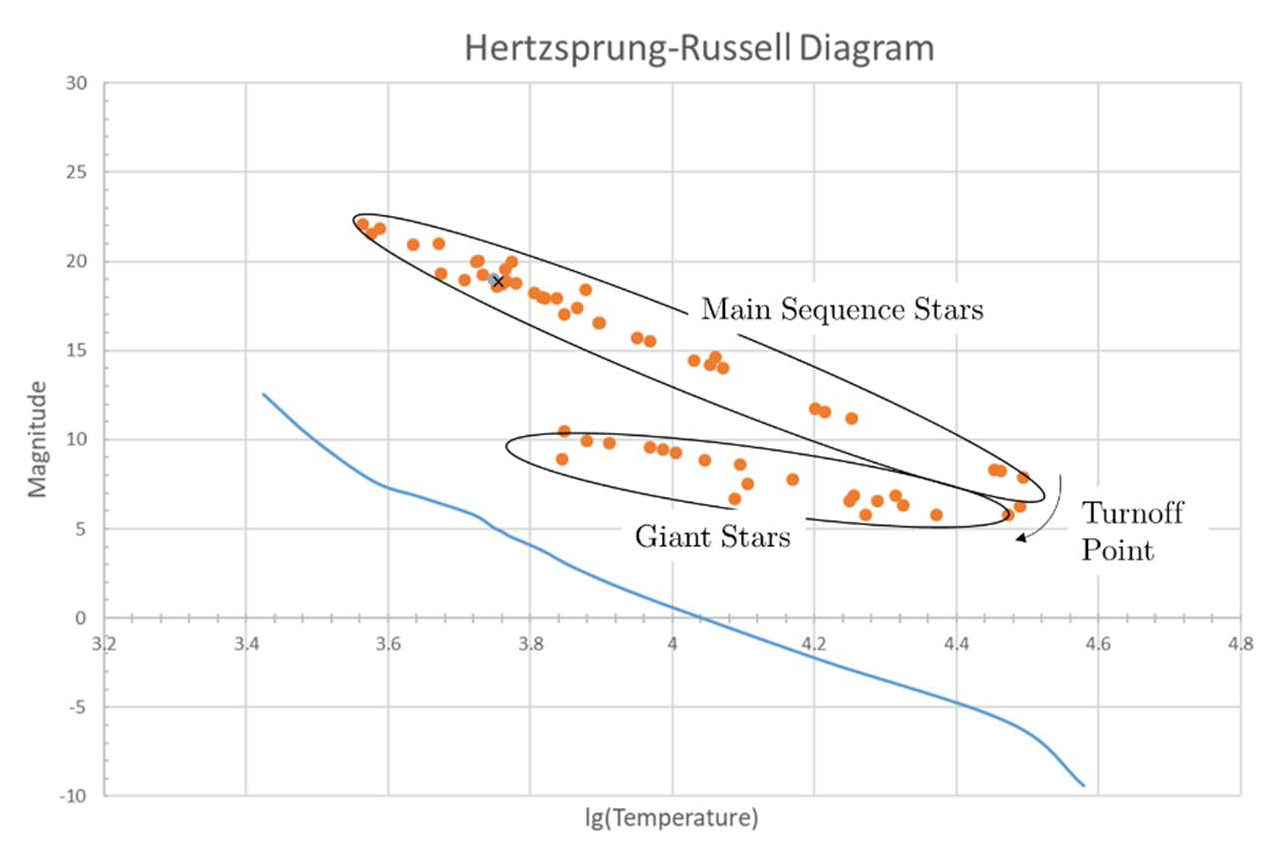
Before we begin measuring the distances, we need to do some filtering. Refer to the labelled diagram below.
M1 Correct identification of MS Stars
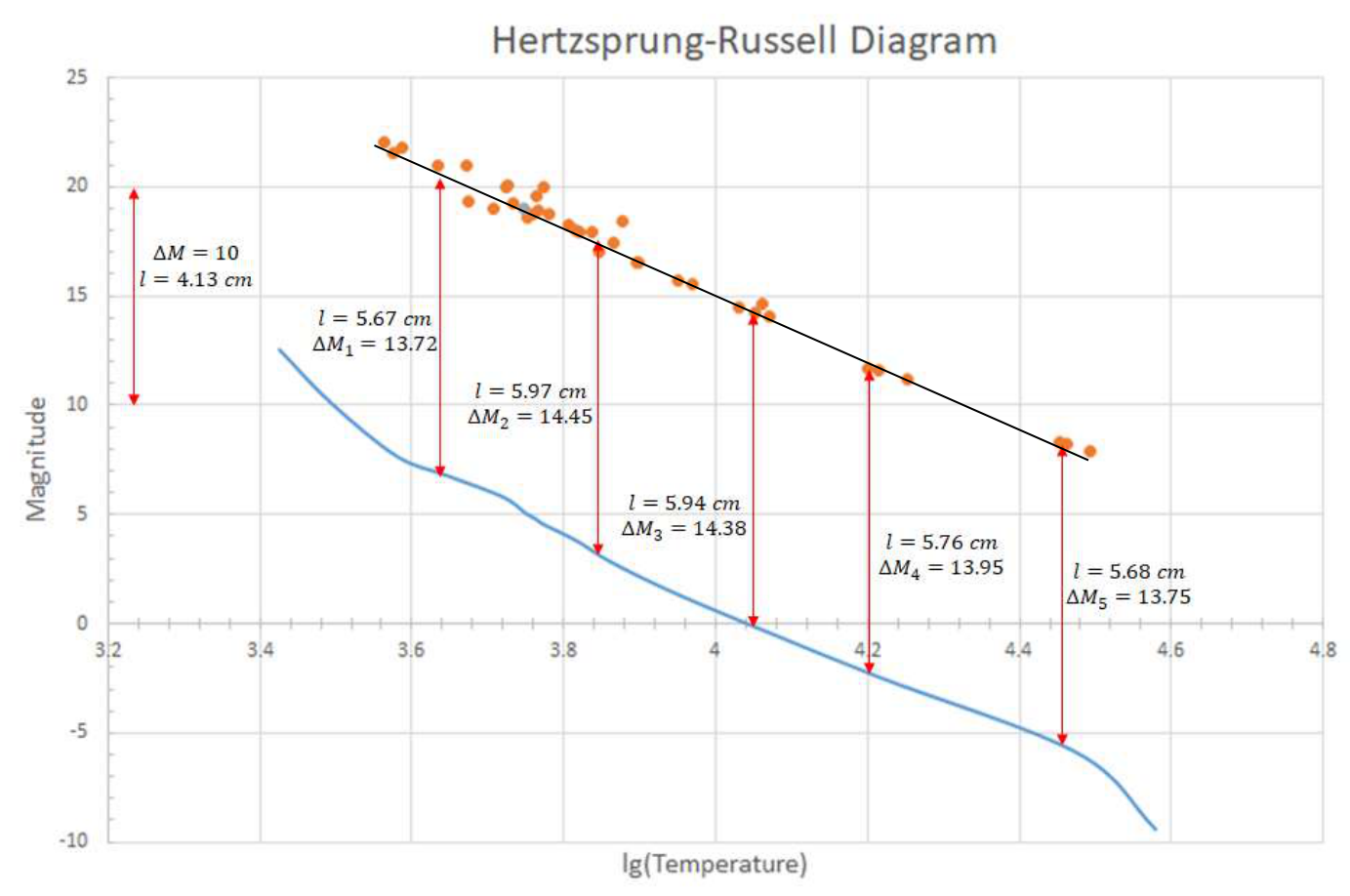
With it labelled, we can then proceed. Referring to the diagram given, we then follow the instructions given in the question. We start by drawing a rough best fit and then measure accordingly.
M1 – Scale
We now have five readings for , hence we can now find .
M1 – readings
Thus:
Tolerance of 1%, will be given full score.
A that is outside the 1% but within 2% tolerance will be given half credit: and
Any other value of will not be accepted.
M1
If the student measures the scale wrongly, but everything else is consistent, then only the marks allocated to measuring scale is deducted.
Extra FYI: This process is known as Main Sequence line fitting.
A1
c
Notice that the “distance factor” is actually the distance modulus of the globular cluster. In other words: M1
Where is the distance to the globular cluster. Hence, to find ,
Subbing in the values from part (b), we get: M1
A1
Note: The value d that participants get will be dependent on their answer in part (b). If the values are consistent, full credit will be given. There will not be double penalty.
Part 2: Digging Deeper
d
Here, technically students should use the transit depth of event (C), due to the fact that SAO-2021c has a moon which causes the double dip. Hence, this part presents two acceptable solutions.
Solution 1: Assume that is negligible for now.
Focusing on event (B), we get that the transit depth (T.D.) is:
M1
Since this system is incredibly far away, we can approximate that the planet and star are on top one another, hence the brightness drop during maximum transit is:
M1
Rearranging:
Hence:
Thus:
A1
Solution 2: Assume that is significant.
For this, we focus on event (C), where the moon has moved past and is no longer blocking SAO-2021. Then, we get the transit depth again and repeat the steps in solution 1:
M1
Since this system is incredibly far away, we can approximate that the planet and star are on top one another, hence the brightness drop during maximum transit is:
M1
Rearranging:
Hence:
Thus:
A1
Notice that there is a slight difference in the answers from solution 1 and 2. However the difference is 3.5% and hence both solutions are acceptable.
Note:
One can also look at the transit depths of events (A) and (B) and then subtract accordingly. Some people may say that we cannot do this because we are not sure if we can treat the planet and its moon to be separate discs. We can be certain that the planet and moon’s discs are separate because of the transition between events (A) and (B), and that (A) has a plateau, which we will not see if the two discs are joined.
e
The most likely candidate that will cause such a transit curve is that the planet SAO-2021c has a moon. A1
A1
Event (A) is caused by the transit of the moon as it first passes across SAO-2021. A1
Event (C) is caused by moon exiting its transit across SAO-2021.
Note: Some students may raise the possibility that it is due to the Rossiter-McLaughin effect. This effect is a valid explanation for the presence of event (C) but it cannot explain event (A). Hence, it will not be a valid response and thus will not be accepted.
Only 1 mark will be given should the explanation be correct in the account for event (C).
f
This artefact on a transit curve is a tell-tale sign of limb darkening. A1
When looking face-on towards a star, the edges will look darker than the centre.
So, as SAO-2021c is blocking the star, it will block more light when it is covering the centre of the star than when it is near the edge of the star. A1 A1
Accept any other plausible sounding answers.
Note: Limb brightening will not be accepted since this transit is observed in the visible light range and the edges of the star (the limbs of the star) is darker.
FYI: The word Limb comes from the Latin Limbus meaning edge.
g
The value of shows that SAO-2021 has a very similar metallicity as compared to the Sun. A1
From this we can infer that SAO-2021 is highly likely a Population III star, which formed at around the same period as our Sun did. A1
The differences could be due to the local variations in stellar material.
Part 3: Earth-like?
h
Considering the hint that the question gives, we should be trying to find the mass via the luminosity of SAO-2021, using the mass-luminosity relationship.
We are given SAO-2021’s apparent magnitude and we have found the distance to the globular cluster in part (c). Hence, we can find SAO-2021’s brightness and then use the distance found in (c) to find the luminosity.
We will compare it to the Sun in this case:
M1
Hence:
M1
Thus:
M1
Now, we plot the graph to get the exponent for the Mass-Luminosity relationship. There are certain restrictions before we plot. Mainly:
- Star is in Main Sequence
- Star’s mass must be between 0.1 and 50 times the mass of the Sun.
Filtering, we get the following list:
| Star | Spectral Type | Mass/ | Luminosity/ |
|---|---|---|---|
| Sirius | A1 V | 2.06 | 25.4 |
| Altair | A7 V | 1.79 | 10.6 |
| Spica | B1 V | 11.4 | 20500 |
| Alkaid | B3 V | 6.10 | 594 |
| Alphecca | A0 V | 2.58 | 74 |
| Achernar | B6 V | 6.70 | 3150 |
| Albireo B | B8 V | 3.70 | 230 |
| Segin | B3 V | 9.20 | 2500 |
M3 – Filtering the correct stars. (0.5M deducted for each star wrongly filtered.)
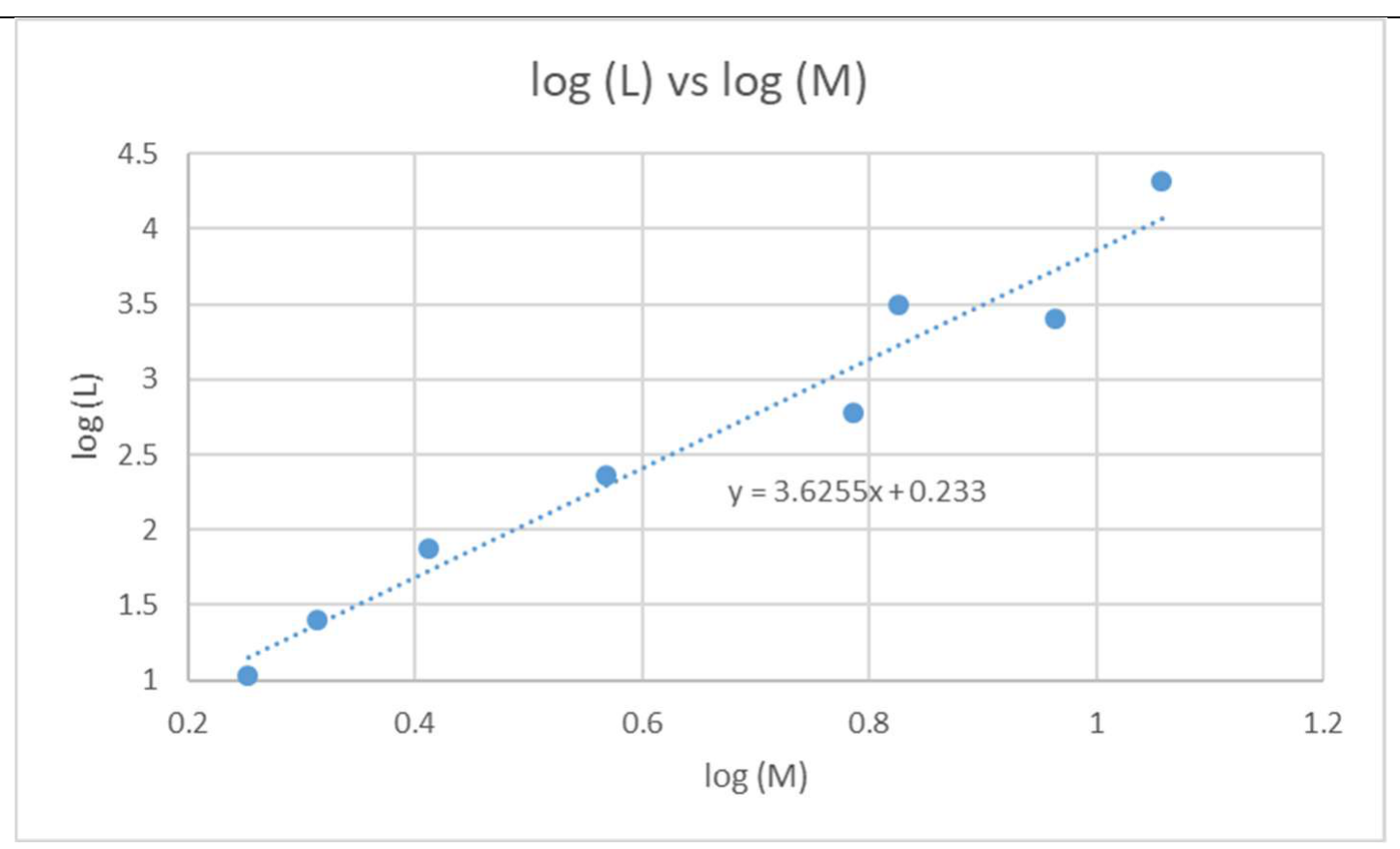
Since we are trying to find the exponent, we do a lg(L) vs lg(M) graph, and the gradient we get will be the exponent .
M1 – Correct type of plot.
Note that there is no need to convert the units to kg and watts as scaling either one will not affect the gradient.
M4 – correctly getting the lg values.
Plotting, we get:
M6 – Plot: 1- Title 2- Axes 3- Good Scale 4- Plot correctly 5- Acpt BF line 6- Gradient triangle or Regression.
Hence,
M1 A1
The acceptable range of is: . (5% Tolerance)
Thus:
Finally, we can find the mass of SAO-2021.
Note: It is of importance that one uses the mass and luminosity of a star in the given list. Usage of the values by different stars in the table results in slightly different answers, of which all are acceptable.
Note: Some participants may choose to skip the plotting of the graph and use the usual value of for MS stars.
In these cases, marks will be awarded for the correctness of ideas while marks allocated for graph drawing will not be awarded since participants have been explicitly told to plot one.
When the participant forgets to filter out the non-MS stars, they will get a gradient and a value of to be in the range: . Here, only the marks allocated to filtering for the correct stars to plot will be penalised. Points for graph drawing and the subsequent workings will still be considered and awarded accordingly.
i
We have the luminosity of SAO-2021, we can find the radius, since we also know the temperature.
M1, A1
Hence, using our answer in (d)
A1
Оригинал в Архива: SAO 2021 Question Paper.pdf · официални решения: SAO 2021 Compiled Solutions.pdf